





Agentic AI is rapidly becoming a core enterprise technology, with industry reports showing that over 60% of large organizations plan to deploy autonomous AI agents by 2026 to automate decision-making and operations. Businesses using autonomous AI agents are already reporting 30–40% faster execution cycles and significant reductions in manual workload. At Kuchoriya TechSoft, we drive agentic AI development from scratch using scalable agentic AI frameworks and enterprise-grade AI agent architecture, enabling agentic AI systems powered by reinforcement learning AI agents, natural language processing AI agents, and coordinated multi-agent AI systems across high-impact industries, including healthcare, fintech, retail, manufacturing, and logistics.
As organizations move from experimentation to production, demand for reliable agentic AI development services continues to surge, especially for solutions that integrate seamlessly with existing systems. Kuchoriya TechSoft delivers end-to-end capabilities spanning AI system development services, autonomous AI application development, AI model development and deployment, and continuous AI agent testing and optimization services, supported by expert AI agent programming services, AI agent integration services, and AI consulting services. Our custom AI agent solutions are designed to deliver measurable ROI, scalable automation, and long-term competitive advantage in the era of intelligent automation, driving enterprise growth in 2026.
Foundations of Agentic AI Systems
True autonomy is at the heart of agentic AI and modern AI agent architecture, enabling software to perceive, learn, and act independently. Kuchoriya TechSoft helps organizations understand and implement agent-based AI systems, which differ fundamentally from traditional predictive models. These systems allow autonomous intelligent agents to analyze their environment and execute tasks efficiently, supporting faster decision-making and scalable automation.
Key types of AI agents include:
- Reactive agents – respond instantly to stimuli, ideal for AI agent task automation
- Deliberative agents – leverage reinforcement learning AI agents to plan optimal actions
- Hybrid agents – combine reactive behavior with deep reasoning for balanced performance
- Multi-agent AI systems – multiple agents cooperate or compete, enhancing scalability, fault tolerance, and emergent problem-solving
A well-designed agentic AI systems framework ensures smooth inter-agent communication, conflict resolution, and shared world-model management. Kuchoriya TechSoft builds custom AI agent solutions leveraging industry innovations such as AI agent operating platforms like PwC or specialized systems like AI agents for dealership management, empowering enterprises to deploy next-generation autonomous AI agents and intelligent automation in 2026.
Key Components and Architecture of Agentic AI
Building enterprise-grade autonomous AI agents requires a modular, end-to-end AI agent architecture where perception, reasoning, and action operate seamlessly. At Kuchoriya TechSoft, we design agentic AI frameworks that allow organizations to build scalable AI agent systems capable of real-time decision-making, adaptive learning, and robust task automation. Mastering these architectural pillars is essential before building AI agents from scratch or implementing custom agentic AI development services.
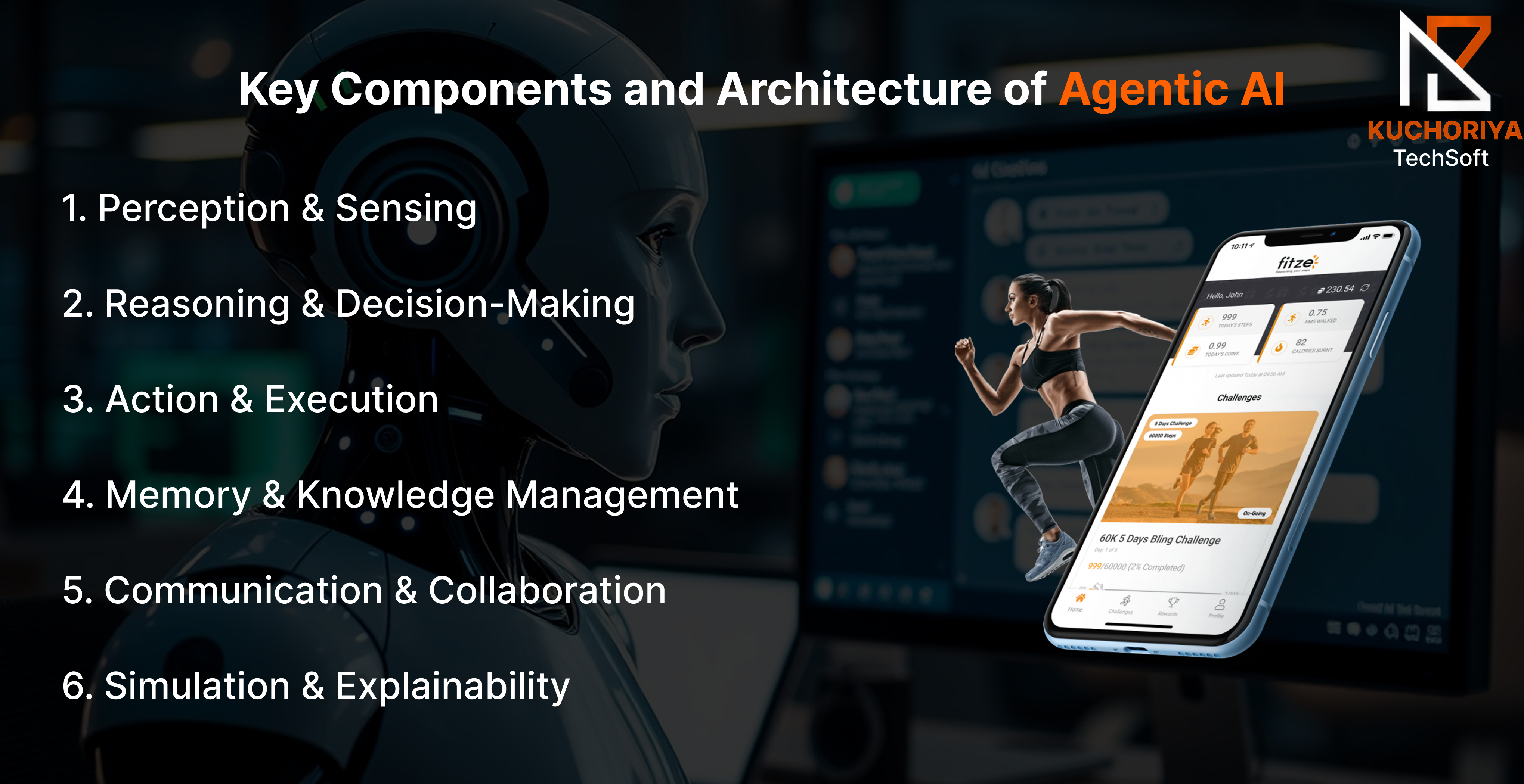
Key components of an effective agentic AI system include:
- Perception & Sensing – Utilize deep learning AI agents and natural language processing AI agents to transform raw inputs into actionable insights.
- Reasoning & Decision-Making – Deploy reinforcement learning AI agents within your AI agent architecture to optimize policies and outcomes
- Action & Execution – Integrate AI agent task automation to reliably translate decisions into real-world operations.
- Memory & Knowledge Management – Implement dynamic memory layers and knowledge representation for continuous adaptation and learning.
- Communication & Collaboration – Enable multi-agent AI systems to share data, negotiate, and coordinate seamlessly.
- Simulation & Explainability – Apply AI agent simulation techniques and explainable AI agents to validate behavior and provide transparent decision rationales.
This structured approach ensures your agentic AI systems are scalable, explainable, and ready for deployment across industries, empowering enterprises to achieve measurable ROI through intelligent automation in 2026.
Design Principles for Effective AI Agents
Designing intelligent, adaptive agent-based AI systems requires scalable, safe, and business-aligned architectures. At Kuchoriya TechSoft, we implement these principles to build autonomous AI agents that deliver measurable results and future-ready automation.
1. Scalability & Modularity
Enable flexible system design through modular components, supporting AI agent programming services and expansion across industries.
2. Robustness & Fault Tolerance
Integrate smart fallback mechanisms to ensure AI agent technology remains stable under unpredictable conditions.
3. Transparency & Explainability
Adopt cognitive AI agents and transparent models to improve trust, interpretability, and clarity in automated decision-making.
4. Ethical & Safety Considerations
Leverage AI agent testing & optimization services to prioritize responsible, compliant, and fair development practices.
Technologies and Techniques in Agentic AI Development
Creating advanced agentic AI systems requires a mix of modern algorithms, intelligent architectures, and specialized tools to ensure autonomy, scalability, and high performance. At Kuchoriya TechSoft, we deliver enterprise-grade solutions that integrate the latest AI technologies, enabling organizations to deploy autonomous AI applications efficiently across industries.
1. AI Agent Architecture
Forms the structural backbone for intelligent behaviors and decision-making in autonomous systems.
2. Cloud-Native AI Agents
Allow distributed, scalable deployment to handle global AI applications seamlessly.
3. AI Agent Simulation Techniques
Provide a safe environment to test and validate agent logic before real-world integration.
4. AI Model Development and Deployment Pipelines
Enable continuous learning, adaptation, and optimization for evolving enterprise needs.
5. AI Agent Integration Services
Support smooth embedding of AI agents into existing workflows and enterprise platforms.
6. AI Agent Programming Services
Deliver custom logic development using Python, Java, and agent-specific domain languages tailored to specific business use cases.
7. Agent-Based AI Systems
Employ decentralized intelligence to simulate collaborative, competitive, and social behaviors among agents.
By leveraging AI agent programming services and structured AI model deployment pipelines, Kuchoriya TechSoft ensures continuous integration, delivery, and optimization of next-generation agentic AI solutions for scalable, intelligent automation in 2026.
Step-by-Step Guide to Building AI Agents from Scratch
Creating scalable and adaptable agentic AI systems requires careful planning, iterative development, and seamless deployment. At Kuchoriya TechSoft, we simplify this process by combining top frameworks, domain-specific solutions, and expert services to build autonomous AI agents that deliver measurable business outcomes. Leveraging innovations like AI agent operating platforms from PwC or AI agents for dealership management systems, enterprises can unlock smarter automation across single and multi-agent AI systems.
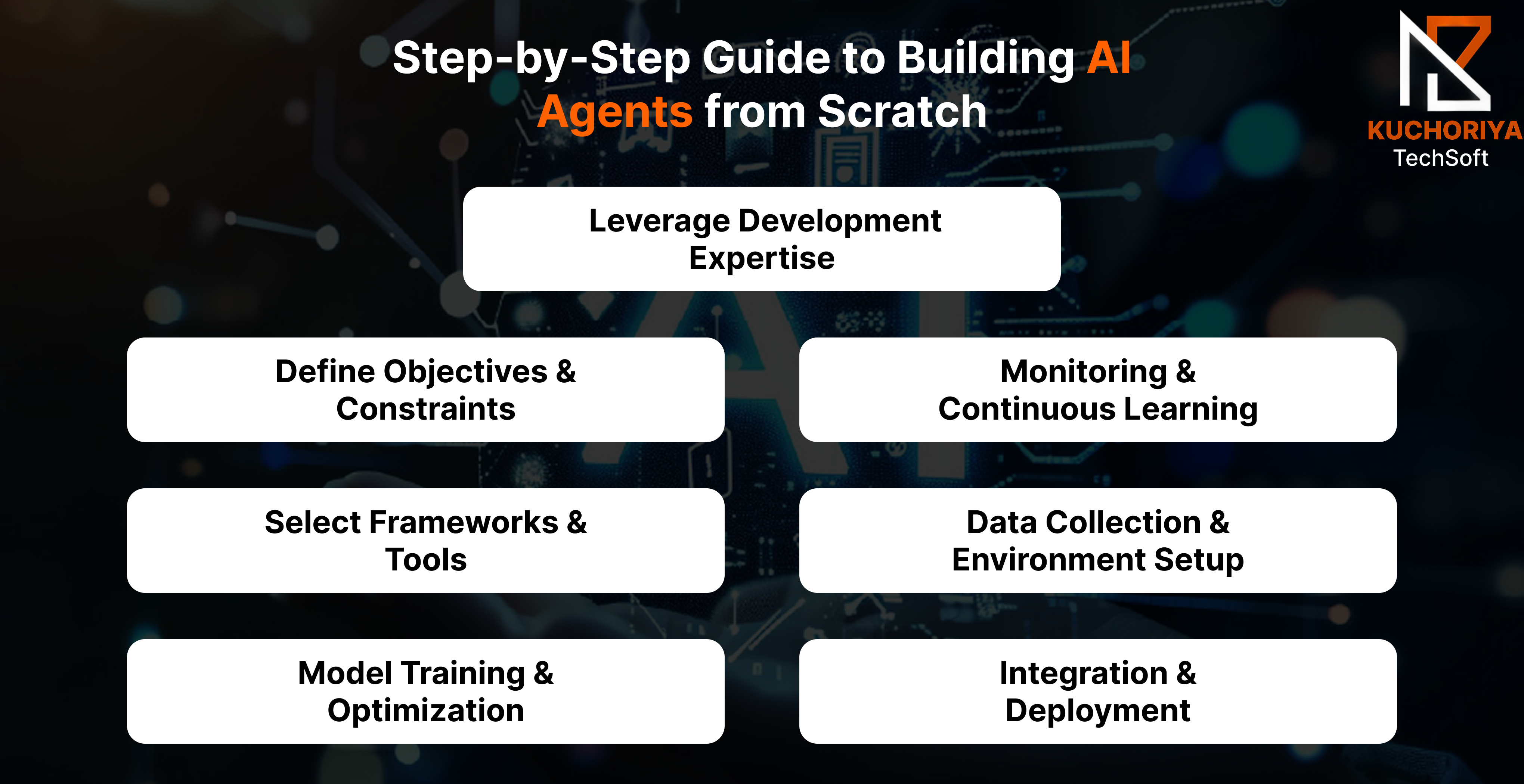
1. Define Objectives & Constraints
Set clear project goals, environmental inputs, and KPIs to align your AI agent architecture with business success and long-term scalability.
2. Select Frameworks & Tools
Choose leading agentic AI frameworks, such as Ray RLlib, LangChain, or OpenAI Gym, to accelerate AI agent development and ensure production-ready performance.
3. Data Collection & Environment Setup
Implement AI agent simulation techniques to create training environments that foster real-time agent-environment interaction and adaptive learning.
4. Model Training & Optimization
Apply reinforcement learning AI agents and leverage AI agent testing & optimization services to enhance autonomous decision-making capabilities.
5. Integration & Deployment
Utilize AI Agent Integration Services and comprehensive full-cycle AI system development services to integrate models into enterprise workflows seamlessly.
6. Monitoring & Continuous Learning
Deploy monitoring tools and feedback loops to ensure ongoing adaptation and improvement, supported by insights from AI research & consulting services.
7. Leverage Development Expertise
Collaborate with trusted AI agent solution companies, offshore development teams, or dedicated AI agent development teams for scalable execution and faster time-to-market.
Popular Agentic AI Frameworks and Platforms
Selecting the right agentic AI framework is crucial for building intelligent, scalable, and autonomous AI agents. At Kuchoriya TechSoft, we help enterprises choose and integrate platforms that accelerate AI agent development while supporting multi-industry automation and innovation. These frameworks empower organizations to implement custom AI agent solutions efficiently.
1. Ray RLlib
A high-performance library ideal for reinforcement learning AI agents, enabling production-grade AI agent systems that scale with enterprise needs.
2. OpenAI Gym
Widely used in AI agent simulation techniques, it allows benchmarking, prototyping, and testing of autonomous AI agents before deployment.
3. Anthropic Platform
Focuses on explainable AI agents, offering built-in safety features and scalable agentic AI architecture for trustworthy automation.
4. LangChain
Designed for natural language processing AI agents supporting language-first autonomous AI application development and enterprise workflows.
5. Microsoft Autonomous Systems
Provides AI agent programming services with integrated cloud-native AI agent capabilities for seamless deployment and global scalability.
These platforms are favored by leading AI agent developers for their modularity, multi-agent AI systems support, and smooth integration into custom AI agent solutions, helping businesses accelerate adoption and ROI in 2026.
Challenges and Best Practices in Agentic AI Development
Deploying agentic AI systems in real-world environments presents technical and organizational complexities. At Kuchoriya TechSoft, we guide enterprises through these challenges by combining best practices, expert frameworks, and advanced AI agent technology to ensure resilient and scalable autonomous AI solutions.
1. Complex & Dynamic Environments
Real-world deployment requires advanced AI agent environment interaction and robust perception mechanisms to handle constantly changing conditions.
2. Partial Observability & Uncertainty
Use cognitive AI agents with belief-state modeling to make adaptive decisions despite incomplete or uncertain data.
3. Multi-Agent Coordination
Managing behavior in multi-agent AI systems introduces challenges in conflict resolution and collaborative decision-making.
4. Incremental Validation
Leverage AI agent testing & optimization services throughout development to ensure reliability and performance.
5. Continuous Feedback Loops
Integrate AI model development and deployment pipelines to enable real-time learning, adaptation, and improvement.
6. Ethical & Explainable Design
Incorporate explainable AI agents and privacy-by-design principles early to ensure responsible and transparent automation.
7. Partner with Experts
Collaborate with leading AI agent development firms in the UK, AI system developers in Asia, or hire contract AI agent developers for agile scaling and region-specific innovation.
By following these best practices and staying aligned with Agentic AI development trends 2026, businesses can overcome challenges, achieve measurable ROI, and build future-ready autonomous AI agent systems.
Use Cases and Real-World Applications of Agentic AI
Implementing agentic AI systems allows businesses to automate complex processes, enhance decision-making, and unlock scalable efficiency. At Kuchoriya TechSoft, we deliver custom AI agent solutions that empower enterprises to deploy autonomous systems across industries, combining strategic planning, advanced frameworks, and domain-specific innovations for measurable ROI in 2026.
1. Robotics & Automation
Manufacturing firms leverage AI agent task automation and autonomous intelligent agents to streamline robotic assembly lines and enable predictive maintenance.
2. Intelligent Virtual Assistants
Enterprises deploy natural language processing AI agents to create virtual assistants that understand context, deliver personalized content, and resolve customer queries faster.
3. Autonomous Vehicles
Modern mobility solutions integrate cognitive AI agents and AI agent environment interaction to handle real-time traffic, safety decisions, and dynamic path planning.
4. Business Process Optimization
Organizations implement AI agent software development and custom AI agent solutions to automate operations such as invoicing, approvals, and workforce management.
For global innovation and deployment, businesses collaborate with AI Agent Development India for cost-effective solutions, AI Agent Developers Europe for research-driven design, AI Agent Development Canada for high-performance systems, and rely on AI System Developers Asia and AI Agent Development Firms UK to support scalable, localized rollouts worldwide.
Future Trends and Research Directions
The landscape of agentic AI and autonomous AI agents is evolving rapidly, with innovations driving next-generation intelligent systems. At Kuchoriya TechSoft, we monitor emerging trends to help enterprises adopt future-ready agentic AI solutions that are scalable, ethical, and high-performing for 2026 and beyond.
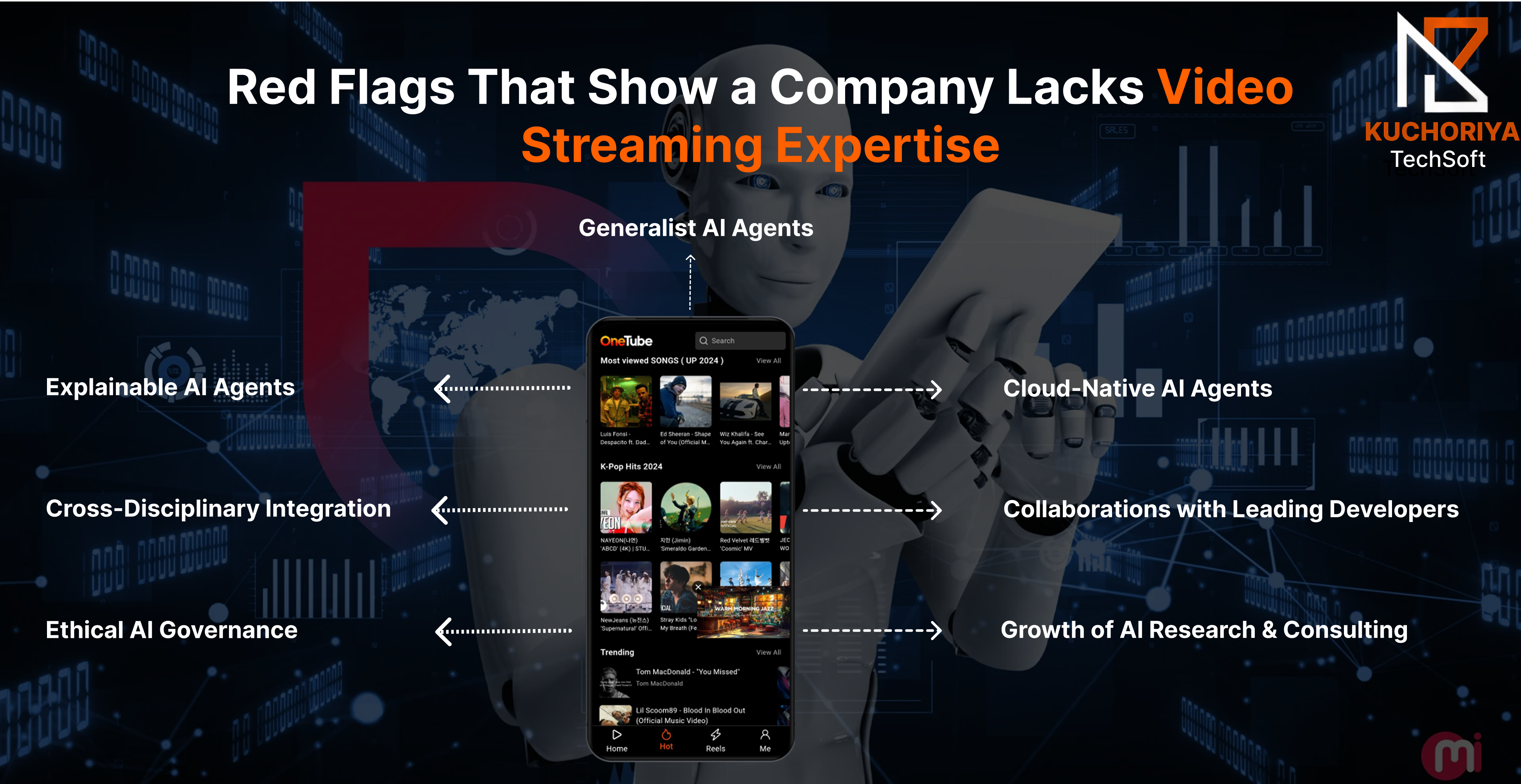
1. Generalist AI Agents
AI agents capable of handling multiple tasks beyond narrow domains are emerging, boosting the versatility of AI agent technology across industries.
2. Explainable AI Agents
A growing emphasis on transparency and trust through explainable AI agents supports regulatory compliance and increases stakeholder confidence.
3. Cross-Disciplinary Integration
Agent-based AI systems are increasingly integrating with IoT, blockchain, and edge computing to enable advanced autonomous AI application development.
4. Ethical AI Governance
Embedding ethics and safety principles in custom AI agent solutions is essential for responsible and compliant AI system development services.
5. Cloud-Native AI Agents
Adopting cloud-native AI agents enables scalable, modular, and flexible AI agent programming services that support global enterprise deployments.
6. Collaborations with Leading Developers
Partnering with the best agentic AI development companies and top AI agent developers accelerates innovation and reduces time-to-market for cutting-edge solutions.
7. Growth of AI Research & Consulting
Expanding AI research & consulting services allows enterprises to stay ahead of agentic AI development trends, optimizing strategy and long-term business outcomes.
Resources to Learn and Build Agentic AI
Kickstart your journey into agentic AI systems with the right courses, tools, and expert guidance. At Kuchoriya TechSoft, we recommend curated learning paths and global talent connections to help professionals and enterprises develop autonomous AI agents efficiently while staying ahead of 2026 trends.
1. Online Courses
Enroll in platforms like Udemy’s AI Agent courses or Maven’s GenAI System Design to build foundational skills in agentic AI development.
2. Open-Source Repositories
Leverage projects like Krishnaik06’s Roadmap-To-Learn-Agentic-AI on GitHub to explore AI agent architecture, experiment, and prototype solutions.
3. Community Forums & Conferences
Participate in AI research groups, forums, and conferences to gain insights, discuss agentic AI frameworks, and stay updated on best practices.
4. Consulting Services
Engage the best AI agent consulting services for tailored guidance on custom AI agent solutions and deployment strategies.
5. Hiring & Outsourcing
Access top global talent by hiring AI agent developers, dedicated AI agent development teams, or freelance AI agent engineers across India, Europe, and North America. Whether you need contract AI agent developers or agile AI development teams, expert guidance ensures scalable and reliable execution.
Conclusion: Empower Your Business with Agentic AI and Autonomous AI Agents
Mastering how to build agentic AI and developing AI agents from scratch empowers organizations to deploy advanced AI agent systems that deliver real business value through intelligence, autonomy, and adaptability. At Kuchoriya TechSoft, we leverage agentic AI frameworks to provide AI agent software development and custom AI agent solutions tailored to enterprise goals in 2026.
From AI agent architecture design to AI model development and deployment, including AI agent programming services, organizations can scale autonomous AI applications that encompass reinforcement learning AI agents, multi-agent AI systems, and cognitive AI agents. Leveraging AI agent testing & optimization services and AI agent integration services ensures reliable, efficient, and explainable operations.
Partnering with top AI agent developers across the USA, Europe, India, or Canada—or collaborating with offshore AI agent development teams—unlocks global expertise for faster innovation. Incorporating cloud-native AI agents and AI agent simulation techniques further enhances deployment agility, safety, and real-world performance.
Following a step-by-step approach to agentic AI development and staying current with AI agent development trends, 2026 positions organizations among leading autonomous AI technology firms and award-winning AI agent solution providers, ready to lead the future of intelligent automation.
Get Started Today: Transform your business with intelligent AI agent technology. Partner with top agentic AI development companies, leverage AI agent integration services, and outsource agentic AI development to expert teams worldwide for scalable, future-ready solutions.
Frequently Asked Questions About Agentic AI and AI Agent Development
Q. What is agentic AI, and why is it important for AI systems?
A. Agentic AI consists of autonomous AI agents that perceive, reason, and act independently. It is critical for developing intelligent, adaptive systems that automate complex tasks and enhance decision-making across industries.
Q. How can I build AI agents from scratch effectively?
A. Building AI agents from scratch requires choosing the right agentic AI framework, training models using reinforcement learning AI agents, and integrating them into enterprise workflows. A structured development process ensures robust, scalable AI agent systems.
Q. What are the benefits of multi-agent systems AI?
A. Multi-agent AI systems allow autonomous agents to collaborate and solve complex problems efficiently. They improve scalability, flexibility, and performance in applications like robotics, automation, and virtual assistants.
Q. Which services are essential in AI agent software development?
A. Key services include AI model development, AI agent testing & optimization, integration services, and expert consulting. Partnering with trusted AI agent development companies ensures high-quality, custom solutions.
Q. How does reinforcement learning improve autonomous AI agents?
A. Reinforcement learning enables AI agents to learn optimal behaviors through trial and error, boosting adaptability, efficiency, and real-time decision-making in dynamic environments.
Q. Can AI agent development be outsourced effectively?
A. Yes, outsourcing to skilled AI agent software firms in the USA, Europe, India, or offshore teams provides access to specialized talent and cost-effective solutions for building agentic AI systems.
Q. Which industries benefit most from agentic AI applications?
A. Agentic AI solutions are highly impactful in robotics, autonomous vehicles, intelligent virtual assistants, and business process automation, delivering efficiency, innovation, and operational excellence.
Q. Why is ethical governance crucial in agentic AI development?
A. Ethical governance ensures safety, fairness, and transparency in AI agent technology deployment, mitigates risks, and builds trust among users of autonomous AI systems.