Introduction – Why Australian Businesses Are Investing in AI
Three years ago, most Australian businesses were treating AI as something to watch from a distance. Today the same businesses are budgeting for it, deploying it, and in some cases rebuilding entire operations around it. CSIRO's 2024 report puts enterprise AI adoption at 68% nationally. AI implementation services in Australia are now a line item in annual budgets, not a one-off experiment. (Source)
IDC puts the growing AI market size in Australia at AUD 7.8 billion by 2026. Retail chains are automating inventory. Banks are running predictive risk models. Logistics companies have ditched manual route planning entirely. Businesses that held off are now three steps behind, and customers are noticing. (Source)
CommBank did not just tweak its fraud detection – it rebuilt the whole thing using AI. Woolworths pulled demand forecasting out of spreadsheets and handed it to machine learning models that update in real time. Neither of these happened overnight, but both are now core to how those businesses run. Real AI case studies from Australia like these are what finally moved AI from the IT department's wishlist to the CFO's budget approval.
Infrastructure costs fell. Platforms got easier to work with. And watching US and Asian competitors pull ahead using AI tools that Australian businesses had access to but weren't using – that stung. The rising AI adoption rate across Australia picked up sharply after 2022 for exactly that reason. The latest AI investment trends in Australia 2025 show that gap is still closing, fast.
Accelerating artificial intelligence adoption across Australia is well underway. What most businesses haven't figured out yet is what it should cost them and what they should expect back. That is what this guide is for.
What Is AI Implementation for Businesses?
Most businesses have heard the term but nobody really sits down to explain what it involves day to day. Signing a contract with a software vendor is maybe the smallest part of it. The bigger job is getting that technology to actually work inside a specific business, with its own data, its own team, and its own way of doing things. That part takes time, planning, and usually a few things going wrong before they go right.
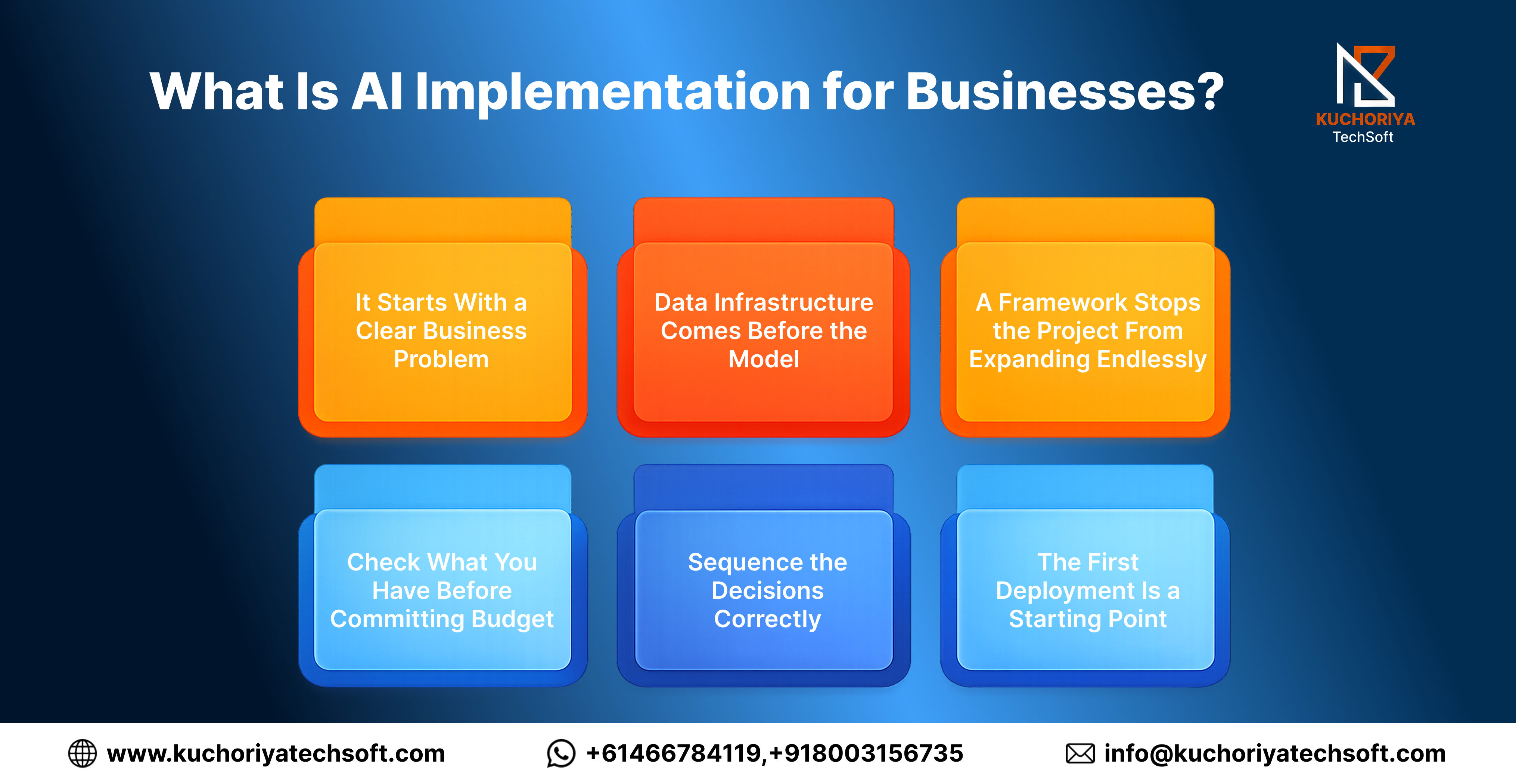
1. It Starts With a Clear Business Problem
Vendors get called too early. Platforms get compared before anyone has written down what problem they are actually trying to fix. The guide to how much AI implementation costs in Australia comes back to this almost every time. Undefined problems produce expensive, directionless projects that nobody is happy with at the end.
2. Data Infrastructure Comes Before the Model
Here is what catches most businesses off guard. Their data is not ready. Not even close. Different systems, different formats, records that contradict each other, fields that were never filled in consistently. Leading AI digital transformation initiatives across Australian industries flag this as the thing that kills timelines more than anything else. And businesses usually find out after the project has already started.
3. A Framework Stops the Project From Expanding Endlessly
AI projects have a habit of growing beyond what was originally agreed. A structured approach stops that from happening. Following an AI maturity model framework keeps teams working through defined stages rather than adding scope every time someone has a new idea.
4. Check What You Have Before Committing Budget
Conducting an AI readiness assessment is not paperwork. It tells you whether your infrastructure can support what you are planning, where the gaps are in your data, and whether your team has any realistic chance of managing what gets built. Finding that out before spending is considerably cheaper than finding it out during.
5. Sequence the Decisions Correctly
Building a strong AI implementation strategy means sorting out the sequence before work begins. Which parts depend on other parts being finished first, where the budget actually needs to go, what can wait. Wrong sequencing means paying twice for work that should have been done correctly the first time.
6. The First Deployment Is a Starting Point
Developing a long-term AI innovation strategy from the start changes the outcome significantly. Businesses that plan for model updates, data changes, and shifting requirements before the first version even launches consistently extract more value from the same initial spend.

How Much Does AI Implementation Cost in Australia?
No fixed number exists here. It depends entirely on what the business actually needs and how complex the implementation is.
1. Pricing Models Are Not Standardised
Vendors price AI work differently and there is no industry standard for it. Flat fees, hourly rates, usage-based billing, per seat charges. Comparing AI pricing models in Australia takes time because the structure changes completely from one vendor to the next. What looks affordable at the start often tells a different story 12 months later.
2. The Upfront Bill Is Bigger Than Expected
Data audits, discovery sessions, infrastructure prep, training, integration work. None of that is free. Planning your AI upfront investment without accounting for these extras is how businesses end up going back to the board for more budget three months in.
3. Running Costs Are a Separate Conversation
Calculating AI total cost of ownership is not just about what gets spent building the thing. Hosting fees, retraining cycles, security patches, support contracts. Three years of these quietly adds up to something close to what the original build actually cost.
4. Subscriptions Grow Faster Than Budgets
The monthly figure on the invoice is rarely the full picture. Understanding AI subscription costs means digging into what happens when usage spikes, when the team grows, or when the contract auto-renews at a higher tier. Australian businesses that skipped this check found their AI bills had doubled inside 18 months with nothing new to show for it. Evaluating AI per-user pricing in Australia means running projections on where headcount will actually be in two years, not where it sits today.
AI Implementation Cost Ranges in Australia
Managing AI deployment costs effectively starts well before any vendor conversation. Knowing which bracket your project sits in changes every decision that follows.
AI Implementation Cost Breakdown
The total AI implementation cost breakdown looks different for every project but the categories stay mostly the same. Here is where the money actually goes.
1. Development and Licensing Costs
Tracking AI development expenses includes discovery, architecture, build, and testing. Custom builds in Australia typically land somewhere between AUD 40,000 and AUD 150,000. Understanding AI software licensing costs goes beyond the headline price. Which API limits the practice, which levels of support are covered, whether or not the employer offers an additional feature for a fee. This information ranks sharply in order of actual annual costs.
2. Infrastructure and Data Pipeline
Managing AI infrastructure expenses is ongoing. Servers, cloud compute, GPU instances. Managing AI data pipeline costs adds ETL processes and engineering time on top. Both grow as usage scales and neither stops after launch.
3. Workforce Training and Maintenance
Calculating AI workforce training costs is consistently underbudgeted. Onboarding, documentation, change management. Skip it and expensive tools sit unused. Ongoing AI maintenance costs are what keep the system actually working after launch. Bug fixes, performance checks, model drift corrections. Most projects budget around 15 to 20 percent of the original build cost per year for this and it is rarely enough.
4. Machine Learning and Model Training
Breaking down machine learning implementation costs separately matters because dataset labelling, model selection, and tuning carry costs standard software projects do not. Understanding AI model training costs depends on dataset size and infrastructure. Cloud GPU sessions alone can run into thousands per round.
5. Data Management and Licensing Fees
Controlling AI data management costs covers governance, access controls, and compliance under Australian privacy law. Comparing AI licensing fees before signing saves money over the contract term. Perpetual, subscription, and consumption models suit different usage patterns entirely.
6. Upgrades and Total Cost Planning
Planning for AI system upgrade costs is not something to figure out later. Framework migrations, version updates, capability expansions. Businesses that leave this unbudgeted find themselves running outdated systems that quietly create bigger problems over time.
What Factors Affect AI Implementation Costs?
Two businesses in the same industry can spend completely different amounts on AI and both be justified. The cost is not random. Specific factors push it up or pull it down and knowing them before budgets get locked saves a lot of painful conversations later.
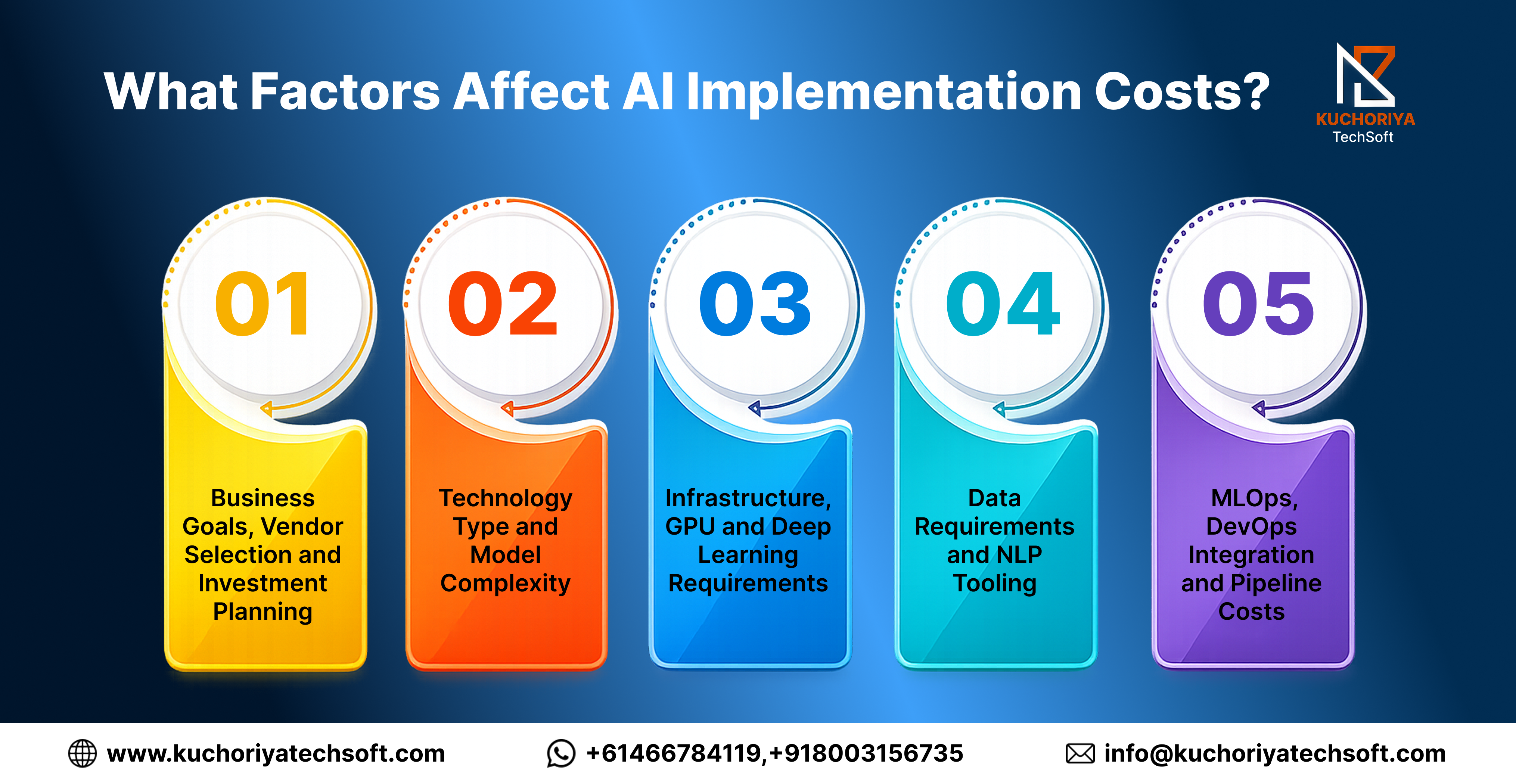
1. Business Goals, Vendor Selection and Investment Planning
Vague goals produce overbuilt, overpriced systems. Key AI implementation success factors almost always trace back to how clearly the outcome was defined before any vendor got involved. Smart AI vendor selection in Australia matters just as much. Wrong vendor means wrong architecture, wrong pricing model, and an expensive exit. Planning AI technology investment wisely means matching the solution to the actual problem rather than buying the most advanced option the budget can stretch to.
2. Technology Type and Model Complexity
Not all AI carries the same price tag. Estimating computer vision AI costs sits in a completely different bracket from a basic recommendation engine. The cost of large language model deployment has come down over the past two years but still carries real infrastructure and licensing expenses for businesses running them at any meaningful scale.
3. Infrastructure, GPU and Deep Learning Requirements
Planning AI GPU infrastructure costs early stops businesses from being caught short when compute bills arrive. GPU instances are expensive, particularly for training workloads. Managing deep learning deployment in Australia adds another layer on top. Deep learning models need more data, more computation, and more engineering time than lighter AI approaches and the budget needs to reflect that.
4. Data Requirements and NLP Tooling
Data volume, quality, and structure directly affect what gets spent building and maintaining an AI system. Businesses working with unstructured text face additional decisions around top natural language processing tools in Australia, which tools fit the use case, what they cost at scale, and whether the team has the capability to manage them without external support.
5. MLOps, DevOps Integration and Pipeline Costs
Building AI MLOps pipelines in Australia is a cost that surfaces after the model goes live when nobody has a system in place for monitoring or retraining it. Integrating AI DevOps practices in Australia adds engineering overhead upfront but cuts long-term maintenance costs considerably. Skipping both creates technical debt that quietly compounds until it becomes a much larger problem to fix.
AI Implementation Cost Ranges for Australian Businesses
What a project costs depends heavily on what it actually needs to do. A small business automating one workflow sits in a very different bracket from a large enterprise rebuilding core operations around AI. Estimating AI project costs in Australia without knowing which category the project falls into is guesswork. The table below gives a working range for effective AI budget planning in Australia across different business types.
Numbers shift based on data complexity, team size, and integration requirements. What looks like a mid-size budget can climb quickly once data preparation and compliance work get factored in properly.
How to Calculate AI ROI for Australian Businesses?
Plenty of businesses greenlight AI projects without any real plan for measuring what comes back. Measuring AI ROI across Australia is handled differently across every industry, which creates a pattern where genuinely valuable projects get cut and underperforming ones keep getting budget because nobody has the numbers to make a proper call.
1. Start With a Clear ROI Formula
Calculating AI return on investment comes down to one equation.
AI ROI = (Business Value Generated / AI Investment Cost) x 100
Business value means revenue gains, cost savings, time recovered, error reductions. Investment cost means build, licensing, infrastructure, training, maintenance. Most calculations get one side wrong and the result ends up being either inflated or undersold.
2. Measure Productivity Gains Specifically
Measuring AI productivity gains in Australia is about hard numbers against specific tasks. Time saved per transaction, manual steps removed from a process, error rates before and after deployment. Numbers like a customer service team processing 40% more queries at the same headcount are worth putting in a report. Vague impressions that things run smoother are not.
3. Track Financial Impact Separately
Measuring AI financial impact in Australia requires separating direct revenue impact from cost reduction. Revenue impact covers upsell rates, conversion improvements, and retention gains. Cost reduction covers headcount efficiency, error-related losses avoided, and process automation savings. Mixing the two makes the number harder to defend when it reaches the board.
4. Run a Proper Cost-Benefit Analysis
Running a detailed AI cost-benefit analysis means every cost goes on the table. Licensing, infrastructure, training, maintenance, and staff time during implementation. Projected benefits need assumptions that hold up under questioning, not figures built around the best possible outcome.
5. Track Performance Metrics Consistently
Tracking AI performance metrics in Australia is not a one-time activity at launch. Model accuracy, processing speed, error rates, adoption figures, cost per transaction. These shift over time and waiting for something to break before checking them means the damage is already done by the time anyone looks.
6. Understand Cost vs Benefit at Enterprise Scale
Understanding AI cost vs benefit for enterprises in Australia gets more complex when multiple systems, departments, and locations are involved. Step-by-step AI ROI calculation for Australian businesses at that scale needs to account for integration costs, change management overhead, and the lag between deployment and measurable return, which typically runs three to six months at minimum.
Real Business Benefits of AI Implementation
Numbers on a spreadsheet only tell half the story. The other half shows up in how a business actually feels to run once AI has been live for a while.
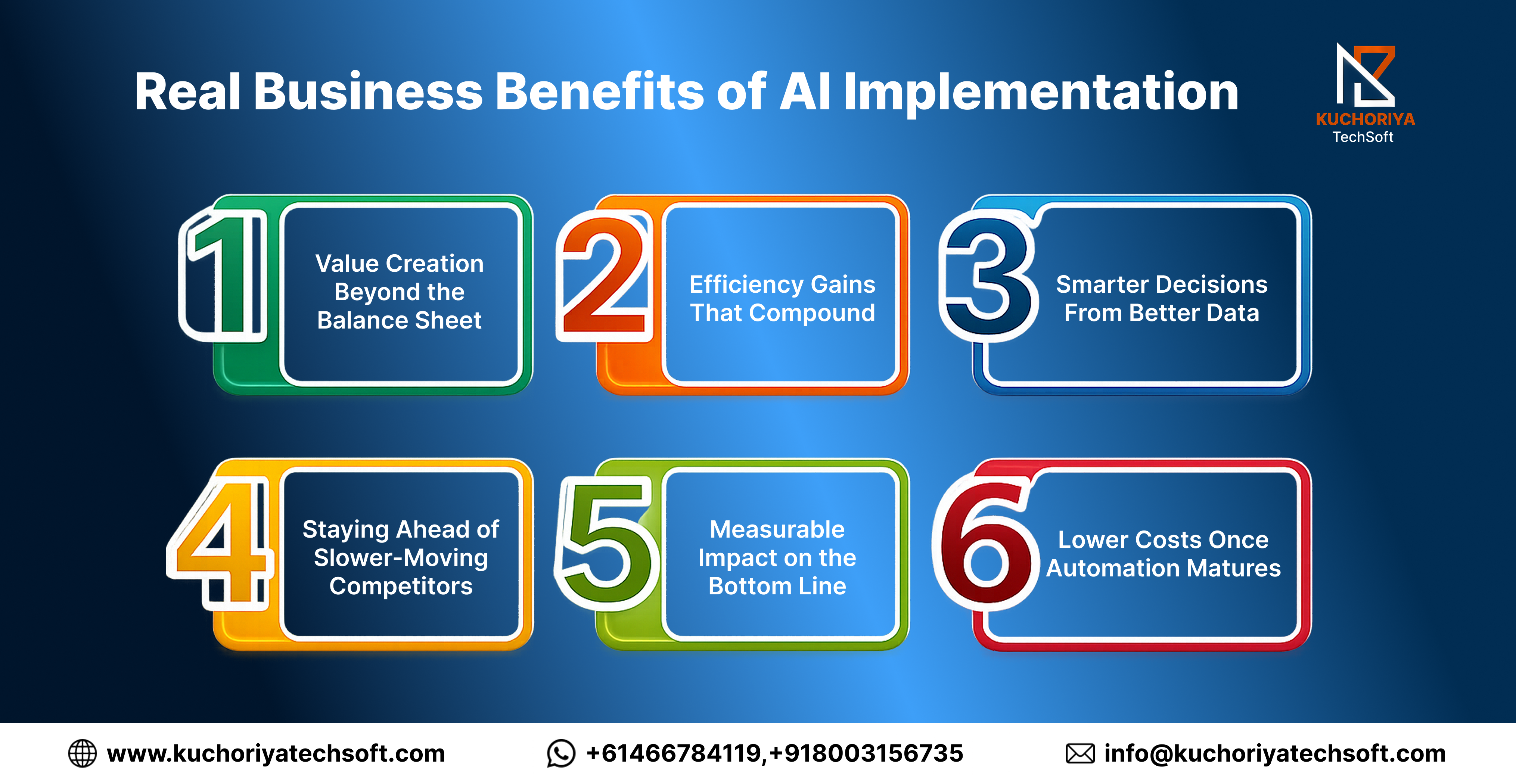
1. Value Creation Beyond the Balance Sheet
Most businesses expect one big payoff and instead get a dozen small ones. Unlocking AI value creation in Australia tends to look like that in practice, quicker responses to customers, fewer mistakes slipping through, decisions that lean on actual numbers instead of someone's best guess. The value often turns up in a department nobody expected it to touch.
2. Efficiency Gains That Compound
A job that used to need three people and most of a day now takes one person an hour, sometimes less. That is improving AI business efficiency in Australia in real terms, not the marketing version. The hours that get freed up rarely sit idle either. They go straight into work that actually grows the business.
3. Smarter Decisions From Better Data
Leadership stops waiting on a monthly report and starts looking at a dashboard instead. Leveraging AI business intelligence in Australia shifts how fast a leadership team can react, from weeks down to days, sometimes hours. That speed alone changes what kind of decisions get made.
4. Staying Ahead of Slower-Moving Competitors
This one is not really about having flashier tech. Gaining AI competitive advantage in Australia usually just comes down to who automated pricing or forecasting first. The businesses that moved early are now operating at a pace their competitors are still trying to figure out how to match.
5. Measurable Impact on the Bottom Line
Boards do not approve of more AI spending on vibes. They want a number tied to an outcome. Measuring AI economic impact in Australia means lower churn, lower operating costs, more output per person, written down clearly enough that someone can sign off on the next budget.
6. Lower Costs Once Automation Matures
The first quarter always looks expensive. Twelve months in, breaking down AI automation costs in Australia tells a completely different story once the system is tuned and people actually use it properly instead of half-heartedly.
AI Implementation Challenges Australian Businesses Face
Most AI projects hit the same six walls, no matter the industry.
1. Adoption Resistance: Overcoming AI adoption challenges for Australian companies is usually a people problem, not a tech one. Staff worry about job security and quietly avoid the new system.
2. Risk Gaps: Addressing AI risk management in Australia means building in checks before launch. Skip this and compliance issues surface at the worst possible time.
3. Integration Surprises: Managing AI API integration costs climbs once legacy systems and custom connectors get involved. That number rarely makes it into the original quote.
4. Drift Goes Unnoticed: Conducting AI audit services in Australia on a set schedule catches performance drift before customers start complaining about it.
5. Hidden Line Items: Uncovering AI hidden costs before signing anything means asking vendors exactly what is excluded from the headline price.
6. Cutting the Integration Bill: Reducing AI integration costs often just means picking platforms with existing connectors instead of paying for custom-built ones.
How Businesses Can Reduce AI Implementation Costs
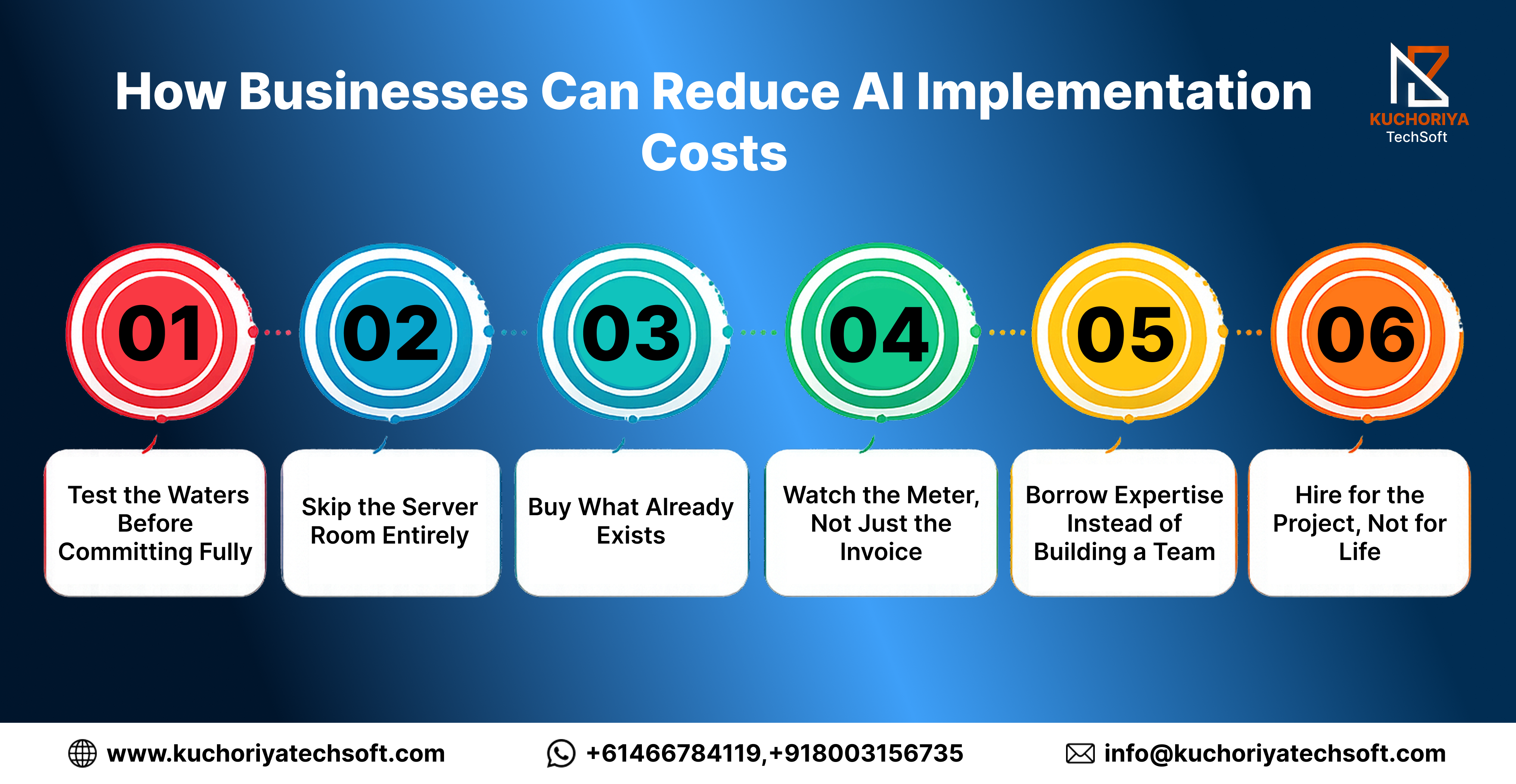
Costs do not have to stay high once a system is live. A few changes make a real difference.
1. Test the Waters Before Committing Fully: Launching an AI pilot program in Australia before a full rollout limits exposure and proves value early. Proven AI cost reduction strategies almost always start here.
2. Skip the Server Room Entirely: Leveraging AI cloud computing in Australia cuts upfront infrastructure spend significantly compared to building servers from scratch.
3. Buy What Already Exists: Choosing AI automation software in Australia off the shelf is often cheaper than custom development, especially for common use cases. Top AI SaaS platforms in Australia now cover most standard needs.
4. Watch the Meter, Not Just the Invoice: Managing ongoing AI operational costs closely stops small overages from quietly turning into a much bigger annual number.
5. Borrow Expertise Instead of Building a Team: Benefits of AI outsourcing in Australia include lower fixed costs and faster access to specialist skills. Choosing AI managed services in Australia removes the need for a large in-house team.
6. Hire for the Project, Not for Life: Flexible AI staff augmentation in Australia lets businesses scale technical support up or down without long-term hiring commitments.
How Kuchoriya TechSoft Helps Businesses Implement AI
Picking the right partner changes how the entire project plays out. Here is what that looks like with Kuchoriya TechSoft.
1. Custom Builds, Not Templates
Hiring an AI development company in Australia like Kuchoriya means investing in custom AI development in Australia shaped around the actual business, not a generic off-the-shelf setup.
2. Generative AI and Full Product Builds
The team handles deploying generative AI tools in Australia alongside end-to-end AI product development in Australia, covering everything from concept to launch.
3. Integration and Testing Done Right
Professional AI integration services in Australia connect new systems to what is already running, backed by reliable AI testing services in Australia before anything goes live.
4. Support That Continues Past Launch
Ongoing AI support and maintenance in Australia keeps systems running well after deployment, with structured AI training programs in Australia getting internal teams comfortable using what was built.
5. A Trusted Name in the Space
Businesses finding AI implementation partners in Australia consistently list Kuchoriya among the leading AI solution providers in Australia for top AI consulting services in Australia.
6. Transparent on Integration Costs
Managing AI API integration costs stays clear from the first conversation, no surprise line items showing up after the contract is signed.
Conclusion: Making AI Work for Your Business
AI is not magic, and it never was. What separates businesses that actually benefit from it comes down to one thing, how well the groundwork was laid before any money got spent.
Building an AI transformation roadmap in Australia turns scattered experiments into something a business can grow on. Planning your AI implementation timeline in Australia with that roadmap in hand means fewer surprises and a clearer view of when returns actually start.
Strategic AI investment in Australia only works as a long game. The businesses pulling ahead are not the ones spending the most, they are the ones treating the first deployment as a starting point, not the finish line. Clear AI benchmarking standards in Australia give something solid to measure against instead of guessing.
How to measure AI success in business across Australia comes down to honest numbers and a willingness to adjust course.If your business is ready to explore where AI fits, contact us for a free consultation, or ask about our referral partner program if you know a business that could use the same guidance.

FAQ Section
Q. How much does AI implementation actually cost in Australia?
A. Depends on what is being built. A small business automating one task might spend AUD 5,000. An enterprise rebuilding core systems can cross AUD 1 million without much trouble. Managing AI deployment costs effectively really just means figuring out which bracket applies before any vendor gets a call.
Q. Should businesses bother comparing consulting fees across firms?
A. Worth the hour it takes. Two firms quoting similar numbers can have wildly different scopes hidden underneath. Comparing AI consulting fees in Australia before signing anything has saved more than one business from an unpleasant surprise three months in.
Q. What is the easiest way to bring integration costs down?
A. Stop building custom connectors for problems someone else already solved. Reducing AI integration costs is mostly about picking platforms that already plug into the tools a business is using.
Q. Are subscription-based AI tools actually cheaper long term?
A. Sometimes, sometimes not. The sticker price on the invoice rarely tells the whole story once usage caps and tier jumps get factored in. Understanding AI subscription costs properly means reading the fine print before the first renewal, not after.
Q. Which AI tools make sense for a smaller business?
A. There is no single answer here, it depends on what the business actually needs to fix. That said, several top AI tools for business in Australia now handle common jobs like automation and customer support without needing anything custom built.
Q. Why bother with a readiness assessment before starting?
A. Because finding out your data is a mess after the project starts costs a lot more than finding out before. Conducting an AI readiness assessment early is cheap insurance against exactly that.