Why Telemedicine Apps Like Teladoc Health Are Growing Fast
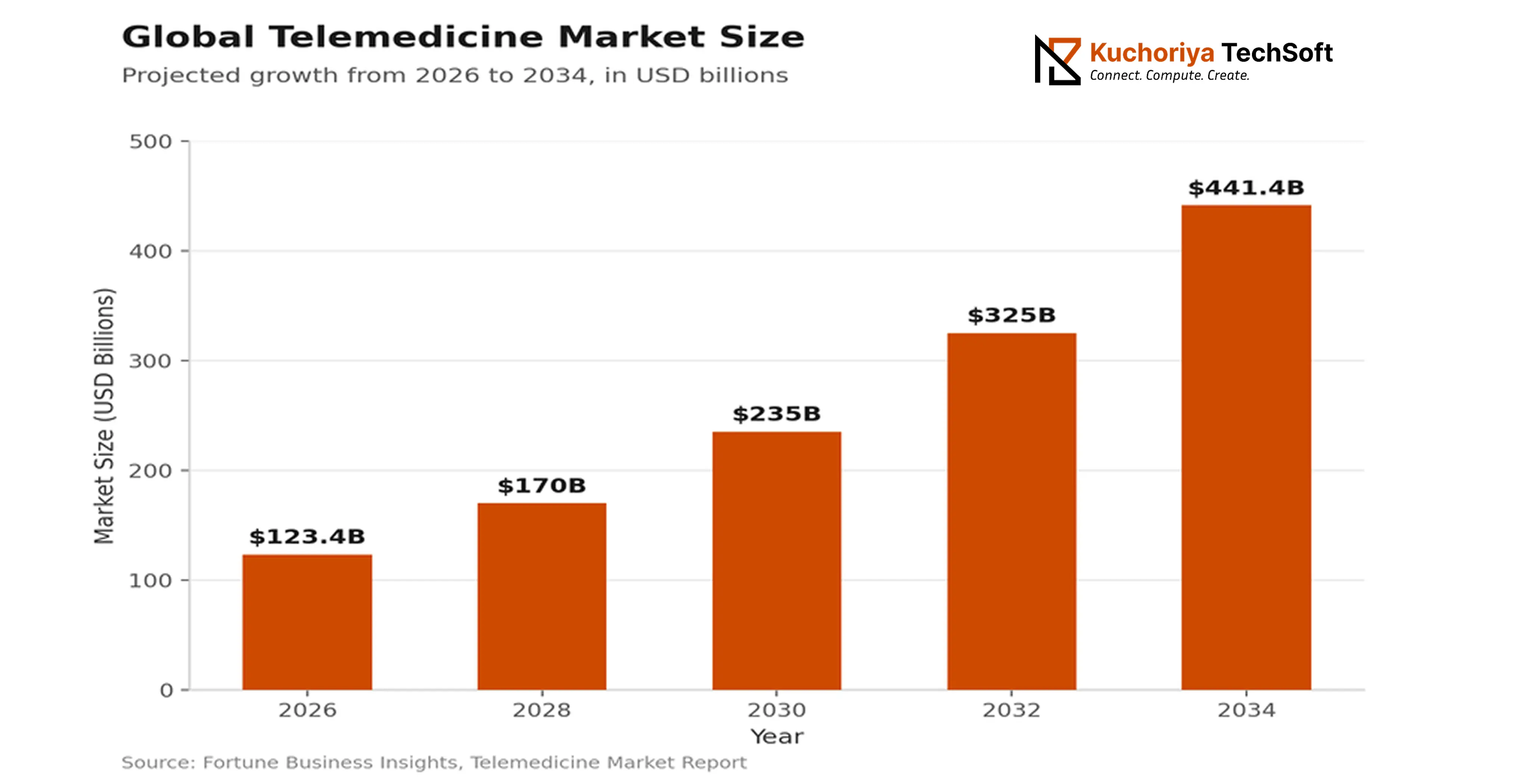
Founders exploring telemedicine app development like Teladoc Health are stepping into a market worth roughly $123.39 billion in 2026, growing at a 17.27 percent CAGR through 2034, per Fortune Business Insights. A lot of that growth comes down to what Teladoc got right from the start, quick bookings, video calls that hold up, and a system doctors actually trust for ongoing patient care, not just the occasional one-off visit.
Patient behavior backs it up too. 44 percent of U.S. adults used telemedicine in the past year, and 94 percent said they would do it again, per Deloitte. That kind of repeat usage says a lot about where the future of telemedicine apps is headed. (Source)
What Is A Telemedicine App Like Teladoc Health?
A telemedicine app like this puts patients in touch with doctors over video, chat, or phone, no clinic visit needed, and handles everything from booking to follow-up under one roof. Teladoc did not win on fancy features. It won by making that whole process easy on both ends; patients get to a doctor fast, and doctors are not stuck fighting clunky admin work between calls.
- Video, chat, and phone consultations in one place, part of a proper online doctor consultation app
- Booking, consultation, prescription, and follow-up in a single flow
- Built as a complete virtual healthcare platform, not just a calling tool
- Supports remote patient monitoring so care does not stop after the call ends
- No juggling between separate systems for records, payments, and scheduling
Must-Have Features In A Telemedicine App
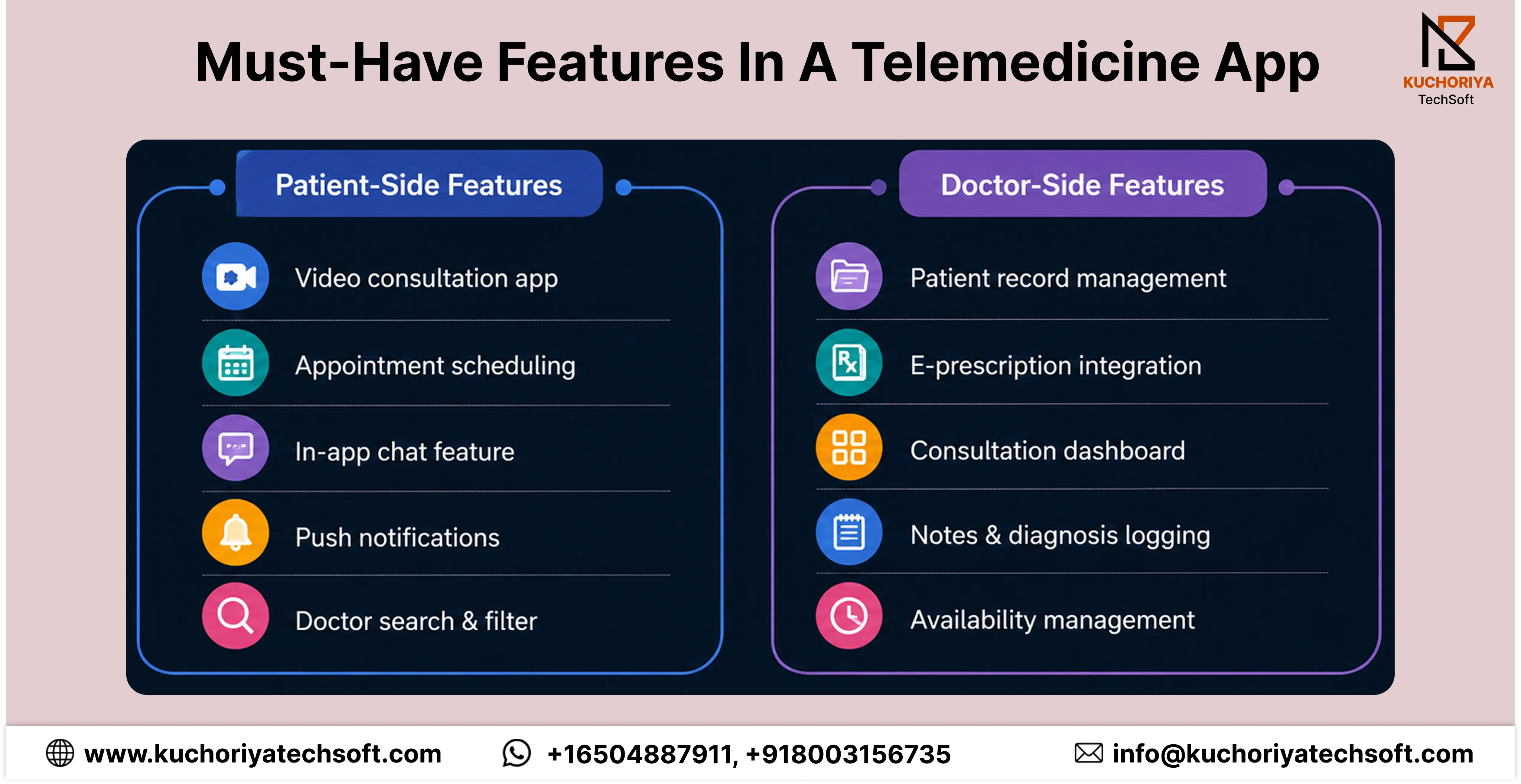
A basic booking-and-call setup is not enough anymore. Patients expect quick access to care, and doctors need tools that do not slow them down between appointments. Here is what a solid build needs on both sides.
Where AI Fits Into Modern Telemedicine Apps
AI is not just a buzzword feature anymore; it actually changes how fast patients get to the right kind of care and how much manual work doctors deal with day to day. Here is where it makes a real difference in a telemedicine build.
- AI-powered symptom checker guides patients toward the right next step before they even book a call.
- AI-based patient triage system routes cases by urgency instead of just order of arrival.
- Machine learning in healthcare apps improves the more people use the platform, not less.
- AI chatbot for telemedicine picks up the easy questions, leaving doctors free for cases that need them.
- Predictive healthcare analytics catches risk patterns in the data that get missed on a busy day.
- Reminders that shift based on how a patient responded last time instead of running on one fixed schedule.
- Specialist matching that looks at past visits, not just whatever symptoms got typed into a form.
- Live language translation during video calls for patients who need it.
Must Read: How Much Does It Cost to Develop a Doctor On-Demand App Like Practo & Teladoc?

Tech Stack Used For Telemedicine App Development
The right stack decides whether your app can handle real patient load or falls apart under it. Here is what actually goes into a build like this.
1. Frontend Development
We use React Native telemedicine app development to keep the app fast and consistent across both Android and iOS from a single codebase.
2. Cross-Platform Framework
For projects needing tighter native performance, Flutter telemedicine app development gives smoother animations and quicker load times on both platforms.
3. Backend Infrastructure
Backend architecture for telemedicine apps handles everything from booking logic to real-time video session management without breaking under peak traffic.
4. Cloud Hosting
Patient volume does not stay flat; it spikes during flu season, after a marketing push, whenever demand shifts. Cloud infrastructure for healthcare apps scales with that instead of falling over when traffic jumps.
5. Third-Party Integrations
Pharmacies, labs, insurance, a telemedicine app touch all three. API integrations for telemedicine platforms connect these without someone manually re-entering data on either end.
6. Data Exchange Standards
HL7 FHIR standards for healthcare apps keep patient records portable between hospitals, clinics, and this platform without formatting issues.
How We Build Your Teladoc Health Clone App
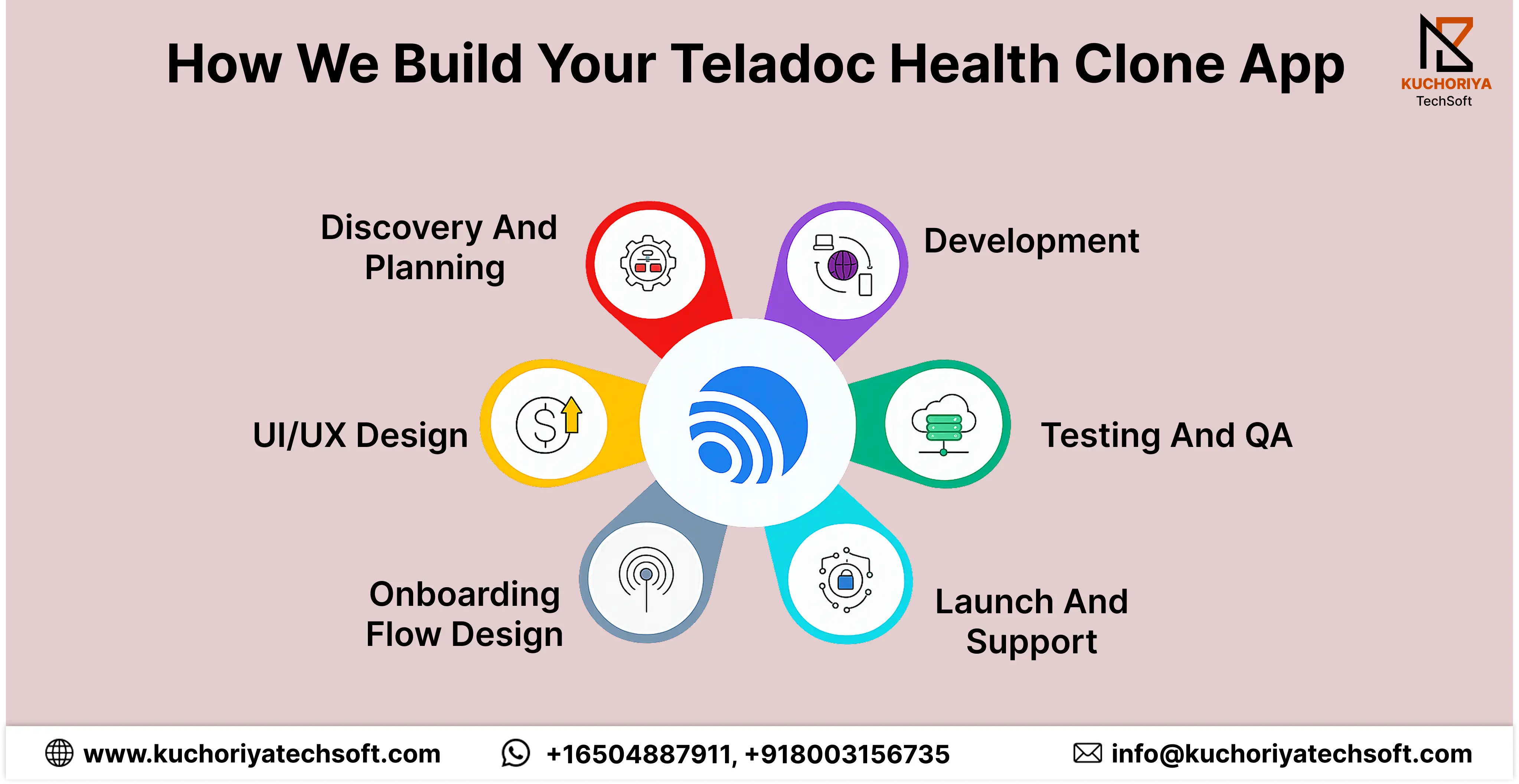
Building a telemedicine app development process that actually works takes more than writing code in order. Here is how we approach it from first call to launch.
1. Discovery And Planning
We map out your specialty focus, target patients, and revenue model before touching any part of the build a telemedicine app roadmap.
2. UI/UX Design
Every screen gets shaped around real patient behavior. Telemedicine app UI/UX design decisions here directly affect how many patients complete a booking versus drop off midway.
3. Onboarding Flow Design
A confusing signup kills trust fast. Careful patient onboarding process design keeps the first few minutes simple, which matters more than any feature buried deeper in the app.
4. Development
This is where the actual telemedicine app development guide turns into working code, with the frontend and backend built in parallel to keep timelines tight.
5. Testing And QA
Every feature gets tested under conditions that mimic real patient load, not just a clean demo environment.
6. Launch And Support
We handle the launch, then stay on to fix what comes up and reduce patient drop-off in healthcare apps issues as real usage data comes in.
Cost To Build A Telemedicine App Like Teladoc Health
There is no single number for this. Cost to build a telemedicine app shifts based on what you actually put into it, so treat this as a starting range, not a quote.
This telemedicine app development cost breakdown gets you in the right ballpark, the exact number comes later once we know your specifics.
What Actually Moves The Price
Platform count and how much AI you want built in usually swing the budget the most, these sit at the center of most factors affecting telemedicine app development cost conversations we have with clients. Pharmacy, lab, and insurance integrations each pile on their own layer of work too, and compliance costs shift depending on where your patients actually are.
The cost of building an app like Teladoc Health only becomes a real number once your feature list and platforms are locked. We hand you that figure upfront, not something that moves once the build is already in motion.
How Telemedicine Apps Make Money
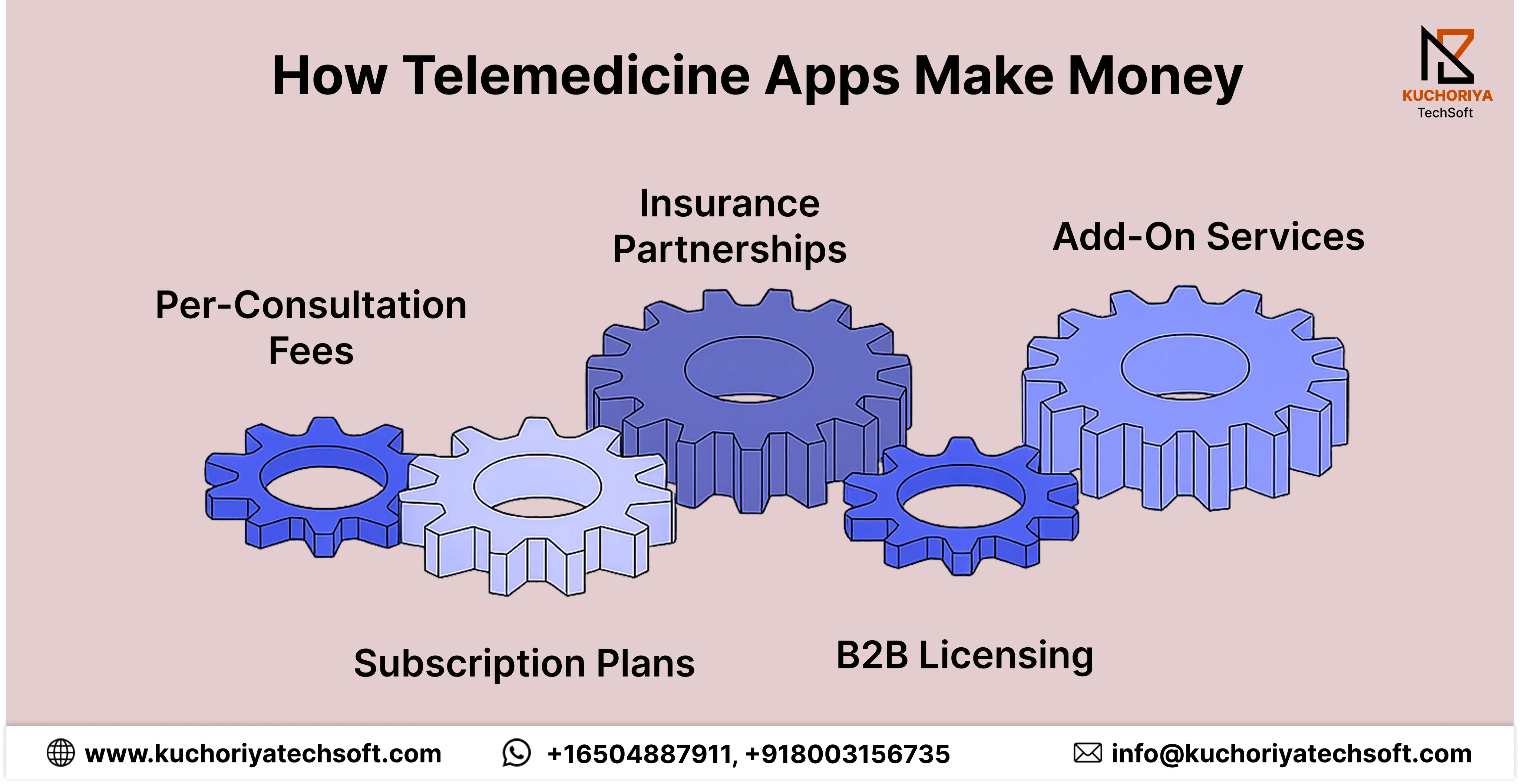
Every telemedicine app needs a real telemedicine business model underneath it, features alone do not keep the lights on.
1. Per-Consultation Fees
Patients pay per visit. Simple, easy to understand, and works well for apps just starting out.
2. Subscription Plans
Monthly or annual plans give patients unlimited or discounted consults. One of the steadier telemedicine app monetization models for platforms with repeat users.
3. Insurance Partnerships
Integrating with health insurance app development lets patients use existing coverage, removing a major barrier before they even book.
4. B2B Licensing
Selling the platform to hospitals or clinics as white-label software. Common among founders following a broader telemedicine startup guide approach.
5. Add-On Services
Lab tests, prescription delivery, and wellness programs each create revenue beyond the core consultation fee.
Anyone launching a telehealth startup should figure out this mix early, not after the app is already out and running.
Compliance And Data Security For Your Telemedicine App
Handling patient data wrong is not the kind of mistake you fix later, get it right from the first line of code.
1. HIPAA Compliance
HIPAA compliance in app development is non-negotiable for any app touching U.S. patient data, covering how records get stored, shared, and accessed.
2. HL7 FHIR Standards
Keeps patient records portable between hospitals, clinics, and this platform, without formatting mismatches breaking the data on either end.
3. Legal Requirements By Region
Telemedicine app legal requirements shift depending on where your patients are, what applies in the U.S. does not automatically apply in the UAE or Australia.
4. Data Privacy Standards
Data privacy in healthcare apps covers encryption, access control, and how long patient data actually gets retained.
5. FDA Guidelines
FDA guidelines for telemedicine apps matter most when the platform includes diagnostic tools or anything close to a medical device function.
6. GDPR For International Patients
GDPR compliance for healthcare platforms applies the moment you have European patients, regardless of where your company is based.
Why Build Your Telemedicine App With Kuchoriya TechSoft
Plenty of teams can write code. Fewer can deliver a Teladoc Health clone app development project that actually holds up once real patients depend on it.
1. Proven Delivery Experience
Our team has already shipped telemedicine app development company work for clients across multiple regions, this is not their first attempt learning on your budget.
2. Full Compliance Built In
Every build follows healthcare app development standards from day one, not something bolted on right before launch.
3. Complete Records Infrastructure
We handle EMR software development and EHR integration so patient history stays connected across every touchpoint, not scattered across separate systems.
4. Hospital-Grade Systems
For larger builds, our hospital management software work supports multi-department operations, not just a single-doctor consult flow.
5. Revenue Infrastructure
RCM software development keeps billing, claims, and insurance processing running smoothly behind the scenes.
6. Patient Engagement Focus
Our patient engagement app approach keeps patients coming back after the first visit, not just downloading the app once and forgetting it.
7. Global Delivery
We build telemedicine app development company in USA, telemedicine app development company in UAE, telemedicine app development company in Australia, telemedicine app development company in Canada, and telemedicine app development company in Singapore projects, with teams that understand regional healthcare rules, not a copy-paste approach across markets.
Should You Build A Telemedicine App Like Teladoc Health?
The market is growing fast, patient habits have shifted for good, and the platforms that got in early are the ones still leading. Waiting longer just means more competition by the time you launch.
What actually decides whether telemedicine app development like Teladoc Health works is not the idea alone; it is whether the features, compliance, and cross-platform telemedicine app development are handled right from day one instead of patched together after the fact.
If you are ready to move on this, contact us today, and we will map out exactly what your telemedicine app project needs before any code gets written. And if you know someone else building in this space, our referral partner program rewards you once their project moves forward with us.
Frequently Asked Questions About Telemedicine App Development
Q. How long does a Teladoc Health app development guide project typically take?
A. Timelines depend on scope, but most builds range from 12 to 20 weeks, starting from custom telemedicine app development through to launch, including testing and compliance checks.
Q. Do you offer full-cycle telemedicine app development services?
A. Yes, our telemedicine app development services cover everything from initial planning to post-launch support, so you are not managing multiple vendors across different stages.
Q. What backend technology do you use for telemedicine apps?
A. We typically build on a Node.js backend for telemedicine apps for its speed and reliability under real-time video and chat loads, paired with secure API integration for telemedicine apps for third-party connections.
Q. How do payments and billing work inside the app?
A. We integrate a secure payment gateway for healthcare apps directly into the booking flow, so patients can pay for consultations without leaving the platform.
Q. Can the app include wearable device integration?
A. Yes, wearable integration in healthcare apps lets the platform pull real-time vitals data, useful for chronic care and remote monitoring use cases.
Q. How do apps like Teladoc Health compare to competitors like Amwell?
A. In the broader Teladoc Health vs. Amwell conversation, both offer strong virtual care coverage, but differentiation usually comes down to specialty focus, monetization model, and how well the app is built for your specific patient base rather than copying a competitor's exact feature set.