Introduction to Car Rental App Development
Today, car rental app development means building one connected platform where a customer can search, verify identity, pay, and unlock a vehicle, while the operator watches every car, booking, and return in real time.
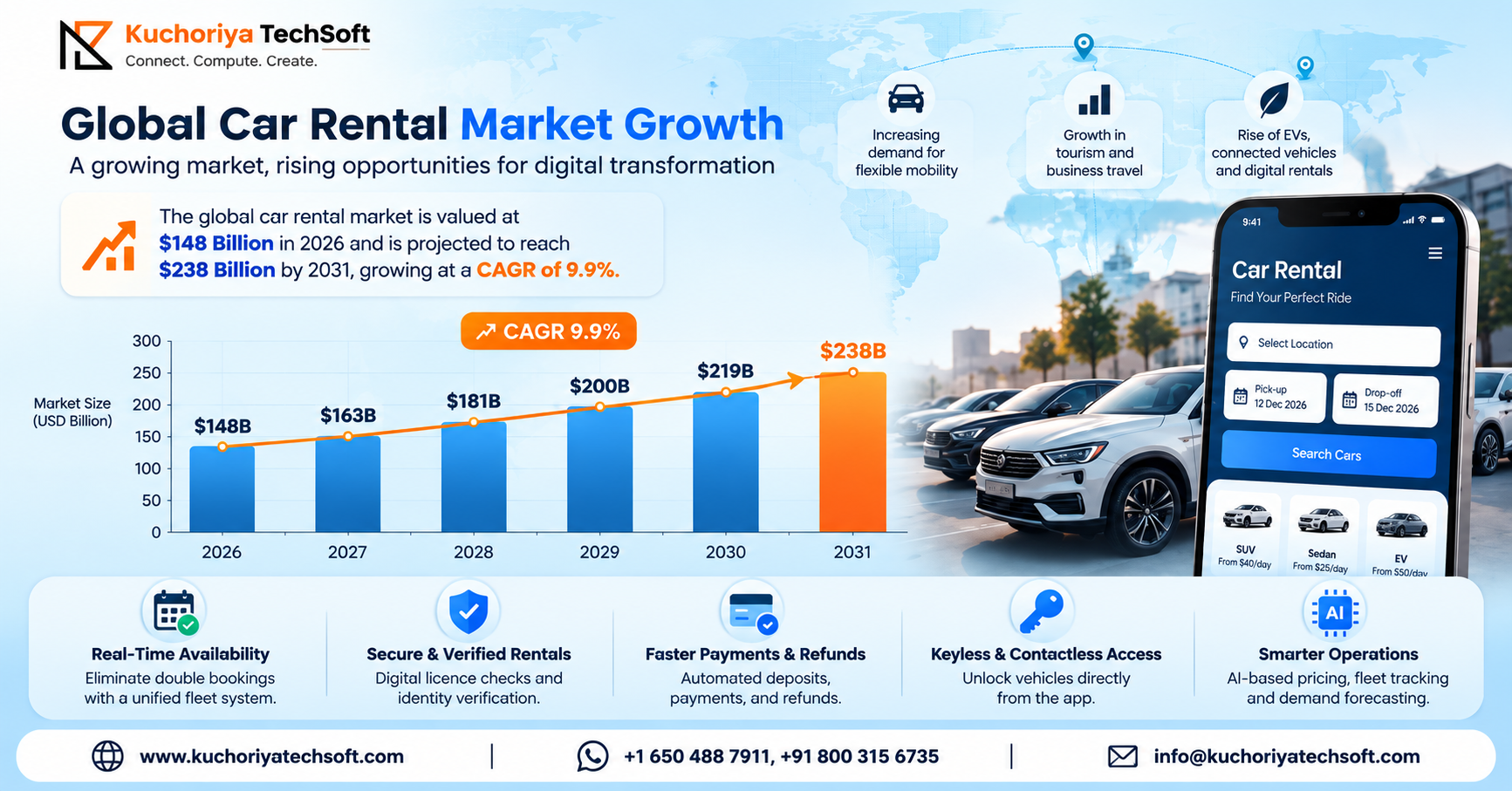
Customers already behave this way. Ken Research puts the global car rental market at about $148 billion in 2026 and sees it reaching $238 billion by 2031. Operators who still lean on phone calls, spreadsheets, and counter paperwork feel that gap first. A car gets listed after it has already left. Two people book the same vehicle. A deposit refund takes a week.
An app fixes this at the source. A solid car rental app booking system checks live availability before it takes a payment, so one shared fleet record replaces the guesswork.
Fleet owners now ask for more than booking, too. AI-based pricing, digital licence checks, keyless pickup, and EV charge tracking have moved from experiments to normal requests.
This car rental app development guide from Kuchoriya TechSoft keeps the focus on what owners and product teams must agree on before design starts. You will see the car rental app development requirements that set scope, the car rental app development features and requirements worth building first, and where custom car rental app development beats a ready-made script.
Planning car rental app development for rental businesses of any size starts with three questions: who rents, how cars are tracked, and which systems must connect.
Types of Car Rental Apps and Business Models
Seven types of car rental apps are common, and each earns money differently.
Self-Drive Car Rental Apps
Customers collect the car and drive it themselves. Owners need car rental app solutions for fleet operators to see which cars sit unused.
Chauffeur-Driven Car Rental Apps
A driver comes with the car, so reliable vehicle booking workflows prevent late pickups.
Peer-to-Peer Car Sharing Apps
Private owners list their cars, as on Turo, so holiday rushes need scalable vehicle rental booking platforms behind them.
Corporate Car Rental Apps
Companies book cars for staff, and finance wants every trip tied to a cost center. Custom vehicle rental platforms for enterprises handle that.
On-Demand Car Rental Apps
Users unlock a nearby car by the hour, as with Zipcar, so car rental mobile app development has to be quick.
Subscription-Based Car Rental Apps
Plans renew every month and customers swap cars, so fleet rental app development solutions have to manage the billing.
Aggregator Car Rental Apps
Many rental firms show up in one search, so enterprise car rental app development is the usual route.
Essential Features of a Successful Car Rental App
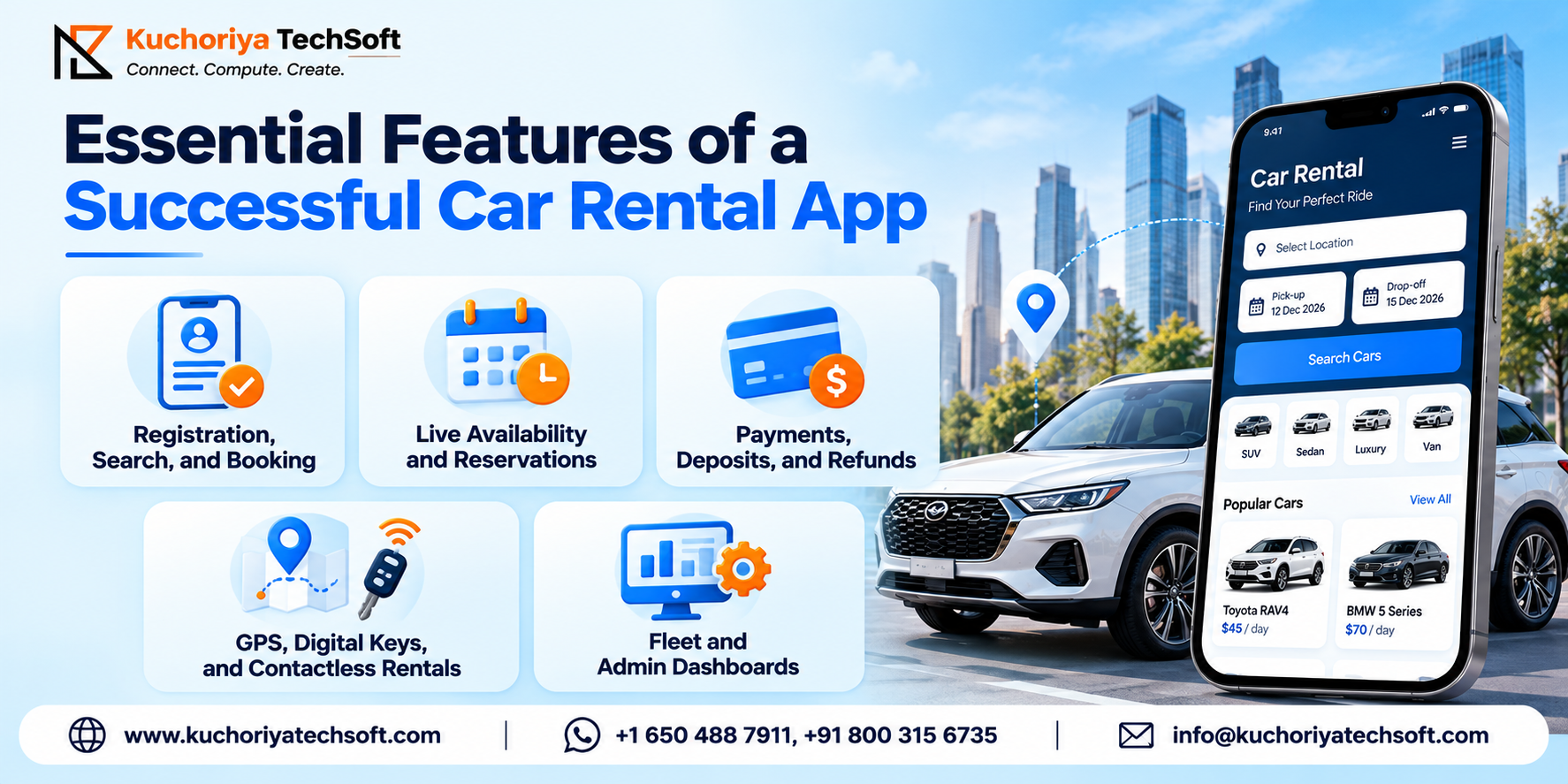
A renter decides fast. Weak car rental app features lose them within seconds. Start with these five.
1. Registration, Search, and Booking
Picture a customer at an airport with one bar of signal. Three fields and a license photo, that is the whole signup. Price and seat filters sit on the home screen, and the vehicle rental booking workflow ends on a single tap. Reviews and alerts bring customers back later.
2. Live Availability and Reservations
If a car is gone, the app should say so right away. Real-time vehicle availability does that job. Now two users tap the same car in the same second. Booking conflict prevention lets the first one in, and the other sees a short message with a few alternatives. Changes and cancellations stay in the app.
3. Payments, Deposits, and Refunds
Card or wallet? Both. Some corporate clients still want an invoice, so add that too. Clean rental deposit and refund processing releases the hold soon after a good return.
4. GPS, Digital Keys, and Contactless Rentals
Live GPS and digital keys remove the counter queue. No desk, no paperwork. Pickup and drop-off management comes down to a phone and a parking spot. Both ends of a trip get photos, and that vehicle inspection workflow is what ends most damage arguments.
5. Fleet and Admin Dashboards
Owners need to see everything at a glance. Customer and admin dashboards show car status, pricing rules, revenue, service alerts, and support tickets. Nothing hides in a spreadsheet.
Technology Stack and Third-Party Integrations for Car Rental Apps
Pick up tools in a hurry, and you pay for them twice. So ask first: what does your car rental app technology stack have to survive on a Friday night? Search, booking, and billing should never share one engine, and car rental app backend development is where that split begins. For car rental app database design, think of three linked lists: cars, renters, and trips.
Every outside vendor needs an account, a key, and a usage cap. List them all under your car rental app API integration plan. Money flows are the riskiest, so run car rental app API and payment integrations through testing before anything else ships. Suspicious bookings go to a human reviewer once AI-based fraud detection in car rental apps scores them. Staff want car location and service dates in one place, which is what car rental app integration with fleet management systems delivers. Put every car rental app third-party integration requirement on paper before coding begins: fees, call limits, and a backup vendor.
AI and Emerging Technologies in Car Rental App Development
A rental app lives on two things, speed and a fair price. AI-powered car rental app development quietly works on both. Renters never see it, they just notice the app feels easy.
- Family of five? AI-based vehicle recommendations put the SUVs on top. Solo traveller, compact cars come first.
- One branch has ten idle cars. The next one has none. Cars get moved across town before sunrise, thanks to AI-driven fleet management.
- Garage first, trip second. Predictive vehicle maintenance reads mileage and sensor data to keep it in that order.
- Last Eid, bookings jumped overnight. Machine learning for rental demand forecasting learns from weeks like that. Next time, the rates are ready in advance.
- Four taps became one. An intelligent car rental booking system handles the car choice, licence check, and confirmation together.
- It is 2 a.m., and someone wants to know about the fuel policy. AI-powered customer support for car rental apps replies right then. Hard cases wait for a human in the morning.
- Counters mean queues. With rental agreement automation, the contract fills itself, and a fingertip signs it.
Car Rental App Development Process: From Planning to Launch
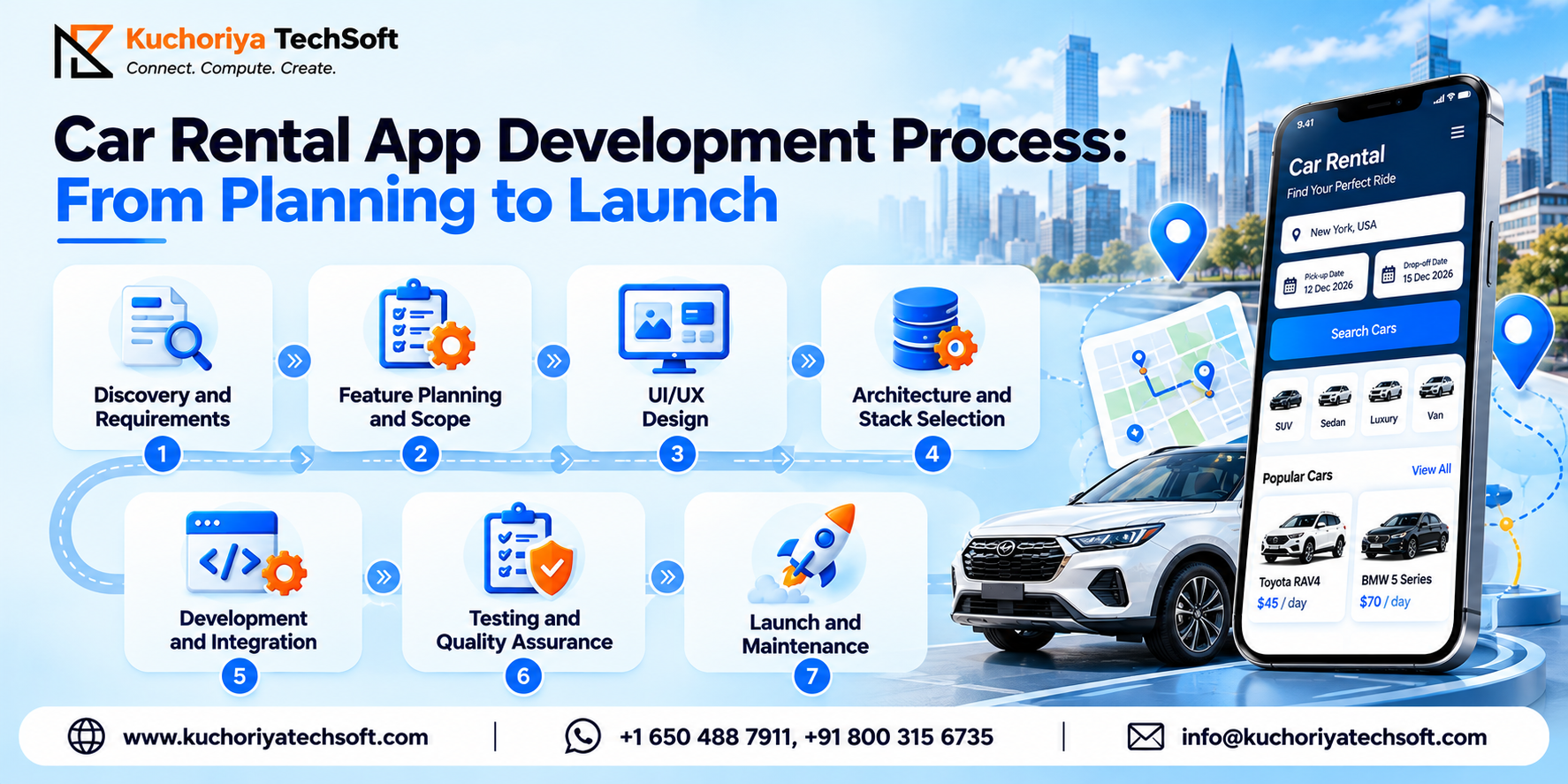
Most of the money in an app project gets wasted in the first few weeks, usually on features nobody asked for. A defined car rental app development process stops that early.
1. Discovery and Requirements
Start by finding out who will use the app every day. Renters want a quick booking, and branch staff want to see which cars are out. Write both lists down, add the cities and fleet size, and get the owner to approve it.
2. Feature Planning and Scope
Not every idea makes the first release. Booking, payment and live car status do, while loyalty points and referral codes get pushed to version two. Each feature is assigned to one person with a date next to it.
3. UI/UX Design
Designers begin with the booking form since most renters drop off there. A clickable prototype goes to about five people outside the company, and wherever they hesitate shows what to change. Developers, meanwhile, sketch the first car rental app architecture so the screens have something to sit on.
4. Architecture and Stack Selection
The car rental app architecture and technology stack get decided together, because the programming language limits which database and hosting options make sense. A secure car rental app architecture includes encrypted license photos and staff accounts that only open the screens their job needs.
5. Development and Integration
Each sprint lasts two weeks and ends with a build the client can open on a phone. The map, payment, and ID check services get hooked up through car rental app integrations. Keep a car rental app integration checklist for keys, sandbox tests, and the error message users see when a service is down.
6. Testing and Quality Assurance
Car rental app testing and quality assurance is mostly about breaking things on purpose. Testers cancel a card halfway through payment, upload a license photo shot in a dark parking garage, trigger the same refund twice, and push a holiday weekend’s worth of traffic through the servers.
7. Launch and Maintenance
We usually release the app at a single branch before anything else. Two or three days of real rentals are enough to show what the testers missed, like a button people keep skipping or a step that takes too long. After those fixes the app goes live in the remaining cities. Someone on the team opens the crash dashboard each morning for the first month.
Car Rental App Development Cost and Timeline
Price follows scope. Clear car rental app technical requirements written before design starts keep the quote honest.
What Drives the Price
Same app, two quotes, $30,000 apart. The gap usually starts with fuzzy scope. Write your car rental booking system requirements before anyone prices anything. How do renters search? Can they extend a trip? What happens on a cancellation? Then settle the platforms, hosting, and languages that make up your car rental app development technical requirements. Android and iOS both? Pick a car rental app development framework like Flutter and share most of the code. Integrations cost the most. Every map, payment, and ID check in your car rental app backend and API requirements adds developer hours.
Costs After Launch
Launch day is not the end of the bill. Plan on 15 to 20 percent of the build cost every year for car rental app maintenance requirements, such as bug fixes, OS updates, and server fees. Before peak season, run a round of car rental app performance optimization. A holiday rush is a bad day to find a slow screen.
How to Choose the Right Car Rental App Development Company
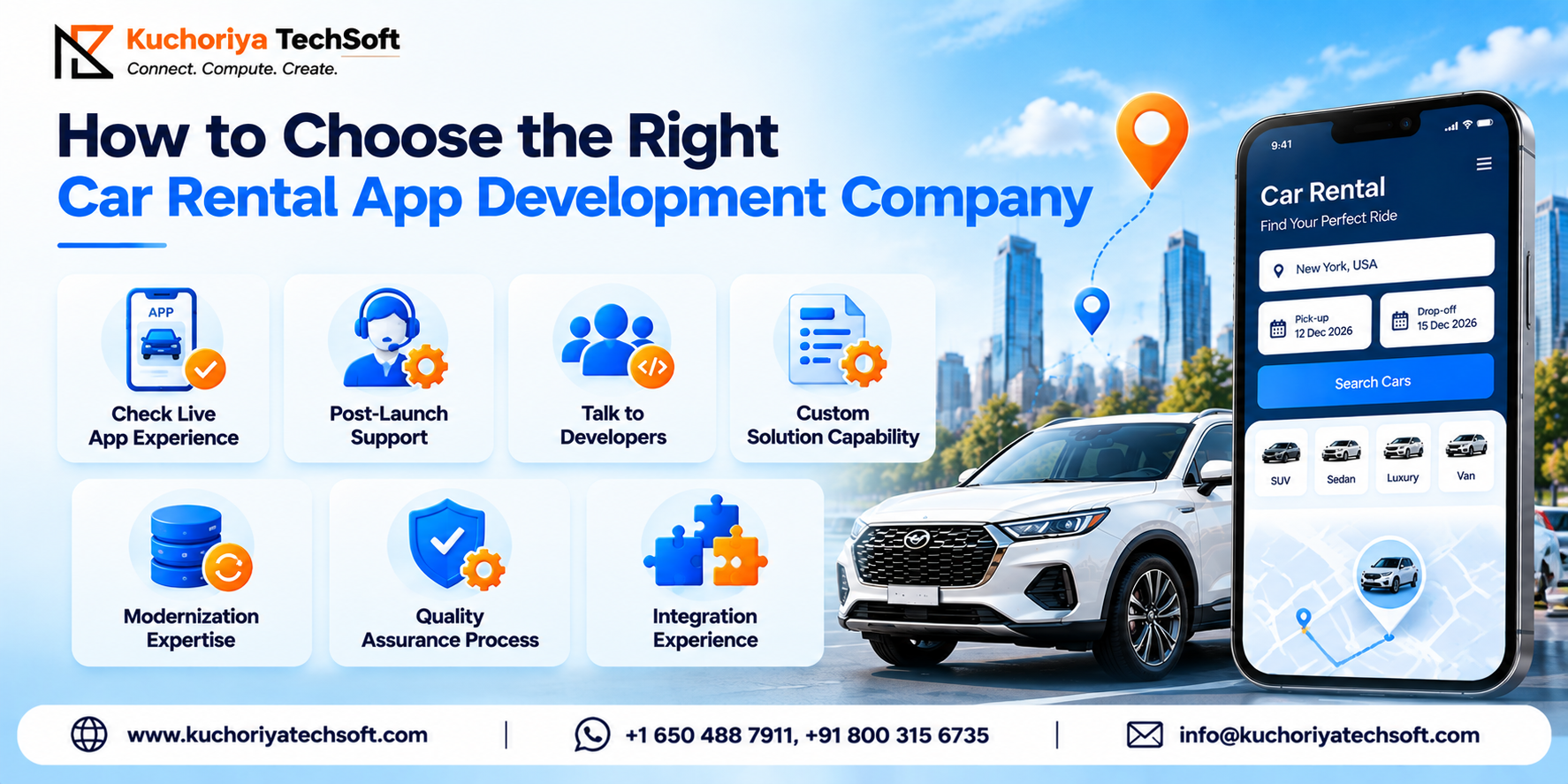
Most owners compare quotes by price first. The seven checks below tell you more than the number at the bottom of the page.
- Ask any custom car rental app development company for a link to an app that is live in the store. Download it and book a car yopaurself.
- Choose a car rental app development partner that offers support after release. Find out who gets the call when bookings stop yourselfon a weekend.
- Want to hire car rental app developers? Speak to the engineers themselves, not just the sales contact.
- Off-the-shelf car rental app development solutions are fine for a pilot in one city. Custom pricing rules or corporate accounts usually need more than that.
- Replacing an old booking tool? Ask about car rental app modernization services, since moving past trips and customer records is a separate job.
- Ask for a written car rental app quality assurance process that names double bookings, failed payments, and refund errors.
- Good car rental app integration services come with a list of the map, payment and ID check vendors the team has already connected.
Why Choose Kuchoriya TechSoft for Car Rental App Development?
Here is what you get when Kuchoriya TechSoft builds your rental app.
Send the Kuchoriya TechSoft team your fleet size and cities to get a scope and timeline.
Conclusion: Building a Scalable and Future-Ready Car Rental App
A rental app earns its keep in the busiest week of the year. So scalable car rental app development should be planned before the first screen is designed, not after the first crash.
Nobody says car rental app scalability and reliability out loud. They say the app was slow, or that it charged them twice. Once the car rental app booking workflow explained to the team is settled, the order stays fixed: check the car, take the payment, send the confirmation. Vehicle availability synchronization in rental apps makes sure the airport branch and the city branch see the same car.
After launch, the owner needs two answers. Where is every car right now, and which ones make money? Fleet inventory management handles the first. Fleet utilization tracking handles the second. And car rental app data protection gets more important each month, since licence photos and card records keep adding up.
Not every owner has a technical lead. CTO services can guide scope and budget during planning. Agencies that bring rental clients can look at the referral partner program, and firms that want a closer tie can ask about the associate partner program.
Ready to plan your own? Talk to the Kuchoriya TechSoft team about your fleet, cities and launch date.
Frequently Asked Questions About Car Rental App Development
Q. What are the technical requirements for a car rental app?
A. Think two phone apps, a server for the booking rules and a database. Maps and card payments usually come from outside companies, so you’ll connect to those. Your staff will want a basic web page to watch the fleet too.
Q. What features should a car rental app include?
A. Signup, a licence photo, then picking a car and paying. That flow comes first. Staff need an admin panel too. Digital keys and GPS can wait for version two.
Q. Which APIs are needed for a car rental app?
A. Four will cover most apps, and they’re maps, payments, ID checks and texts for alerts. Google Maps, Stripe and Onfido come up a lot. Got trackers in your cars? Then you’d add a telematics one as well.
Q. How does a car rental app manage vehicle availability?
A. Each car lives in the system as one record. A booking, a return or a workshop visit edits it on the spot. All screens read that record, so branches never disagree.
Q. How can a car rental app prevent double bookings?
A. The moment a renter hits checkout, that car is held for a few minutes. Anyone else sees a message with other options. A failed payment frees the car again.
Q. How do car rental apps handle cancellations and refunds?
A. That’s up to the owner. Rules differ. Some refund fully if you cancel a day early, some keep a small fee. The car goes back on the list, and the refund goes to the same card.
Q. How do you secure customer data in a car rental app?
A. Encrypt the licence photos. Don’t store card numbers yourself, let the payment gateway do that. Staff should only see the screens they need, and admins should confirm logins with a second step.