
Introduction: Why Every Startup Needs a Global Growth Strategy Today
Most startups chase global startup growth without a real plan, and that is exactly why they fail. In 2026, international business growth is no longer reserved for big corporations. A bootstrapped team today can close deals in Dubai, acquire users in Singapore, and scale across Canada, but only with the right global growth strategy for startups and a clear global market expansion roadmap from day one.
The problem is not ambition. It is the absence of structure. According to CB Insights, 38% of startups collapse due to cash flow issues, and a large chunk of that happens when founders rush into new markets without a plan, a tech partner, or a clear understanding of what expanding internationally actually demands on the ground.
This blog is your blueprint. Whether you are funded, bootstrapped, or still hunting your first investor, the best global growth strategy for startups looks different at every stage, and we break down every single one.
What Is a Global Growth Strategy for Startups?
A global scaling strategy is not just about launching your product in a new country. It is a full-stack plan covering market research, technology infrastructure, local compliance, customer acquisition, and revenue growth – built specifically for startups that want to expand beyond their home market without burning through runway. Markets like Dubai are no longer just regional hubs, a global growth strategy Dubai-focused startup today can access MENA, South Asia, and East Africa from a single base. And with AI development services for startups now automating operations and personalizing user experiences across regions, international scaling has never been more accessible – or more competitive.
A strong startup expansion strategy in 2026 covers:
- Market validation and demand testing before entry
- Product localization and business scalability planning
- Multi-region technology infrastructure setup
- Startup global expansion phased rollout from POC to MVP to full launch
- Long-term technology partnership beyond go-live
- Revenue growth tracking across each new market from day one
Funded vs Non-Funded: Which Startup Path Leads to International Business Growth?
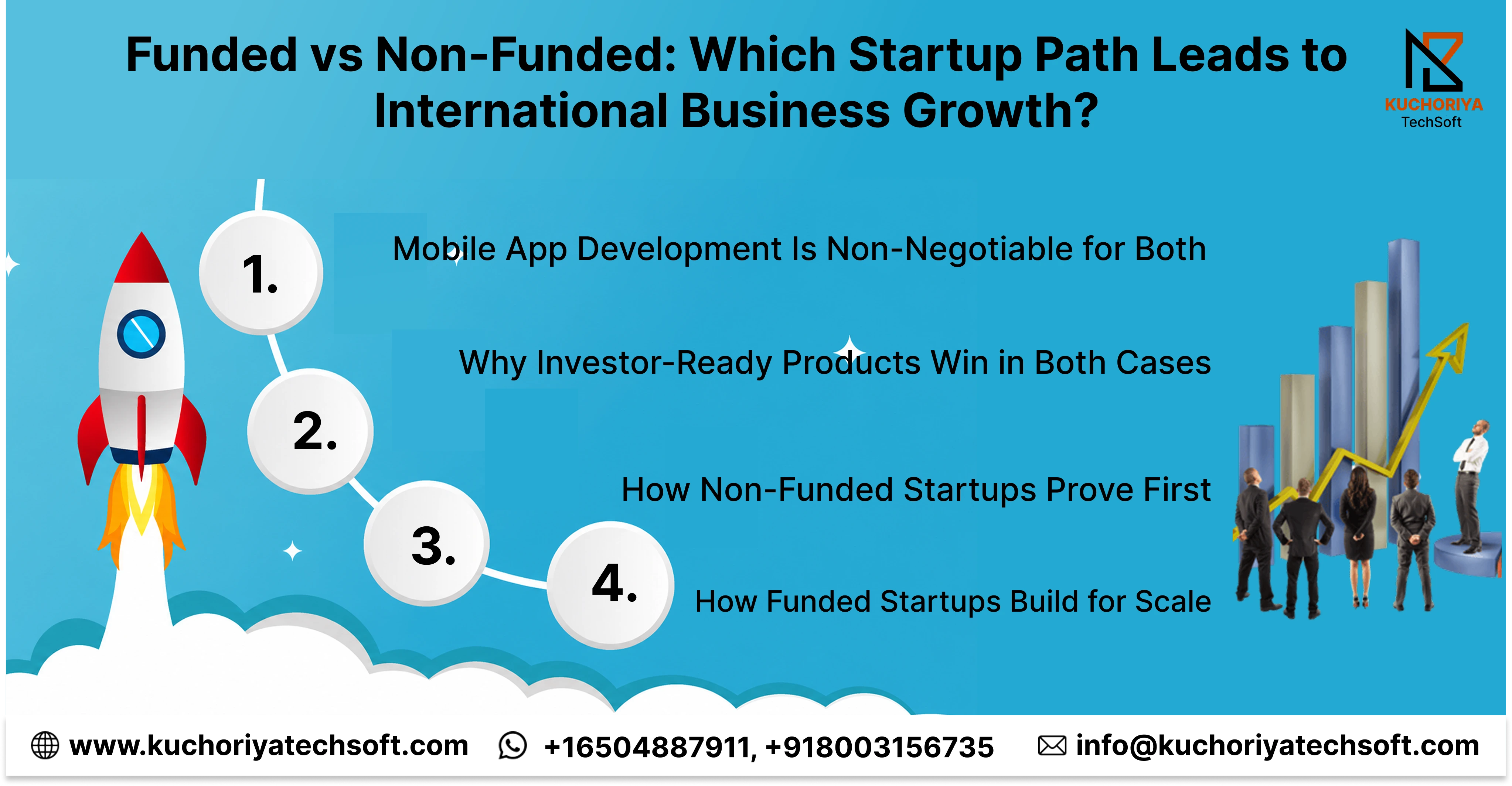
Not every startup begins with a war chest, and that is completely fine. What matters is knowing which path fits your current stage. Whether you have secured funding or are still bootstrapping, global business expansion is achievable, the route just looks different, the timeline shifts, and the priorities change at every turn.
1. How Funded Startups Build for Scale
Funded startups skip the guesswork. With capital locked in, they move straight into funded startup MVP development, building a market-ready product, assembling core teams, and mapping a clear startup scaling strategy before the first international customer is even approached.
2. How Non-Funded Startups Prove First
Bootstrapped founders cannot afford to build blind. A non-funded startup POC strategy means validating the core idea with minimal spend, creating just enough of a working product to prove demand and unlock the next funding conversation.
3. Why Investor-Ready Products Win in Both Cases
Funded or not, startup investor ready product development is what opens doors globally. Enterprise clients in international business growth UK markets, UAE, and Canada evaluate product maturity before any deal moves forward, a half-built MVP closes nothing.
4. Mobile App Development Is Non-Negotiable for Both
In 2026, mobile app development for startups is table stakes. Whether you are pitching investors or acquiring first users across global markets, a mobile-first product signals seriousness, and without it, no global business expansion strategy holds up.
Read Insights: MVP Mobile App Development Agency for Startups: Build, Validate & Launch Faster
How Virtual CTO Services Accelerate Digital Transformation for Startups and Enterprises
How Do Funded Startups Go from POC to MVP to Global Scale?
Funded startups have one real advantage: they can afford to build right the first time. But money without a clear phase-by-phase plan gets burned fast, and most funded founders figure that out somewhere between their first MVP demo and their first international client walking away.
1. POC: Test Before You Spend
Think of it like checking soil before laying a foundation. POC development for startups is a few weeks of honest validation, does this idea actually hold up outside a pitch deck? Does the target market in Canada or Singapore care enough to pay for it? You find that out here, not after six months of engineering.
2. MVP: Ship What Sells
The MVP is not your final product and it was never meant to be. MVP development services get the one thing that makes customers pay into their hands as fast as possible. A FinTech startup scaling strategy MVP might be just one transaction flow. A SaaS startup go-to-market strategy MVP might be a single dashboard, nothing more.
3. Phase 1: Break It Before the Market Does
Real users are brutal and that is exactly what Phase 1 is for. Controlled market exposure, hard feedback, and custom software development services that fix what theory missed and build what users are actually asking for.
4. Phase 2: Build for Many Markets, Not One
One validated market means nothing if the product collapses under a second. Phase 2 hardens infrastructure, adds compliance layers, and builds architecture that supports startup scaling strategy Canada, global market entry strategy Singapore, and every other market queued up on the roadmap.
5. Phase 3: Cross Borders with Proof
So far, there are real customers, real feedback and real market stress behind the product. Local partnerships are active, regulatory consolidation is taking place in the US with the help of the UK, and the foundations of time hold without reform whenever a new market is introduced to the list.
Can Non-Funded Startups Still Execute a Global Expansion Strategy?
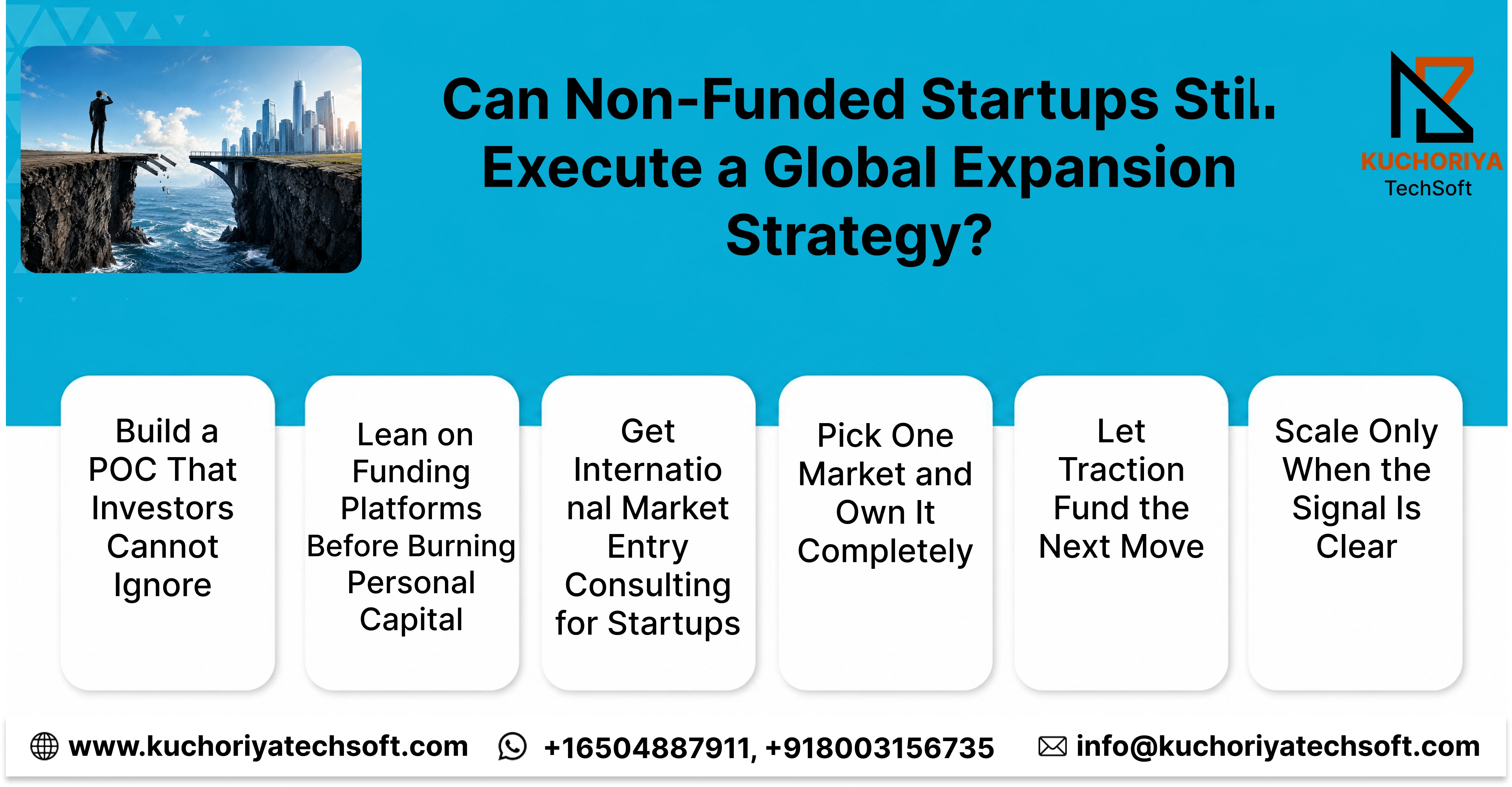
No funding does not mean no future. It means a different playbook. Non-funded founders who crack international business growth do one thing differently, they validate first, pitch smart, and let traction open the doors that capital usually buys.
1. Build a POC That Investors Cannot Ignore
Startup investor ready product development is not about building everything. It is about building the one thing that makes an investor say yes.
2. Lean on Funding Platforms Before Burning Personal Capital
Accelerators, angel networks, and grant programs exist for this exact stage. Know which ones are active in your target market before spending a rupee.
3. Get International Market Entry Consulting for Startups
Going global without guidance is expensive guesswork. The right consulting partner maps the market, the compliance needs, and the entry timing before you commit.
4. Pick One Market and Own It Completely
How to expand a startup internationally starts with one geography, one segment, one use case. EdTech international business growth in Singapore looks nothing like expense tracking solutions Canada, treat them differently.
5. Let Traction Fund the Next Move
Revenue, retention, and real users are the only currency that matters before funding. Build those numbers first and the capital conversation becomes much easier.
6. Scale Only When the Signal Is Clear
How startups can scale globally without funding comes down to patience. One validated market with strong numbers is worth more than five markets with zero proof.
Why Do Startups Fail at Cross-Border Expansion Without CTO as a Service?
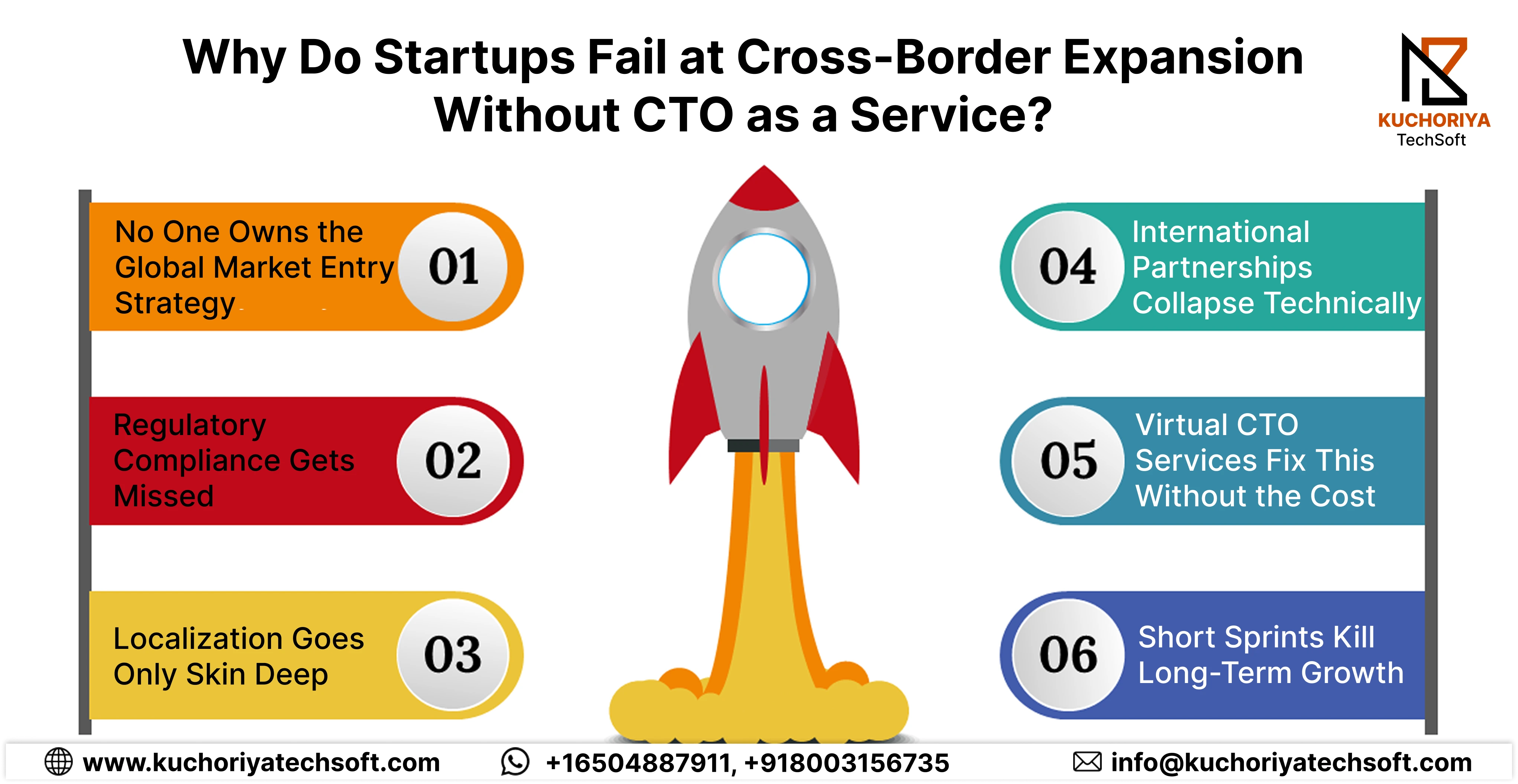
Most startups hit the same wall during cross-border expansion, not a bad product, not a weak market, but zero senior technology leadership guiding the move. A full-time CTO costs $150,000 to $300,000 annually. That budget does not exist at an early stage. And without that seat filled, every technical decision during international expansion becomes a liability.
1. No One Owns the Global Market Entry Strategy
Without CTO as a Service, the global market entry strategy stays theoretical. Nobody is deciding what gets built, in what order, and for which market first.
2. Regulatory Compliance Gets Missed
Every market has its own data laws and payment standards. Regulatory compliance failures do not slow growth, they get products pulled and partnerships killed.
3. Localization Goes Only Skin Deep
A real localization strategy covers payment methods, UX patterns, and legal requirements. Without technical leadership, most startups localize the surface and ignore everything underneath.
4. International Partnerships Collapse Technically
International partnerships need API integrations and compliance alignment. Remote CTO services handle the technical due diligence that keeps deals from falling apart after the handshake.
5. Virtual CTO Services Fix This Without the Cost
Virtual CTO services deliver senior technology leadership at a fraction of full-time cost, architecture, vendor selection, team management, and expansion roadmapping all covered.
6. Short Sprints Kill Long-Term Growth
Most dev companies deliver in 4 weeks and vanish. A long-term technology partner for startups stays through POC, MVP, Phase 1, 2, 3, and owns the technical strategy across every new market.

More Reads: Why Startups in Austin, TX Need Fractional and Virtual CTOs to Compete at the Enterprise Level
Top Car Rental App Development Solutions for Startups and Enterprises
Which Industries Are Winning with a Global Market Entry Strategy?
Not every industry travels well across borders. The ones winning at international market expansion have one thing in common, a digital-first product and a clear go-to-market strategy.
1. HealthTech and LegalTech
HealthTech startup global expansion is government-backed in UAE, Canada, and Australia. EMR system development budgets are serious. LegalTech, contract automation and compliance tooling, is becoming standard in UK, Singapore, and Canada.
2. Smart Mobility and LogisticsTech
City governments across Dubai, London, and Sydney are paying for car parking app development and urban solutions. LogisticsTech global startup growth is rebuilding supply chains, last-mile delivery and warehouse tech are on every enterprise shortlist.
3. FinTech, eCommerce and HRTech
Outdated banking rails across UAE and Southeast Asia are creating massive FinTech opportunity. eCommerce global market entry strategy is generating serious revenue across Middle East and Europe. HRTech startups built for multi-currency operations are scaling with minimal friction.
4. EdTech and PropTech
Skill-based learning platforms found their permanent audience post-2020. PropTech is closing enterprise deals across UAE, UK, and Australia that legacy software never touched.
5. AI and Automation
Enterprises across UAE, UK, Canada, and Singapore are cutting operational costs with AI-powered workflow tools and predictive analytics, and these products need almost no country-specific rebuilding to work across borders.
How Does Kuchoriya TechSoft Support Global and Local Business Expansion?
Most development companies build your product and leave. Kuchoriya TechSoft stays. That is the actual difference, not just in words but in how engagements are structured, how long partnerships run, and what gets delivered beyond the code.
1. Development Plus Establishment
Other companies handle development. Kuchoriya handles global and local business establishment for startups, market entry support, local compliance guidance, and the operational groundwork that most dev shops never touch.
2. Business Expansion Services Beyond Code
Business expansion services at Kuchoriya cover product strategy, market positioning, tech stack decisions, and growth consulting, everything a startup needs to move from one market to many without rebuilding from scratch.
3. Startup Business and Digital Transformation Consulting
Startup business consulting and digital transformation consulting sit inside every engagement. Founders get senior-level strategic input, not just sprint deliveries.
4. Building a Global Brand from Day One
Building a global brand for startups requires consistent product experience, localized marketing foundations, and the right technology infrastructure. Kuchoriya builds all three in parallel.
5. 12 Months, Not 4 Weeks
Where competitors close tickets in 4 weeks, Kuchoriya commits to 12-month partnerships. As a technology partner for startups, the goal is not delivery, it is growth, market expansion, and long-term global market expansion consulting that compounds over time.
From Local to Global: Final Thoughts on International Business Growth
Going global is a decision, not a milestone. The startups that crack cross-border expansion are rarely the best-funded, they are the most disciplined. They built for business scalability early, respected the phases, and found a partner who stayed beyond go-live.
Geography was never the real barrier. A bootstrapped founder in Tel Aviv, a seed-stage team in Bangalore, a two-person startup in Toronto, any of them can compete in Dubai, Singapore, or London when the international scaling plan runs on data, not optimism.
Revenue growth follows clarity. Validate, build in phases, expand when the numbers say so. That discipline is worth more than any funding round.
When startup growth consulting is what stands between your idea and your first international market, book a free consultation and build the roadmap properly.
Know founders navigating expansion? The Kuchoriya Referral Partner Program rewards you for connecting great startups with the right technology partner.

FAQs on Global Growth Strategy and Startup Scaling Strategy
Q. What is a global growth strategy for startups and why does it matter?
A. Founders who skip the strategy and jump straight into execution usually end up spending six months and serious money in a market that was never going to work for them. A global growth strategy for startups tells you which markets are worth entering, what stage your product needs to be at before you enter them, and what compliance and infrastructure decisions need to happen before the first dollar gets spent abroad.
Q. How to expand a startup internationally without a large budget?
A. The worst thing a cash-strapped startup can do is try five markets at once. Pick one geography, one customer type, one core problem, own that completely before anything else moves. International market entry consulting for startups exists specifically to help founders avoid that expensive spread-thin mistake. Accelerators and funding platforms can bridge the capital gap while the first market gets validated properly.
Q. When does a startup need a CTO as a Service?
A. The honest answer is before most founders realise they need one. Architecture choices, compliance requirements, vendor decisions, these are all getting made during the expansion phase whether a senior technical voice is in the room or not. Fractional CTO Service puts that expertise where it belongs without the startup committing to a full-time executive salary at a stage where every rupee or dollar still counts.
Q. What is a startup scaling strategy for global markets?
A. A startup scaling strategy follows a phased approach, POC, MVP, Phase 1, Phase 2, Phase 3. Each phase validates before the next one opens. Skipping phases is where most scaling attempts fall apart.
Q. Why choose a long-term technology partner for startups over a short-term agency?
A. A long-term technology partner for startups owns the product journey across every phase and every market. Short-term agencies deliver and disappear, and that gap shows up the moment the product needs to scale.