






Fantasy Sports App Development: What You Need to Know
Money is pouring into this space, and the numbers explain why. The global fantasy sports market sits at $42.37 billion in 2026, up from $37.28 billion just last year, with analysts putting it at $80.31 billion by 2031, a 13.66 percent CAGR (source). Behind those figures sits a wave of founders, gaming studios, and sports brands all racing into fantasy sports app development before the space gets any more crowded.
Mobile access has been the biggest driver. Fans no longer need a desktop, just a phone between innings or quarters, which has turned Fantasy Sports Platform Development into an ongoing effort rather than a one-time build.
Operators also want modular systems that can add a new sport, region, or contest type fast, without a full rebuild. This is where Fantasy Sports Software Development, Fantasy Sports Application Development, and Custom Fantasy Sports Development move past generic app templates, since real-time scoring, payouts, and compliance all add complexity a typical app never faces.
Together, smartphone growth, wider legal sports wagering, and rising fan engagement have shaped today's mature fantasy gaming ecosystem. The opportunity is still wide open, but the platforms winning right now are the ones built on solid infrastructure, not a leaderboard bolted onto a basic app.
_(1)_1789042225527.webp)
How Does a Fantasy Sports App Work?
Think of the IPL season, you're setting a lineup before the toss with a fixed budget of credits to spend across eleven players. Whoever scores well in the real match earns you points. That's the whole idea behind How Fantasy Sports Apps Work, and it plays out in a few clear steps:
- Team building – You draft a squad within a set credit or salary cap, usually balancing one or two expensive stars with cheaper picks to stay under budget.
- Contest entry – Once your team is set, you join a Fantasy Sports Contest, anything from a one-on-one matchup to a large pool with thousands of entries and prize money at stake.
- Match format choice – Daily Fantasy Sports contests run for a single game, so you're only committed for a few hours. A Fantasy League Platform works differently, where the same group manages trades and lineups across a full season.
- Live scoring – As the real match plays out, the app pulls in Player Performance Data, runs, wickets, goals, whatever the sport tracks, and converts it into points almost instantly.
- Standings and payouts – Once the match ends, the Sports Gaming Platform settles final rankings and distributes rewards based on where your team landed.
At scale, this all has to hold up when millions of users are refreshing scores during a single big match, which is really where the engineering behind a fantasy app gets tested.
Essential Features of a Fantasy Sports App
Every fantasy platform needs the same core building blocks, no matter the sport. Here's what actually goes into one.
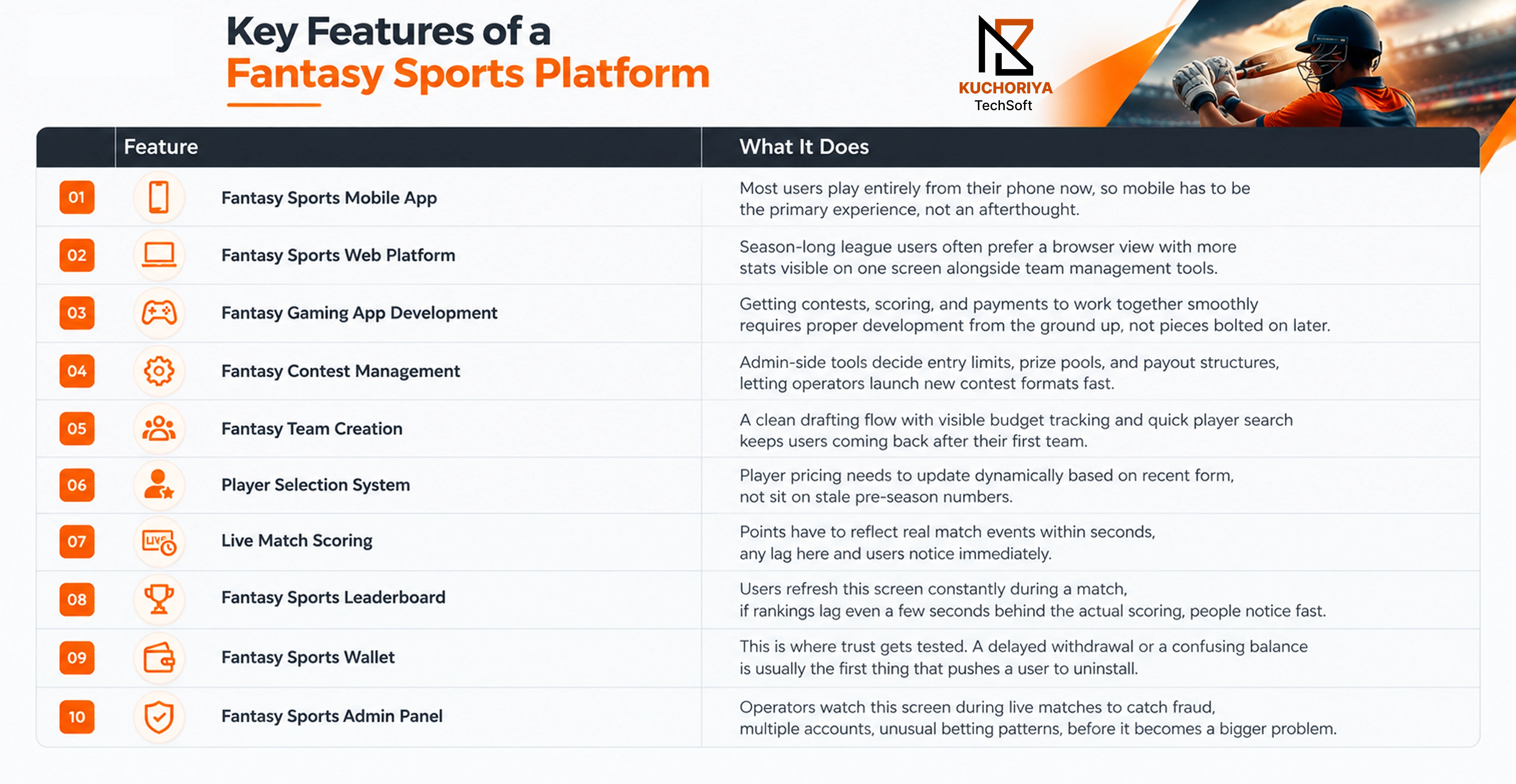
How to Build a Fantasy Sports App: Step-by-Step
Skipping a stage here usually shows up later as a bug during someone's biggest match of the season, so each one earns its place.
Step 1. Fantasy Sports Product Discovery
Starts with picking the sport, studying what competitors are missing, and locking down how the app actually makes money, entry fees, subscriptions, or ads.
Step 2. Fantasy Sports UI/UX Design
Goes hardest into the draft screen, since that's where users spend the most time and where a clunky flow makes people quit first.
Step 3. Fantasy Sports MVP Development
Ships just the essentials, team creation, one contest type, basic scoring, and lets real user behavior decide what gets built next instead of guessing.
Step 4. How to Build a Fantasy Sports App
The full build is where this actually plays out at scale, with sports data APIs, payment gateways, admin dashboards, and regional compliance all wired in together.
Step 5. Fantasy Sports App Testing
Simulates thousands of users refreshing scores at once, since that's the exact load that breaks weak infrastructure, not a quiet five-account staging test.
Step 6. Fantasy Sports App Deployment
Pushes everything to production at once, and for native apps, app store review can run longer than expected once real-money contests are involved.
Step 7. How to Develop a Fantasy Sports App
Post-launch is where doing this properly really shows budgeting time for bug fixes, seasonal features, and scaling infrastructure as the user base grows.

Technology Stack for Fantasy Sports App Development
None of this stack gets picked because it's trendy, it has to survive live scores and real money moving at once.
- Match data comes in through SportRadar or Genius Sports, payments run on Razorpay or Stripe, and OTPs plus push notifications usually go through Firebase or Twilio, all pieces of what falls under Fantasy Sports API Integration.
- That raw feed, runs, wickets, goals, isn't usable straight out of the box. A small Node.js or Go service typically cleans it up first, which is really what Sports Data API Integration comes down to before anything reaches the scoring engine.
- Polling adds delay a live scoreboard can't survive, so most teams skip it entirely and lean on WebSockets or Firebase Realtime Database for Live Sports Data Integration instead.
- Getting a point update on screen in under a second usually means Node.js or Go on the backend with Redis handling the fast math, this pairing is the core of the Real-Time Scoring Engine and honestly where user trust gets decided.
- Contests, wallets, and accounts sit on Node.js with Express, backed by either PostgreSQL or MongoDB depending on how the data's shaped, that's the backbone of Fantasy Sports Backend Development.
- The second a big match starts, traffic spikes hard, and auto-scaling plus load balancers on AWS, GCP, or Azure are what absorb it, this is Fantasy Sports Cloud Infrastructure doing its job.
- Microservices on the backend, React Native or Flutter covering both iOS and Android from a single codebase, together this is what most teams mean by Fantasy Sports App Architecture.
- Leaderboards updating the instant a wicket falls, no refresh needed, run on WebSockets or Firebase under the hood, this is Real-Time Fantasy Sports Architecture at work.
- Swapping data providers eighteen months in should be a config change, not a rebuild, and whether that's true comes down to how well Sports API Architecture was planned from day one.
- When millions check scores within the same five minutes, Docker containers orchestrated through Kubernetes are what keep things standing, this is Fantasy Sports Cloud Architecture.
AI and Emerging Technologies in Fantasy Sports

AI isn't just a buzzword bolted onto a fantasy app anymore, it's what decides whether a user sees a smart suggestion or scrolls past a generic stat.
1. AI-Powered Fantasy Sports Platform
The entire app runs smarter when machine learning sits underneath contest matching, pricing, and recommendations instead of static rules, usually built with something like TensorFlow or AWS SageMaker feeding models trained on years of match data.
2. AI Sports Analytics
Player form, pitch conditions, head-to-head history, all of it gets crunched to surface patterns a casual user would never spot on their own, turning raw stats into something closer to actual insight.
3. Fantasy Sports Prediction Engine
Focused specifically on points, this forecasts how many fantasy points a player is likely to score in the upcoming match, giving users a number to plan their pick around before the toss even happens.
4. AI-Based Team Recommendations
Based on a user's past picks and current form data, the app can nudge toward a captain choice or a budget pick they might've missed, without taking the decision out of their hands entirely.
5. Predictive Sports Analytics
This sits a level above single-player predictions, looking at broader match outcomes, likely top scorers across both teams, weather impact on a pitch, or how a venue historically favors batters or bowlers.
6. AI Fantasy Team Builder
For users who want speed over control, this auto-generates a full team within budget constraints in seconds, still editable afterward, and useful for daily contests where time before the toss is tight.
Must Read: Top Fantasy Sports App Development Company
How to Build Engaging Fantasy Sports Platforms
Fantasy Sports App Security and Compliance
None of this is optional once real money enters the picture, one weak link here and users stop trusting the app fast.
Fantasy Sports App Security
Covers everything from encrypted API calls to session handling, the kind of groundwork that stops most casual attack attempts before they even get close.
Fantasy Sports Data Security
User details, payment info, match history, all of it needs encryption at rest and in transit, since a single breach here does more damage than any bug ever could.
Fantasy Sports Fraud Prevention
Catches the stuff like multiple accounts run by one person or bots grinding through contests, usually through pattern detection watching for behavior that doesn't look like a normal user.
Fantasy Sports KYC Integration
Before anyone withdraws winnings, identity verification kicks in, PAN and Aadhaar checks in India, similar document checks elsewhere, mostly to keep the platform on the right side of local gaming laws.
Fantasy Sports Compliance
Every region has its own rules on real-money gaming, some states or countries restrict it outright, so this is the ongoing work of keeping the app legal wherever it operates, not a one-time checklist.
How to Choose a Fantasy Sports App Development Company
_1789040260763.webp)
Picking who builds this matters more than most founders expect, since a lot of what breaks later traces back to a decision made in week one.
Ask to see actual live-scoring work they've shipped before, not just a portfolio slide, since handling real-time data under load is a different skill than building a standard app.
Top Fantasy Sports App Development Company
Look past the pitch deck and check how long they've been building specifically for real-money gaming, since compliance and payment handling aren't things a team picks up mid-project.
Fantasy Sports Development Company
Team size matters less than whether they've handled a full launch cycle before, discovery through post-launch support, rather than just the build phase.
Custom Fantasy Sports App Development Company
If the plan involves a sport or contest format outside the usual cricket or football templates, confirm early they can actually build custom logic instead of stretching an existing template to fit.
Fantasy Sports App Development Services
Check what's actually included, some teams stop at deployment, others stay on for testing, scaling, and updates, and that gap changes the real cost significantly.
Fantasy Sports Technology Partner
The right partner pushes back on bad ideas instead of just building whatever's asked, that pushback usually saves more time than it costs.
Fantasy Sports Development Agency
Pricing models vary a lot here, fixed-cost versus time-and-materials, and it's worth getting clear on that upfront since fantasy app scope tends to shift as testing reveals what the load actually looks like.
Fantasy Sports App Development Timeline
Timelines shift a lot depending on scope, but there's a rough shape most builds follow, and where you're hiring from changes the numbers more than people expect.
- Knowing how to launch a fantasy sports platform on schedule starts with locking scope early, most delays trace back to features added mid-build, not the actual coding taking longer than planned.
- A typical Fantasy Sports Platform Launch runs three to six months for an MVP, stretching past that once payment compliance and multi-region testing get added in.
- Teams going with Fantasy Sports App Development USA usually pay the highest hourly rates, but timezone overlap with US-based product owners tends to speed up review cycles.
- Fantasy Sports App Development Australia often runs on rates close to the US, though the smaller talent pool can mean longer hiring lead time before the build even starts.
- Fantasy Sports App Development Israel taps into a strong concentration of fintech and security-focused engineers, useful specifically for the payment and fraud-prevention pieces.
- Fantasy Sports App Development UAE timelines often factor in extra runway for regional gaming compliance, since real-money contest rules vary sharply across Gulf countries.
- Fantasy Sports App Development Canada offers a middle ground on cost with a talent pool that overlaps heavily with US time zones, keeping standups and reviews practical.
- Fantasy Sports App Development Singapore works well as a base for teams targeting Southeast Asian markets, where fantasy interest is growing fast around cricket and football both.
- Fantasy Sports App Development Brazil has become a common outsourcing hub for LATAM-facing apps, generally at a lower cost than US or Western European rates.
- Fantasy Sports App Development Mexico's overlapping time zones with the US make it a practical nearshore option without the premium US price tag.
- Fantasy Sports App Development Spain serves as an entry point for teams building toward the broader European market, where gambling and gaming regulations differ by country.
- Fantasy Sports App Development Hong Kong tends to suit apps planning an APAC rollout, though local gaming law here is stricter than in most neighboring markets.
Related Insights: Hire Expert Fantasy Sports App Developers to Build Your Platform Today
Fantasy Sports App Promotion: Best Strategy to Market & Attract Millions in 2026
Key Takeaways for Building a Successful Fantasy Sports App
Is your app built to make money or just to look good in a demo? That's the real question after everything above.
Get the Fantasy Sports Business Model locked early, entry fees, subscriptions, ads, most apps blend two or three rather than betting on one.
A strong fantasy sports revenue model leans on more than new user spend. A referral partner program rewarding users for bringing friends in usually beats paid ads on cost per signup.
Fantasy Cricket app development still leads across South Asia. Fantasy Football App Development fits Europe, Latin America, and Africa best. Fantasy basketball app development works well for North America and parts of Asia. Planning beyond one sport from day one, multi-sport fantasy app development costs more now but saves a rebuild later.
None of this works without the right team. An associate partner program with agencies and resellers often drives more sustainable growth than a marketing push alone. Got a fantasy sports app idea in mind? Contact us and let's talk through what actually fits your market.
_1789040260498.webp)
FAQs About Fantasy Sports App Development
Q. What is a fantasy sports app?
A. Users pick a virtual team made up of real players from an upcoming match, and however those players perform in the actual game is what decides the points. No randomness involved, it's tied directly to real stats, runs, goals, assists, whatever the sport counts.
Q. How does live scoring work in fantasy sports apps?
A. Data comes in from sports providers the moment something happens on the field, and a scoring engine converts it into points within seconds. A wicket falls or a goal goes in, and the leaderboard shifts almost instantly, nobody's sitting there hitting refresh.
Q. How do you choose a fantasy sports app development company?
A. Skip the sales pitch and ask for actual products they've shipped, ideally real-money gaming apps specifically. Payment compliance, fraud checks, live scoring under load, these aren't things a general app team figures out on the fly mid-project.
Q. How long does it take to build a fantasy sports app?
A. A basic MVP runs three to six months, just team creation, one contest type, and core scoring. Add AI recommendations, multiple sports, and full compliance across regions, and that stretches to eight or twelve months pretty easily.
Q. How much does it cost to develop a fantasy sports app?
A. Depends a lot on where the team's based and how many features are in scope. A lean MVP can start in the tens of thousands, but a full platform with AI features and multi-region compliance pushes well past that.
Q. Are fantasy sports apps legal?
A. Varies region by region. Plenty of places classify fantasy sports as a game of skill and allow real-money play, others ban it outright, so compliance ends up being a separate piece of work for every market the app enters.