What Are AI Agents in Software Development?
For years, developers treated AI like a smart search bar. Type a problem, get a suggestion, copy what works, move on. That version of AI is already outdated.
AI agents in software development are autonomous systems powered by large language models and machine learning that take a goal, break it into steps, write code, run tests, catch errors, and loop back until the task is complete. No hand-holding. No approval at every turn.
An AI agent running on a modern AI agent development platform handles that entire chain itself, reads the requirement, writes the code, runs the test, spots the error, and fixes it without waiting for a go-ahead. The average agent session now autonomously covers 47 tool calls. According to the Stack Overflow Developer Survey 2026, 71% of developers use an AI coding assistant tool daily, saving 9.4 hours per week. Not a helper. A full executor.
Why AI Agents Are Transforming Software Development in 2026
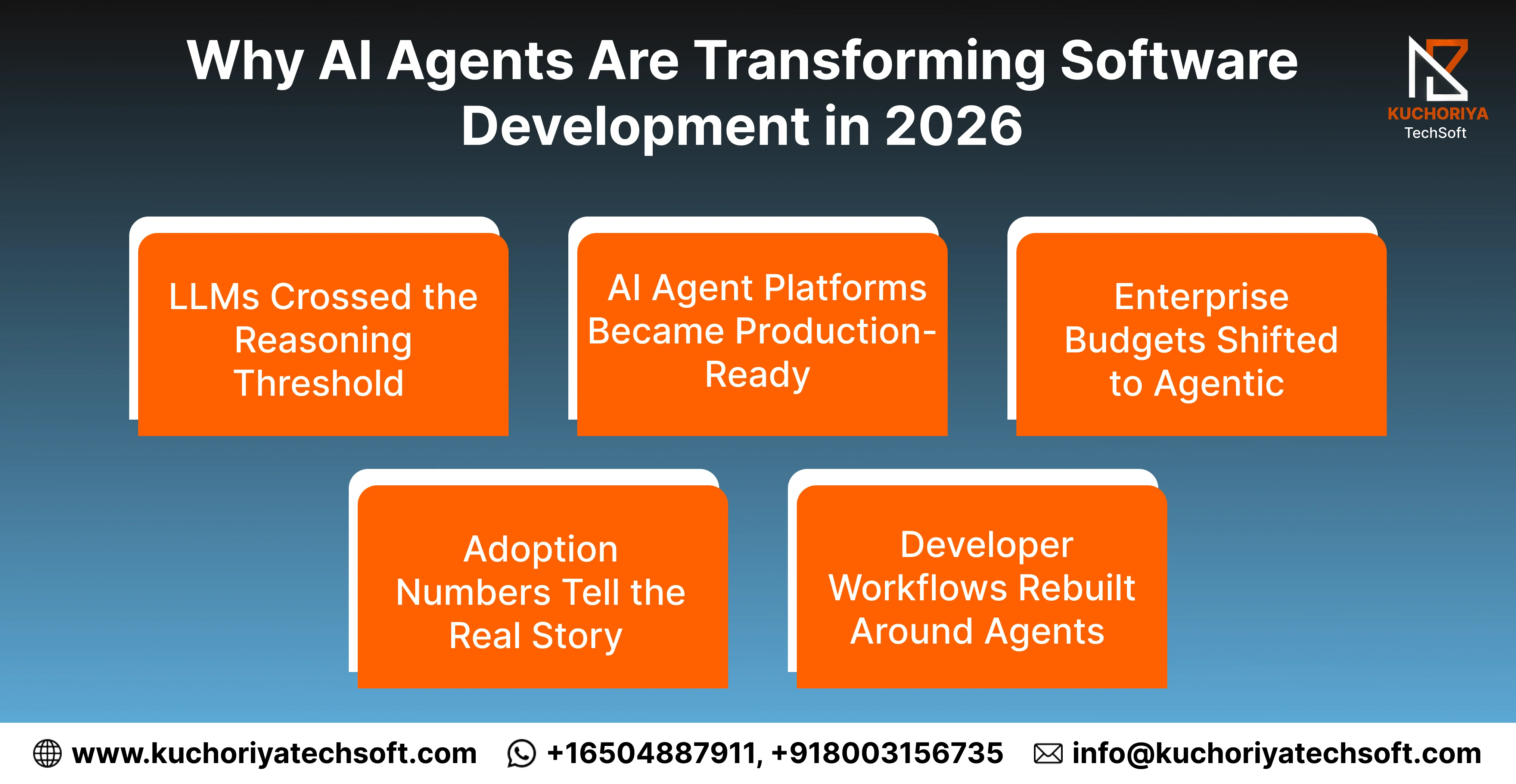
The shift is not gradual; it is structural. Here is what actually changed in 2026 and why development teams cannot afford to ignore it.
1. LLMs Crossed the Reasoning Threshold
Large language model development reached a point where models stopped completing lines and started completing goals, breaking tasks, making decisions, and iterating without human input at every step.
2. AI Agent Platforms Became Production-Ready
Early AI agent development platforms were fragile prototypes. In 2026, they are stable, scalable, and embedded directly into enterprise DevOps automation pipelines.
3. Enterprise Budgets Shifted to Agentic
AI Gartner reports enterprise automation solutions spending on agentic AI hitting $201.9 billion in 2026, a 141% increase from 2025. Pilots became programs.
4. Adoption Numbers Tell the Real Story
The global AI agents market is projected to be $11.78 billion in 2026 with a 46.61% CAGR. By year-end, 40% of business applications will include task-specific intelligent automation systems, up from less than 5% in 2025.
5. Developer Workflows Rebuilt Around Agents
71% of developers now use AI-driven software engineering tools daily. The average time saved per engineer is 9.4 hours every week. That is not a productivity gain. That is a different way of working.
Key Capabilities of AI Agents in Modern Software Engineering
AI agents do not just write code. They bring a connected set of capabilities that cover the full scope of AI-powered development workflows. Here is what makes them fundamentally different from any tool that came before.
1. Autonomous Code Generation and Debugging
Modern AI coding assistant tools do not wait for a prompt on every line. They generate entire modules, detect what breaks, trace the root cause, and fix it within the same session, without a developer stepping in.
2. Intelligent Task Planning and Execution
Give an agent a goal and it figures out the rest. Autonomous decision-making tools built into modern agents break work into subtasks, sequence them, pick the right resources, and move through each step without waiting to be told what comes next.
3. Multi-File and Cross-Codebase Editing
By Q1 2026, 78% of agent sessions involved coordinated edits across multiple files, up from 34% in Q1 2025. One instruction now triggers changes across imports, test files, and configs simultaneously through AI-driven software engineering platforms.
4. Continuous Testing and Quality Checks
Every code change gets tested on the spot. Agents running inside AI automation solutions catch regressions before they stack up, document what passed, and surface only the decisions that actually need a developer in the loop.
5. Natural Language to Working Code
Through AI-powered application development pipelines, teams can describe a feature in plain language and receive tested, documented, deployable code. No translation layer needed between idea and execution.

How AI Agents Are Revolutionizing the Software Development Lifecycle
Every stage of the development lifecycle looks different when AI-powered development workflows are running underneath it. Not faster versions of the same steps. Different steps entirely.
1. AI-Powered Requirements to Roadmap Planning
What used to take days of back and forth between product and engineering now takes a single structured prompt. Agents convert raw requirements into mapped user stories, sprint tasks, and dependency lists automatically inside AI consulting services workflows.
2. AI-Driven Code Generation and Self-Review
Developers on AI software development solutions are no longer the first reviewers. The agent generates the code, checks it against the existing codebase, catches what does not fit, and suggests cleaner alternatives before any human opens the pull request.
3. Intelligent Automation in Software Testing Cycles
QA used to sit at the end of the pipeline and slow everything down. With intelligent automation systems, regression tests, edge cases, and bug documentation run alongside development in real time. Nothing waits.
4. DevOps Automation and Deployment Risk Management
Before a build reaches production, agents inside DevOps automation pipelines run vulnerability scans, validate the build, and test across environments back to back. Teams are shipping faster with far fewer rollbacks.
5. Adaptive AI Systems for Post-Launch Monitoring
Most teams find out something broke when a user reports it. With adaptive AI systems watching live performance, anomalies surface early, the problem traces back to the exact commit, and in mature setups, the fix goes out before anyone files a ticket.
Top Benefits of AI Agents for Software Development Teams
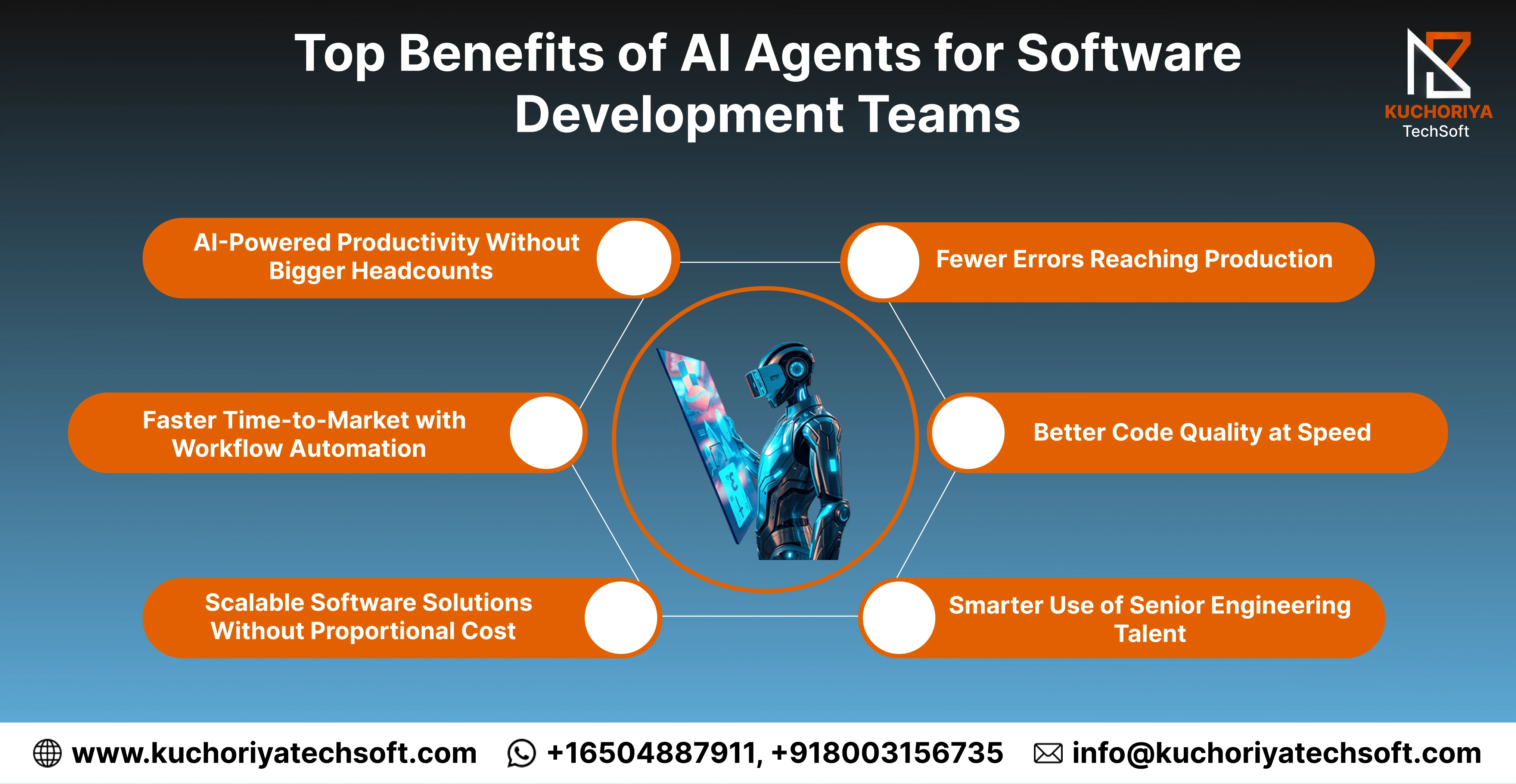
Teams past the pilot stage are seeing results that go beyond speed. Here is what actually shifts when AI development services become part of daily operations.
1. AI-Powered Productivity Without Bigger Headcounts
More output no longer means more people. AI-powered productivity tools absorb the repetitive side of development so the same team delivers what previously needed a much larger headcount.
2. Faster Time-to-Market with Workflow Automation
Two-week sprints are compressing fast. Testing, debugging, and deployment prep run as continuous background activity through workflow automation services, cutting release timelines without cutting corners.
3. Scalable Software Solutions Without Proportional Cost
Bigger projects no longer mean proportional hiring spikes. Teams on scalable software solutions stretch existing capacity further without the usual cost curve catching up.
4. Fewer Errors Reaching Production
Bugs caught early cost a fraction of what they cost post-deployment. Intelligent process automation intercepts issues at the point they are introduced, not three sprints later.
5. Better Code Quality at Speed
Standards slip when teams move fast. AI-powered application development keeps patterns consistent, flags technical debt as it forms, and handles documentation automatically.
6. Smarter Use of Senior Engineering Talent
Experienced developers stop burning hours on routine fixes. Intelligent enterprise applications handle predictable workloads so human judgment gets reserved for architecture and product decisions that actually need it.
Real-World AI Agent Use Cases in Software Development
The most convincing proof is not market data. It is what engineering teams are actually doing with AI agent development platforms right now.
1. Automated Code Reviews at Scale
Pull requests used to pile up waiting for a senior developer's bandwidth. Now, AI-powered development tools check every commit against coding standards, security gaps, and performance issues the moment it lands. The senior developer steps in to decide, not to discover.
2. AI Chatbot Development for Internal Dev Tools
Engineering teams are building AI chatbot development layers on top of their internal documentation, codebases, and ticketing systems. Developers ask questions in plain language and get accurate, context-aware answers pulled from live company data.
3. Generative AI Development for Rapid Prototyping
Product teams are using generative AI development solutions to go from a written brief to a working prototype in a single session. What used to need a full sprint now comes back as a testable build the same afternoon.
4. ML Development for Predictive Bug Detection
Teams integrating ML development services into their pipelines are catching bug patterns before they surface as actual failures. The model learns from historical incidents and flags code that matches those patterns at commit time.
5. NLP Development for Requirements Processing
Stakeholder notes are messy, contradictory, and full of gaps. NLP development services process that raw input, pull out what is actually being asked for, and hand back structured user stories that are ready to build from without a manual rewrite in between.
Industries Adopting AI-Powered Software Development Solutions
AI agents are not sitting inside tech companies alone. Across completely different sectors, the way software gets built has started looking very different. Here is where AI-powered software development is already in play.
1. Healthcare AI Solutions
Patient data systems, diagnostic tools, and appointment platforms in healthcare used to need constant IT intervention to stay updated. Teams building healthcare AI solutions now ship systems that catch their own errors and update without a maintenance cycle in between.
2. Fintech AI Development
Fraud detection and credit scoring models in banking go stale fast when markets shift. Fintech AI development teams are building engines that retrain on live transaction data instead of waiting for a scheduled update from an engineering team.
3. Ecommerce AI Solutions
Inventory systems and recommendation engines on retail platforms break down the moment buying behavior shifts. Developers building e-commerce AI solutions are shipping tools that read live purchase patterns and adjust without redeployment.
4. Logistics Automation Solutions
Route planning and warehouse coordination in freight used to require constant human oversight to stay accurate. Logistics automation solutions built on agentic workflows handle route adjustments, delay flags, and dispatch updates without a coordinator in the loop for every decision.
5. Real Estate AI Software
Lead scoring, listing management, and document processing in property tech have always been labor-heavy. Teams shipping real estate AI software are cutting that manual layer out entirely and letting agents handle the repetitive processing underneath.
6. Manufacturing AI Solutions
Production lines generate more data than any team can manually monitor. Manufacturing AI solutions watch that data in real time, spot patterns that precede equipment failure, and raise flags before the line goes down.
Leading AI Agent Development Tools and Platforms in 2026
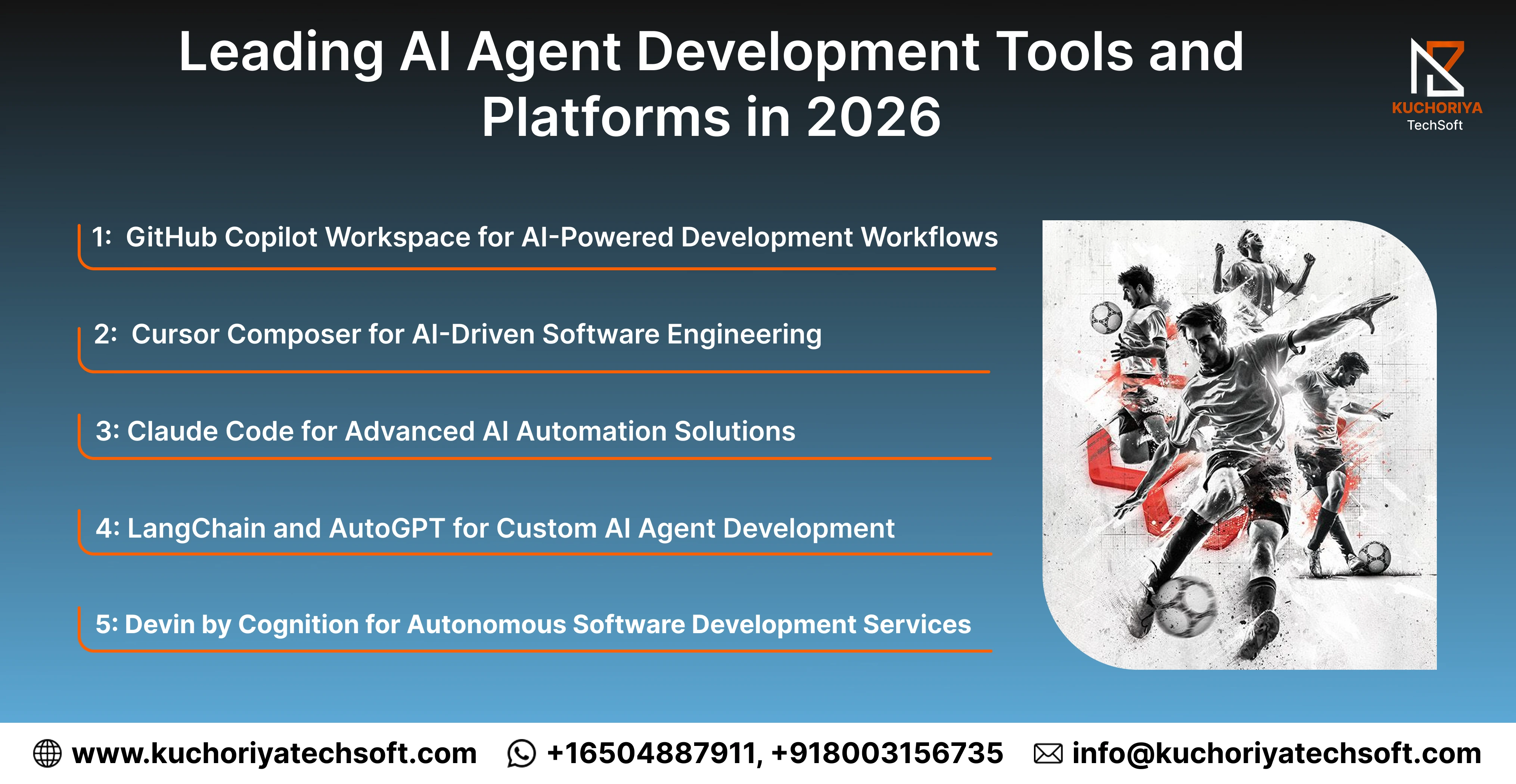
Knowing what tools are actually being used matters as much as knowing why agents work. Here is what engineering teams are building on top of in 2026.
1. GitHub Copilot Workspace for AI-Powered Development Workflows
No longer just an autocomplete tool. Copilot Workspace handles full task execution from issue to pull request, making it one of the most widely adopted AI coding assistant tools inside enterprise development teams.
2. Cursor Composer for AI-Driven Software Engineering
Cursor moved from single-file edits to full codebase coordination. Teams use it for multi-file refactors, test generation, and documentation updates inside a single session across AI-driven software engineering operations.
3. Claude Code for Advanced AI Automation Solutions
Built for agentic coding from the ground up. Claude Code handles long-horizon tasks, reads large codebases in context, and sits at the core of teams running serious AI automation solutions at scale.
4. LangChain and AutoGPT for Custom AI Agent Development
For teams building their own pipelines, LangChain and AutoGPT provide the scaffolding. Most custom AI agent development stacks in production today have these frameworks somewhere underneath.
5. Devin by Cognition for Autonomous Software Development Services
The first tool marketed as a fully autonomous software engineer. Devin takes a task, researches solutions, writes and tests code, and delivers working output across autonomous software development services handling high-volume build work.
Challenges of Implementing AI Agents in Enterprise Software Development
Adoption is accelerating, but it is not frictionless. Teams moving AI agents into enterprise software development are running into real blockers that do not show up in vendor demos.
1. Security Risks in AI-Powered Application Development
Agents with write access to codebases and deployment pipelines create attack surfaces that traditional security models were not built for. AI-powered application development teams are having to rethink access controls, audit trails, and permission scopes from scratch.
- Agents can push code, trigger builds, and access sensitive configs
- Existing security frameworks were not designed for autonomous actors
- Every action needs a traceable, reviewable log
2. Integration Gaps in Enterprise Automation Solutions
Most enterprise stacks were not built with agents in mind. Connecting enterprise automation solutions to legacy systems, internal APIs, and proprietary tooling takes significant custom engineering work before anything runs reliably.
- Legacy systems lack the APIs agents need to operate
- Custom connectors add time and maintenance overhead
- Integration failures break entire automated workflows
3. Output Quality Control in AI Software Development
Agents produce output fast but not always accurately. Teams relying on AI software development workflows without proper review gates are shipping code that passes automated checks but fails in production edge cases.
- Speed creates pressure to skip human review layers
- Agents confidently produce plausible but incorrect solutions
- Quality gates need rebuilding around agentic output specifically
4. Skill Gaps Slowing AI Development Services Adoption
Most engineering teams know how to use tools. Far fewer know how to design, supervise, and debug agentic systems. AI development services adoption stalls when the team managing the agents does not fully understand how they make decisions.
- Prompt engineering and agent orchestration are still niche skills
- Training programs have not caught up with tooling yet
- Mismanaged agents create more work than they remove
What to Look for in an AI Agent Development Company
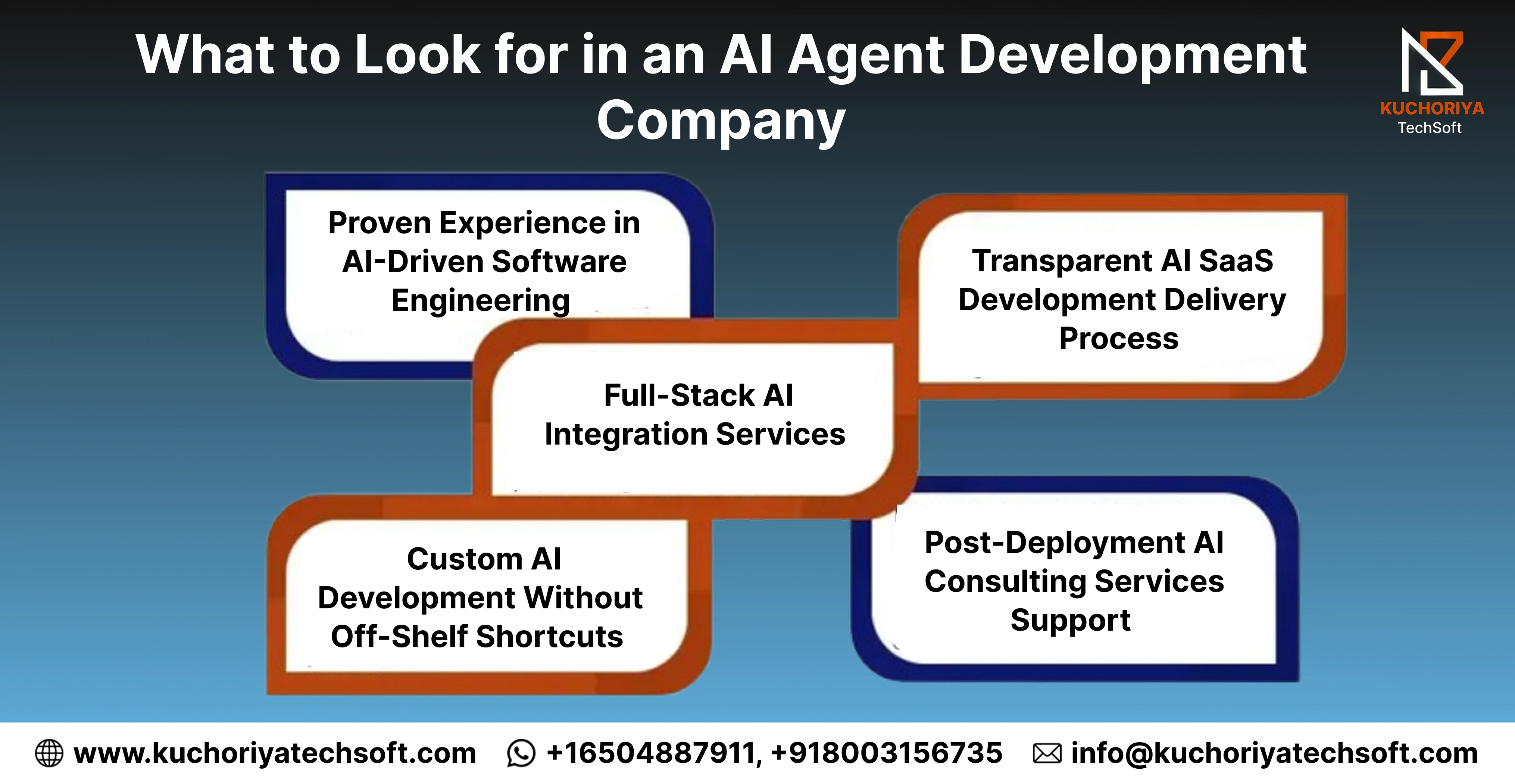
Picking the wrong partner is expensive. The AI agent development company market is crowded and most vendors are repackaging general software services with an AI label. Here is what actually separates a serious partner from a rebranded one.
1. Proven Experience in AI-Driven Software Engineering
Capability decks are easy to produce. Ask what they actually shipped, what went wrong, and how they handled it. A real AI-driven software engineering partner has answers. A rebranded one has slides.
- Verifiable project history not just logos on a website
- Outcomes measured, not just features delivered
- Client references provided without being chased
2. Full-Stack AI Integration Services
Agents do not run in a vacuum. The right AI integration services partner knows how to plug agentic systems into your existing stack, legacy tools, and security layers without a full rebuild.
- Hands-on experience with enterprise environments
- Custom connectors for proprietary internal systems
- Clean documentation handed over after deployment
3. Custom AI Development Without Off-Shelf Shortcuts
Most agent frameworks are built for demos, not production. A serious custom AI development company builds around how your team actually works, not around what their existing template supports.
- Workflow-specific architecture, not recycled blueprints
- Every design decision comes with a reason behind it
- Room to adapt as requirements shift post-launch
4. Transparent AI SaaS Development Delivery Process
Vague timelines and black-box development create problems that surface after go-live. A reliable AI SaaS development partner keeps milestones visible, shares progress regularly, and flags blockers before they become delays.
- Clear sprint structure with defined checkpoints
- Regular updates without having to ask for them
- Honest about scope changes and their impact
5. Post-Deployment AI Consulting Services Support
The build is not the finish line. AI consulting services that disappear after launch leave teams running systems they barely understand. The right partner stays involved through monitoring, iteration, and team enablement.
- Defined support structure from day one
- Performance reviews are not scheduled reactively
- Upskilling is built into the engagement, not sold separately
How AI Agents Are Shaping the Future of Software Development
The teams winning right now are not the ones with the biggest engineering departments. They are the ones who figured out earlier than everyone else that AI-powered digital transformation changes what a development team actually looks like.
Agents handling code generation, testing, deployment, and monitoring are not a future scenario. They are a 2026 production reality. The gap between teams running advanced automation technologies and teams still debating whether to adopt them is already wide enough to matter commercially.
For businesses still evaluating, the question is no longer whether AI engineering services belong in the development stack. It is how much ground has already been lost by waiting. The companies that move now are not taking a risk. They are closing one.
Kuchoriya TechSoft builds production-grade AI-driven digital products for companies that need more than a demo. Contact us today and see what is actually possible for your stack. And if you know other businesses ready to make this move, explore our Referral Partner Program and grow together.
FAQs About AI Agents in Software Development
Q. What is the difference between an AI coding assistant and an AI agent in software development?
A. One answers when asked. The other gets handed a problem and does not stop until it is solved. An agent writes the code, runs it, reads what broke, and keeps going without someone steering every step.
Q. How are AI agents used in enterprise software development?
A. The entry point for most enterprise AI solutions is the unglamorous stuff – code checks, test runs, deployment validation, bug tracing. That is where the time savings show up first and where teams build confidence before expanding scope.
Q. Which industries are seeing the most impact from AI-powered software development?
A. Healthcare, fintech, ecommerce, logistics, real estate, and manufacturing are leading. What they have in common is not the industry – it is the volume of technical maintenance work that was eating engineering hours before agents took it over.
Q. How long does it take to implement AI agents into an existing development workflow?
A. Modern stacks with clean APIs get AI integration services running in weeks. Older environments with patched-together tooling and no documentation take two to four months, sometimes longer if nobody knows how the legacy system actually works.
Q. What should a business look for when hiring an AI agent development company?
A. Ask about a project that went sideways and what they did about it. A credible AI agent development company has that story ready. One that does not is either too new or not being straight with you.
Q. Is AI-driven software development suitable for small and mid-sized businesses?
A. Two years ago the honest answer was maybe. Today smaller teams are running AI-driven software engineering tools that used to require enterprise infrastructure and getting real output without the matching price tag.