In a market where speed, accuracy, and control define success, inventory management is no longer just an operational task—it’s a strategic advantage. A well-built custom inventory management system helps businesses automate stock tracking, reduce manual errors, and gain real-time visibility across the supply chain. But before moving forward, a critical question for decision-makers arises: what does it really cost to develop inventory management software?
Modern inventory management software goes far beyond counting stock. The right software for inventory management enables workflow automation, demand forecasting, and smarter decision-making through live data insights. Whether a startup explores free inventory management software for early operations or an enterprise invests in the best inventory management software with advanced features, understanding cost implications is essential. With countless softwares for inventory management available, choosing the right solution starts with knowing what you’re paying for.
At Kuchoriya TechSoft, we help businesses plan inventory software investments with clarity and confidence. From core inventory system development and third-party integrations to advanced analytics, scalability, and long-term support, this guide breaks down every factor influencing inventory software development cost. The goal is simple—build a powerful, scalable inventory management solution that delivers measurable ROI and supports long-term growth.
Inventory Management Software Development Cost Overview
The cost of inventory management software development can differ significantly based on system functionality, scalability requirements, and the overall development strategy. Businesses investing in custom inventory management software should evaluate not just upfront pricing, but also long-term operational value.
Based on real-world project analysis by Kuchoriya TechSoft, inventory software development costs typically fall into the following ranges:
The final inventory software development cost is influenced by customization depth, feature complexity, real-time data requirements, and third-party integrations. Businesses seeking scalable, future-ready solutions should factor these elements into their budgeting strategy to ensure long-term efficiency and ROI.
Key Factors Influencing Inventory Management Software Development Cost
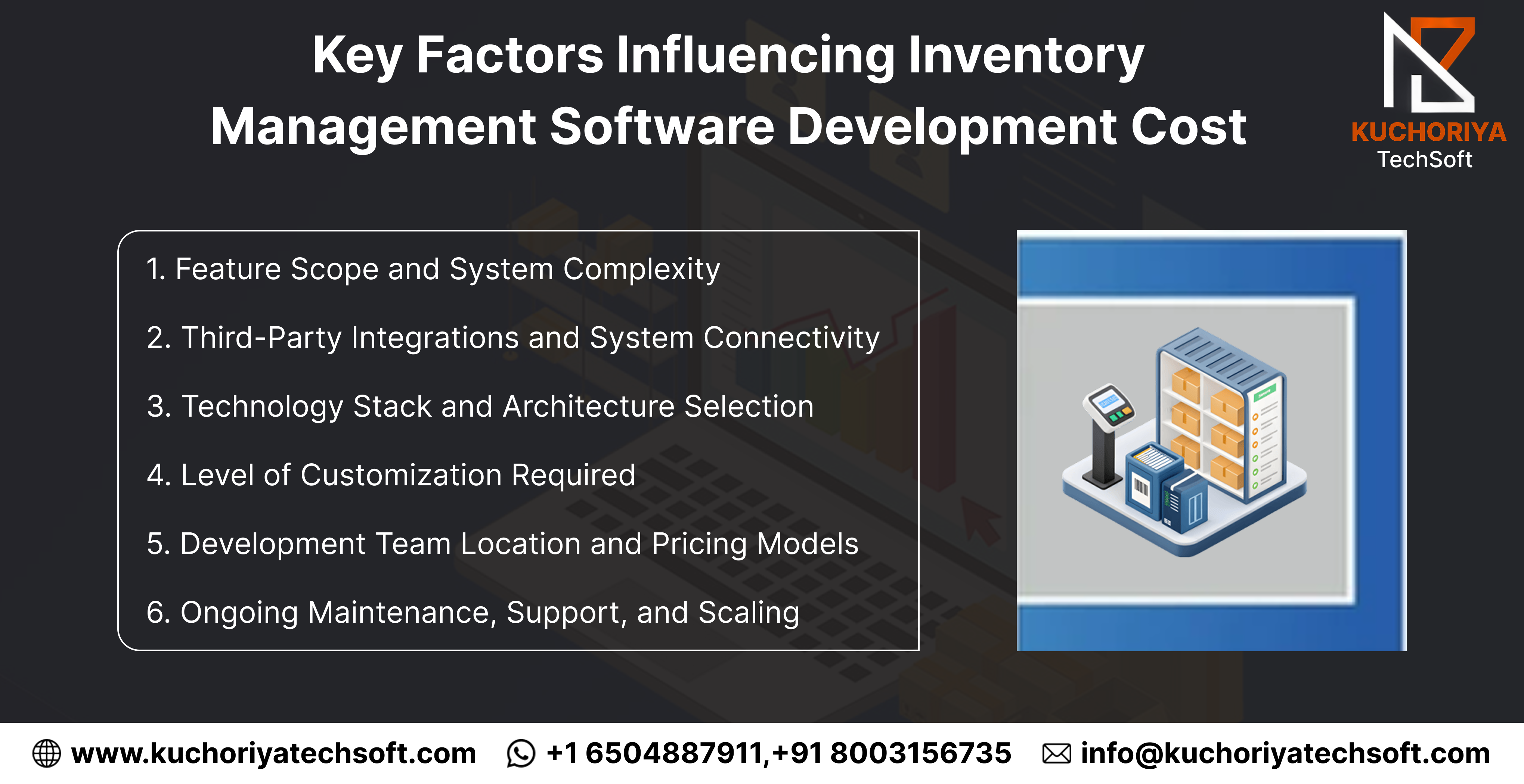
The total inventory management software development cost depends on multiple technical and business factors. Understanding these cost drivers helps organizations plan smarter investments and avoid unexpected expenses during custom inventory software development.
1. Feature Scope and System Complexity
The functionality you include has the biggest impact on cost. A basic inventory tracking system with stock reports and alerts may stay under a lower budget, while advanced capabilities significantly increase development effort.
Features such as AI-powered demand forecasting, multi-warehouse inventory management, real-time inventory analytics, barcode and RFID scanning, payment gateway integration, and automated reorder systems can raise costs substantially based on logic depth and data processing needs.
2. Third-Party Integrations and System Connectivity
Modern inventory management systems rarely work in isolation. Integration with ERP software, CRM platforms, accounting systems, eCommerce platforms, and supply chain management software increases development cost due to API design, testing, and data synchronization requirements. The more systems connected, the higher the inventory software integration cost.
3. Technology Stack and Architecture Selection
Choosing a scalable technology stack directly affects pricing. Using modern frameworks, cloud infrastructure, and microservices architecture increases upfront cost but delivers better performance, flexibility, and long-term ROI.
Businesses investing in cloud-based inventory management software benefit from scalability, security, and faster updates, making this a cost-effective choice over time.
4. Level of Customization Required
Off-the-shelf tools cost less but limit flexibility. In contrast, custom inventory management software solutions tailored to specific workflows require more development time, UI/UX planning, and quality assurance.
Industries such as retail, manufacturing, logistics, warehouse management, healthcare, and eCommerce often need deep customization, which directly impacts development cost.
5. Development Team Location and Pricing Models
Developer rates vary by region and influence the overall budget. Many businesses reduce inventory software development costs by working with offshore or hybrid teams while maintaining quality standards.
Kuchoriya TechSoft uses a global delivery model to balance cost efficiency, technical expertise, and project reliability.
6. Ongoing Maintenance, Support, and Scaling
Post-launch costs are a critical but often overlooked factor. Regular updates, performance optimization, security patches, feature upgrades, and cloud maintenance typically account for a percentage of the initial development investment each year.
For businesses planning long-term growth, inventory software maintenance and support is essential to protect system performance and data integrity.
Detailed Cost Breakdown by Inventory Management Software Type
The cost of inventory management software development varies widely depending on system complexity, customization, and integrations. High-end solutions with advanced features and multiple integrations naturally cost more, but deliver better scalability and ROI.
Note: The final inventory software development cost is influenced by the depth of customization, real-time analytics requirements, integration complexity, and scalability needs. Investing in a tailored solution ensures long-term efficiency, improved operational workflows, and measurable ROI.
Additional Feature Costs to Consider in Inventory Management Software Development
When planning custom inventory management software development, certain advanced features can significantly impact the total cost. These additions enhance functionality, security, and overall business value, so budgeting for them upfront is critical.
Note: Incorporating features like AI analytics, cloud-based access, and advanced security ensures your inventory software is future-ready, scalable, and secure. While these add to the inventory software development cost, they provide long-term operational efficiency, better data-driven insights, and improved ROI.
Cost vs. Return on Investment (ROI)
Investing in custom inventory management solutions can deliver significant financial and operational benefits. Businesses often recover their initial investment within 5–8 months, while the expected ROI ranges between 120% and 190%, depending on the level of automation and feature integration.
Key advantages include:
- Minimizing stockouts and overstock situations
- Optimizing inventory levels for better cash flow
- Automating reporting and analytics for smarter decision-making
- Streamlining workflows to improve overall operational efficiency
By prioritizing features that directly impact productivity and data-driven insights, companies can ensure that every dollar spent on inventory software development generates measurable returns.
Development Timeline and Cost Correlation
The duration of your inventory management software project directly impacts the overall investment. At Kuchoriya TechSoft, typical development phases and their influence on cost are outlined below:
Note: Longer project timelines typically increase both development and operational costs. Strategic planning, clear requirements, and phased delivery help optimize software investment while ensuring high-quality, scalable inventory management solutions.
Cost to Build Inventory Software Like NetSuite or Zoho Inventory
Creating a feature-rich inventory management system similar to NetSuite or Zoho Inventory requires developing a robust platform capable of handling complex business operations. Key capabilities often include multi-warehouse management, automated reorder workflows, supplier and vendor management, and advanced analytics for inventory optimization.
To ensure efficiency and accuracy, such platforms must support seamless third-party integrations with ERP, CRM, accounting software, and other critical business systems, maintaining real-time visibility and operational consistency.
Developing enterprise-grade inventory software demands a strong backend built on modern technology stacks, cloud infrastructure, and scalable architecture. The typical custom inventory software development cost for platforms of this caliber ranges between $150,000 and $500,000, with the higher end reflecting extensive customization, integrations, and advanced analytics capabilities.
At Kuchoriya TechSoft, we specialize in delivering scalable, secure, and fully customizable inventory solutions that align with your unique workflows. Our approach ensures optimized performance, seamless integrations, and long-term value, helping businesses future-proof their inventory software investment.

How Much Does a Retail Inventory App Cost?
Retail inventory applications help small and medium businesses streamline store-level operations, integrating POS synchronization, barcode scanning, stock tracking, and sales analytics. They also support multi-branch management and mobile accessibility, enabling managers and staff to make quick, informed decisions on the go.
The estimated development cost for a retail inventory app ranges from $30,000 to $100,000, depending on features, mobile compatibility, and sales tracking complexity. Adding modules like CRM integration or customer loyalty management may increase the investment. Typical development timelines span 3–6 months, ensuring a balance between speed and quality.
At Kuchoriya TechSoft, we design retail inventory applications that optimize store operations, enhance customer experience, and provide seamless management across all retail channels. Our solutions are tailored to deliver maximum operational efficiency and ROI.
Cost to Develop a Warehouse Inventory System
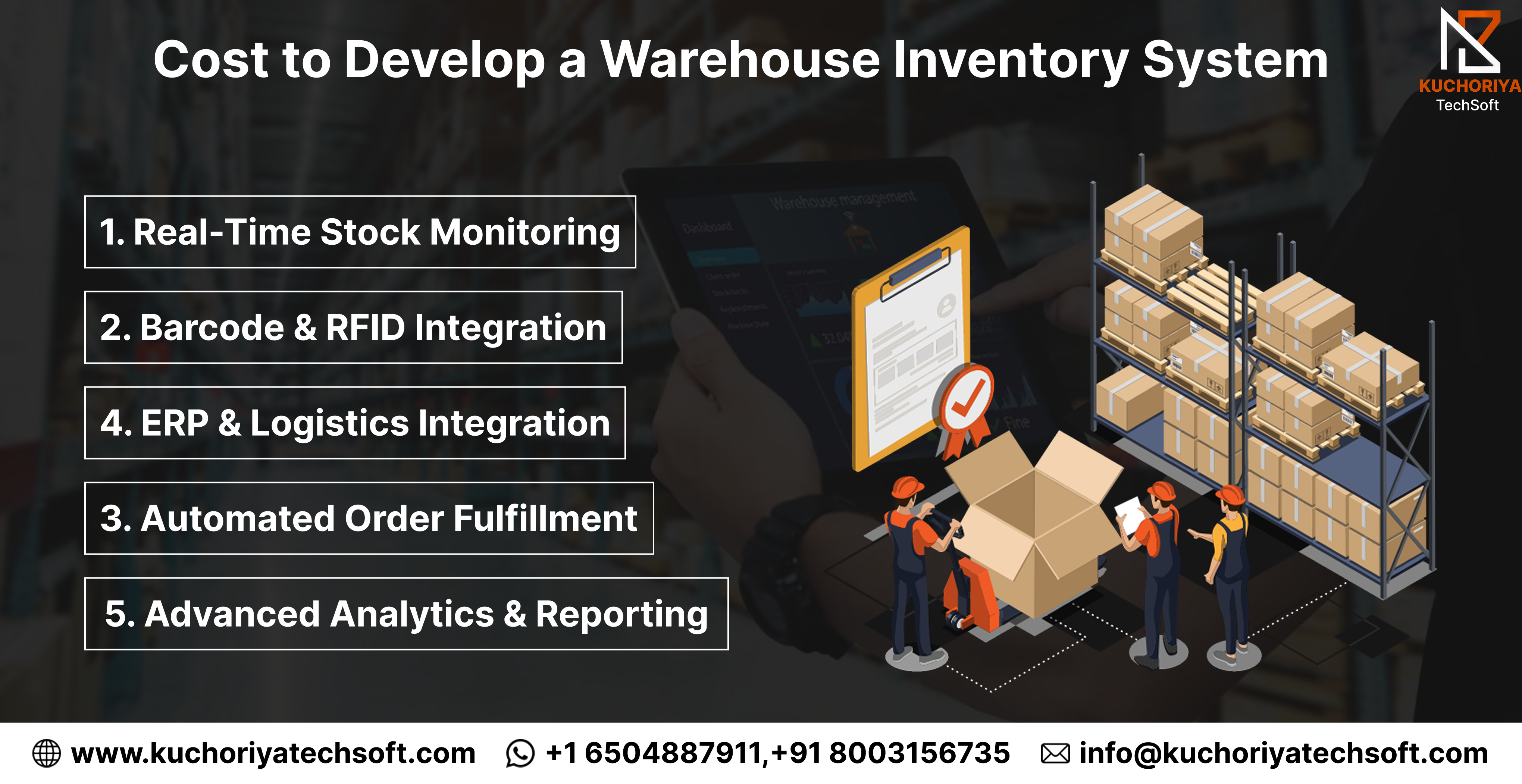
Warehouse inventory systems are designed for businesses that demand high precision in stock management and logistics operations. These solutions integrate real-time inventory tracking, RFID/barcode scanning, automated order fulfillment, and ERP synchronization to streamline warehouse workflows and reduce errors.
1. Real-Time Stock Monitoring: Track inventory levels instantly with live updates for all products across warehouses.
2. Barcode & RFID Integration: Enable fast scanning, automated tracking, and error-free inventory management.
3. Automated Order Fulfillment: Streamline picking, packing, and shipment processes for higher efficiency.
4. ERP & Logistics Integration: Sync seamlessly with ERP and supply chain platforms to optimize operations.
5. Advanced Analytics & Reporting: Custom dashboards and reports provide actionable insights for smarter decisions.
The estimated development cost for a robust warehouse inventory system ranges from $50,000 to $250,000+, with typical development timelines spanning 4–9 months depending on feature complexity and integration needs.
Kuchoriya TechSoft specializes in delivering scalable, secure, and feature-rich warehouse inventory solutions that enhance accuracy, speed, and operational efficiency—helping businesses optimize inventory management and maximize ROI.
Cost to Create a Custom Inventory Platform Like TradeGecko
Custom inventory platforms like TradeGecko provide businesses with a unified interface to manage inventory, orders, suppliers, and customer relationships, making them ideal for companies with complex sales channels and growth ambitions.
Building such a solution requires robust backend development, multi-currency support, workflow automation, and analytics dashboards to monitor sales performance, stock health, and operational efficiency.
The development cost for a TradeGecko-style platform typically starts at $100,000 and can go beyond $300,000, depending on customization depth, automation features, and deployment scale. Cloud-based, scalable architecture and experienced developers are essential to ensure reliability and future-proof performance.
At Kuchoriya TechSoft, we specialize in custom inventory platform development, delivering scalable, secure, and feature-rich solutions that empower businesses to optimize operations, enhance decision-making, and achieve faster ROI.
How Much Does Inventory Software Cost in the USA, Canada, and Dubai?
The cost of inventory software development varies significantly across regions due to labor rates, regulations, and market demand.
- In the USA, hourly rates for skilled developers range from $80 to $200, making custom inventory management software a higher investment.
- In Canada, developing a complete system typically costs between $80,000 and $350,000, influenced by feature complexity, integrations, and compliance with local regulations.
- In Dubai, costs are impacted by regional standards, certifications, and enterprise requirements, often placing development in the mid-to-high investment range.
Additional expenses may arise from taxes, local business regulations, and software certification standards. To optimize budgets without sacrificing quality, many North American and Middle Eastern companies partner with offshore experts like Kuchoriya TechSoft. Our global teams deliver custom inventory management solutions at competitive rates while ensuring scalability, security, and on-time delivery.

How Much Does a Simple Inventory App Cost?
For startups and small businesses, a simple inventory app provides the essentials: product tracking, manual stock updates, and basic reporting. These MVP (Minimum Viable Product) solutions are perfect for validating business needs before investing in full-scale inventory management software.
The estimated development cost for a basic inventory app ranges from $10,000 to $25,000, with a typical timeline of 1.5–3 months, enabling rapid market entry. Features can be enhanced later as your business grows, ensuring scalability and flexibility.
At Kuchoriya TechSoft, we develop affordable MVP inventory apps designed to streamline your initial inventory management processes, helping businesses start digital operations efficiently while laying the foundation for future growth.
Explore more about the inventory system:
Cost to Develop Inventory Software with Real-Time Analytics
Adding real-time analytics transforms your inventory management software into an intelligent, data-driven platform. Businesses gain actionable insights for stock replenishment, demand forecasting, and sales optimization, helping secure a competitive advantage.
Key Real-Time Analytics Features of Inventory Software:
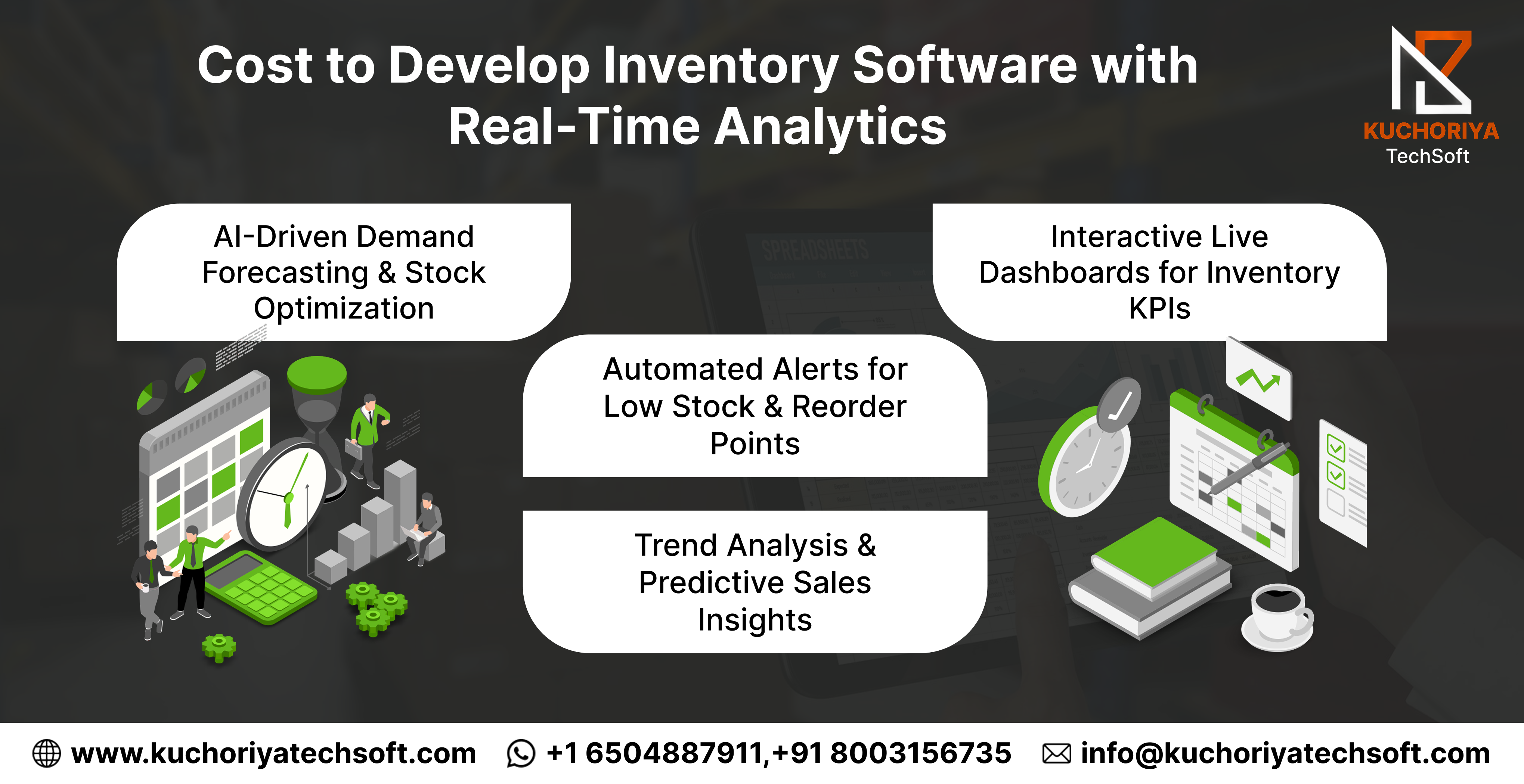
- AI-Driven Demand Forecasting & Stock Optimization
- Automated Alerts for Low Stock & Reorder Points
- Trend Analysis & Predictive Sales Insights
- Interactive Live Dashboards for Inventory KPIs
Integrating these capabilities typically adds $15,000 to $40,000 to the base development cost and may extend the timeline by 2–4 months, depending on complexity and existing system architecture.
At Kuchoriya TechSoft, we leverage AI, big data, and cloud tools to deliver smart inventory management solutions that enhance operational efficiency, reduce errors, and maximize ROI for businesses of all sizes.
Inventory Software Development with Payment Gateway Integration
For inventory management systems connected to e-commerce platforms or POS systems, integrating a secure payment gateway is essential for real-time transaction processing and accurate inventory updates. This ensures sales and stock data remain synchronized, reducing errors and discrepancies.
The additional development cost for payment gateway integration typically ranges from $5,000 to $12,000, depending on the payment provider, security requirements, and transaction volume. PCI compliance and encryption standards are critical to safeguard financial data and maintain regulatory adherence.
At Kuchoriya TechSoft, we deliver secure, PCI-compliant payment gateway integrations for retail and online businesses, ensuring seamless inventory and sales synchronization, enhanced customer trust, and reliable transaction processing.
Must Read: How to Create an Inventory System: Features, Use Cases, Steps
Integrating Third-Party Tools, Security, and Pricing Models in Inventory Software
Enhancing your inventory management software with third-party tools and security features adds value but impacts development costs. Choosing the right integrations, security protocols, and pricing model ensures scalability, efficiency, and ROI.
Popular Third-Party Integrations & Costs
Cost of KYC & Security in Inventory Software
For platforms handling sensitive transactional or regulatory data, implementing KYC processes, encryption, and role-based access controls is essential to prevent fraud and data breaches.
- Estimated Additional Cost: $5,000 – $15,000
- Benefits: Enterprise-grade security, compliance, and protected business operations
At Kuchoriya TechSoft, we integrate best-in-class security features to safeguard your inventory platform while optimizing costs.
Inventory Software Pricing Models
Choosing the right pricing approach ensures budget alignment and project success:
- Fixed Price: Best for projects with a clearly defined scope; offers budget certainty.
- Hourly Rate: Flexible for evolving requirements and incremental features.
- Dedicated Team: Ideal for long-term development and ongoing support, typically starting at $20,000+/month.
Kuchoriya TechSoft provides custom pricing models tailored to project size, timeline, and business goals, ensuring maximum ROI from your inventory software investment.
Conclusion: Plan Your Inventory Software Budget
Understanding the cost of custom inventory management software is crucial for strategic planning and digital transformation. At Kuchoriya TechSoft, we deliver scalable, feature-rich inventory software solutions tailored to your business, ensuring operational efficiency and maximum ROI.
Investing in the right inventory software transforms stock management, improves accuracy, and provides real-time visibility across your supply chain. Whether you’re exploring software for inventory management to streamline daily tasks, comparing the best inventory management software for long-term scalability, or starting with affordable MVP solutions, a custom-built system ensures your exact business requirements are met.
Contact Kuchoriya TechSoft today for a detailed inventory software development estimate and expert consultation. Let us help you build a cost-effective, future-ready inventory management platform that drives growth and operational excellence.

Frequently Asked Questions: Inventory Software Cost
Q. How much does it cost to build a basic inventory system?
A. A basic inventory management system with core features typically costs $10,000–$20,000, depending on platform and tech stack.
Q. What is the average cost for an advanced inventory management solution like Zoho or SAP?
A. A custom-built advanced inventory software with multi-warehouse support, analytics, and third-party integrations ranges from $40,000 to $100,000+.
Q. Is there a cost difference between cloud-based and on-premise inventory software?
A. Yes. Cloud-based inventory software usually has lower upfront costs but recurring subscription fees, while on-premise systems require a higher initial investment with minimal long-term charges.
Q. How does customization impact inventory software pricing?
A. Tailored features like barcode scanning, ERP/CRM integration, and AI analytics increase development costs, but deliver better operational fit and higher ROI.
Q. Can I start small and scale features later to manage costs?
A. Absolutely. With Kuchoriya TechSoft’s modular inventory software development, you can launch with essential features and expand functionality as your business grows, controlling upfront investment.