What Makes Zillow and Realtor the Apps to Beat in 2026?
How to build a real estate app like Zillow or Realtor in 2026 means building more than a listing platform. It means building an intelligent ecosystem powered by AI Real Estate innovations. Zillow and Realtor already democratized property search. Now both are becoming full housing "Super Apps." That shift matters for anyone exploring Zillow Clone Development 2026: Features, Cost, and Next-Gen AI Innovations.
The numbers back this up. Zillow hit 227 million unique monthly users by early 2026, with Realtor close behind as the second-largest player in the space. Neither platform is a database anymore. Both work like advisors. Zestimate 2.0 now runs on neural networks, delivering sharper property valuations than ever, while Realtor leans on MLS-verified data for accuracy. Anyone building a Zillow clone app has to crack one problem first: the trust gap between buyers and sellers.
That's the job of the AI-powered real estate roadmap. Companies building a real estate mobile app are chasing one goal: frictionless transactions. Some users want the best real estate app for browsing. Others need an investing app for portfolio tracking. Either way, data transparency is the real product. Startups usually start this journey with strategic CTO advisory, building an architecture that scales to millions of listings without lag.
Market Analysis: The Future of Real Estate Apps Like Zillow & Realtor
The PropTech landscape in 2026 is undergoing a massive transformation. According to Fortune Business Insights, the global PropTech market size is valued at USD 44.59 billion in 2026 and is projected to skyrocket to USD 104.57 billion by 2034, with a CAGR of 11.9%. This growth is fueled by a massive shift: nearly 48% of prospective homebuyers in 2026 now plan to use AI tools for their property search.
Key Market Statistics for 2026:
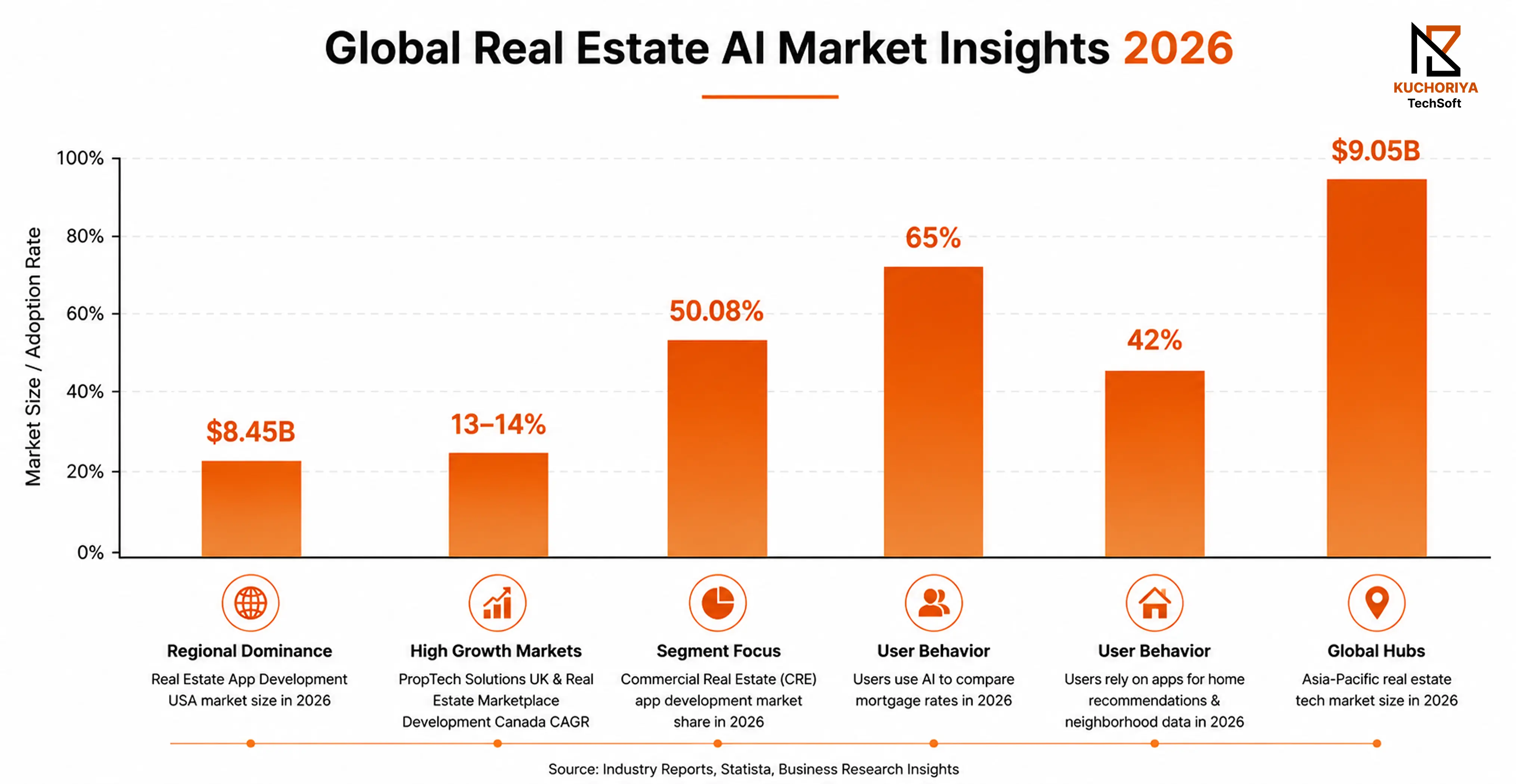
- Regional Dominance: Real Estate App Development USA remains the largest market, projected to reach USD 8.45 billion alone this year. Meanwhile, PropTech Solutions UK and Real Estate Marketplace Development Canada are seeing a 13-14% CAGR in digital adoption.
- Segment Focus: The Commercial Real Estate (CRE) app development segment is anticipated to account for 50.08% of the market share in 2026, as firms shift toward automated asset management.
- User Behavior: Data shows that 65% of users now use AI to compare mortgage rates, and over 42% rely on apps for personalized home recommendations and neighborhood data.
- Global Hubs: AI Real Estate Solutions UAE (specifically Dubai) and Southeast Asia Real Estate Tech Trends are emerging as high-growth zones, with the Asia-Pacific market expected to reach USD 9.05 billion this year.
As we move through 2026, the demand for a comprehensive real estate investment app, one that offers global real estate lead generation and automated valuation models (AVM), is at an all-time high. For any startup launching a real estate portal development project, these numbers prove that the market is ripe for innovation.
Top 5 Real Estate Apps Like Zillow to Watch in 2026
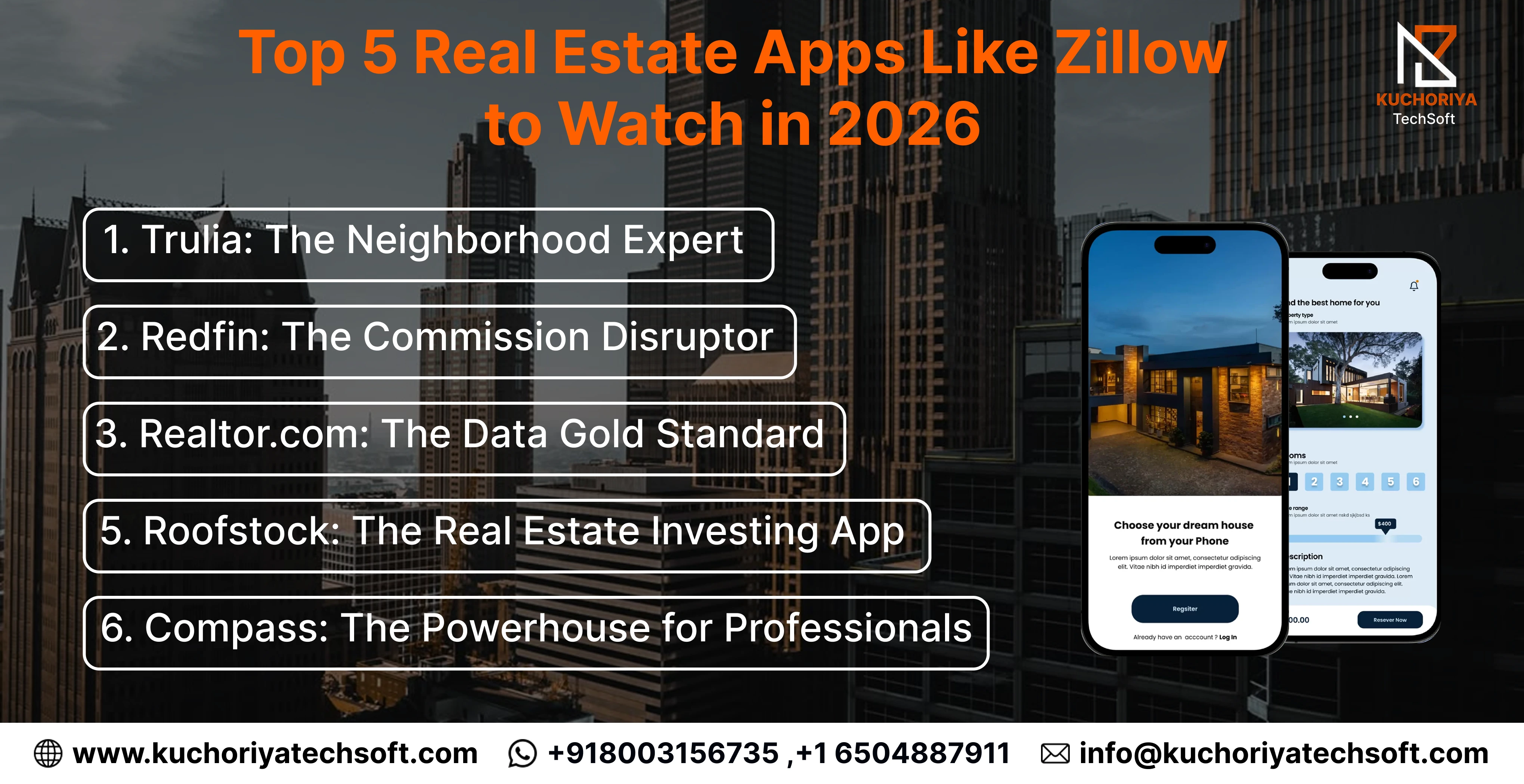
Zillow and Realtor lead the pack, but the market runs deeper. Niche platforms are carving out real estate app development wins across investing, rentals, and luxury brokerage. Building a platform that beats them means studying what these five do right.
1. Realtor.com: The Data Gold Standard
Realtor.com plugs into 800+ MLS databases. That makes it the benchmark for real-time listing accuracy. Anyone studying real estate app development starts here.
2. Redfin: The Commission Disruptor
Redfin runs a hybrid discount brokerage model, blending in-house agents into one clean mobile app. For a real estate app development company, Redfin proves complex transactions can still feel effortless on mobile.
3. Trulia: The Neighborhood Expert
Trulia wins on vibe, not just listings. Crime rates, school ratings, commute times, all mapped visually. It's built for buyers who care about the neighborhood as much as the house.
4. Roofstock: The Real Estate Investing App
Roofstock skips the noise and focuses on single-family rentals with tenants already in place. It's become the go-to real estate investment app for investors buying sight unseen, anywhere in the world.
5. Compass: The Powerhouse for Professionals
Compass built its edge for agents, not buyers. High-end CRM tools, AI-driven marketing, luxury listing support. It's one of the strongest apps for real estate agents working the high-net-worth market.
Industry Insights: AI Real Estate App Development: Features, Use Cases, and Future Trends
How Australian Real Estate Software Streamlines Property Management
Key Steps to Develop a Real Estate App Like Zillow (The Professional Roadmap)
Nobody builds a market leader by just writing code. You need a plan that survives contact with real users, and that's what a real estate app development company actually gives you, a roadmap instead of guesswork.
Phase 1: Strategic Leadership and Technical Architecture
Get the real estate mobile app architecture sorted first. Skip this and you'll be rebuilding it later, at ten times the cost. Fractional CTO services for PropTech startups exist for exactly this problem. Should you go monolithic or microservices? A virtual CTO has already answered that question for a dozen platforms your size, so you don't have to guess.
Phase 2: Market Niche and Problem Validation
Pick one pain point. Not five, one. Residential buyers move differently than commercial investors, so figure out early which crowd you're building for. A real estate tech consultant will tell you honestly whether your idea beats what Zillow and Realtor already do, or whether it just copies it.
Phase 3: Interactive UI/UX Design and Prototyping
2026 users don't open a laptop to browse homes. They're on their phones, thumb-scrolling between listings on a lunch break. Three taps, that's the rule for good real estate app UI/UX, search to shortlist. And build the 360-degree walkthrough into the prototype now, not as an afterthought once the app's already live.
Phase 4: MVP Development
Resist the urge to build everything at once. A tight real estate app MVP, just profiles, saved searches, and basic listings, gets you in front of real users months earlier. Their behavior tells you more than any spec document ever will.
Phase 5: Data Integration and AI Training
Behind every Zillow-style app sits a data pipeline nobody sees. RESO Web API or RETS feeds pull listings straight from MLS sources, live. Once that's stable, the real work starts, training models that price homes accurately and recommend the right ones to the right buyers.
Phase 6: QA and Global Launch
This is not the phase to rush. If smart contracts or blockchain escrow are part of the plan, test them harder than everything else combined. Then launch with real app store optimization behind it, because an app that ranks in week one beats one that quietly waits for month six.
Top 10 Features to Build an App Like Zillow (2026 Edition)
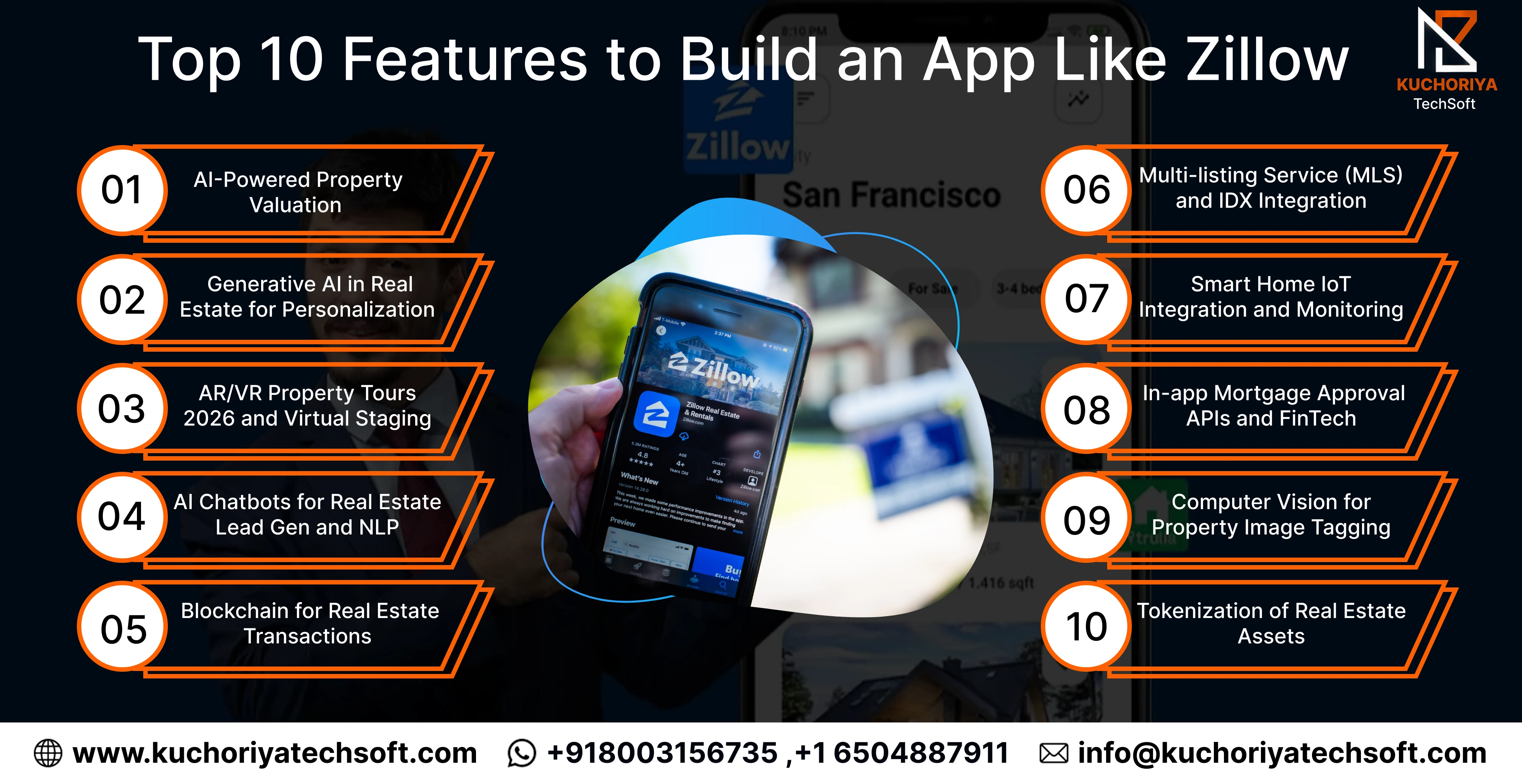
To beat today's market leaders, your app needs features built around hyper-personalization, immersive visualization, and secure automation, the same playbook Zillow and Realtor already run on.
1. AI-Powered Property Valuation (Zestimate 2.0)
- Run automated valuation models (AVMs) for instant price estimates
- Use neural networks for real estate trends to track market volatility
- Show historical growth using big data analytics in real estate
2. Generative AI in Real Estate for Personalization
- Power results with machine learning for property recommendations based on user behavior
- Add an AI concierge trained on predictive analytics in PropTech
- Build hyper-personalized feeds that learn from every swipe
3. AR/VR Property Tours and Virtual Staging
- Offer immersive 360-degree virtual walkthroughs for remote buyers
- Use AI-driven virtual staging to furnish empty listings instantly
- Add AR/VR property tours for renovation previews
4. AI Chatbots for Real Estate Lead Gen
- Deploy AI chatbots for real estate lead gen to qualify leads 24/7
- Use NLP for automated property descriptions
- Add AI-powered lead scoring to flag high-intent buyers
5. Blockchain for Real Estate Transactions
- Close deals with smart contracts in property dealing
- Secure titles using blockchain for real estate transactions
- Offer decentralized real estate finance (DeFi) for global buyers
6. MLS and IDX Integration
- Sync inventory with multi-listing service (MLS) integration
- Enable IDX website development for realtors
- Standardize data flow with RESO Web API integration
7. Smart Home IoT Integration
- Add smart home IoT integration for remote lock and light control
- Show HVAC monitoring systems data for energy efficiency
- Connect maintenance request systems to local service providers
8. In-App Mortgage and FinTech APIs
- Enable in-app mortgage approval APIs for one-click financing
- Add digital loan processing with instant credit checks
- Automate closing with escrow payment gateways
9. Computer Vision for Property Search
- Use computer vision for property image tagging to auto-detect room types
- Improve search by flagging features like hardwood floors or open kitchens
- Explore AI-generated video tours for listing engagement
10. Tokenization of Real Estate Assets
- Enable tokenization of real estate assets for fractional ownership
- Add real estate investment tracking for small investors
- Build a secure marketplace for trading decentralized real estate assets
The Cost to Develop an App Like Zillow in 2026
Feature-Wise Cost Breakdown
Beyond the region, the specific tech you integrate drives the real estate app development price.
1. Advanced Search & MLS Integration: Implementing basic filters is standard, but multi-listing service MLS integration and RESO Web API integration require specialized data handling. Expect this to add approximately $10,000 – $15,000 to the initial development cost.
2. AI & Predictive Analytics: Adding AI-powered property recommendations and predictive market analytics is a premium move. These features, powered by machine learning for property recommendations, usually require an additional investment of $20,000 – $40,000, depending on the data complexity.
3. Immersive Visualization (AR/VR): Integrating 360-degree virtual walkthroughs and AR/VR property tours in 2026 is essential for high-end listings. This tech can range from $15,000 to $30,000 as it involves specialized UI components and heavy media processing.
4. Security and Blockchain: For platforms offering smart contracts in property dealing or blockchain for real estate transactions, the cost increases due to the need for rigorous security audits. This typically adds $25,000+ to ensure a tamper-proof environment.
Deep Dive: How to Build an AI-Powered Car Rental App Like Uber
Virtual CTO Solutions for Dubai’s FinTech, E-Commerce, and Real Estate Startups
Conclusion: The AI Transformation in Real Estate
There's never been a better time to build a Zillow clone app. Zillow and Realtor clone apps got where they are by betting early on the AI-powered real estate roadmap, and that same playbook is open to anyone willing to actually execute it. Three things have to line up for that to work. Someone senior needs to own the technical calls from day one, not after something breaks. The real estate mobile app architecture has to survive real scale, not just a demo. And the product itself has to feel good enough that people choose to keep using it.
That's the gap Kuchoriya TechSoft fills. We don't just write code, we help founders build platforms that hold their own against category leaders. Our fractional CTO services for PropTech startups give you senior technical direction exactly when you need it most, before the architecture decisions get expensive to undo. Know other founders building in this space? Our Referral Partner Program rewards you for sending them our way.
Thinking about building the next Zillow or Realtor? Contact us today for a straight answer on real estate app development cost, timeline, and what it actually takes to build something that competes.

Frequently Asked Questions (FAQs)
Q. How long does it take to build a real estate app like Zillow?
A. A real estate app MVP takes 3 to 5 months. Add AI valuation and advanced features, and it stretches past 9 months. Flutter for real estate apps speeds things up by covering iOS and Android from one codebase.
Q. Why hire a fractional CTO if I already have developers?
A. Developers build what's decided. A fractional CTO for PropTech startups decides it, monolithic or microservices, what ships first, where technical debt is quietly forming before it gets expensive.
Q. What separates a new app from Zillow and Realtor?
A. Data and trust. Both run on deep MLS integration and years of transaction history. New apps win by nailing that integration early and moving faster on personalization and niche tools.
Q. Which AI feature matters most for a real estate app?
A. AI-powered property valuation. Get pricing wrong and users stop trusting everything else on the page. Personalized recommendation feeds come second; they drive repeat visits.
Q. Should I skip the MVP and build the full product?
A. No. A lean real estate app MVP gets real user data in months. Skipping it means building a full year on assumptions, then finding out too late.