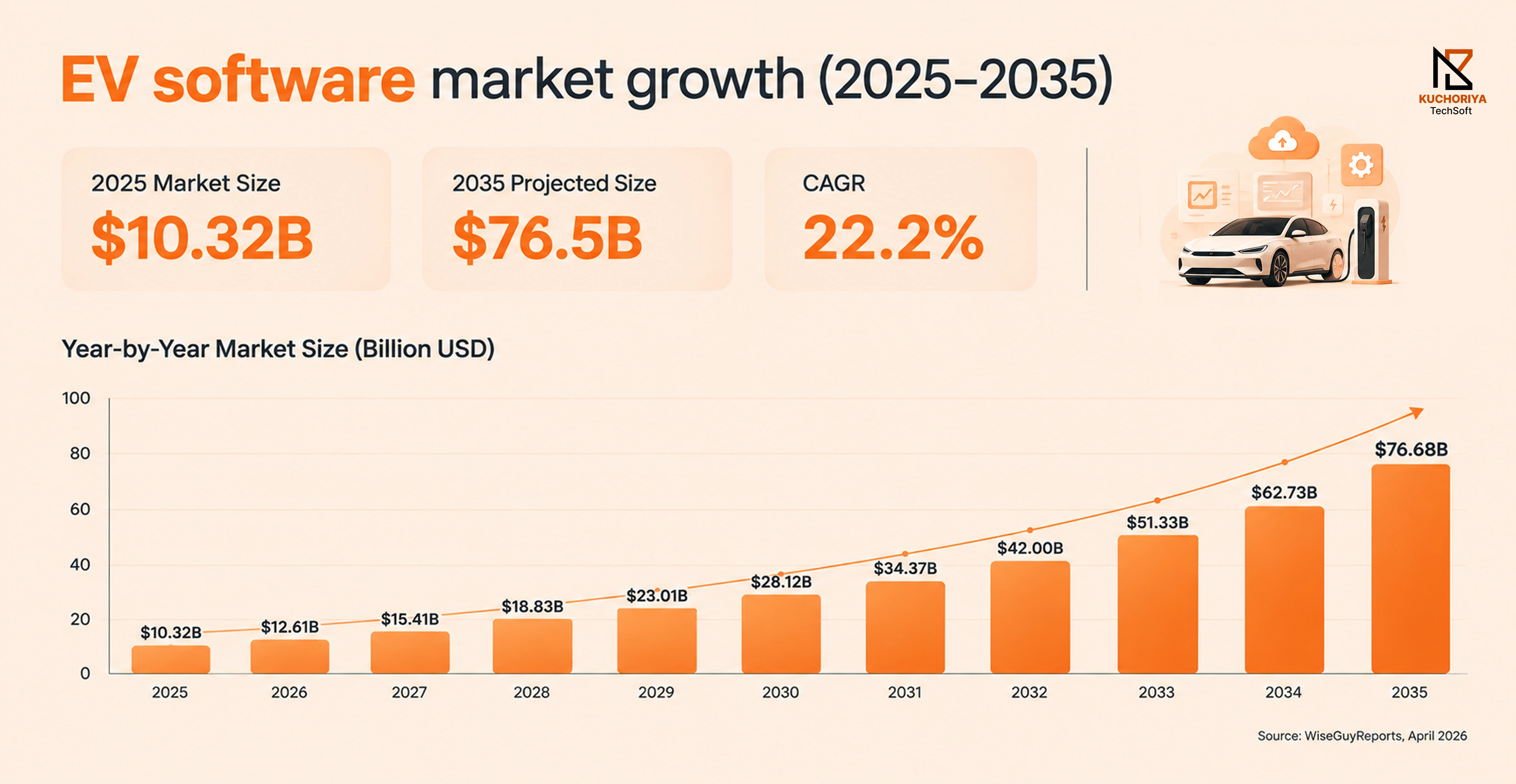
The global EV software market is projected to grow from $10.32 billion in 2025 to $76.5 billion by 2035, expanding at a 22.2% CAGR, and charging management software is scaling even faster as more networks go digital. This is why custom EV software development has moved from a nice-to-have to the backbone of any electric mobility product.
A working platform has to do more than show nearby stations on a map. It needs live charging session data, remote vehicle diagnostics, secure payments, and route planning that accounts for battery range, the core of solid electric vehicle app development. None of that works unless the app can talk to charging networks built on different hardware, which is where EV interoperability protocols matter. OCPP (Open Charge Point Protocol), OCPI (Open Charge Point Interface), ISO 15118, and CCS let vehicles and stations from different manufacturers communicate without custom integration for every single network.
EV software development cost shifts a lot depending on feature scope, third-party integrations, and platform choice, something this guide breaks down later. More teams are also adding AI in EV software for smart routing and predictive battery health, plus blockchain in EV software for transparent billing on fleet and peer-to-peer charging models.
This guide walks through the features, tech stack, and real costs behind building a smart EV car app, drawn from an actual EV mobility software build for a fleet operator.
EV Software Development Approach
A Canada-based EV mobility startup came to us with a half-built platform meant to serve private drivers and fleet operators through custom EV software services. Charging integration, remote monitoring, payments, and trip planning. On paper, it looked fine. In practice, none of it held together.
Challenge
Every charging provider ran its own API, so integrations broke constantly. Nobody had standardized around EV interoperability protocols like OCPP, OCPI, ISO 15118, or CCS, so each new network was basically a rebuild. No AI-based routing. No predictive battery analytics. And the EV car app development cost was already blown before launch.
Solution
First we fixed the protocol layer, since nothing else mattered if the app couldn't talk to charging stations reliably. Once OCPP, OCPI, ISO 15118, and CCS worked properly, a new network stopped meaning a rebuild. Then we added the smart EV app features that were missing: AI-based route planning with charging stop suggestions, predictive battery health tracking, live availability data, and energy analytics sitting inside the app itself.
Technology
Node.js, React Native, MongoDB, AWS, and our usual EV tech stack. Nothing exotic, but it cut build time and got the EV software development cost down to something sustainable. Built on a microservices architecture, so a new payment provider or fleet module doesn't mean touching the core system. Implementation of blockchain handles transaction logging on energy credits and billing. Encryption and multi-factor authentication cover the rest, GDPR-aligned from day one.
Outcome
The platform launched, talking to charging networks across providers, with AI features already in place and security built into the architecture instead of patched on later. That's what an experienced EV software development company delivers when interoperability, cost, and security get solved together, not separately.
Why EV Software Matters Now
- Ask any EV driver what they actually want from the app and it's simple: find a station, pay without hassle, get a nudge when something needs servicing. That's basically why over 70% of them are already on an app to develop EV charging apps experiences worth keeping.
- Smart routing. Charging that adjusts to grid load. Predictive alerts before something breaks. Fleets doing this aren't seeing small savings either, operating costs are down close to 30% in some cases.
- Bringing in an EV software development company early usually means shipping 40-50% faster, and OCPP, ISO 15118, OCPI compliance stops being a scramble you deal with post-launch.
- And the question keeps coming up more: how to build EV software that's interoperable and AI-ready from day one instead of patched together after the fact.
Cost Breakdown for EV Software Development
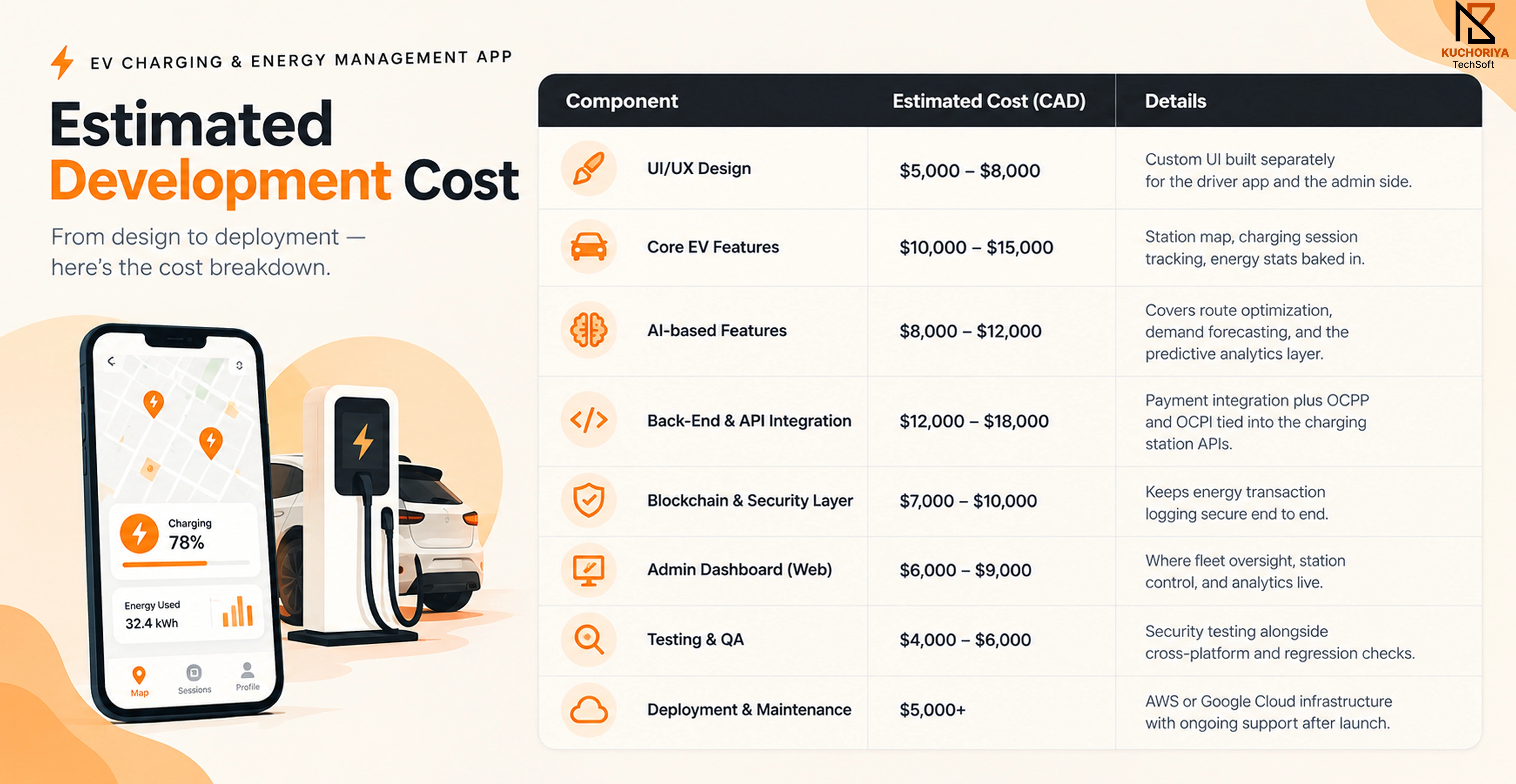
Cost transparency matters when you're delivering real EV mobile app development solutions, not just a number thrown on a slide. Final numbers move with feature complexity, tech stack, third-party integrations, and where the thing actually deploys. Here's the cost model we used on our electric vehicle app development project.
Technology Stack Details and Justification
Building solid EV Driver Booking software development in Vancouver, British Columbia, Canada, and beyond meant picking a stack that could actually keep up, not just look good on paper. Here's what our team at Kuchoriya TechSoft went with.
1. Front-End (Mobile & Web)
- React Native, since cross-platform speed is exactly why most teams hire EV mobile app developers who already know it
- Next.js + Tailwind CSS, keeping the admin dashboards responsive even under load
2. Back-End
- Node.js with Express.js, light enough to handle high-concurrency EV charging traffic without choking
- MongoDB for flexible, document-based storage across session data and analytics
- Redis handling caching and live location tracking
3. AI & Machine Learning
- Python + TensorFlow doing the predictions that actually matter: battery usage, station demand
- OpenAI API tied in for driver support and faster insights
4. Blockchain
- Hyperledger Fabric running secure session logs with eWallet transaction transparency
5. Protocols
- Stations and vehicles talk through OCPP 2.0.1 and OCPI on one side
- ISO 15118 and CCS handle the vehicle-to-grid interoperability on the other
6. Deployment & DevOps
- AWS (Lambda, EC2, S3) hosting that scales without needing babysitting
- Docker + Kubernetes for containerization and load balancing
- GitLab CI/CD running the testing and deployment pipeline
7. Why This Stack
None of this got picked because it's trendy. It supports AI-based EV charging solutions, holds up under a modular design across fleet electrification platforms, and stays scalable as the geography spreads across different parts of Canada.
Security, Protocols & Performance: What Powers This EV Platform
1. How Secure Is EV Software Against Compliance and Cyber Risks?
Built around EV software security compliance: GDPR, ISO 27001, and Halifax-specific EV charging regulations, backed by encryption, MFA, and real-time threat monitoring for EV telematics software development. Retention up 25%, cybersecurity risk down 60%.
2. Which Protocols Make EV Charging Networks Actually Talk to Each Other?
OCPP, OCPI, ISO 15118, and CCS as core EV interoperability protocols, paired with OTA updates for real-time fixes without manual updates. Integration time down 40%, accessibility up 35%, support tickets down 45%.
3. How Does IoT and Data Analytics Improve EV Fleet Performance?
IoT sensors feeding EV battery monitoring software and predictive maintenance through a cloud-based EV fleet software system. Fleet efficiency up 50%, maintenance costs down 20%.
4. What's Next for EV Software: AI, Blockchain, and V2G
Built to absorb AI-based EV charging solutions, blockchain payments, and V2G without needing a rebuild. Scalability projected up 40%.
5. What We Learned from Tesla and ChargePoint's Playbook
Adapted proven models from Tesla and ChargePoint for the Canadian market instead of starting from scratch. Go-to-market down 35%, R&D cost down 25%.
6. What Challenges Come Up in EV App Development, and How We Solved Them
High upfront costs, limited interoperability, and data sync lags handled through MVP-first agile cycles, standard API integration, and a custom dashboard for EV car analytics. Delivery time down 28%, bugs down 40%.
EV Charging Software: White-Label or Custom Build?
Montreal-based fleet client had to choose between shipping fast with something ready-made or building for the long run. Given the pan-Canada plans on the table, that decision needed more thought than usual.
The Choice
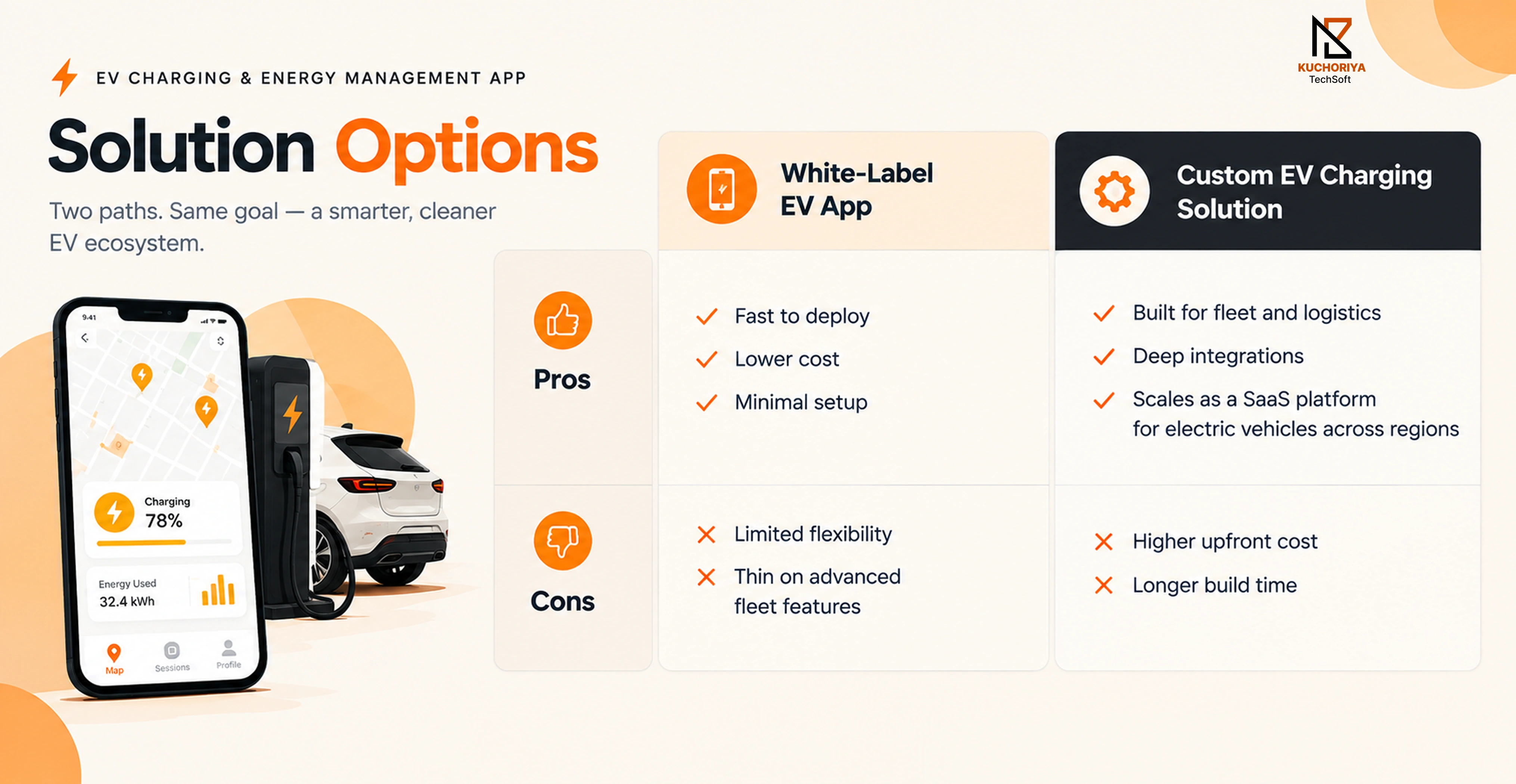
Two paths were on the table: a white-label EV app for quick deployment, or a custom EV car charging solution shaped specifically around fleet and logistics work.
Core Features
Real-time station locator, EV route optimization tied into GPS, and multi-payment support running through one fleet dashboard.
Advanced Capabilities
AI battery diagnostics, predictive maintenance alerts, and IoT charging control, all wired into an electric vehicle app management system.
White-Label vs Custom
Why Custom Won
The client ultimately went with the custom route because they needed a smart mobility EV app with Montreal's provincial grid compliance and bilingual UX built in from day one instead of patched on after launch, and because fleet operations at this scale needed real predictive analytics and control rather than something bolted onto a generic template.
Outcome
Operational efficiency came in 40% better than a white-label build would have delivered, with full regional compliance intact and stronger performance across the board once the platform actually launched.
How to Build EV Software: The Development Process
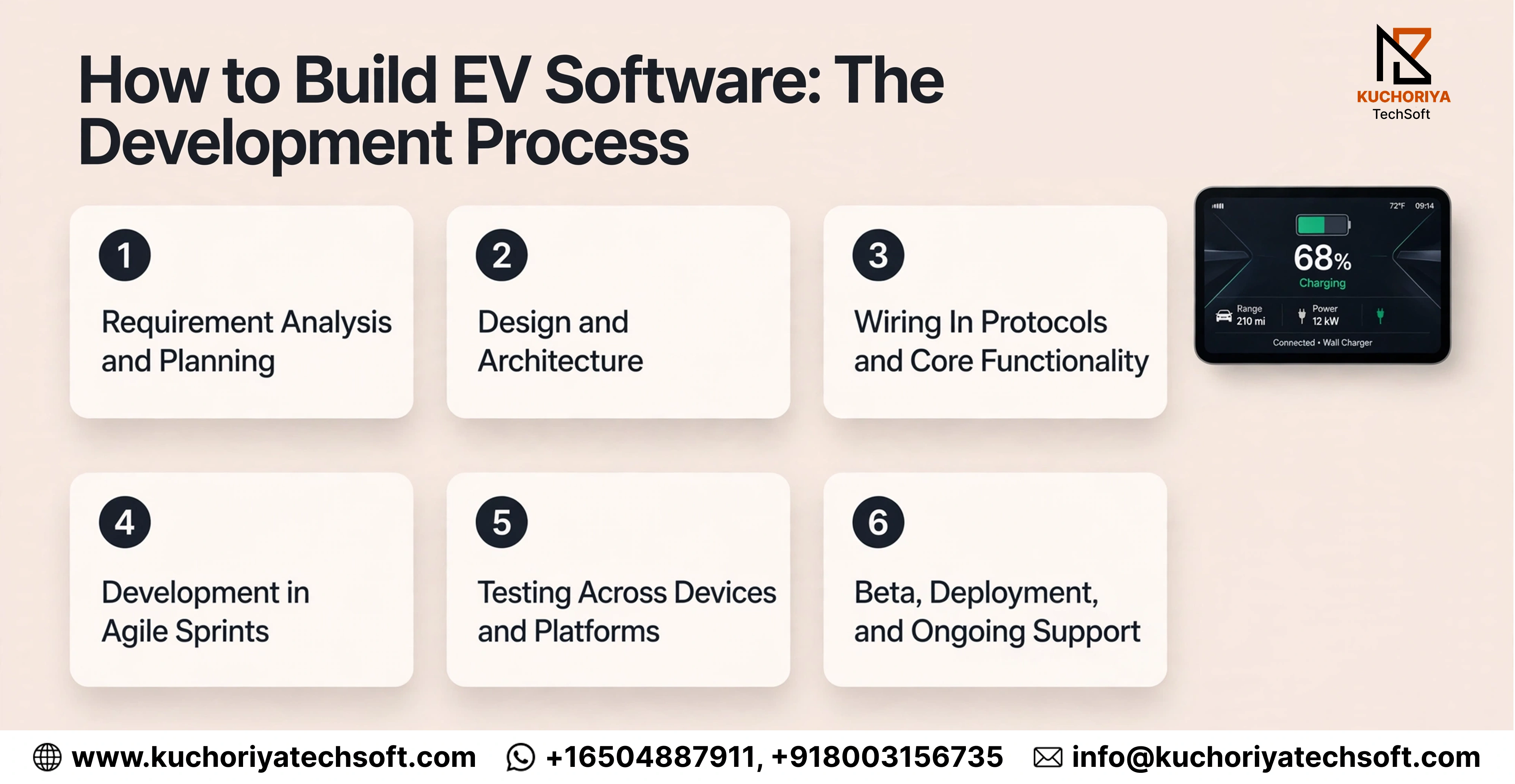
Getting from idea to a working EV platform is not just about writing code. Process, timeline, and team readiness all have to line up before anything ships.
1. Requirement Analysis and Planning
Every build starts here. Business goals, user needs, and regulatory scope get pinned down before any design work begins. Skipping this step is where most EV software development timelines blow past their original estimate.
2. Design and Architecture
Wireframes come next, along with a scalable EV software architecture. Scalability gets built in at this stage, not bolted on after launch when it is far more expensive to fix.
3. Wiring In Protocols and Core Functionality
This is where OCPP and ISO 15118 integration actually happens, alongside the backend work that lets the platform talk to charging networks without breaking every time a new one gets added. AI-driven diagnostics get built in through the same cycle, not tacked on separately.
4. Development in Agile Sprints
The actual build runs through agile EV app development, adding AI, IoT, and blockchain pieces gradually instead of all at once. This keeps the team able to adjust course without derailing the whole timeline.
5. Testing Across Devices and Platforms
Everything goes through EV software testing for functionality, security, and performance before deployment, catching problems while they are still cheap to fix.
6. Beta, Deployment, and Ongoing Support
A beta version goes out to real users first, and their feedback shapes the final refinements. Full deployment follows, backed by OTA software updates and support that keeps running well past launch day.
Architecture Behind the Platform
Modular is the whole point here. One module going down shouldn't take the rest of the system with it.
Mobile apps and admin dashboards talk to the backend through secure APIs. That backend runs on microservices, handling processing and security in one place instead of scattered across the stack. Charging networks connect through OCPP, OCPI, and ISO 15118, so hardware from different vendors just works, no custom build per network. Payment gateways, AI analytics, mapping, all the third-party pieces plug in the same modular way. Add one later, and the core system doesn't need touching.
What the Tech Stack Actually Looks Like
React Native for the front-end. Cross-platform, cheaper than building native iOS and Android separately, and fast enough for most EV use cases.
Node.js and Express on the back-end, built for real-time APIs. MongoDB for the database, since charging session data and sensor readings rarely fit into neat rigid tables anyway. Hyperledger Fabric over Ethereum for blockchain, mainly because it's permissioned and built for enterprise settings, not public transactions nobody asked for. Python with TensorFlow for AI and ML. Not glamorous, just the strongest ecosystem out there right now.
Cost Breakdown for 2026
Add it up and most builds land somewhere between $57,000 and $83,000, though scope creep pushes that higher fast.
Staying Compliant
Protocol conformance runs on OCPP 2.0.1, OCPI, and ISO 15118. Data handling for EU users follows GDPR, and the backend itself is built to ISO 27001 standards.
Regional certificates for specific provinces only go in if they're actually true for the setup being described. Claiming a compliance certificate that doesn't exist causes more damage than just leaving the line out.
Get CTO-Level Guidance Before You Build
Most EV software problems trace back to decisions made before a single line of code got written: wrong protocol priorities, a stack that can't scale past the pilot, no plan for compliance until it's already a blocker. That's exactly where a virtual CTO consultation earns its place, catching those calls early instead of paying for them later in rework.
Talk to Kuchoriya TechSoft's EV software team before locking in a build. A short conversation upfront on architecture, protocol choices, and compliance scope tends to save far more than it costs, and it's the fastest way to find out if your current plan actually holds up at fleet scale.
Kuchoriya's Referral Partner Program
Fleet operators, mobility consultants, and agencies working alongside EV businesses can also partner with Kuchoriya TechSoft through its referral partner program, passing along projects that need real EV software expertise in exchange for partner benefits on every successful referral.
Have an EV software idea? Share your requirements with our experts and let us handle the development.

Frequently Asked Questions
Q. How Much Does EV Software Development Cost?
A. Somewhere between $57,000 and $83,000 for most builds. It moves depending on scope, AI routing pushes it up, a basic charging locator keeps it down. UI/UX alone runs $5,000 to $8,000. Add blockchain-based transaction logging and security work, and that's another $7,000 to $10,000 on top. The real number depends on how much of the app gets built custom versus how much comes off the shelf.
Q. Which Protocols Actually Matter for EV Charging Software?
A. OCPP and OCPI first. They're what let your app talk to stations run by different networks without a rebuild every time. ISO 15118 and CCS come in for vehicle-to-grid communication. Skip these and every new charging partner turns into its own mini project, which gets expensive fast.
Q. How Long Does an EV Software Build Take?
A. There's no fixed number. It runs through requirement planning, architecture, protocol integration, sprints, testing, then a beta before full launch. A team that's already handled OCPP and ISO 15118 before moves faster through the middle stretch, since that part isn't new to them.
Q. White-Label or Custom, Which One Should You Pick?
A. White-label ships faster. Custom fits your actual fleet workflows and regional rules. If you're running one city and need something live next month, white-label works fine. If you're planning to scale across provinces with different compliance requirements, custom tends to pay off even though it costs more upfront.
Q. Does EV Software Actually Need AI?
A. Not for every feature. But predictive battery diagnostics and smarter route planning are usually where AI earns its cost, catching problems before they turn into downtime instead of just reacting after something fails.
Q. Is It Worth Talking to a CTO Before Starting?
A. Usually yes. A short call on architecture and compliance before development starts tends to save more than it costs. Most expensive mistakes in EV software happen early, not late, when nobody flagged them in time.