n8n vs Zapier vs Make: What's the Difference?
A client of mine spent two months on Zapier before figuring out it wasn't built for what her team actually needed. She's not the first person I've heard say that.
n8n vs Zapier vs Make gets treated like a spec-sheet comparison online: integrations, pricing, features in neat columns. But what is the difference between n8n, Zapier, and Make actually comes down to something simpler: how much control you're willing to trade for how much speed you want. Same question, different framing than what most automation platform roundups give you.
What Is Zapier Used For?
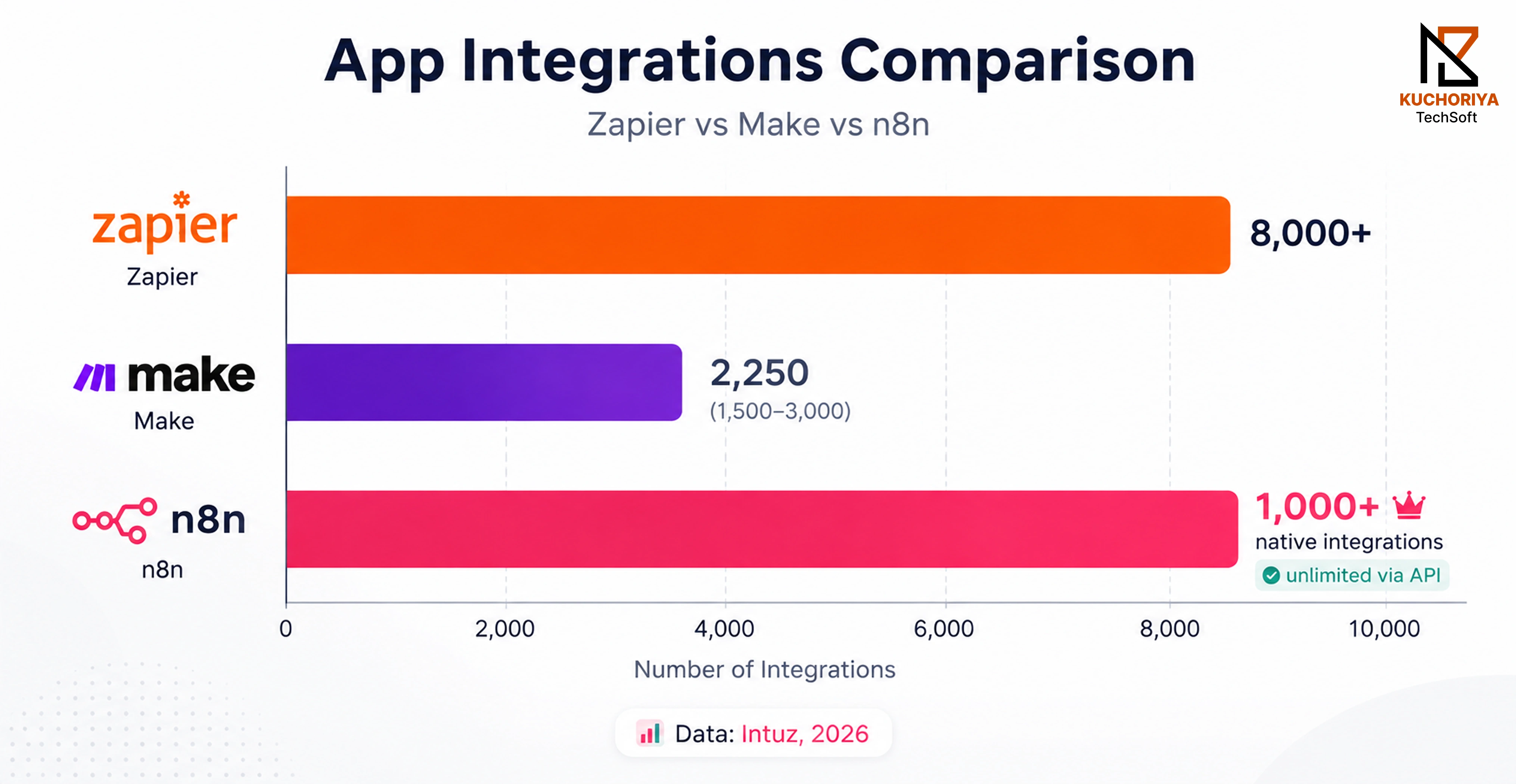
Honestly, it's the easy answer. Been around since 2011, past 3 million users at this point, and over 8,000 apps it can talk to. You link two things and tell it what should trigger what, done. I've set up Zapier flows for clients who couldn't write a line of code and had it running in twenty minutes.
What Is It Made For?
This used to be Integromat, somewhere between 1,500 and 3,000 integrations before Celonis picked it up in 2020, depending on which website you read. What really bought me into Make changed the first time I used it. It wasn't the integration count, though; it was watching a workflow branch three different ways on one canvas, something I couldn't get Zapier to do without five separate zaps duct-taped together.
What Is n8n Used For?
n8n's integration number looks small next to the other two, just about 1,000 native ones. That's a bit of a trick, though: its HTTP node will talk to any service with a public API, so in practice there's no real limit. What you're actually paying for (or not paying for, since you can self-host it) is control. Full access to your workflow's code, your data staying on your own server instead of someone else's cloud. What makes n8n different from Zapier and what makes n8n different from Make boils down to that one thing: ownership.
Cost tells the same story once volume goes up. Firing 10,000 instances per month runs 10-step workflow automation 80 to 90% cheaper on n8n, which is calculated in line with the Zapier initiative. Ask Zapier vs. Make vs. N8n as a choice, and you land within the same space; never doubtless about of order.
n8n vs Zapier vs Make: Feature-by-Feature Comparison
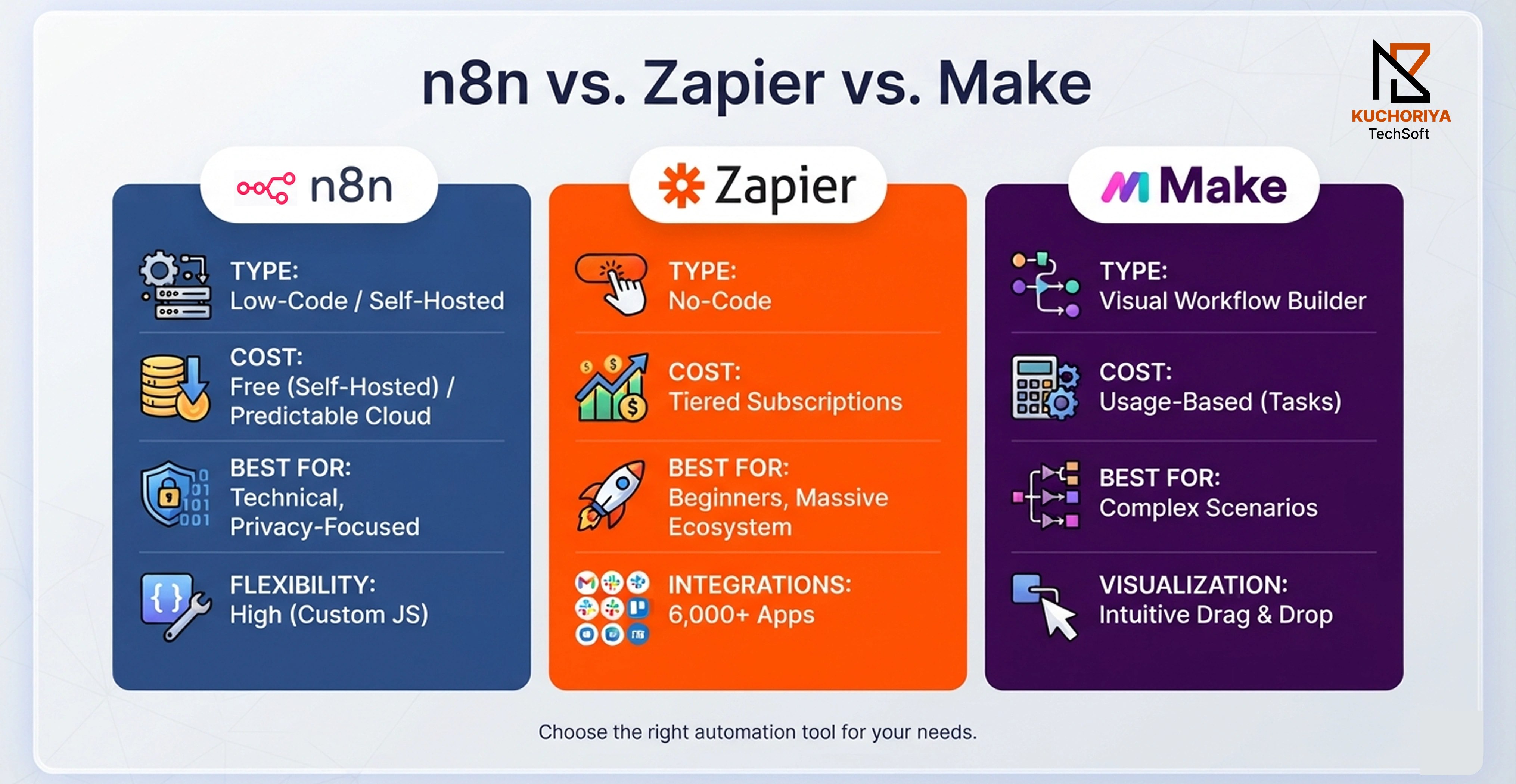
Numbers only tell half the story. Comparing n8n vs Zapier vs Make features side by side shows where each platform actually pulls ahead.
No single platform wins everything here. Zapier's fastest to start. Make is the most powerful for visual automation and analytical logic. N8n begins to remember once workflow orchestration, automation platform for API workflows, genuine no-code vs low-code automated platform management and extra than short configuration, which is exactly where N8n vs Zapier vs Make scalability and n8n vs Zapier vs Make self-hosting are.
Which Platform Offers More Flexibility and Control in Workflow Automation?
This is where n8n stops looking like the underdog. Once workflows get complicated, the platform built for control usually wins, even if it took longer to learn.
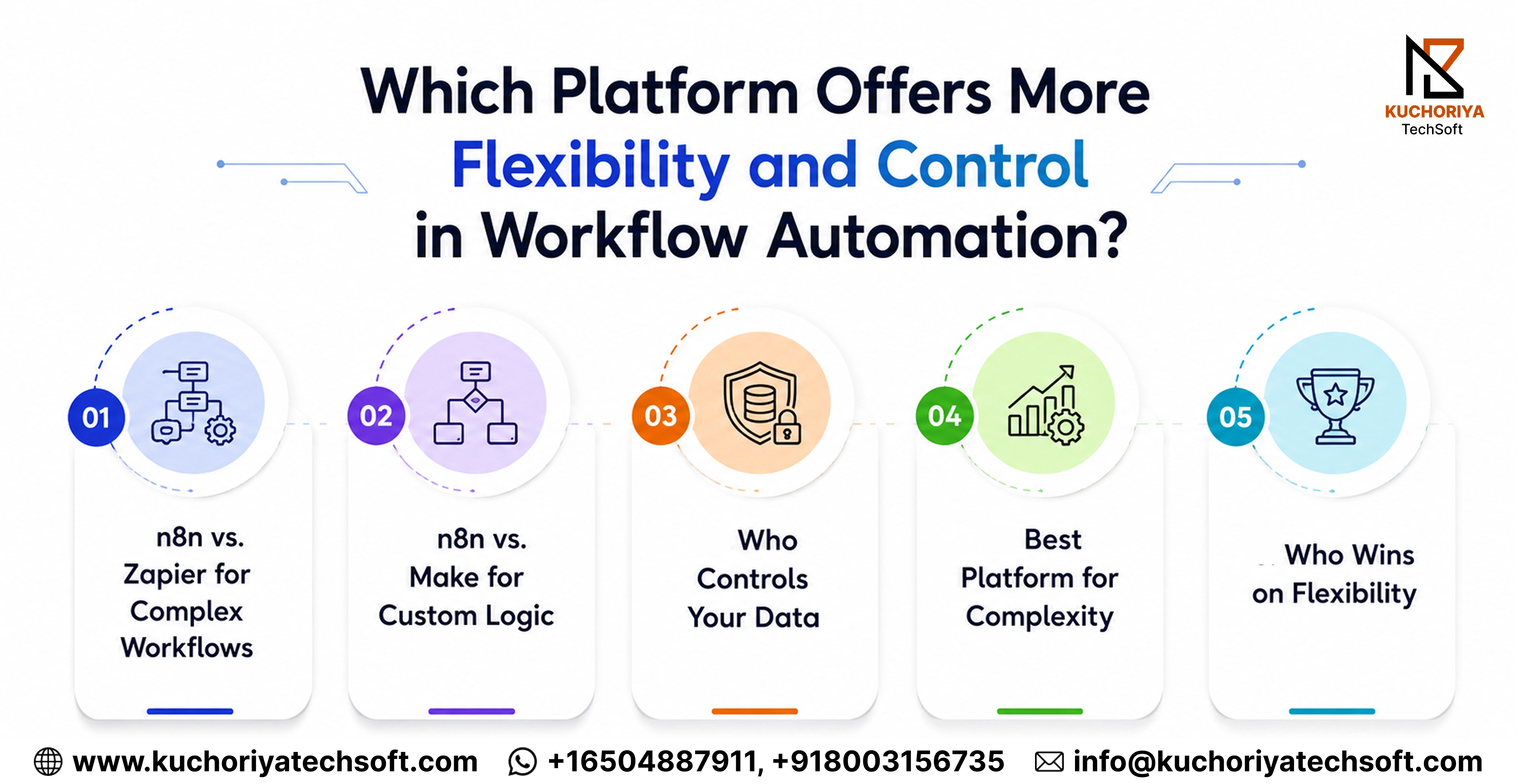
1. n8n vs. Zapier for Complex Workflows
Zapier's linear, trigger-then-action format breaks down once a workflow needs branching or conditional paths. n8n's canvas handles loops, error handling, and custom code directly, which usually means fewer separate automations stitched together to do one job.
2. n8n vs. Make for Custom Logic
Make's canvas handles branching well, arguably better than most no-code tools. But it still runs inside Make's own cloud, on Make's own terms. n8n adds something Make doesn't offer, dropping in custom JavaScript mid-workflow when a built-in node isn't enough.
3. Who Controls Your Data
Ask which platform offers more control over data, and it's not close. n8n is the only open-source workflow automation platform of the three, built to self-host on your own server. Zapier and Make process everything through their own cloud; no alternative is offered.
4. Best Platform for Complexity
For teams asking which automation platform is best for complex workflows, or searching for the best automation platform for complex workflows outright, technical teams tend to land on n8n. It's a genuine developer-friendly automation platform, built for people who'll write a script when the visual builder hits its limit.
5. Who Wins on Flexibility
Run the automation platform flexibility comparison to its logical end, and which is more flexible, n8n, Zapier, or Make, stops being close. Zapier and Make optimize for getting started fast. n8n optimizes for custom workflow automation that doesn't hit a ceiling six months in.

Which Automation Platform Fits Different Business Needs?
There's no universal winner here, only a better fit depending on team size, technical comfort, and how far you plan to scale.
- Startups: Early on, speed beats everything else. That's usually what automation platform should a startup use boils down to, Zapier gets something running the same afternoon you sign up. For the best workflow automation platform for startups, that's worth more than flexibility you won't need yet, especially since Zapier's entry plan stays workable under 2,000 tasks a month.
- Non-Technical Teams: I've watched someone with zero coding background build a working Zapier automation before their coffee got cold. That's basically the answer to which automation tool is best for non-technical users, backed by G2's own numbers, Zapier scores 8.6 on ease of setup against n8n's 8.1.
- Beginners: For anyone asking which automation platform is best for beginners, Zapier still wins on pure accessibility. Make is a barely second, its canvas takes longer to click than pays off as soon as the first workflow is built, and its library runs over 30,000 pre-built steps after you get there.
- Growing and Mid-Size Businesses: Growing and mid-sized companies: Somewhere between "simply started" and "business effort," groups are hitting Zapier's cost ceiling earlier than predicted, with real-world reports showing that a five-step AI-heavy Zap can run three to ten instances of value added over the same Ma or Ma workflow. That's usually when Make becomes the practical middle ground.
- Developer and Technical Teams: Which automation tool is best for developers isn't much of a debate. Search best automation platform for developers and n8n comes up first, G2 reviewers give it a 4.7 to 4.9 average rating, ahead of Zapier's 4.5, largely on flexibility and control.
- Enterprise Teams: What automation platform should an enterprise use comes down to compliance and volume. For the best workflow automation platform for enterprises, n8n's self-hosted option kills per-task billing entirely, which matters once monthly executions cross into the thousands, exactly where Zapier's cost curve gets steep.
- AI-Focused Businesses: For which platform is best for AI automation, or the best AI workflow automation platform specifically, n8n ships close to 70 dedicated AI nodes and native LangChain support, well past the prompt-based AI add-ons Zapier and Make offer.
- Scale and Long-Term Fit: Which platform is best for scalable automation is rarely the platform a team started with. How do I know which automation platform to choose? Match it to where the business is headed, that's really what is the best automation platform for my company size, and it usually changes at least once as a company grows.
Deep Dives: Top 10 n8n Workflow Automation Use Cases for Businesses
Why Hire Dedicated n8n Developers for Your Automation Projects?
Top n8n Workflow Automation Company for Growing Businesses
n8n vs Zapier vs Make: Cost and Pricing Model Comparison
Pricing is where most decisions actually get made, not features. Plenty of teams learn that the hard way, three months in, when the bill shows up.
How does Zapier pricing work? Per task, every action, every run. $19.99 a month sounds fine until a workflow touches four apps, then teams at 10,000 tasks a month end up paying $3,600 or more a year.
How does Make pricing work? Credits instead of tasks, each step in a scenario draws from a pool. Cheaper than Zapier at moderate volume, and stays predictable even with branching workflows.
How does n8n pricing work? Self-hosted, there's no per-execution cost at all, you pay for a server, not for runs. One benchmark found a 5-step AI workflow costing 3 to 10 times less on n8n than on Zapier.
n8n vs Zapier vs Make pricing, side by side:
When Should You Choose n8n Over Zapier or Make?
There's a specific moment most teams hit this question, usually right after a bill or a workflow that just won't do what they need. Here's how to know if that moment's arrived.
1. Zapier or n8n: Which One Actually Wins?
It depends on what you are optimizing for, really. G2 rewards n8n with 4.7 to 4.9 in contrast to four. Five at Zapier, and Zapier itself is a hard 1.4 to 1.5 on Trustpilot, which usually drags the billing processing down to that range. Asking something complex or over-volume is no better than Zapier, and the numbers now lean. For a five-minute setup with 0 technical staff, however, Zapier wins that round.
2. Is n8n Better Than Make?
Closer call, this one. Make's canvas handles branching well; n8n adds custom code and self-hosting on top of that. Is n8n better than Make really comes down to whether your team's willing to write JavaScript occasionally; if yes, n8n pulls ahead.
3. Can n8n Actually Replace What You're Using?
Can n8n replace Zapier for most standard workflows? Yes, and usually at a fraction of the cost; one benchmark clocked a 5-step AI workflow running 3 to 10 times cheaper on n8n. Can n8n replace Make, mostly, a slightly steeper learning curve on day one?
A pattern shows up before most teams switch, and it's rarely subtle. Task limits get hit every single month. Costs climb faster than actual usage does. Workflows end up rebuilt across four or five separate Zaps that really should've been one. That's usually how do I know if I need n8n over Zapier: less a single moment, more a slow accumulation of friction.
Whether it's actually worth the move is a fair question to sit with. Is n8n worth switching to? For teams still under a few hundred monthly tasks, probably not yet; the migration effort outweighs the savings. Past a few thousand tasks a month, is it worth switching to n8n from Zapier or Make stops being a maybe; self-hosting removes the per-task math entirely at that point, and the math just works out.
4. Should You Use n8n, Zapier, or Make?
Should a business choose n8n, Zapier, or Make isn't one answer for every team. Should I use n8n or Zapier if technical staff exists and volume's growing? Should I use n8n or Make if you've outgrown visual-only building? For the best Zapier alternative for business, or specifically the best Zapier alternative for AI automation, n8n comes up first in independent reviews, largely on cost and control.
Final Verdict: Is n8n the Best Choice for Your Business?
Three platforms, three different bets. Zapier gets you moving fast. Make things in branches instead of straight lines. n8n asks more upfront and pays it back once things get complicated.
So, which is better, n8n, Zapier, or Make? Wrong question, really. Is n8n better than Zapier and Make for businesses that know they'll outgrow a no-code tool eventually? That's closer to it, and the answer tends to lean yes once volume or AI workflows enter the picture.
For the best workflow automation platform for business in general, n8n edges ahead on flexibility and cost at scale, but it's not automatically right for everyone. A two-person team running five automations a month doesn't need self-hosting. A twenty-person team running AI agents across six tools probably does.
Comparing against Make specifically, the best Make alternative for business and the best Make alternative for complex automation point in the same direction; n8n covers what Make's canvas does and adds custom code on top. For the best enterprise workflow automation platform, buyers usually care more about compliance and data control than integration count; both places n8n has a real answer.
Run the full workflow automation platform comparison, and which automation platform is best for my business stops being one universal answer. It's n8n for technical teams with scale ahead of them, and the other two if speed matters more right now.
If you're leaning toward n8n but don't want to handle setup or custom workflow builds alone, our virtual CTO services team at Kuchoriya TechSoft handles n8n implementation, integration, and ongoing support end to end. We also run an n8n partner referral program for agencies and consultants who want to bring us in on client automation work. You can talk to our automation team right away.

FAQs About n8n vs Zapier vs Make
Q. Cloud vs. self-hosted automation: which wins for an AI agent automation platform?
A. Self-hosting wins on cost and control: no per-task bill, no vendor deciding where data lives. This matters most for an AI agent automation platform, where n8n's self-hosted setup keeps AI workflows on your own infrastructure. A self-hosted automation platform comparison usually comes down to whether your team can manage a server.
Q. What makes n8n an AI agent workflow builder?
A. n8n ships close to 70 dedicated AI nodes with native LangChain support, built for actual custom agents, not a chatbot bolted onto existing automation. Run an agentic workflow platform comparison, and n8n gives more room for multi-step reasoning than Zapier or Make's prompt-based tools.
Q. Which platform wins on AI, and what about data privacy?
A. Depends on the task; an AI automation platform comparison shows Zapier's Copilot fastest for simple help and n8n ahead for custom agents. On automation platform data privacy, only n8n keeps data entirely on infrastructure you control.
Q. What's the best enterprise workflow automation platform?
A. Large teams weigh compliance and data residency over integration count. An enterprise automation platform comparison usually favors n8n's self-hosted option, which matters more for workflow automation for technical teams than a bigger app marketplace.
Q. Does location matter, USA, UK, Canada, Australia?
A. Not much technically. Workflow automation platforms USA, business automation software UK, workflow automation platforms Canada, and workflow automation platforms Australia all get similar pricing and features. Data residency rules vary by country, though, worth checking.
Q. Does workflow automation for SaaS companies change the choice?
A. SaaS teams managing customer data across borders tend to lean toward a workflow builder with self-hosting over a fully cloud-locked business process automation software, mostly for the same data-control reasons enterprise teams care about.