




Why Every Growing Company Eventually Faces This Decision
Finding the right engineers fast has gotten harder every year. Local talent pools can't keep up, and by the time a role gets filled, the project's already behind. That's usually when companies start looking at offshore software development, and run straight into staff augmentation vs ODC vs. BOT, three models that get lumped together but solve nothing alike.
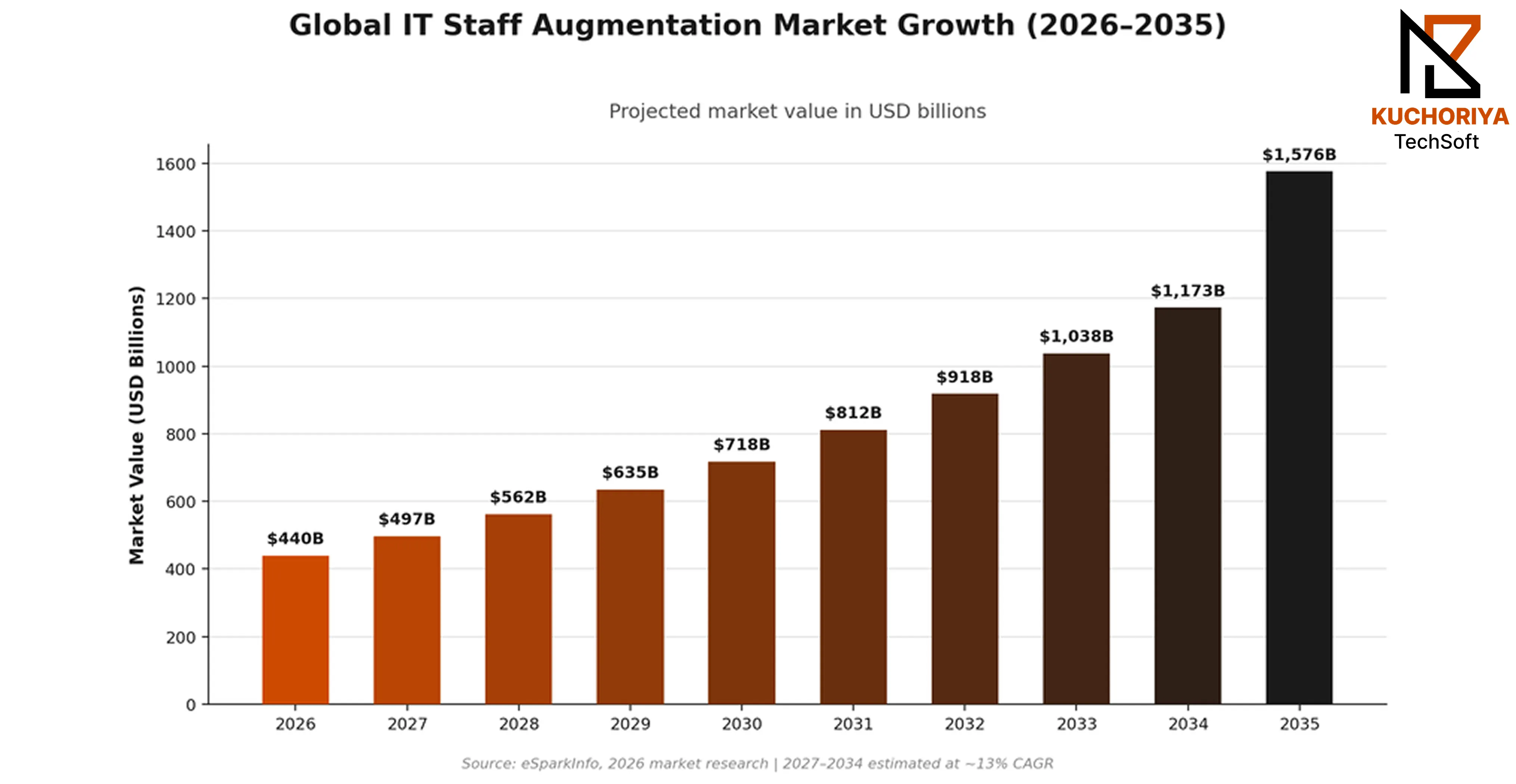
The global IT staff augmentation market crossed $439 billion in 2026 and could hit $1.5 trillion by 2035 (Source). Numbers like these explain why so many businesses are stuck picking an offshore hiring model without knowing the real difference between offshore engagement models. Some need AI staff augmentation for niche skills, others want stable offshore software teams, and a few are building toward a full offshore development center USA setup.
Choosing the right offshore engagement model matters more than chasing the lowest price. Broader enterprise outsourcing models and software development outsourcing strategies all come back to this same decision eventually. Here's where each one actually fits.
What Is Staff Augmentation?
Staff augmentation means slotting outside developers into your team without putting them on payroll. The vendor handles hiring and paperwork; you run the actual work.
- An IT staff augmentation services setup matches vetted developers to a role you've already defined; most start within days, not weeks.
- The staff augmentation model exists mainly to close skill gaps fast, skipping the months-long hiring process most companies dread.
- Speed is the biggest draw among the benefits of staff augmentation; you scale up or down as the project shifts.
- Staff augmentation for startups makes sense when cash is tight and the roadmap keeps changing every few weeks.
- Companies that hire staff augmentation developers usually need one senior engineer for a single sprint, not a full-time hire.
- Staff augmentation services UK and similar regional providers open up talent that's simply not available in the local market.
- More teams now rely on AI-powered offshore team management to match candidates and track augmented staff, cutting down the admin work.
- None of this holds up without solid remote engineering teams habits underneath, documentation that's actually maintained, sprints with clear owners, and people who reply on time.
What Is an Offshore Development Center (ODC)?
An offshore development center is a long-term team built exclusively for one client, housed and managed by the vendor but run under your own processes.
- Most clients don't realize this until later, but a dedicated offshore development center shares your reporting structure and goals too, not just a task list handed off every sprint.
- Companies with a roadmap stretching past a year tend to lean on the ODC model, mainly because continuity ends up mattering more than a short burst of extra hands.
- ODC services typically bundle infrastructure, HR, and compliance, so you're not managing three vendors just to keep one team running.
- Firms offering offshore development centre services structure pricing as a fixed monthly cost, which makes budgeting far more predictable than hourly billing.
- A dedicated development team under this model compounds product knowledge sprint after sprint, something rotating contractors rarely manage.
- Building a dedicated ODC team takes longer to launch, usually six to ten weeks, but the payoff shows up in delivery consistency later.
- ODC services in Dubai and similar regional hubs are gaining traction as companies look beyond the usual outsourcing destinations.
- A dedicated AI development center follows the same ODC logic, just applied to teams building AI and machine learning products specifically.
- The model leans heavily on IT resource augmentation at the setup stage, before the team stabilizes into its own independent rhythm.
What Is the Build-Operate-Transfer (BOT) Model?
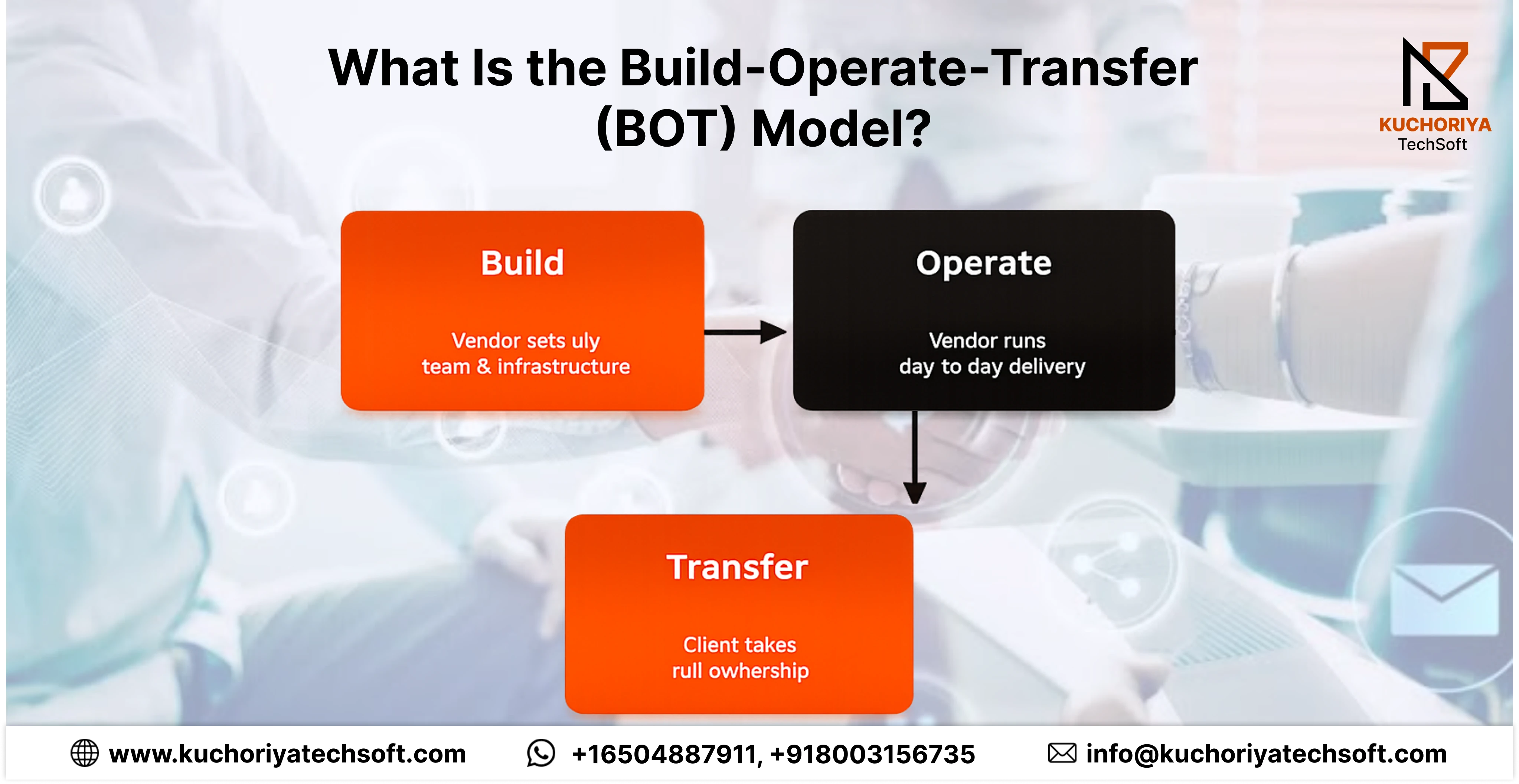
The build-operate-transfer model hands a vendor the job of setting up and running your offshore team, then transfers full ownership to you once things stabilize.
- A BOT model offshore setup runs in three phases, build, operate, transfer, so the risk of starting from scratch never sits entirely on your shoulders.
- Vendors offering build-operate-transfer services usually handle everything from hiring to legal entity setup before you take over day-to-day control.
- Choosing a BOT engagement model makes sense when the goal isn't just delivery; it's owning a permanent offshore presence eventually.
- BOT offshore development works best for companies planning a multi-year horizon, not a single product release.
- Teams pursuing build-operate-transfer software development get the benefit of a fully operational unit before they're responsible for running it themselves.
- A typical BOT model timeline stretches 18 to 36 months, build takes months, operate takes over a year, transfer wraps things up.
- Enterprises chasing a captive center ownership model almost always land on BOT since it's the only structure where legal ownership actually moves to the client.
- An offshore engagement model Spain based company might choose, would look similar in structure, though compliance and labor law details shift by region.
- Even AI engineering ODC setups sometimes evolve into BOT arrangements once a company decides it wants that offshore AI team under its own roof long-term.
Staff Augmentation vs ODC vs BOT
Comparing staff augmentation vs. dedicated ODC vs. BOT side by side cuts through most of the confusion. Cost, control, speed - none of the three models handle these the same way.
ODC vs. staff augmentation usually comes down to timeline; augmentation gets a developer in days, ODC takes weeks but builds something that actually lasts.
- BOT vs ODC is really a control question; ODC gives you a managed team, BOT eventually hands over the whole operation.
- A proper offshore engagement model comparison means weighing cost against how much oversight your team can realistically manage.
- The offshore engagement model selection matrix scores your business across five factors to point you toward a model that fits.
- This scoring approach, known as the OEMSM framework, replaces guesswork with something closer to a checklist.
- Companies comparing different offshore team engagement models rarely get it right on cost alone; structure matters just as much.
- An offshore team Australia based company weighing these options usually starts with staff augmentation before committing further.
- Teams that hire AI developers offshore often lean toward augmentation first, since AI talent needs shift too fast for a long ODC contract.
- Building distributed engineering teams across models isn't unusual, some workstreams sit in augmentation while the core product runs as an ODC.
Cost Breakdown: What Each Model Actually Costs
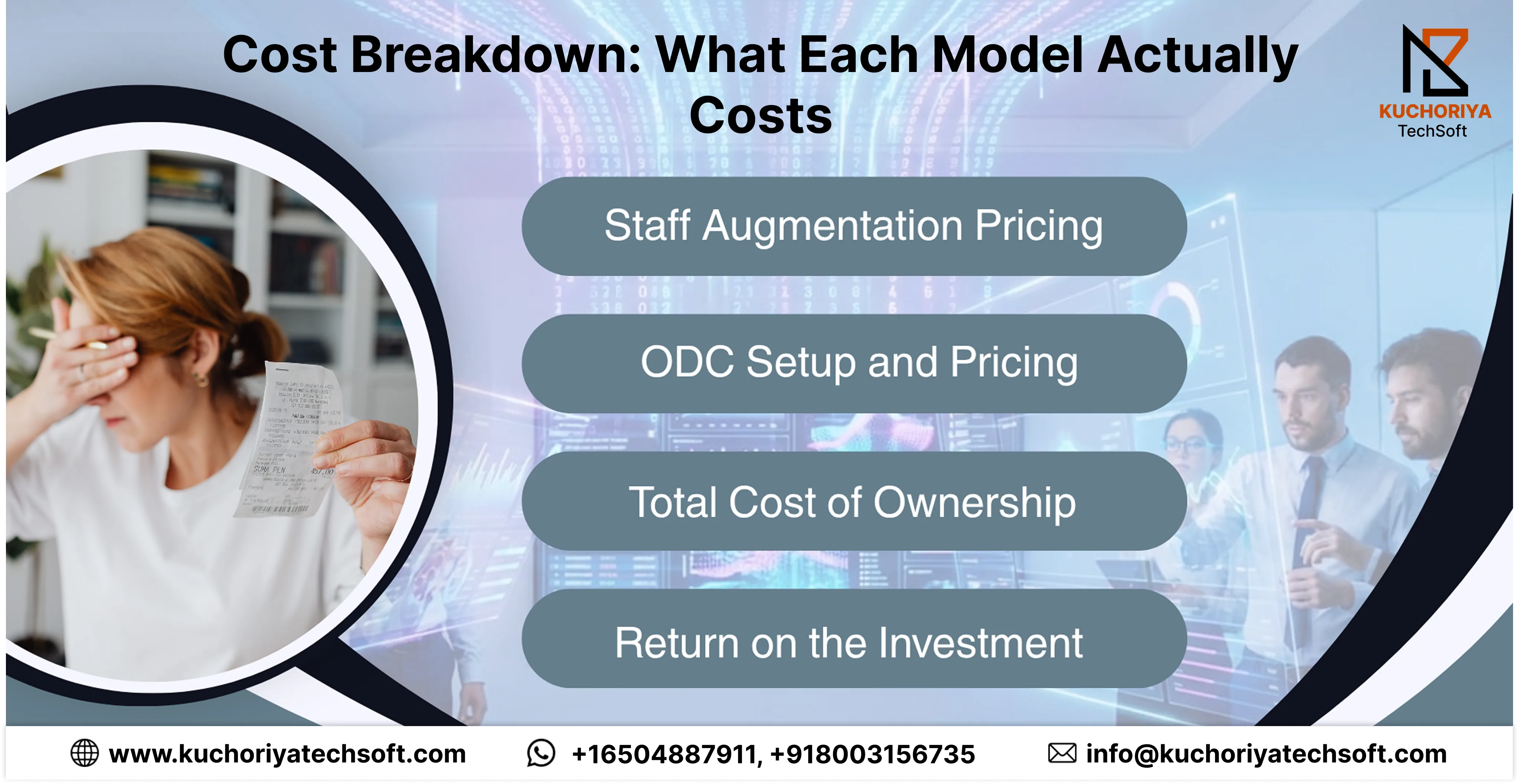
Numbers change the conversation fast once budgets get real. Here's how staff augmentation pricing, ODC, and BOT actually stack up.
1. Staff Augmentation Pricing
Staff augmentation cost structure runs hourly or monthly, no setup fees, no infrastructure cost, just pay for the hours or the month.
2. ODC Setup and Pricing
ODC setup cost stays low to medium since there's no legal entity involved, and the ODC pricing model works as a fixed monthly retainer covering the whole team.
3. Total Cost of Ownership
Looking at total cost of ownership offshore matters more than the sticker price, management overhead and knowledge loss add up fast if ignored. Running the numbers through TCO offshore engagement models usually favors ODC once a team crosses 12 to 24 months.
4. Return on the Investment
An honest offshore engagement model cost comparison and offshore team cost comparison should include hiring speed and retention, not just the invoice, since offshore hiring cost breakdown and offshore engagement ROI both shift depending on how long the team stays intact.
Must Read: IT Staff Augmentation Services
Offshore Software Development in 2026: Cost, Benefits, Trends & Best Countries to Hire Developers
Top 15 Offshore Software Development Companies in Dubai, UAE 
How to Choose the Right Offshore Engagement Model
Picking between the three models comes down to five practical factors, not gut feeling.
1. Budget and BOT Ownership Transfer
Staff augmentation flexes with headcount, no upfront cost. ODC needs a fixed monthly commitment. BOT demands the highest investment upfront, with BOT ownership transfer happening only after that cost is absorbed.
2. Project Duration and Staff Augmentation Timeline
Short, defined work fits staff augmentation. A multi-year roadmap points toward ODC or eventually BOT once the staff augmentation timeline stretches past what makes sense for a temporary hire.
3. Control and the Offshore Model Selection Framework
An offshore model selection framework should weigh how much day-to-day oversight your team can actually handle, not just what sounds ideal on paper.
4. Hiring Speed and the Offshore Engagement Decision Matrix
Staff augmentation wins here, often onboarding in days. Running the decision through an offshore engagement decision matrix helps when speed and long-term fit pull in different directions.
5. Long-Term Goals and Enterprise Digital Transformation
Companies planning enterprise digital transformation at scale usually need more than a temporary offshore resourcing model. Strong offshore team management practices and a stable offshore delivery center matter more once the goal shifts from filling gaps to building lasting capability.
A staff augmentation company Canada based enterprise looks different from one running AI development staff augmentation, since AI roles often need faster, more specialized hiring cycles than standard engineering augmentation.
Which Model Works Best for Enterprises?
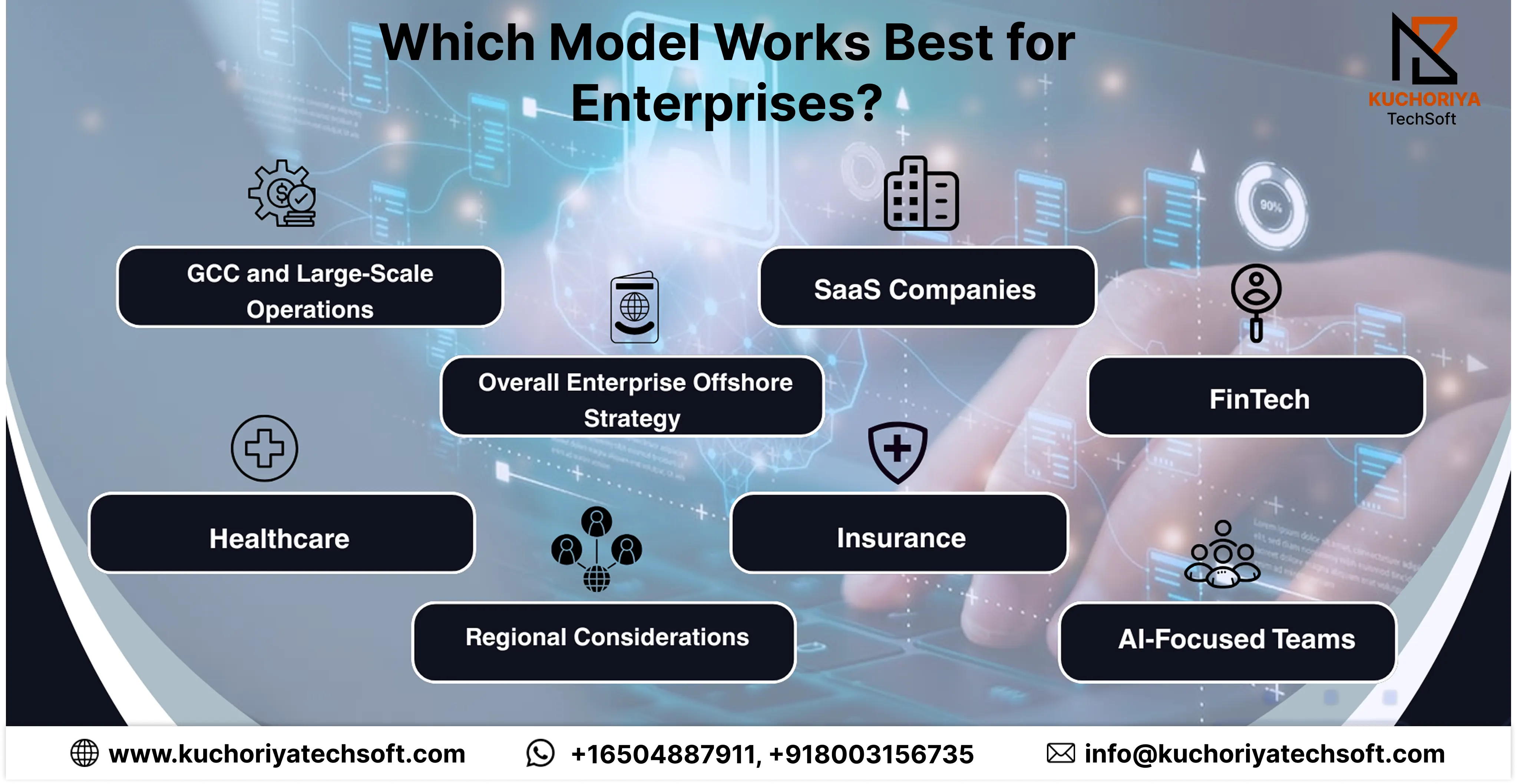
The right fit shifts by industry and scale, here's how enterprise offshore engagement models typically play out across sectors.
1. Overall Enterprise Offshore Strategy
A solid enterprise offshore strategy rarely locks into one model forever. Most large companies start with staff augmentation, move to ODC, and eventually build toward a global capability center as headcount and complexity grow.
2. GCC and Large-Scale Operations
The GCC offshore model works for companies with 50+ offshore roles and a multi-year horizon, usually paired with an ODC first before transitioning toward full ownership.
3. SaaS Companies
An offshore engagement model for SaaS companies almost always favors ODC, continuous product development needs a team that stays intact release after release.
4. FinTech
Offshore engagement model for FinTech decisions lean heavily on compliance. ODC with embedded governance is the safer starting point given how strict financial regulations get.
5. Healthcare
Offshore development for healthcare compliance demands contractually enforced privacy controls; ODC handles this better than staff augmentation ever could on its own.
6. Insurance
An offshore model for insurance companies needs defined data governance and audit rights, sensitive policyholder data doesn't tolerate loose oversight.
7. Regional Considerations
An offshore development center Hong Kong based setup faces different compliance and labor considerations than one in India or Eastern Europe, worth factoring in before signing anything.
8. AI-Focused Teams
Enterprises building an offshore AI engineering team often need faster iteration cycles than a standard ODC, closer to a hybrid between augmentation and dedicated delivery.
From First Hire to Full Ownership: The Offshore Transition Playbook
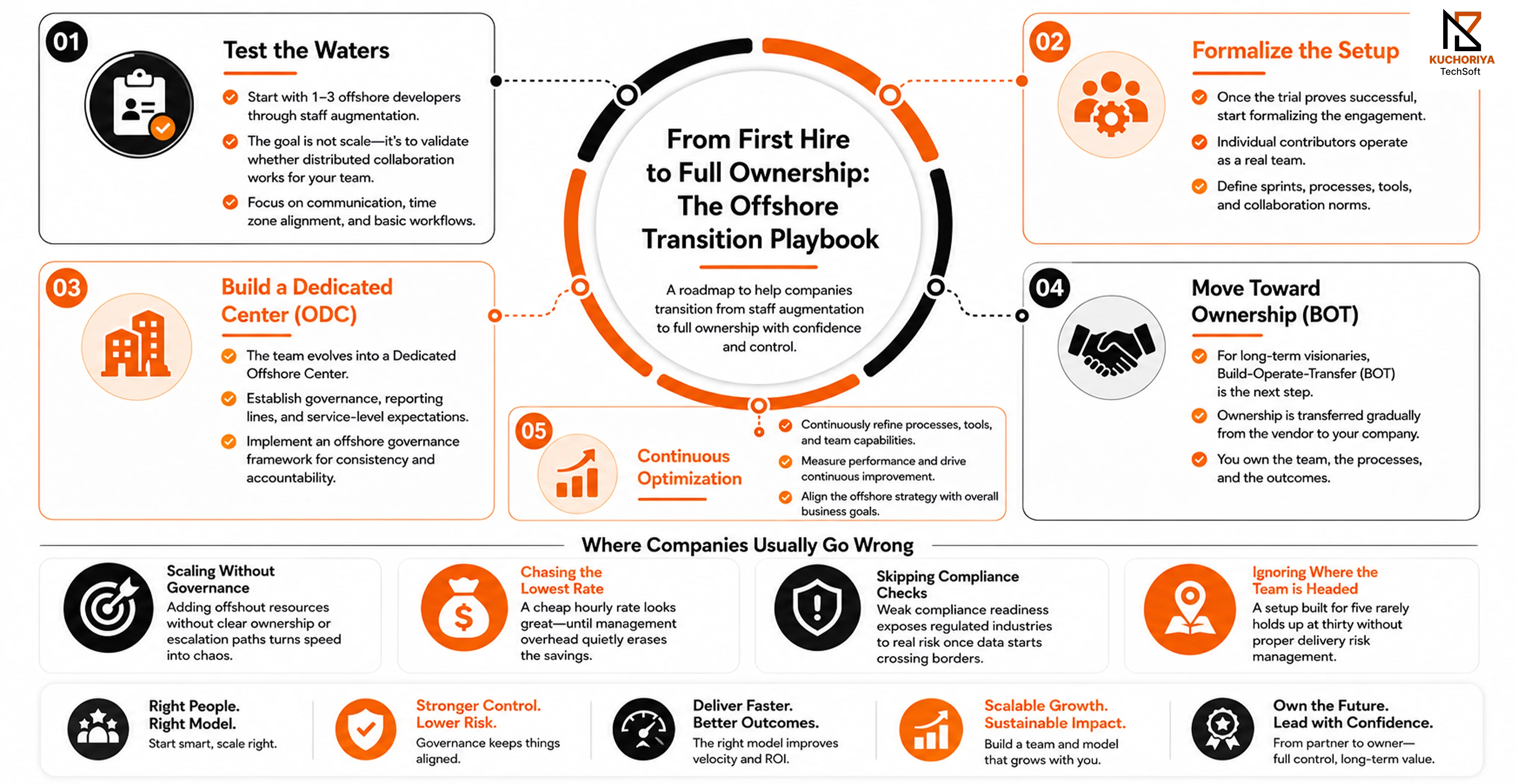
Most companies don't land on the right model on day one, and that's expected. An offshore engagement transition roadmap helps map out where you are versus where you're headed, and where things usually go wrong along the way.
How the Transition Usually Plays Out
Phased offshore adoption rarely happens in one jump. It tends to follow four rough stages:
- Test the waters – bring in one to three offshore developers through staff augmentation first. The goal isn't scale, it's finding out whether distributed collaboration actually works for your team.
- Formalize the setup – once the trial holds up, individual contributors start operating like a real team, with defined sprints and shared processes.
- Build a dedicated center – the team graduates into a proper ODC, complete with a working offshore governance framework and service-level expectations.
- Move toward ownership – for companies with a long enough horizon, BOT comes in here, the vendor hands off control gradually until the client owns the whole setup.
Where Companies Usually Go Wrong
Solid offshore vendor management best practices catch most of these early:
- Scaling without governance – adding offshore hands without clear ownership or escalation paths turns speed into chaos, this is one of the most common offshore hiring mistakes teams make.
- Chasing the lowest rate – a cheap hourly cost looks great until management overhead quietly erases the savings.
- Skipping compliance checks – weak offshore compliance readiness exposes regulated industries to real risk once data starts crossing borders.
- Ignoring where the team is headed – a setup built for five rarely holds up at thirty without proper offshore delivery risk management in place.
A Quick Readiness Check Before You Commit
Running an offshore team readiness checklist before you sign anything that includes documentation, financial visibility, internal bandwidth, compliance support, and growth plans is exactly what separates scaling offshore teams safely from a partnership seeking a six-month solution.
Why Kuchoriya TechSoft for Your Offshore Engagement Needs
Picking the right model is only half the decision, the partner running it matters just as much.
1. Experience Across Every Engagement Type
Kuchoriya TechSoft brings an offshore engineering team structure that adapts to whatever stage your business is at, not a one-size-fits-all package pushed regardless of fit. As an offshore software development company with offices across the USA, UAE, Australia, Canada, and Singapore, we've built teams for startups needing a quick augmentation hire and enterprises building a full offshore product development center from scratch.
2. Clarity on Staff Augmentation vs Outsourcing
Most vendors blur the line between staff augmentation vs outsourcing, we don't. Our teams walk you through the actual difference before recommending a model, so you're not sold the wrong structure because it's easier for us to staff.
3. Deeper Governance Than Standard IT Outsourcing Models
Where typical IT outsourcing models stop at delivery, we build in reporting, escalation paths, and defined ownership from day one, so you always know exactly what your offshore team is working on.
4. Industry-Specific Execution
Whether it's an offshore engagement model for ecommerce handling seasonal scaling, or an offshore model for manufacturing companies managing domain-heavy ERP builds, our teams come with prior context instead of a learning curve on your dime.
5. Global Reach Without Losing Consistency
Clients running an offshore engagement model Mexico based team get the same delivery standard as our teams anywhere else, we don't dilute quality just because the geography changes.
6. Built for AI-Driven Delivery
Our AI-driven offshore delivery approach means faster new releases by reducing code penalty, which is supported through real offshore AI product development experience across a pair of patron peaks.
What sets us apart: faster onboarding than most vendors promise, clear pricing with no hidden management fees, and a crew that sticks with your product instead of replacing mid-business.
Choosing the Right Offshore Model Starts Here
Most businesses don't stick with one model forever, and that's fine. Many staff augmentation companies work well as an entry point, then a natural staff augmentation-to-ODC transition happens once the roadmap stabilizes. From there, some pursue an ODC-to-BOT transition once full ownership becomes the actual goal.
A hybrid offshore engagement model often makes more sense than picking just one, especially when different parts of the business move at different speeds. What matters most is a phased offshore engagement strategy built around where you are right now, not where a vendor wants to place you.
Whether you need a proper offshore team scaling strategy, an offshore capability building roadmap, access through staff augmentation services Singapore, or specialized machine learning staff augmentation, the right partner meets you at your stage. No in-house tech lead yet? A fractional CTO can sit in on this decision too, it's not something you have to figure out alone. Got questions? Contact us; we're happy to walk through it. Or if partnering up sounds more your speed, our referral partner program is worth a look.
Frequently Asked Questions
Q. What's the difference between staff augmentation, ODC, and BOT as an offshore delivery model?
A. Staff augmentation adds individual developers to your team. ODC builds a dedicated team under the vendor's roof but your processes. BOT sets up and runs the team, then hands over full ownership once it's stable.
Q. Which model works better for agentic AI development outsourcing?
A. Most companies start agentic AI development outsourcing with staff augmentation, since AI talent needs shift fast and rarely fit a long-term contract right away. ODC comes later, once the roadmap settles.
Q. How does offshore compliance and IP protection differ across the three models?
A. Offshore compliance and IP protection gets stronger as you move from staff augmentation to ODC to BOT, loose augmentation contracts offer the least legal cover by comparison.
Q. What does an AI talent outsourcing model actually look like?
A. An AI talent outsourcing model usually blends specialized hires, prompt engineers, ML researchers, with a core team that handles integration. It rarely works as a single generic role.
Q. Is AI software development outsourcing harder to vet than regular outsourcing?
A. Yes, honestly. AI software development outsourcing needs people who've shipped real AI products before, standard engineering vetting doesn't catch that gap.
Q. What's the point of building an AI center of excellence offshore?
A. An AI center of excellence offshore pulls scattered AI expertise into one place instead of duplicating it across product lines. Makes sense once you've got more than one team asking for the same skills.