






In 2026, digital transformation has become the backbone of B2B growth, with over 70% of B2B buyers now preferring online purchasing for complex enterprise requirements. This shift has pushed businesses to invest heavily in B2B eCommerce website development and B2B eCommerce mobile app development, enabling faster procurement, personalized pricing, self-service portals, and seamless omnichannel experiences. Modern B2B buyers expect the same convenience as B2C—backed by enterprise-grade security, scalability, and performance.
To meet these expectations, organizations are increasingly adopting custom B2B eCommerce solutions that integrate smoothly with critical systems such as CRM, ERP, inventory management, and accounting platforms. A future-ready development approach—like the one delivered by Kuchoriya TechSoft—helps enterprises streamline operations, reduce manual workflows, improve order accuracy, and enhance long-term customer relationships through intelligent automation and data-driven insights.
Looking ahead, the global B2B eCommerce market is projected to reach nearly $25 trillion by 2027, making 2026 a decisive year for businesses to modernize their digital commerce strategies. From scalable B2B eCommerce platform development and AI-powered features to multi-vendor marketplaces, advanced analytics, and conversion-focused digital marketing, enterprises must build ecosystems that are flexible, secure, and growth-oriented. This in-depth guide covers everything you need to succeed in 2026—from cost breakdowns and must-have website features to AI integration, marketplace models, and emerging trends that are shaping the future of B2B eCommerce and driving real, measurable business growth.
What is B2B eCommerce, and why does it matter in 2026?
B2B eCommerce involves online transactions between businesses rather than end consumers. It is designed for bulk purchases, negotiated pricing, and multi-level approval workflows, which are essential for enterprise buyers in 2026. With the growing demand for ecommerce website development and b2b ecommerce website development, companies are increasingly investing in custom ecommerce website development to manage large-scale orders efficiently across digital channels.
At the same time, enterprises are adopting ecommerce mobile app development, including mobile app development for ecommerce and mobile ecommerce app development, to provide faster access, real-time order tracking, and seamless purchasing experiences. Understanding ecommerce website development cost and ecommerce mobile app development cost has become crucial for businesses planning to build scalable and future-ready digital commerce systems.
The rise of B2B ecommerce software development and ecommerce website development services has enabled organizations to deliver personalized buyer portals, automate procurement processes, and scale operations with ease. Many enterprises now partner with an experienced ecommerce website development company or ecommerce website development agency to build secure, high-performance platforms.
Key benefits of B2B eCommerce platforms:
- Improved order accuracy and operational efficiency
- Better customer engagement through personalized portals
- Scalability to handle thousands of SKUs and buyers
Popular formats include B2B online marketplace development and enterprise B2B eCommerce solutions, where businesses choose between single-vendor platforms or multi-vendor marketplaces. To stay competitive in 2026, companies increasingly rely on custom ecommerce website development services and ecommerce mobile app development services to expand reach, improve efficiency, and drive long-term growth.
Critical Features of B2B eCommerce Websites and Apps (2026)
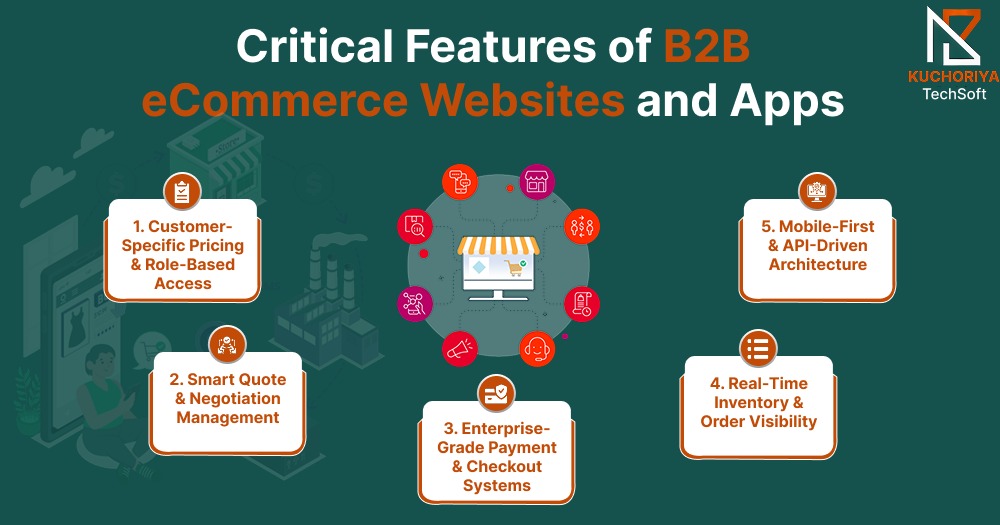
For a successful B2B eCommerce website design in 2026, platforms must align with modern eCommerce website development standards and scalable eCommerce web development practices. Businesses also need to balance functionality with the cost of B2B ecommerce platforms and ecommerce mobile app development to ensure long-term digital growth.
1. Customer-Specific Pricing & Role-Based Access
Advanced B2B eCommerce platforms should support custom pricing, catalogs, and permissions based on buyer roles, regions, or contracts—enhancing personalization and purchase control for enterprise users.
2. Smart Quote & Negotiation Management
An integrated quote management system allows buyers to request, modify, and approve quotes online, simplifying complex procurement workflows common in enterprise ecommerce solutions.
3. Enterprise-Grade Payment & Checkout Systems
Modern platforms require flexible checkout options such as invoices, credit limits, net payment terms, and multi-currency support, enabled through secure B2B payment gateway integration.
4. Real-Time Inventory & Order Visibility
Seamless integration with ERP and warehouse systems ensures real-time stock availability, order status, and shipment tracking—critical for scalable B2B ecommerce website development.
5. Mobile-First & API-Driven Architecture
With buyers increasingly using mobile devices, B2B eCommerce mobile app development, PWAs, and headless commerce architectures enable faster performance, omnichannel selling, and personalized buyer journeys across devices.
These core features help businesses build future-ready enterprise B2B ecommerce solutions that improve efficiency, boost buyer satisfaction, and drive sustainable growth in 2026.
Choosing the Right B2B eCommerce Platform in 2026
Choosing the right B2B eCommerce platform development approach depends on business size, industry type, budget, and scalability goals. In 2026, companies across manufacturing, wholesale, healthcare, logistics, and SaaS industries are adopting modern ecommerce website development and ecommerce web development solutions to support global B2B operations.
1. Magento B2B eCommerce Development
Magento is widely used by large enterprises due to its highly customizable architecture. It supports complex B2B workflows, large product catalogs, multi-store management, and advanced integrations, making it ideal for businesses operating across North America, Europe, and Asia-Pacific markets.
2. Shopify Plus for B2B eCommerce
Shopify Plus is best suited for companies that prioritize faster deployment and ease of management. It offers a clean interface, reliable cloud infrastructure, and essential B2B features, making it popular among retail, D2C-to-B2B, and fast-growing startups.
3. BigCommerce B2B Website Development
BigCommerce provides strong API-first and headless commerce capabilities. It is ideal for businesses that require seamless third-party integrations, omnichannel selling, and scalable solutions across US, UK, and global enterprise markets.
4. WooCommerce B2B Solutions
WooCommerce works well for businesses already using WordPress. With lightweight B2B extensions, it offers flexibility and cost efficiency, making it suitable for small to mid-sized businesses in local and regional markets.
Beyond platform selection, many organizations are shifting toward cloud-based B2B ecommerce platforms for improved security, performance, and global accessibility. While evaluating options, enterprises carefully consider the B2B ecommerce platform cost and the ecommerce mobile app development cost to ensure long-term ROI and sustainable growth.
With the right platform strategy and expert implementation support from Kuchoriya TechSoft, businesses can build scalable, secure, and future-ready B2B eCommerce ecosystems aligned with 2026 digital commerce trends.
CRM and ERP Integration: A Game Changer for B2B eCommerce in 2026
In 2026, seamless CRM and ERP integration has become a cornerstone of B2B eCommerce platform development. Businesses aiming for scalable growth rely on integrations that automate workflows, improve data accuracy, and enhance customer experiences across multiple digital touchpoints.
A. CRM Integration
Modern B2B eCommerce platforms integrate with leading CRM systems to centralize customer data, automate sales pipelines, and deliver personalized buyer experiences for enterprises in restaurant management software, online learning platforms, healthcare IT solutions, travel booking systems, media streaming platforms, logistics management software, fitness apps, fintech solutions, insurance management systems, real estate CRM software, automotive B2B portals, retail management solutions, manufacturing ERP software, social media marketing platforms, fleet management systems, banking CRM tools, and Fractional CTO services platforms.
1. Zoho CRM
Helps automate lead tracking, sales workflows, and customer engagement, making it ideal for restaurant ordering systems, retail distributors, and manufacturing procurement platforms.
2. HubSpot
Supports inbound marketing automation, customer journey tracking, and analytics for online learning portals, fitness apps, SaaS enterprises, and media streaming services.
3. Salesforce
Offers enterprise-grade CRM functionality with advanced automation and analytics, suitable for banking platforms, fintech solutions, insurance portals, automotive B2B marketplaces, and fleet management software.
CRM integrations enable automated follow-ups, precise sales forecasting, and personalized B2B buyer interactions, driving growth across diverse industries.
B. ERP Integration
ERP integration connects your B2B eCommerce website or mobile app with back-office systems, automating inventory management, procurement, invoicing, accounting, and supply chain workflows. Key industries benefiting include manufacturing ERP solutions, logistics management systems, automotive B2B portals, retail ERP platforms, healthcare management software, and real estate B2B systems.
1. SAP
Provides robust ERP tools to synchronize finance, inventory, and operations for enterprise manufacturing, banking, insurance, and large-scale retail organizations.
2. Microsoft Dynamics
Offers scalable ERP solutions for financial control and supply chain automation, commonly adopted by logistics providers, fleet management platforms, travel booking systems, and education management software.
By enabling real-time data flow between eCommerce platforms, CRM, and ERP systems, businesses reduce errors, ensure accurate pricing and inventory, and maintain operational efficiency. With expert implementation support from Kuchoriya TechSoft, enterprises can build fully connected, future-ready B2B eCommerce ecosystems optimized for sustainable growth in 2026.
Artificial Intelligence and Bots Transforming B2B eCommerce in 2026
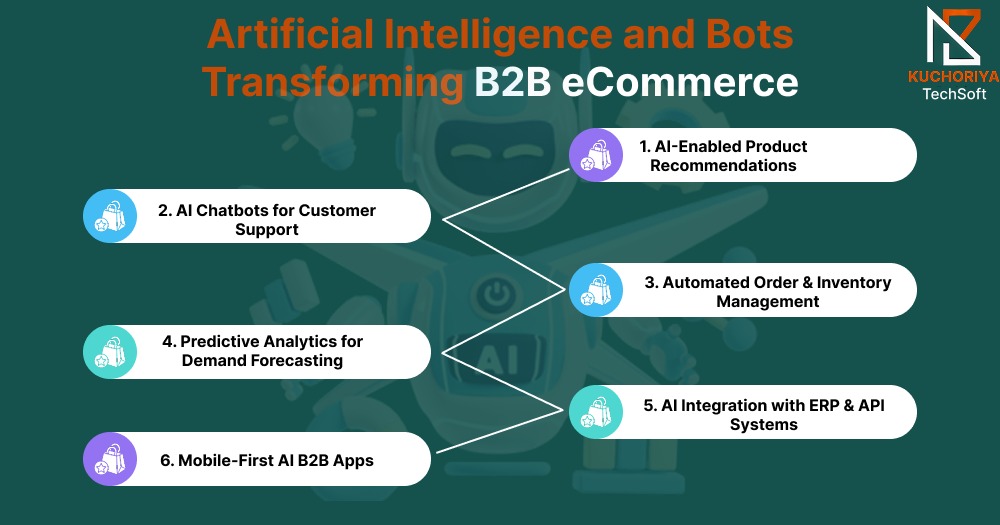
AI and intelligent bots are revolutionizing B2B eCommerce platforms in 2026, enabling personalized buyer experiences, automated workflows, and operational efficiency. With expert AI integration from Kuchoriya TechSoft, businesses can enhance performance across retail B2B marketplaces, healthcare eCommerce platforms, logistics management systems, fintech portals, manufacturing B2B apps, and SaaS enterprise solutions.
1. AI-Enabled Product Recommendations
AI analyzes buyer behavior to deliver personalized product suggestions, boosting conversions and average order value for industries like retail distribution, restaurant ordering platforms, and automotive B2B portals.
2. AI Chatbots for Customer Support
Intelligent B2B eCommerce chatbots provide 24/7 assistance, track orders, resolve queries, and upsell products. Ideal for travel booking platforms, healthcare management software, and fintech applications to improve customer retention and satisfaction.
3. Automated Order & Inventory Management
AI bots streamline order processing and inventory updates, reducing errors and optimizing supply chains. Works effectively for manufacturing B2B solutions, logistics management systems, and retail ERP platforms.
4. Predictive Analytics for Demand Forecasting
AI-driven predictive analytics help forecast demand, maintain optimal stock levels, and prevent overstock or stockouts. Beneficial for restaurant platforms, healthcare supply chains, and retail B2B marketplaces.
5. AI Integration with ERP & API Systems
Integrating AI with B2B eCommerce APIs and ERP systems automates procurement, invoicing, and accounting workflows. Drives efficiency for real estate B2B portals, insurance management systems, and fleet management software.
6. Mobile-First AI B2B Apps
Mobile B2B eCommerce apps powered by AI provide instant assistance, seamless navigation, and on-the-go ordering, enhancing engagement for SaaS platforms, travel portals, and healthcare apps.
Digital Marketing Strategies for B2B eCommerce Success in 2026
Effective digital marketing is essential for driving traffic, boosting conversions, and scaling B2B eCommerce platforms in 2026. By leveraging ecommerce website development, ecommerce web development, and mobile app development for eCommerce, businesses can create impactful marketing campaigns while keeping B2B ecommerce platform cost and ecommerce mobile app development cost in mind. With support from Kuchoriya TechSoft, companies can implement strategies that engage buyers across industries like retail B2B marketplaces, healthcare platforms, logistics solutions, fintech portals, manufacturing B2B apps, and SaaS enterprise platforms.
1. SEO and Content Marketing
Invest in B2B eCommerce SEO services focusing on industry-specific keywords such as restaurant ordering platforms, travel booking B2B portals, healthcare supply chains, and fintech solutions. High-quality content—including blogs, white papers, and case studies—builds credibility and positions your business as an industry authority.
2. Omnichannel Marketing
Integrate multiple channels to nurture leads effectively:
- Email marketing for B2B sales and follow-ups
- Social media campaigns targeting decision-makers in real estate portals, automotive B2B solutions, and retail distributors
- Retargeting ads to re-engage potential buyers
This ensures consistent messaging and strengthens the buyer journey across platforms.
3. Lead Generation & Customer Retention
Leverage B2B lead generation strategies like gated content, webinars, and interactive tools, while also implementing customer retention techniques such as loyalty programs, personalized offers, and AI-driven recommendations. Effective strategies boost engagement and sales across logistics management systems, manufacturing B2B portals, SaaS platforms, and healthcare B2B apps.
Types of B2B eCommerce Solutions: Single Vendor, Multi-Vendor & Hybrid (2026)
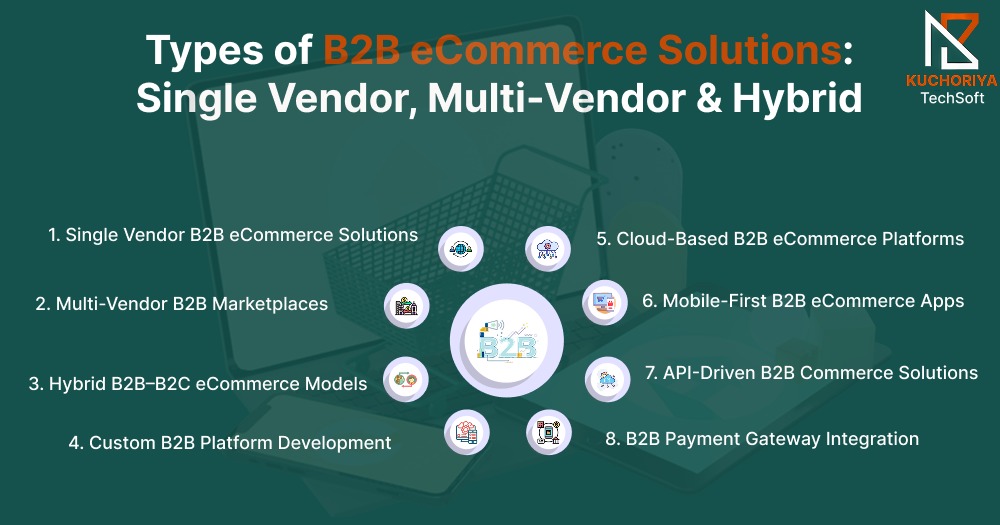
Choosing the right B2B eCommerce platform development model plays a critical role in scalability, performance, and long-term ROI. In 2026, businesses invest in flexible B2B eCommerce website development and mobile-first commerce solutions to meet evolving buyer expectations and enterprise requirements. With expert guidance from Kuchoriya TechSoft, companies can select the most suitable model based on their business goals and industry needs.
1. Single Vendor B2B eCommerce Solutions
A traditional B2B eCommerce website development model where a single business sells directly to other businesses. This approach supports customer-specific pricing, contract-based catalogs, and controlled buyer relationships.
2. Multi-Vendor B2B Marketplaces
B2B online marketplace development allows multiple sellers to list products on one platform, offering a wide catalog, competitive pricing, and scalability for retail distribution, manufacturing supply chains, and wholesale platforms.
3. Hybrid B2B–B2C eCommerce Models
Hybrid platforms combine B2B and B2C eCommerce features, enabling businesses to serve wholesale buyers and retail customers through a single system with flexible pricing and user roles.
4. Custom B2B Platform Development
Custom B2B eCommerce development focuses on scalable architecture, complex buyer roles, and seamless CRM and ERP integration, making it ideal for enterprises with unique operational workflows.
5. Cloud-Based B2B eCommerce Platforms
Cloud-based B2B eCommerce platforms ensure high scalability, advanced security, global accessibility, and smooth B2B eCommerce API integration for fast-growing businesses.
6. Mobile-First B2B eCommerce Apps
B2B eCommerce mobile app development and progressive web apps (PWA) support on-the-go purchasing with responsive design, real-time updates, and enhanced user experience.
7. API-Driven B2B Commerce Solutions
API-driven B2B commerce enables seamless integration with back-end systems, automates workflows, and improves efficiency across inventory, order management, and analytics.
8. B2B Payment Gateway Integration
Secure B2B payment gateway integration supports complex transactions such as invoices, purchase orders, credit limits, and net payment terms—essential for enterprise-level commerce.
Development Costs and Pricing Models for B2B eCommerce in 2026
Understanding the cost of B2B eCommerce website development is crucial for accurate budgeting and long-term digital planning in 2026. Development costs vary based on platform selection, customization requirements, integrations, and ongoing support. With strategic planning from Kuchoriya TechSoft, businesses can choose cost-effective and scalable B2B eCommerce development pricing models aligned with their growth goals.
1. Platform Choice
Costs differ significantly between open-source B2B eCommerce development platforms and SaaS-based B2B eCommerce solutions. Open-source platforms offer flexibility, while SaaS solutions provide faster deployment and predictable pricing.
2. Customization Level
Highly custom B2B eCommerce solutions, including advanced buyer roles, custom workflows, and industry-specific features, increase development effort and overall project cost.
3. Integration Requirements
Integrating CRM systems, ERP software, and B2B payment gateway integration adds to development costs but is essential for automation, real-time data sync, and enterprise-grade operations.
4. Design & Mobile Optimization
A responsive B2B eCommerce website design, along with B2B eCommerce mobile app development or progressive web apps (PWA), enhances user experience but requires additional investment.
5. Maintenance & Support
Ongoing B2B eCommerce website maintenance services—including security updates, performance optimization, and feature enhancements—ensure platform stability but involve recurring costs.
6. B2B eCommerce Pricing Models
Common pricing models include fixed-price projects for clearly defined scopes, hourly billing for flexible requirements, and retainer-based models for continuous development and support.
By understanding these cost factors, businesses can select the right B2B eCommerce development pricing model that balances budget, scalability, and long-term ROI in 2026.
Future Trends and Growth Tactics for B2B eCommerce in 2026 and Beyond
As the global digital ecosystem continues to evolve, B2B eCommerce is entering a phase of rapid innovation and expansion in 2026. To remain competitive, businesses must adopt future-ready technologies and data-driven growth strategies that enhance scalability, performance, and buyer experience. With strategic support from Kuchoriya TechSoft, enterprises can align with emerging trends and unlock sustainable growth.
Emerging B2B eCommerce Trends
- AI-enabled B2B eCommerce platforms are transforming personalization, automating buyer interactions, and improving decision-making across the entire purchasing journey.
- The rapid adoption of headless commerce for B2B allows businesses to build fast, flexible, and device-agnostic storefronts while maintaining powerful backend control.
- Cloud-based B2B eCommerce platforms are replacing traditional infrastructure, offering scalable, secure, and globally accessible solutions for enterprise operations.
- Growing investment in B2B eCommerce Progressive Web Apps (PWA) enables faster load times, mobile-first experiences, and improved customer engagement and retention.
Strategic Growth Tactics for 2026
- Implementing omnichannel B2B eCommerce marketing strategies helps deliver consistent buyer experiences across websites, mobile apps, social platforms, and digital marketplaces.
- Applying B2B eCommerce SEO best practices improves search visibility, organic traffic, and high-intent inbound lead generation in competitive markets.
- Advanced B2B eCommerce conversion optimization techniques, such as simplified checkout flows, personalized pricing models, and AI-powered search, are driving higher conversion rates and long-term ROI.
Portfolio: Successful B2B eCommerce Development Projects
A strong portfolio reflects real-world expertise in B2B eCommerce website development, marketplace solutions, and mobile-first commerce platforms. Below are some proven B2B eCommerce projects delivered with a focus on scalability, integration, and measurable business growth.
Project 1: Custom B2B eCommerce Website for Industrial Equipment Supplier
Kuchoriya TechSoft delivered a fully customized B2B eCommerce website for an industrial equipment supplier, integrating enterprise-grade systems like Zoho ERP and SAP to streamline backend operations.
Key Features:
- Customer-specific pricing models
- Bulk ordering and quote management
- Automated inventory synchronization
Result: Achieved a 40% increase in order volume and significantly improved sales workflow efficiency.
Project 2: Multi-Vendor Marketplace for Wholesale Distribution
For a wholesale distribution business, Kuchoriya TechSoft built a scalable B2B online marketplace platform with secure B2B payment gateway integration to support multi-seller operations.
Key Features:
- Dedicated vendor dashboards
- Real-time sales and performance analytics
- AI-powered product recommendations
Outcome: Expanded the vendor ecosystem and improved customer retention and repeat purchases.
Project 3: Mobile-First B2B eCommerce App for Foodservice Operations
Kuchoriya TechSoft developed a mobile-first B2B eCommerce app for a large foodservice distributor, integrating HubSpot CRM and AI-driven chatbots to simplify ordering and support.
Key Features:
- AI-assisted order placement
- Real-time customer engagement
- Optimized mobile user experience
Impact: Delivered a noticeable improvement in operational efficiency and faster order processing across the distribution network.
Final Thoughts: Launching & Scaling with the Right B2B eCommerce Partner
In today’s digitally driven landscape, successful B2B eCommerce is not just about launching a platform—it’s about scaling with the right strategy, technology stack, and execution partner. As we move through 2026 and beyond, businesses must focus on proven B2B eCommerce growth strategies, including scalable infrastructure, performance-driven ecommerce website development, and data-backed digital marketing.
Whether you are overcoming common B2B eCommerce development challenges or planning to adopt headless commerce architectures for speed and flexibility, choosing the right technology partner directly impacts long-term success. Platforms built with progressive web apps (PWA), real-time analytics, and mobile-first B2B eCommerce apps enable faster decision-making, better user experience, and sustained scalability.
With Kuchoriya TechSoft, businesses gain access to affordable B2B eCommerce solutions tailored to their industry, business model, and growth goals. From Shopify B2B, Magento B2B eCommerce, to WooCommerce B2B solutions, every implementation is designed to maximize ROI while supporting global and regional commerce requirements.
From defining custom B2B eCommerce development budgets to strategic execution, we ensure your platform is optimized not only for launch but for long-term growth. A clear understanding of B2B ecommerce platform cost and ecommerce mobile app development cost further helps businesses scale confidently with predictable outcomes.

Frequently Asked Questions (FAQs)
Q. What is B2B eCommerce development, and how does it help businesses scale?
A. B2B eCommerce development focuses on building digital platforms that enable businesses to sell to other businesses with features like bulk ordering, custom pricing, and approval workflows, helping automate operations and drive scalable growth.
Q. How much does B2B eCommerce website development cost in 2025–2026?
A. B2B eCommerce website development cost varies based on platform selection, customization, integrations with ERP or CRM, ecommerce website design, and ecommerce mobile app development requirements.
Q. Which B2B eCommerce platform is best for long-term growth?
A. The right B2B eCommerce platform depends on business needs—Shopify B2B for rapid scalability, Magento B2B eCommerce for enterprise-level customization, and WooCommerce B2B solutions for flexible and cost-effective development.
Q. Can B2B eCommerce solutions integrate with ERP and CRM systems?
A. Yes, modern B2B eCommerce solutions support seamless ERP and CRM integration, enabling real-time inventory management, automated invoicing, better customer data handling, and improved sales efficiency.
Q. Why is mobile-first B2B eCommerce important today?
A. Mobile-first B2B eCommerce apps and progressive web apps (PWA) improve user experience, accelerate purchasing decisions, and support on-the-go buyers, increasing engagement and conversion rates.
Q. How does SEO support B2B eCommerce lead generation?
A. B2B eCommerce SEO enhances organic visibility, targets high-intent industry keywords, drives qualified traffic, and helps generate consistent leads through search engines.