






Why Travel Marketplaces Are Driving the Future of Travel
Travel marketplace development is picking up fast, and the numbers explain why. The online travel market is headed toward USD 680 billion in 2026, and it's not even peaking yet, estimates put it at USD 684.2 billion this year, climbing to USD 1,370 billion by 2033. But the size isn't really the interesting part. What's interesting is that people are booking differently now. Mobile's overtaken desktop already, and it's mostly convenience, biometric logins, offline itineraries, alerts that pop up right when you need them.
That's the problem for old-school booking sites. Nobody wants five tabs open just to plan one trip. So an online travel marketplace fixes that, one platform, airlines, hotels, tours, rentals, all in the same place, and the business earns commission across every category instead of fighting for scraps in one.
If you're looking into travel technology solutions for 2026, the timing's good. Market's growing fast, and it's tilting hard toward mobile and AI-personalized booking. This guide gets into the marketplace types, the features you actually need, what it costs, and how to pick someone who knows what they're doing.
What Is a Travel Marketplace Platform?
A travel marketplace platform is where multiple vendors, hotels, airlines, tour operators list and sell their inventory through one shared system, instead of each running a separate booking site. That's basically the answer to what is a travel marketplace platform: it's not the same as a plain travel booking engine, which usually belongs to a single company. Here, several vendors plug into one system, and the platform owner takes a cut on every booking.
- Runs on travel marketplace software that handles listings, pricing, and bookings from multiple suppliers
- Different from a single-brand OTA (online travel agency) since it's built for many vendors, not one
- Vendors manage their own inventory, the platform just connects them to buyers
- Revenue comes from commission, not from owning the inventory
Types of Travel Marketplace Solutions
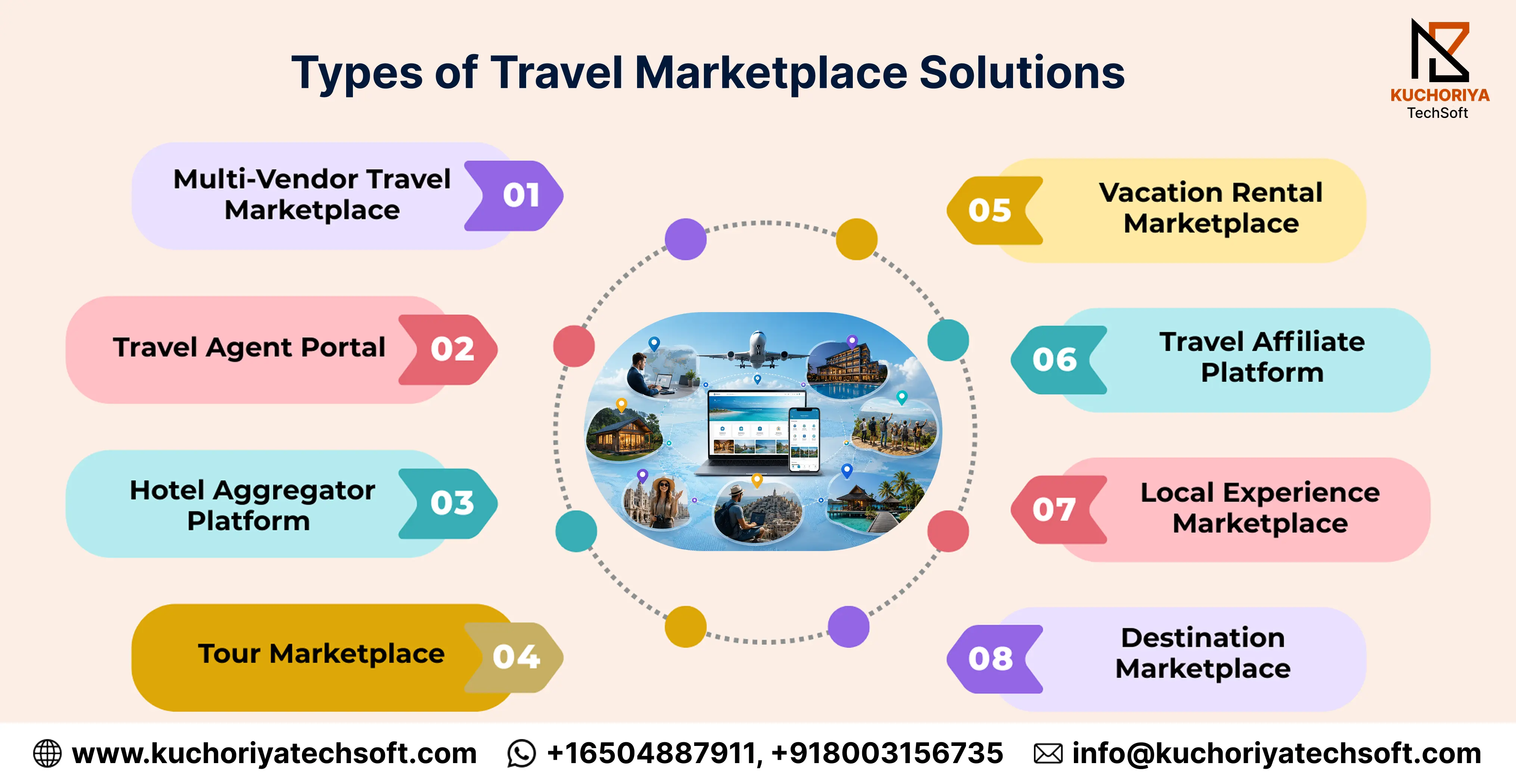
Not every travel business needs the same setup. The right type depends on who you're building for and how you plan to make money off it. Here are the main ones worth knowing.
1. Multi-Vendor Travel Marketplace
This is the big one. Hotels, airlines, tour operators, all sitting on one platform, the way Expedia or Booking.com does it. A multi-vendor travel marketplace doesn't rely on one category for revenue, it earns a cut across all of them.
2. Travel Agent Portal
Built for agents, not end customers. A travel agent portal lets agents log in, search inventory at negotiated rates, and book on behalf of their clients, usually with better margins than public pricing.
3. Hotel Aggregator Platform
This one's narrower, hotels only. A hotel aggregator platform pulls listings from several sources, direct hotel tie-ups, external booking systems, APIs, and stitches them into one search results page for the user.
4. Tour Marketplace
Here it's less about "where to stay" and more about "what to do." A tour marketplace lets tour operators and local guides list day trips and multi-day packages, stuff a hotel-only site wouldn't cover.
5. Vacation Rental Marketplace
Pretty much the Airbnb model. A vacation rental marketplace lets owners list short-term properties, guests book directly, and the platform earns its cut per stay, no hotel chains involved.
6. Travel Affiliate Platform
This model skips inventory entirely. A travel affiliate platform lets third parties promote listings elsewhere and earn a commission whenever their referral turns into an actual booking, low overhead, purely performance-based.
7. Local Experience Marketplace
Cooking classes, walking tours, adventure activities, a local experience marketplace is less about logistics and more about what someone actually does once they've landed.
8. Destination Marketplace
A destination marketplace bundles hotels, transport, and activities together, but scoped to one specific region or route rather than trying to cover the whole world.
Must-Have Features of a Travel Marketplace App, Platform & Portal
A good travel marketplace app has to work for three different groups at once, users, vendors, and admins. Miss one, and the whole travel booking platform starts feeling broken even if the other two are solid.
- Search filters, real-time availability, secure checkout, this is just the baseline, nothing fancy, but skip it and users bounce fast.
- Vendors need their own dashboard to handle listings, pricing, and payouts, otherwise they're calling support for every small change.
- Admin side needs commission tracking, vendor approvals, and analytics, honestly this is where most of the real travel marketplace features actually sit.
- Reviews, wishlists, booking history, small things, but they're what separate a finished app from something that still feels half-built.
- Multi-currency and multi-language support becomes non-negotiable the moment vendors or travelers start coming in from outside one region.
- Notifications for price drops, confirmations, itinerary changes, keep people checking your app instead of switching to five others.
- Recommendations based on past searches are getting close to expected now, not really a bonus feature anymore.
- A clear refund and cancellation process matters more than people think, it's usually the first thing someone checks before trusting a platform with money.
Business Models Behind Successful Travel Marketplaces
Most marketplaces don't stick to just one revenue stream, they stack a few together depending on what stage they're at.
- Commission-based pricing is the most common by far, a cut on every booking that goes through the platform.
- Subscription fees work when vendors want steady visibility, they pay a recurring fee just to keep listing.
- Freemium listings let vendors join for free, but better placement or extra visibility costs something.
- Featured placements are basically paid ranking, vendors pay to show up higher in search results.
- Licensing the whole platform out, white-label style, is common for agencies that want their own branded version without building from scratch.
This mix is really what shapes a travel marketplace business model long term. And for platforms leaning more toward agencies than individual travelers, a B2B travel marketplace setup usually makes more sense, bulk rates and licensing deals tend to matter more there than one-off bookings.
Key Benefits of Travel Marketplace Development

Building a proper marketplace instead of a basic booking site pays off in ways that aren't always obvious upfront. Here's what actually makes the investment worth it.
1. More Ways to Earn
Instead of one revenue stream, commissions flow in across hotels, tours, rentals, and whatever else vendors bring onto the platform. One of the clearest benefits of travel marketplace development is that income isn't tied to a single category anymore, which matters a lot in a tourism industry where seasonal demand swings hard.
2. Grows Without Breaking
A well-built platform doesn't need a rebuild every time a new vendor type gets added. That's the whole point of scalable travel marketplace software, new categories plug in instead of forcing a redesign, similar to how hospitality management systems scale as new properties come onboard.
3. Keeps Users From Leaving
When someone can book a flight, hotel, and tour without switching apps, they've got less reason to go elsewhere. That stickiness is hard to replicate with a single-vendor site.
4. Own the Data
Every search, booking, and cancellation tells you something about what travelers actually want. That data stays with the platform, not scattered across third-party tools, giving businesses in the travel and tourism sector a real edge in planning inventory and offers.
5. Trust Compounds Over Time
Vendors and travelers stick around longer when the platform holds up, uptime, secure payments, no random glitches during checkout. That reliability is basically what reliable travel marketplace solutions comes down to in practice, and it leans heavily on solid payment gateway integration behind the scenes.
6. Room to Compete With the Big Players
Niche or region-specific inventory is something giants like Expedia can't always match locally. A focused marketplace can win on specificity even without matching their scale, especially against larger online travel agency platforms that spread thin across too many markets.
Must Read: Top Travel Marketplace Solutions Development Company
Tech Stack & Integrations Needed to Build a Travel Marketplace
Getting the tech stack right matters more than people think, wrong choices here show up later as slow searches, failed bookings, or vendors who can't sync their calendars properly. Here's what a solid setup actually looks like.
None of this has to be built from scratch every time. Most established providers offer ready APIs, the real work is stitching them together so the platform feels like one system instead of eight different tools bolted onto each other.
Travel Marketplace Development Process (Step-by-Step)
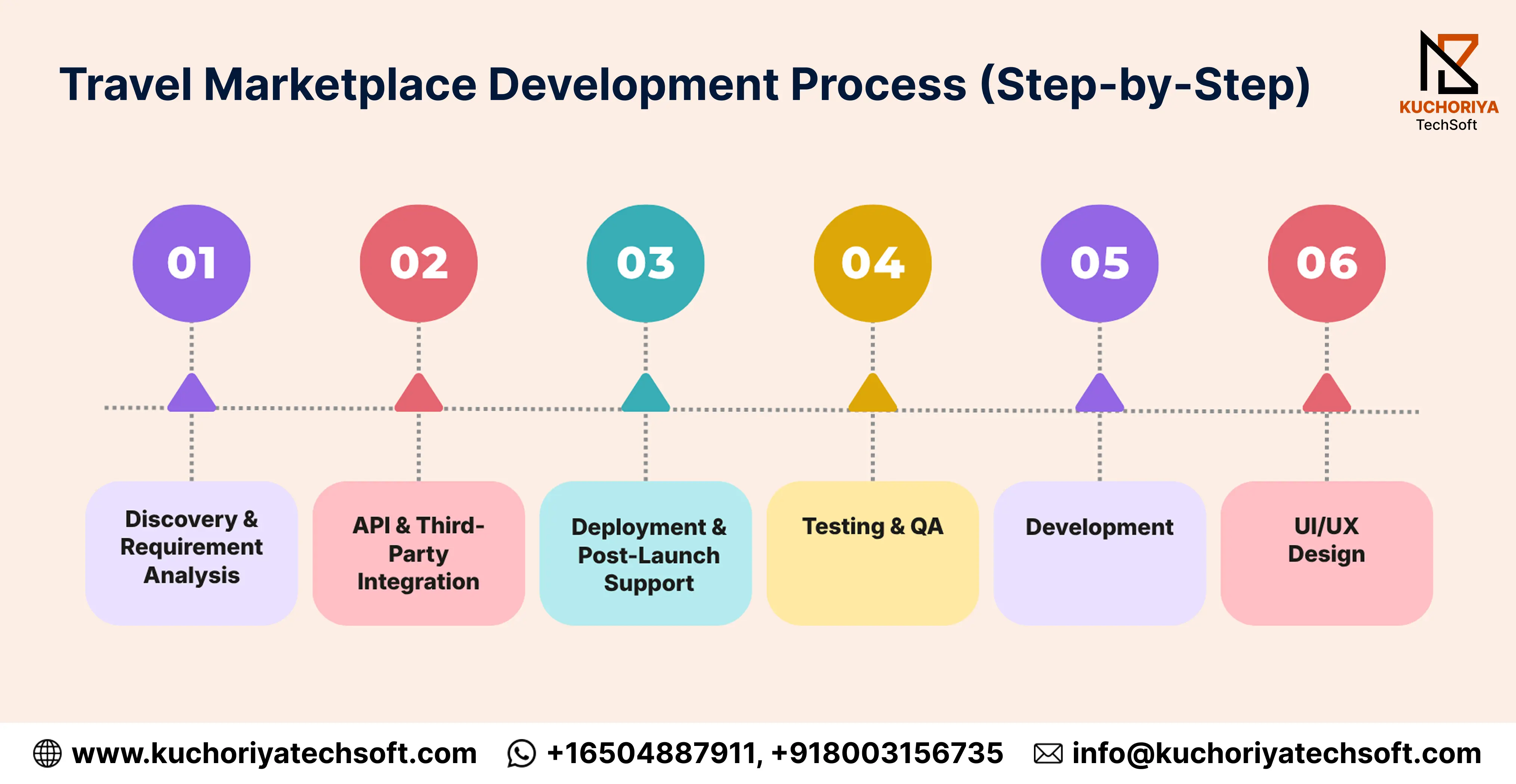
Want to know how to build a travel marketplace? It's less about chasing shiny features and more about getting the order right, skip a step and you'll pay for it later. Here's roughly how the travel marketplace development process goes.
1. Discovery & Requirement Analysis
First things first, lock down the business model, who you're building for, and what features actually matter. Rush this and you'll end up rebuilding half the thing months later, seen it happen too many times.
2. UI/UX Design
Three different experiences need wireframing here, one for users, one for vendors, one for admins. They don't behave the same way, so they shouldn't look or feel the same either.
3. API & Third-Party Integration
Flight, hotel, payment, maps, all get connected here. This part drags on the most, every provider's got its own weird quirks and documentation that's half-finished at best.
4. Development
Front-end, back-end, admin panel, ideally all moving at once in parallel sprints. Do it sequentially and your timeline blows way past whatever was quoted at the start.
5. Testing & QA
Functional checks, security testing, load testing across devices. Skip this and one small vendor-side bug can quietly break bookings for everyone on the platform without anyone noticing right away.
6. Deployment & Post-Launch Support
Launch day isn't the finish line, not even close. Bugs still show up, features still need updates. If you're figuring out how to build a travel marketplace app, budget time for this stretch too, not just the build itself.
Realistically, most teams wrap this whole process in 4 to 9 months, depends on how many integrations and platforms, web, iOS, Android, you're dealing with.
How Much Does Travel Marketplace Development Cost?
There's no single number here, it depends on scope. Here's a rough breakdown of travel marketplace development cost.
So how much does travel marketplace development cost? It really comes down to which row above matches what you're building.
What moves the price:
- Number of vendor types, hotel-only costs less than a full multi-vendor setup.
- How many APIs get integrated, GDS, payments, maps, each one adds time.
- Web-only vs. web + iOS + Android.
- Compliance needs like PCI-DSS or GDPR.
- Ongoing maintenance, usually 15-20% of build cost annually.
Costs often track close to what hospitality management systems and booking engine development projects run, since a lot of the API and payment groundwork overlaps.
How to Choose the Right Travel Marketplace Development Company
Picking a travel marketplace development company isn't just about who has the nicest portfolio, it's about who actually understands the travel-specific stuff, GDS integrations, OTA logic, multi-vendor payouts, that a general software vendor might miss.
- Look for a trusted travel development company with real experience shipping travel-specific platforms, not just e-commerce sites relabeled as marketplaces.
- Check if they explain their tech choices clearly, that transparency usually tells you whether you're working with a genuine custom travel technology company or just a template shop.
- Ask about post-launch support, a travel marketplace solution provider worth hiring should still be around after go-live, not just during the build.
- When you're ready to hire travel marketplace developers, ask for references from past travel projects specifically, general dev experience doesn't always translate well here.
Location matters too. Businesses across the USA, Canada, the UK, Australia, Dubai, Singapore, and India are all investing in this space right now, and each region comes with its own compliance quirks, GDPR in the UK, GST considerations in India, multi-currency norms across the Gulf and Southeast Asia. A company with experience across these markets tends to save you from expensive rework later.
Future Trends: AI & Automation in Travel Marketplace Development

AI isn't some far-off "future trend" here, it's already changing bookings right now. About 90% of travelers already know AI tools can help plan or book a trip, and over three-quarters of AI users say an AI recommendation was the main reason they booked what they did. That's a big enough number that platforms sitting this out are already behind.
1. AI-Powered Recommendation Engines
An AI-based travel recommendation engine watches what someone searched, clicked, skipped, all of it, and uses that to push suggestions that actually make sense for them. Way better than the same top-10 list every visitor sees.
2. AI Chatbots for Support and Booking
Chatbots have gone past just answering FAQs now. A lot of platforms use them to check availability or finish a booking outright. Build an AI travel booking platform around this, and wait times drop noticeably.
3. Dynamic, Demand-Based Pricing
Rates don't need to stay fixed anymore. With machine learning in travel booking, prices shift in real time based on demand and season, something a manual pricing team just can't match speed-wise.
4. Predictive Demand Forecasting
Instead of reacting after demand spikes, vendors get a heads-up before it happens. That means smarter inventory decisions and fewer panic price hikes at the last minute.
5. Voice and Conversational Search
People are typing (or saying) searches the way they'd talk to a friend now, something like "cheap beach trip in March." Platforms are catching up by moving away from rigid dropdown filters toward this kind of natural search.
6. AI-Native Marketplace Models
An AI-powered travel marketplace bakes all of this in from day one instead of adding it later as a patch. And this isn't a small trend either, 64% of travel operators are planning to spend more on AI over the next year, mostly to boost personalization and booking conversion.
Conclusion: Build a Future-Ready Travel Marketplace with the Right Partner
At this point, it's less about whether to build a travel marketplace and more about when. The market's growing fast, travelers expect everything in one place, and AI is quickly becoming table stakes rather than a bonus feature. Sitting on the sidelines just means competitors capture that demand first.
Getting there mostly comes down to picking the right travel marketplace development company, one that actually understands GDS integrations, vendor payouts, and multi-region compliance, not just general web development. Good travel platform development services should cover the full stretch too, not just the build, but post-launch support, updates, and scaling as the vendor base grows.
If you're running an agency or already have a referral network, it's worth asking potential partners about affiliate or referral programs upfront; some development companies offer discounted rates or ongoing support credits for partners who send them repeat business. And for larger operations looking at enterprise travel software solutions, it's worth getting a custom consultation rather than a generic quote, since enterprise needs (multi-vendor scale, custom compliance, dedicated support) rarely fit a one-size-fits-all package.
If you're ready to move forward, reach out for a free consultation; most serious development companies will walk through your requirements and give a realistic cost and timeline before you commit to anything.

Travel Marketplace FAQs
Q. How does a travel marketplace work?
A. It connects multiple independent suppliers, hotels, tours, agencies, on one platform, letting travelers search and book across all of them in a single flow.
Q. How much does travel marketplace development cost?
A. Cost depends mainly on how many supplier integrations you need and whether commission splitting is built in from the start, so it ranges widely between a lean MVP and a full platform.
Q. How do you create a travel booking marketplace?
A. Start by picking a model, single-vendor, multi-vendor, or aggregator, then build supplier onboarding, a booking engine, and payment splitting before adding search and reviews.
Q. Which travel marketplace business model works best?
A. It depends on supplier volume, commission-based models suit high booking volume, while listing-fee or subscription models fit a smaller, curated set of partners.
Q. Is a travel marketplace different from a travel agency website?
A. Yes, an agency site sells one company's own packages, while a marketplace hosts inventory from many independent suppliers who manage their own listings.
Q. How long does travel marketplace development take?
A. An MVP usually takes a few months, while a full platform with multiple live integrations takes longer depending on testing needs.