






Website Development Cost: An Overview
A friend of mine got quotes of $4,000, $22,000 and $61,000 last year for the same one-line brief: "a website for my consulting business." Same words, three totally different numbers. She called me confused, and honestly, fair enough.
Website development cost was never one figure to begin with. A five-page site for a bakery down the street and a booking platform with logins and payments both technically fall under "a website," but the work behind them isn't close. GoodFirms surveyed the industry and found the range runs from $3,000 to $150,000 or more, and both ends of that are true, just for very different projects (source).
So skip the average. Ask instead what your site will cost given what it actually needs to do. Type of site, how custom the design is, what's running on the backend, who's building it for you, all of it moves the number. Website development pricing can jump by tens of thousands over something that looked like a small ask on paper.
This guide covers all of that. Real cost to develop a website broken down by type, what goes into each stage of a build, and the costs that show up months after launch that most quotes never mention. Use it as a working website development cost guide for businesses planning a 2026 budget, not a number to hold agencies to. The better way to think about pricing anyway is the total cost of owning a website over its life, not just the first invoice.
How Much Does It Cost to Build a Website in 2026?
Had a client ask me this on Tuesday and I just laughed a bit, not because it's silly, but because I genuinely can't answer it in one line. How much does it cost to build a website? Depends what you mean by "website." I've built $500 landing pages. I've also seen full platforms cross $150,000. Neither one is wrong.
If we're talking about a normal small or mid-sized business site, most people end up somewhere in the $5,000 to $30,000 range. That's the average website development cost, and it usually buys you something mobile-friendly with SEO basics already sorted, nothing exotic.
Now if you want it broken down further. A basic 5 to 10 page site, think $2,000 to $8,000. Start throwing in custom features and it climbs, usually $8,000 to $25,000. Selling stuff online changes things a lot, expect $10,000 up to $50,000 depending on your catalog size. And full custom platforms or web apps? Those start near $30,000 and honestly just keep going from there once integrations get involved.
Getting an actual website development cost estimate, not a random figure someone pulled out of thin air, comes down to answering three things first. Page count. Whether you're selling anything. Whether users log in or pay through the site directly. Miss any of these and whatever number you're quoted is basically a guess dressed up as a quote.
Build your realistic website development budget off what your site needs to do, not off whatever someone else paid for theirs.
And this bit matters more now than it used to for website development cost in 2026 specifically. AI chatbots, smart search, that stuff isn't a nice-to-have anymore, it's just expected. So don't be shocked if quotes run higher than what you remember from a couple years back, that's why.
Website Development Cost by Website Type

"A website" means completely different things depending on who's asking. Here's what each type actually runs in 2026, plus who it fits and how to get eyes on it without burning cash on ads.
Landing Page
This is where landing page development cost stays lowest, one page, one job, usually pulling in leads or pushing a single offer.
- Cost: $500 – $2,500
- What you get: A headline that does the heavy lifting, a short form, one CTA, mobile-first
- Best for: Product launches, ad campaigns, event sign-ups
- Free growth move: A couple of well-placed posts where your audience already scrolls, plus a short email nudge, gets these filled without touching an ad budget at all.
Business & Corporate Website
Covers both business website development cost and corporate website development cost. Keep it simple and a small business website cost usually lands under $9,000. Bring in a designer who wants to reinvent the wheel and that changes fast.
- Cost: $1,500 – $17,000
- What you get: A handful of pages, a CMS your team can actually update, contact forms, basic SEO groundwork
- Best for: Local businesses and consultants going online for the first time
- Free growth move: Claim your Google Business listing, get on a few free local directories. Slow, unglamorous, works anyway.
Portfolio & Content Website
Portfolio website development cost and blog website development cost live here, since neither one is really selling anything, it's just showing work.
- Cost: $400 – $5,000
- What you get: Galleries, simple publishing, categories, sharing built in
- Best for: Freelancers, designers, writers building a body of work over time
- Free growth move: Pick the one platform your work already circulates on naturally and just stay consistent there instead of spreading thin across five.
E-commerce Website
Add a cart, secure checkout, and inventory logic, and ecommerce website development cost climbs quickly.
- Cost: $5,000 – $59,000+
- What you get: Product catalog, checkout, payment gateway, order tracking
- Best for: Brands selling physical or digital products directly
- Free growth move: Build the email list before you spend a dollar on ads. Get early customers talking about you. Organic TikTok and Instagram still work if it doesn't look like an ad.
Marketplace, SaaS & Enterprise Platforms
Marketplace website development cost, SaaS website development cost, and enterprise website development cost all sit near the top because these need multi-user systems and heavier infrastructure from day one, not bolted on afterward.
- Cost: $34,000 – $99,000+
- What you get: Vendor or subscription dashboards, role-based access, reviews, admin controls, scalable infrastructure
- Best for: Multi-vendor platforms, subscription software, large organizations needing custom internal systems
- Free growth move: Early users rarely come from ads. They come from a founder showing up in whatever community already cares, a subreddit, a Discord, wherever. Referral perks cost nothing and tend to work better anyway.
Custom Web Application
The catch-all bucket. Custom web application cost, web app development cost, booking website development cost, and membership website development cost all fall in here, basically anything built around user accounts and custom logic.
- Cost: $24,000 – $89,000+
- What you get: Authentication, custom dashboards, booking or membership systems, whatever integrations you already run on
- Best for: SaaS tools, booking platforms, internal software, membership sites
- Free growth move: A waitlist does more than people expect before launch, and the first real users come out of your existing network almost every time.

Website Development Cost Breakdown Calculator: How to Estimate Your Budget
Every quote is really just line items stacked on top of each other. Break those out, and the total stops feeling like a mystery number.
Here's what makes up the website development cost breakdown on most projects:
- Design & Planning: wireframes + layout + website UI/UX design cost, basically how the site feels once someone lands on it
- Development: frontend and backend development, everything visible plus everything running behind it, servers, databases, logic
- Content: website content development cost, copywriting, photography, graphics, whatever actually fills the pages
- Extras: third-party plugins, integrations, anything layered on once the core build is done
Rough split across a typical project:
Design usually runs 20-30% of the budget. Development takes the biggest bite, often 40-50%. Content sits around 10-20%, and whatever's left covers integrations depending on what the site needs to pull off.
The Cost Formula:
Total Cost = (Design Hours + Development Hours) × Hourly Rate + Content Costs + Third-Party Add-Ons
Not exact, obviously; every agency prices differently. But it gives you something to bring to a quote conversation instead of just nodding along to whatever number shows up.
Key Factors That Affect Website Development Cost
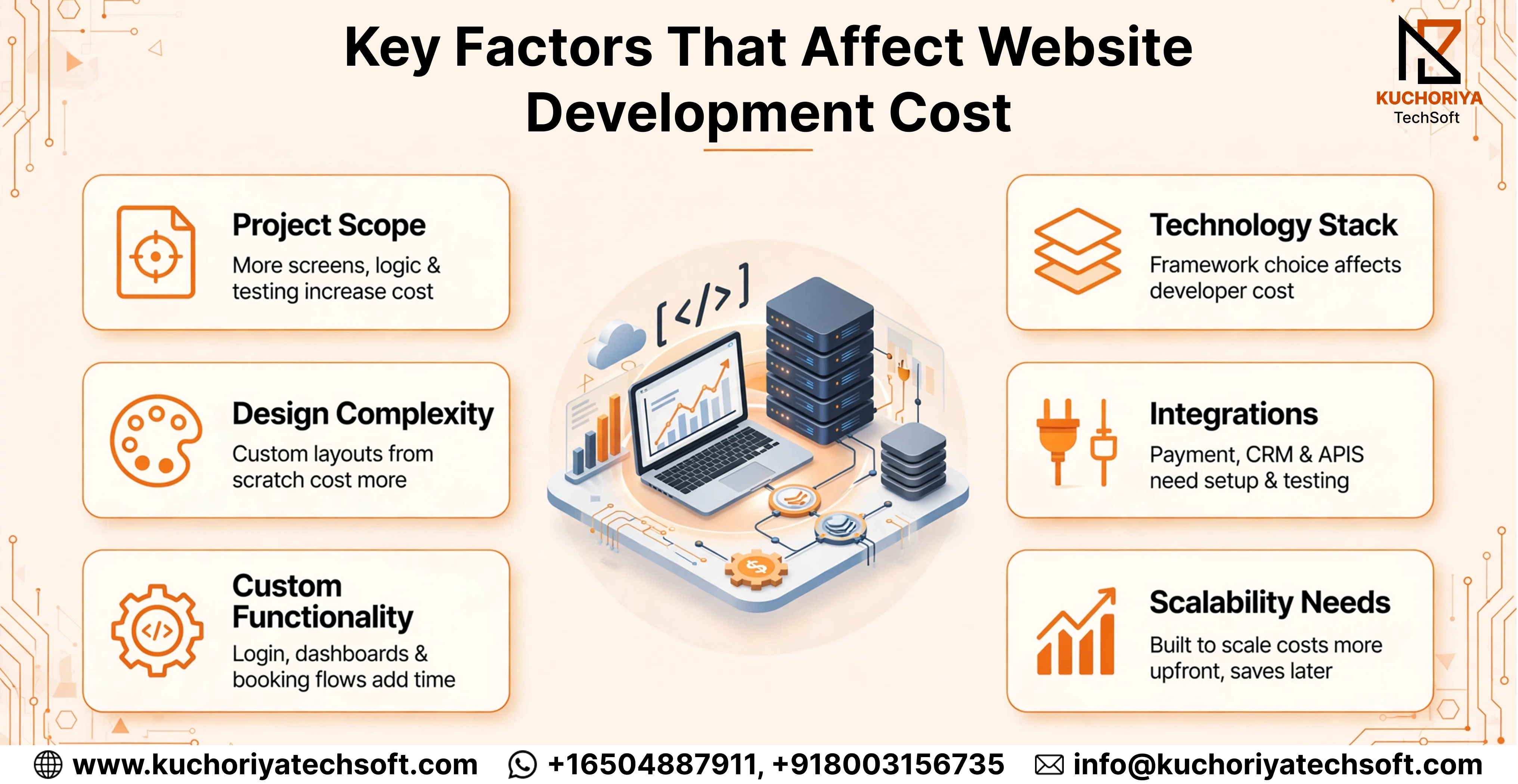
Two sites with the exact same page count can cost completely different amounts. The gap almost always comes down to a handful of things, not the number of pages at all.
Here are the factors affecting website development cost that actually move the number:
1. Project Scope
Bigger project scope means more screens, more logic, and more testing. A five-page brochure site and a booking platform aren't priced on the same scale, even if both technically qualify as "a website."
2. Design Complexity
Custom layouts push website design cost up fast. Template-based design keeps things cheap, but the moment you want something built from scratch, hours add up fast.
3. Custom Functionality
Login systems, dashboards, booking flows, anything falling under custom functionality adds real development time. Off-the-shelf features are quick. Anything custom isn't.
4. Technology Stack
"Tools like Laravel, ReactJS, or a simple WordPress development setup all price out differently. A custom full-stack development build using NodeJS or AngularJS costs more upfront than a CMS-based site, but scales better long-term."
Your choice of tools directly shapes website technology stack cost. Some frameworks are faster to build with; others need specialized developers who charge more per hour.
5. Integrations
APIs, payment gateways, CRMs, all of it adds to your website integration cost. Each connection needs setup time and ongoing testing to make sure it actually works.
6. Scalability Needs
Building for scalable architecture from day one costs more upfront but saves a rebuild later. Skip it, and growth becomes expensive fast.
Website Development Cost by Development Approach
Hired a freelancer for my first site years ago because it was cheap. Learned the hard way why price alone shouldn't decide this. Who builds your site changes the final number almost as much as the site itself does.
Here's roughly how website development company pricing shifts depending on who you go with.
Freelancers
Lowest cost on paper, no argument there. Works fine if you already know exactly what you want and the project's small. Gets riskier fast once the build gets bigger, because one person is doing design, development, testing, everything, all at once.
Agencies
Go with an agency and you're not hiring one person, you're getting a team. Designers, developers, someone doing QA, someone managing the project so things don't fall through cracks. That's why professional website development cost runs higher here. You're paying for structure, not just code.
In-House Teams
Only makes sense if you're building sites nonstop, not for a single project. Salaries, tools, benefits, all of that adds up whether you're actively working or not.
Should You Hire a Freelancer or Agency for Website Development?
Depends how big the project actually is. Small site, clear requirements, tight budget, a freelancer usually gets it done. But once custom website development cost starts climbing into five figures, or you need someone around after launch for updates and fixes, an agency tends to save you headaches down the line.
Quick Comparison
- A freelancer costs the least but carries the most risk once scope grows.
- An agency costs more but brings a full team and steadier timelines.
- An in-house team costs the most long-term, worth it only if you're building constantly.
Must Read: Full-Stack Development Cost: Detailed Pricing Breakdown
WordPress Website Development Cost: Complete Pricing Guide for Businesses
ASP.NET Website Development Cost: Complete Pricing Guide for Businesses
Website Development Cost Breakdown
Every quote is really just line items stacked on top of each other. Break those out and the total stops feeling like a mystery number.
Here's what makes up the website development cost breakdown on most projects:
1. Planning & Wireframes
Layout, user flow, and website UI/UX design cost, basically how the site feels once someone lands on it.
2. Build Phase
Frontend and backend development, everything visible plus everything running behind it, servers, databases, logic.
3. Copy & Media
Website content development cost, copywriting, photography, graphics, whatever actually fills the pages.
4. Add-On Tools
Third-party plugins, integrations, anything layered on once the core build is done.
Rough split across a typical project:
Design usually runs 20-30% of the budget. Development takes the biggest bite, often 40-50%. Content sits around 10-20%, and whatever's left covers integrations depending on what the site needs to pull off.
One thing worth noting here: these percentages shift a lot based on project type. An e-commerce build leans heavier on development and integrations, while a portfolio site puts more weight on content and design. Section 7 covers how to turn these numbers into an actual estimate for your specific project.
Hidden and Additional Website Development Costs
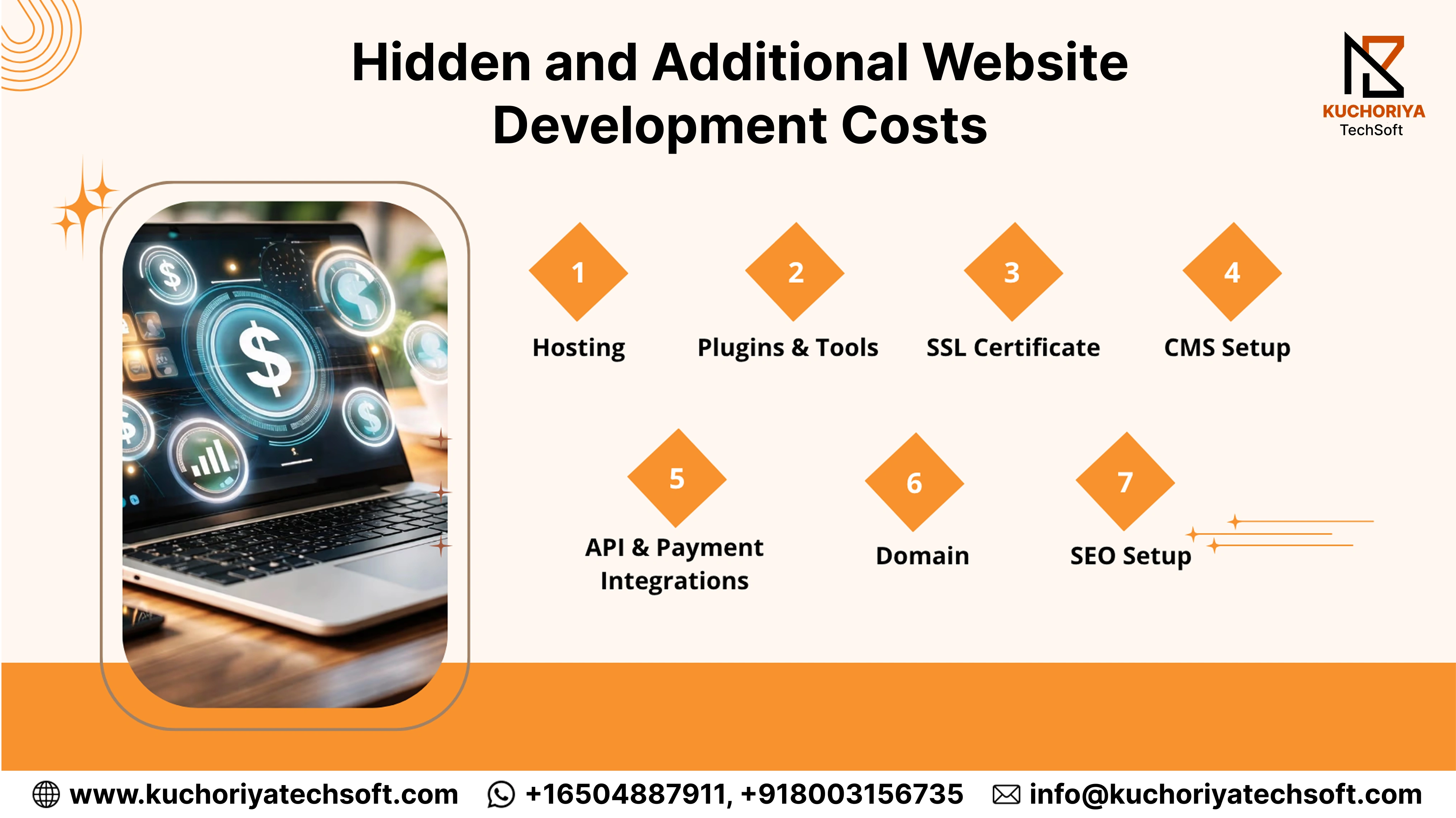
Got hit with an unexpected hosting renewal bill last year on a client project and that's when it clicked how much stuff never makes it into the original quote. The build itself is one number. Keeping the site running is a whole different set of numbers nobody mentions upfront.
Here are the most common hidden factors:
1. Hosting
A server is what keeps your website reachable around the clock. Reliable website hosting cost planning means your pages load quickly even during a traffic spike.
What it includes: Server space, bandwidth, uptime, backups
Cost: $5-$100+ per month
2. Domain
Think of this as your storefront sign online, the name people type to reach you. Domain registration cost looks tiny on paper, but it's a recurring bill, so it needs a spot in the budget every single year.
What it includes: Domain registration and annual renewal
Cost: $10-$50 per year
3. SSL Certificate
Skip this and browsers slap a "Not Secure" warning right next to your name, which does nothing good for trust. SSL certificate cost depends on how much encryption your site actually needs.
What it includes: Data encryption and a security padlock
Cost: $0-$300 per year
4. CMS Setup
A system like WordPress lets your team update pages without calling a developer every time. Getting CMS WordPress and Shopify set up right from day one avoids headaches later.
What it includes: installation, configuration, and basic structure
Cost: $100-$800
5. Plugins & Tools
Adds functionality without building everything from the ground up. Third-party plugin cost adds up quicker than people expect, especially once you're running several premium ones together.
What it includes: Extra functionality, forms, SEO tools, security
Cost: $500+ per year
6. API & Payment Integrations
This connects your site to the tools you already use, CRMs, email platforms, checkout systems. API integration cost for website work varies a lot depending on complexity, and payment gateway integration specifically needs extra testing before it goes live.
What it includes: Connecting third-party services and testing
Cost: $200-$2,000+
7. SEO Setup
Getting found on Google isn't automatic; someone has to actually set it up. Basic website SEO cost covers the groundwork that saves you from playing catch-up months later.
What it includes: Meta tags, sitemap, speed, structure
Cost: $200-$1,500
Add all of this up before signing off on any quote. A $10,000 build on paper can quietly become $12,000+ once hosting, SSL, and integrations actually get factored in.
Website Maintenance, Security & Support Costs
Launching a site isn't the finish line, it's more like day one of a much longer bill. Most people budget for the build and completely forget what comes after.
Here's what ongoing costs actually look like:
Break it down a bit more and it starts making sense. Website maintenance cost covers the routine stuff, updates and monitoring, basically what keeps a site from quietly falling apart. Website bug fixing cost and website backup cost are what save you when something actually breaks, and trust me, something eventually breaks. Website security cost deserves its own line item because one breach wipes out years of what you'd have spent preventing it.
Website performance optimization cost and domain renewal cost are the two people forget most, small numbers individually but painful when missed. Running a store adds its own weight, which is why ecommerce website maintenance cost sits higher than a standard brochure site. And eventually every site needs a refresh, that's where website redesign cost, website upgrade cost, and website support cost come into play.
Bottom line, whatever number you saw on the build quote isn't your final number. It's just where the bill starts.
Website Development Timeline: How Long Does It Take?
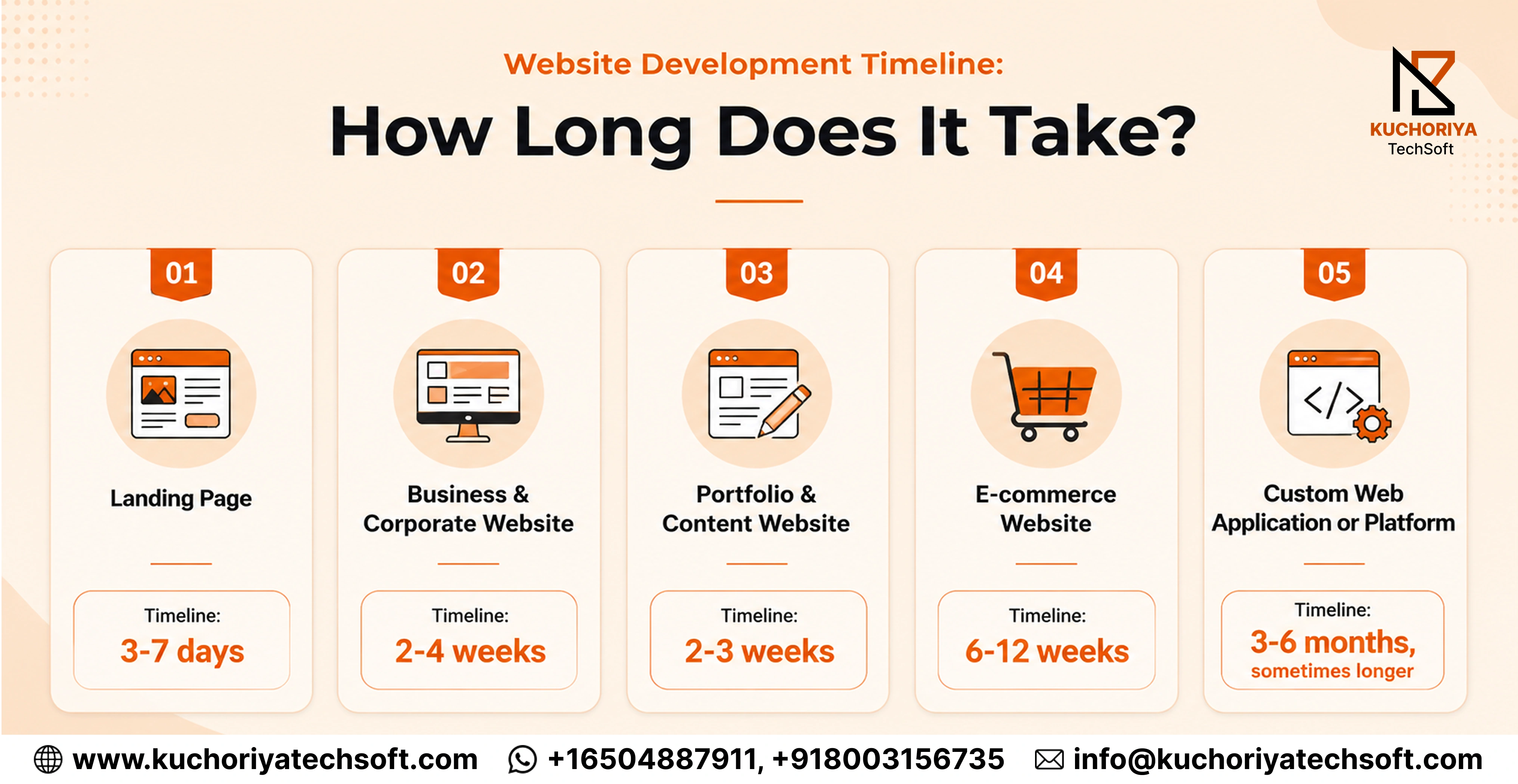
There's no single number for this, and anyone who gives you one without asking about your project first is guessing. A landing page and a full booking platform don't belong in the same sentence, let alone the same timeline.
1. Landing Page
One page, one purpose, usually wrapped in under a week once someone actually sends over the copy and images. The build itself is the easy part here.
Timeline: 3-7 days
2. Business & Corporate Website
Not hard because of the coding, it's the back and forth. Header bigger, then smaller, then back to the first version. Two to four weeks is normal once all that gets factored in.
Timeline: 2-4 weeks
3. Portfolio & Content Website
Site structure here is simple. What actually eats time is waiting on content, photos that need editing, bios that haven't been written yet.
Timeline: 2-3 weeks
4. E-commerce Website
This is where things stretch. Cart logic, payment testing, making sure checkout actually works before real money goes through it. Nobody wants that bug showing up after launch.
Timeline: 6-12 weeks
5. Custom Web Application or Platform
Doesn't really have a ceiling. Three to six months is a fair starting point, and that's assuming scope doesn't shift halfway through, which it usually does. One more login flow, one more dashboard requirement, and the timeline moves with it.
Timeline: 3-6 months, sometimes longer
A few things drag out every project regardless of type. Feedback that takes a week to come back. Content that isn't ready when the dev team needs it. Scope that quietly grows past what was agreed. None of it shows up on the original plan, but all of it shows up in the final delivery date.
How to Reduce Website Development Cost Without Compromising Quality
Cutting corners and cutting cost aren't the same thing, though people treat them like they are all the time. There's a way to bring the number down that doesn't leave you rebuilding everything in six months.
Here's what actually works if you're asking how can I reduce website development costs:
1. Start with an MVP
Don't try to build everything at once. Get the core stuff live, see what people actually use, then spend on the rest. Half the features clients want upfront never even get clicked once real users show up.
2. Use a Proven Tech Stack
Had a client insist on some brand-new framework because a blog post called it "the future." Took twice as long to hire for and cost more in the end. Boring, well-tested tools exist for a reason, developers already know them.
3. Reuse Templates Where They Fit
Nobody's home page needs to look like nobody else's home page, sure. But your internal pages, the ones users barely glance at? Save the custom design budget for what actually gets seen.
4. Prioritize Features by Impact
Everyone wants everything on launch day. Most of it can wait. Pick the two or three things that actually move revenue or keep users around, build those first, let the rest sit in a backlog until there's real demand for it.
5. Work With the Right Partner From the Start
An affordable website development cost doesn't always mean the cheapest quote. The lowest bid often turns into the most expensive fix later, when things need to get rebuilt properly.
6. Plan for Growth Early
Saw a startup rebuild their whole site a year and a half in, purely because nobody thought past launch day. Cost them more than the original build. If you're working with website development pricing for startups, spend a little extra now on something that can actually scale, it's cheaper than starting over.
A tighter budget doesn't mean a weaker site. It just means being picky about what gets built first and what can wait.
How to Choose the Right Website Development Partner
Picked the wrong developer once early in my career, cheapest quote on the table, and spent more fixing it six months later than the original build would've cost done right. Price tells you almost nothing about who you're actually hiring.
1. Know What Region Pricing Actually Looks Like
Rates shift a lot depending on where the team's based, and that's worth knowing before you compare quotes side by side.
- Website development costs in the USA and website development pricing USA sit on the higher end, driven by local talent rates.
- Website development cost UK follows closely behind for similar reasons.
- Website development costs in Canada usually lands somewhere between US pricing and offshore rates.
- Website development cost in the UAE and website development cost in Dubai stay surprisingly competitive for a market that's grown fast in recent years.
- Website development cost in Israel runs higher, mostly because strong technical talent there is concentrated across fewer agencies.
- Website development cost in Spain offers decent mid-range value if you're comparing across Europe.
- Website development cost Mexico works well for nearshore outsourcing, especially with US timezone overlap.
- Website development cost in Singapore and website development cost Hong Kong sit toward the higher end within Asia.
2. Look at Real Work, Not Just the Sales Pitch
Anyone can show off their best three projects. Ask for something close to what you're actually building, not just what looks good in a portfolio.
3. Ask How They Handle Scope Changes
This is where budgets quietly spiral. A partner who explains this clearly upfront usually keeps that promise later too.
4. Confirm What Happens After Launch
A site that works on day one and breaks a month later isn't a win. Get clarity on who fixes what, and what it costs once the project's technically "done."
5. Talk to Someone Before You Sign Anything
A written quote rarely tells the whole story. Kuchoriya Techsoft offers a straightforward website development consultation before any commitment, the kind of conversation that surfaces real scope and hidden costs before they become a problem mid-project.
Final Thoughts: Budgeting for Your Website in 2026
No single number was ever going to answer this. That's not a dodge; it's just how pricing actually works here.
Before you sign anything, run your own website development cost comparison. Weigh the build against website development cost including maintenance, since a cheap site with expensive upkeep isn't cheap; it just moved the cost.
Web development pricing shifts on type, region, and who's building it. If you skipped ahead, website development cost by website type covers most of what people actually search for.
Is website development worth the investment? Depends on what it's replacing. A site that brings in leads or saves hours pays for itself. One built and forgotten doesn't.
Need senior technical direction without a full-time hire? Fractional CTO and Virtual CTO support covers that. Already in the industry? The Referral Partner Program lets you earn from projects you're not even building.
Got a project in mind? Reach out for a straightforward conversation about what your site should actually cost.

FAQs About Website Development Cost
Q. How much does website development cost in 2026?
A. Could be $500 for a landing page, could be $150,000+ for something custom and complex. Most small to mid-sized businesses end up somewhere between $5,000 and $30,000, depending on what the site actually needs to do.
Q. What factors affect website development cost?
A. Mostly scope, design complexity, and whatever custom features you're asking for. Tech stack and integrations play a part too. Two sites with identical page counts can still land on completely different numbers once you factor these in.
Q. What is included in website development pricing?
A. Usually design, development, content, and testing. That's the core of most quotes. Things like hosting, domain, and SSL rarely make it into the initial number, so don't assume they're covered unless someone specifically says so.
Q. What should a website development quote include?
A. A real breakdown of pages and features, hosting and domain costs spelled out, a timeline, how many revisions you get, and what support looks like after launch. Any quote missing these is probably going to surprise you later.
Q. Is website development worth the investment?
A. Depends entirely on what the site's supposed to do for you. One that brings in leads or saves you hours every week pays for itself pretty quick. One that just sits there looking nice usually doesn't, no matter what it cost to build.
Q. How long does website development usually take?
A. A landing page, maybe a week. A full custom platform, three to six months easy, sometimes longer once scope starts shifting mid-build, which it almost always does.