




What Is Custom CRM Development, and Why Does It Matter?
Most CRM platforms follow the same playbook. Build one system, sell it to thousands of businesses, and let each one configure around whatever's already there. Custom CRM software development does the opposite. The system gets shaped around how one specific business actually sells, follows up, and closes deals, not the other way around.
Growth numbers back this up. Global CRM software revenue sits around $126 billion in 2026, up from about $90 billion two years ago, and forecasts put the market past $320 billion by 2034. That's not just more businesses adopting CRM software. A lot of that growth comes from companies outgrowing generic platforms and moving toward something built specifically for them.
One question tends to come up early: where does CRM stop and ERP software start? Put simply, CRM vs. ERP is a focus difference. CRM tracks customer-facing activity, deals, support tickets, and communication history. ERP runs the internal side, inventory, finance, supply chain. A lot of custom builds now merge both into a single customer data platform, so sales and operations teams aren't pulling from two different versions of the same customer record.
There isn't one trigger point for choosing a CRM development approach like this. It usually happens gradually, contact records get messier, reporting takes longer to trust, and deal stages stop matching how the team actually sells. At some point, building something custom stops being a luxury and starts being the more practical option.
_1788951573815.webp)
What Is the Best Tech Stack for Custom CRM Development?
There's no fixed answer to this one. The right CRM technology stack depends on team size, how much data you're dealing with, and what else the system needs to talk to.
- React, Angular, Vue.js. These three cover most frontends. They're just good at handling dashboards without lagging.
- CRM backend technologies like Node.js work well for speed with lots of small requests, while Django or Laravel fit better when the business rules get more complex.
- MySQL and PostgreSQL still hold up fine for standard contact and deal data. MongoDB comes in when the data gets messy or inconsistent across clients.
- Most systems now run on cloud CRM infrastructure through AWS, Azure, or Google Cloud. Nobody's running their own servers anymore just to handle a busy sales month.
- CRM API integration matters more than people think early on. Get it wrong, and you're stitching tools together manually later.
- Planning for AI CRM integration, say predictive lead scoring, means the backend has to be ready for it from day one. Retrofitting AI later is a pain.
- Some teams go with a CRM microservices architecture once things get big enough. Costs more to set up, but one part breaking doesn't take everything else down with it.
- Whatever gets chosen, lock in CRM system development decisions early. Changing the stack mid-build is expensive, and it happens more than people admit.
Custom CRM vs Low-Code CRM: Which Is Better?
Neither one wins outright. It depends on how specific your process is and how much time you actually have.
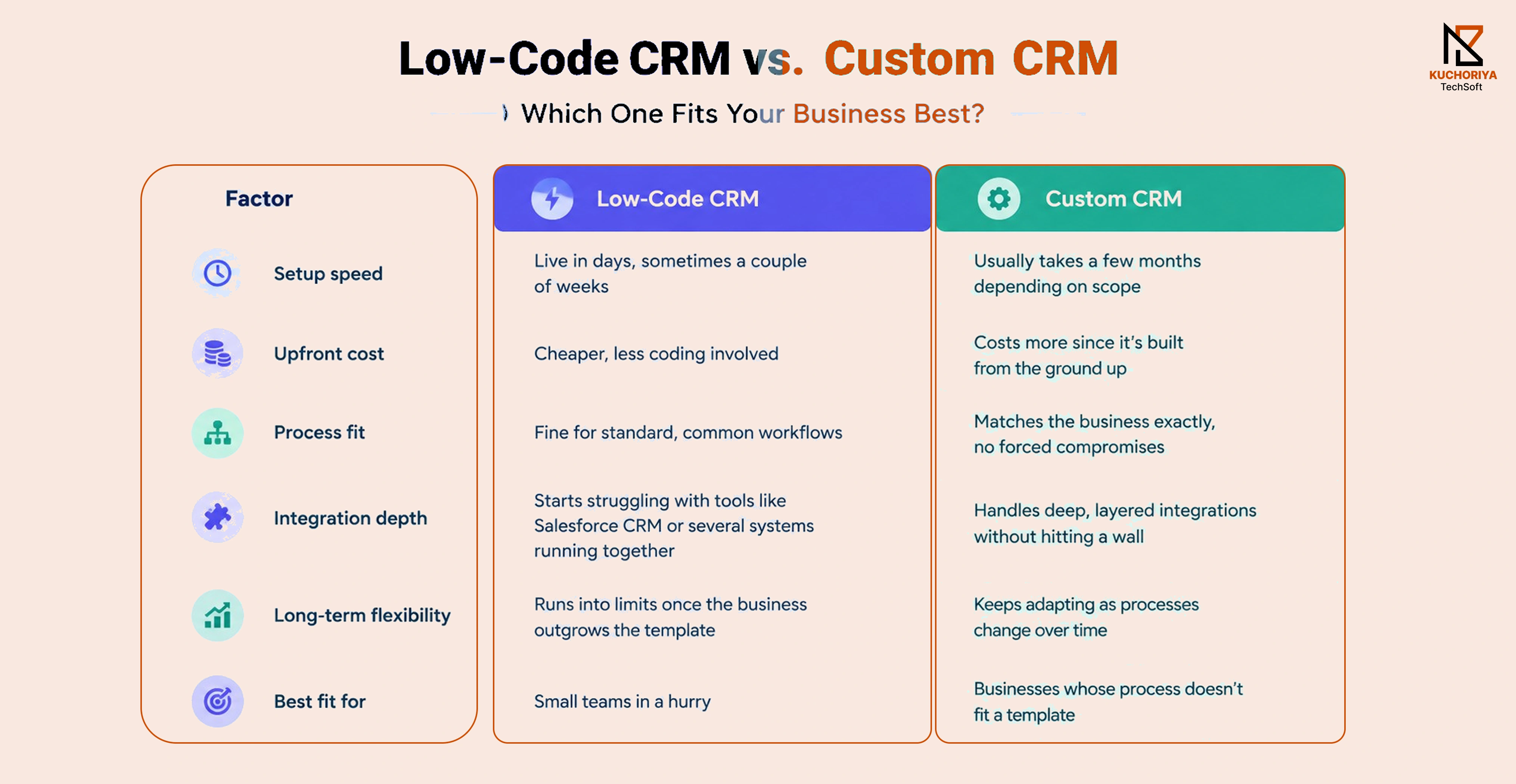
A no-code CRM platform works fine early on, before a team even knows exactly what its process should look like. Problems start once CRM application development needs outgrow what a template can offer. That's usually when low-code CRM development stops helping and starts getting in the way.
How Much Does Custom CRM Development Cost in 2026?
Cost depends on a handful of factors, mostly tied to complexity rather than the base feature list people usually focus on first. Most businesses can expect to spend somewhere between $8,000 and $90,000, depending on how far the requirements stretch.
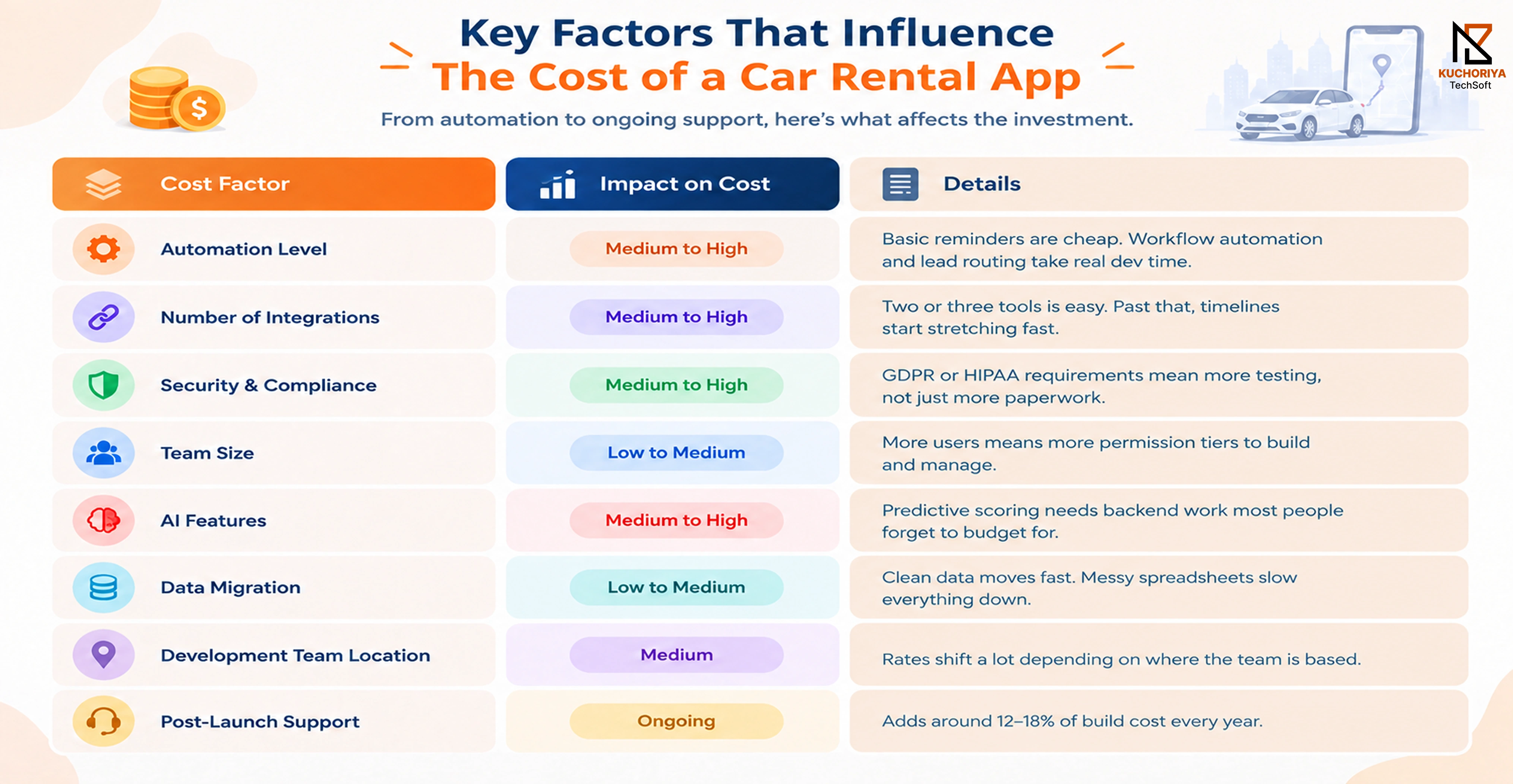
For context: a basic CRM (contacts, deals, simple reporting) starts around $8,000-$18,000. A mid-complexity build with automation and integrations runs $18,000-$45,000. Full enterprise builds with AI and heavy compliance needs land between $45,000 and $90,000+, still well under the $30,000-$300,000 range most agencies quote as a starting point.
Integration count and security scope are usually the real CRM development cost factors, more than anything else on this list. Two projects that look nearly identical on paper can end up tens of thousands apart once those two things get factored in properly. That's why accurate CRM development services pricing only comes from a scoped quote, never a generic range pulled off a website.
AI is the other wildcard. Add predictive scoring or automated insights later, and custom CRM development pricing jumps in ways most businesses don't see coming until it's already happening.
Choosing to build a scalable CRM costs a little more upfront. Skipping proper scalable CRM development now and rebuilding later, once the system can't keep up, costs a lot more.
Must Read: How to Build a Custom CRM Like Zoho: Step-by-Step Business Guide
How Do You Build a Secure, Scalable & AI-Ready CRM?
Security used to be an afterthought. Not anymore. And AI isn't optional either, most buyers expect it built in from day one.
1. Records get encrypted both in transit and at rest through proper CRM data encryption. Without it, one breach turns into a full customer list floating around somewhere it shouldn't be.
2. Not everyone needs to see everything. CRM access control splits that up by role, so a sales rep's view looks nothing like what finance sees. Small teams barely notice this. Bigger ones can't function without it.
3. There's more to enterprise CRM security than a login screen. Audit logs, session tracking, who accessed what and when. Boring stuff, until the day something breaks and someone needs answers fast.
4. Smart features like automated follow-ups don't just appear. AI-powered CRM development means the backend gets built for that from the start, because retrofitting AI onto an old structure barely ever works well.
5. Which deals are actually going to close? Predictive CRM analytics answers that using real sales history instead of a rep's gut feeling, which turns out to be wrong more often than people admit.
6. Digging through menus to find one customer note gets old fast. Conversational AI in CRM fixes that with a chat assistant that just pulls up whatever's needed.
7. Emails alone don't say much. Neither do calls or tickets on their own. But put together, AI-driven customer insights start showing a real pattern in what a customer's likely to need next.
8. The system doesn't stay static either. Machine learning CRM automation adjusts workflows over time, based on what's actually working rather than whatever got set up on day one and never touched again.
9. And none of it matters if the dashboard takes forever to load. CRM performance optimization is what keeps a feature-heavy CRM from feeling sluggish every single day someone opens it.

How Do You Choose the Right Custom CRM Development Company?
Picking a partner matters more than picking a tech stack. A wrong choice here costs months, not just money.
Start by checking whether the CRM development company handles full CRM development and integration in-house or only builds the front end while leaving integrations to another provider.
Ask about real experience in enterprise CRM development. A portfolio full of small business websites won't show how a team handles complex permissions or heavy data loads.
A solid CRM development agency should explain their process clearly, without sounding rehearsed.
Some businesses do better with a custom CRM solution provider that stays involved after launch, rather than one that disappears once the invoice clears. A dedicated CRM development team assigned specifically to the project also tends to move faster than a rotating group.
Location matters too, though not in a fixed way. CRM developers in the United States usually mean overlapping hours at a higher rate. Teams that outsource CRM development to Canada often land on a middle ground, solid pricing with good timezone overlap.
UK-based CRM software teams fit well for businesses already operating across Europe, especially with data compliance in mind. Australian CRM development experts suit APAC-facing companies, though real-time collaboration with North America can lag. Singapore CRM development services are a common choice for businesses expanding across Southeast Asia.
There's no universally right location. Just the one that matches your team's timezone and how much real-time collaboration the project actually needs.
What Are the Latest Custom CRM Development Trends in 2026?
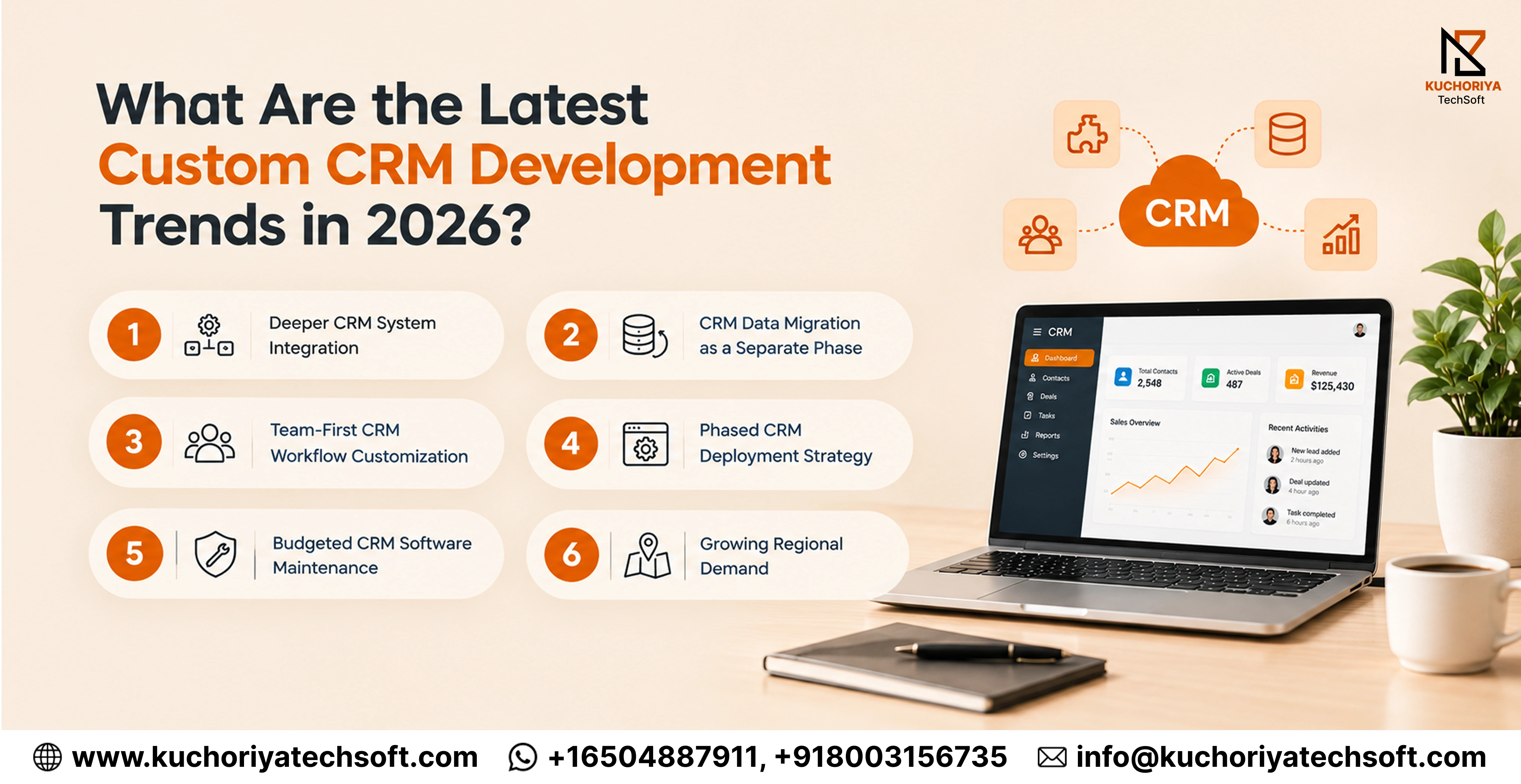
A few shifts are showing up across most custom builds this year, not just in theory but in what businesses are actually requesting.
1. Deeper CRM System Integration
CRM system integration has moved past basic email syncing. Businesses now expect their CRM to talk to accounting software, support platforms, and internal tools without manual data entry bridging the gap.
2. CRM Data Migration as a Separate Phase
CRM data migration used to be an afterthought tacked onto the end of a build. Now it's planned separately, since moving years of messy spreadsheet data incorrectly causes more damage than starting fresh.
3. Team-First CRM Workflow Customization
CRM workflow customization has become less about picking from preset options and more about mapping the exact steps a sales or support team already follows, then automating around that.
4. Phased CRM Deployment Strategy
A rushed all-at-once launch is losing ground to a staged CRM deployment strategy, rolling out core features first and adding complexity once the team has adjusted.
5. Budgeted CRM Software Maintenance
CRM software maintenance is showing up in initial project scopes instead of being negotiated after launch, since businesses have learned that skipping this creates bigger problems later.
6. Growing Regional Demand
Interest in CRM solutions for UAE enterprises has grown alongside the region's push toward digital transformation across finance and real estate. CRM technology partners in Israel are seeing more demand tied to the country's dense tech and startup ecosystem.
Elsewhere, Hong Kong software development for CRM is picking up as businesses modernize legacy systems, while Spain-based custom CRM builders are seeing more requests from companies expanding across the EU. Mexico's CRM outsourcing services continue growing too, largely driven by nearshoring trends for US-based businesses.
Why Choose Kuchoriya TechSoft for Custom CRM Development?
Low-code or custom, the right call usually comes down to a partner who's built both and won't push whichever is easier to sell.
Kuchoriya TechSoft has delivered over 1,000 projects across 100+ industries since 2009, so the CRM work rarely starts from zero. Some things that come up on every project:
- The CRM gets built around actual business processes. Not squeezed into a template that half-fits.
- AI goes in where it earns its place, leading scoring, automation, and predictive insights, not tacked on for a feature list.
- ERP, accounting software, marketing platforms, and whatever's already running get properly connected instead of left disconnected.
- The CRM software architecture handles growth from the start. More users, more data, no rebuild required down the line.
- Repetitive tasks like follow-ups and approvals run automatically, freeing up actual selling time.
- Security gets built in from day one, not patched in after someone asks about it.
- ISO 27001 and ISO 9001 certifications back that up on paper, not just in a sales pitch.
- One team runs the whole build, from requirements to support. No handoffs, no lost context between departments.
- A 98% client retention rate says something about what happens after launch, not just during it.
Projects have run across the USA, UAE, Australia, Canada, Singapore, and several other markets, each with its own compliance and workflow quirks worth knowing before development starts.
Conclusion: Choosing the Right Custom CRM Development Approach
Low-code, custom, something in between, there's no single answer. It comes down to how specific the process is, how fast the business needs to move, and how much room it needs to grow into.
A good decision usually accounts for where the business will be in two or three years, not just what's needed right now. Fixing a CRM that can't scale ends up costing more than building it right the first time would have.
For most growing businesses, that means three things: a clear picture of the actual workflow, a tech stack that won't create limits later, and a team that's dealt with enough of these builds to know where they usually go sideways. Getting those right tends to matter more than which specific path gets chosen.
If you're at that decision point, the Kuchoriya TechSoft team can walk through your requirements and give a straight answer, low-code, custom, or somewhere in between. [Get in touch to discuss your project].
Agencies and consultants working with CRM clients can also check out the [Referral Partner Program] for project-based collaboration.

Frequently Asked Questions About Custom CRM Development
Q. What is the difference between custom CRM development and low-code CRM?
A. Low-code is faster. Drag, drop, done in a few days using components someone else already built. Custom takes longer because nothing's pre-made, the whole thing gets shaped around how your business actually runs. The tradeoff shows up later. Low-code eventually hits a wall once your process gets specific enough. Custom doesn't have that ceiling.
Q. How long does custom CRM software development take in 2026?
A. Depends what you're building. A simple setup, contacts, deals, basic reports, that's 6 to 10 weeks. Throw in automation and a few integrations and you're looking at 3 to 5 months. Full enterprise stuff with AI baked in and heavy compliance requirements can stretch past 6 months easily.
Q. Can a custom CRM integrate with existing ERP software?
A. Almost always, yes. This is one of the more common asks actually. APIs handle the connection so sales and inventory data update on both sides automatically. Nobody's copy-pasting numbers between two systems anymore.
Q. Is a custom CRM more expensive to maintain than Zoho or Salesforce?
A. Surprisingly, often not. Zoho and Salesforce bill per user every single month, forever. A custom CRM has a bigger bill upfront, but yearly maintenance sits around 12 to 18% of what it cost to build. Once a team gets big enough, the math flips in favor of custom.
Q. Does a custom CRM support mobile access for remote sales teams?
A. Pretty much has to, at this point. Reps pull up records and check the pipeline from their phone constantly, not just sitting at a desk. Given how many teams are hybrid or fully remote now, a CRM without mobile access is honestly a bit behind.