






Why Choosing the Right AI Car Rental Technology Partner Matters
Everyone building a car rental app right now wants to slap "AI-powered" somewhere on the homepage. Fair enough, the market's growing fast, and most research firms put it well past $120 billion by 2028. But here's what actually happens on the ground: a business picks a developer after one, maybe two, decent demo calls, signs off, and three months in, they're finding out the platform can't handle a traffic spike or the payment gateway keeps throwing errors nobody bothered testing for. This is usually the moment someone realizes they need a real AI car rental technology partner, not just a team that could say the word 'AI' convincingly.
That's the whole point of doing a car rental technology vendor evaluation properly, before the contract, not after something breaks.
And if you're stuck on how to choose a car rental technology partner without walking into that same mess, here's the honest answer: stop paying attention to how well someone talks about AI and start asking what they've actually built and shipped. Integration is usually where things fall apart, GPS syncing, dynamic pricing, and compliance across regions, none of that plays nice together unless the team's already been through it once or twice before.
A real AI car rental technology partner will have answers ready. A car rental platform development partner worth hiring won't dodge the hard questions either, uptime numbers, concurrent vehicle load, and how fast they fixed something that broke at 2 am.
This guide breaks all of that down, starting with the technical stuff.
_(1)_1788874791640.webp)
IoT Car Rental Technology: What Should You Actually Check?
Anyone can say "we do IoT integration" on a pitch call. Whether they've shipped something that survives real fleet conditions is a different story, and this is where most evaluations fall apart, people treat connectivity like a checkbox instead of the thing running daily operations. Some things worth actually digging into:
1. Ask about connected mobility solutions first. Berg Insight's numbers show telematics penetration across car rental fleets in Europe and North America jumping from 56% at the end of 2025 to 87% by 2030. Not an early-adopter thing anymore, basically table stakes now, and it's pulling in OEM embedded data alongside the usual aftermarket devices.
2. Don't just ask if a partner "can do GPS tracking." Ask if they've handled a real-time vehicle tracking system at fleet scale, with hundreds of cars pinging location and telemetry data at once without the whole thing lagging or dropping sync mid-update.
3. Then there's the sensor side, fuel levels, mileage, tire pressure, and engine health, all reported back without anyone touching the car. Sounds simple until a sensor loses connection mid-trip or a predictive maintenance alert fires late. Teams who've only built booking apps usually haven't thought this far.
4. Telematics integration for car rental is also where keyless car entry technology comes in, since half the platforms now expect someone to unlock a car straight from their phone. Not just a mobile feature, it's security, embedded hardware, and app architecture colliding at once. Worth asking what broke the first time they built this, because something usually did.
5. Look at how the platform connects outward too, payment gateways, insurance APIs, mapping services, and third-party booking channels, that's car rental app integration services in practice, and it's where a lot of "AI-powered" platforms quietly fall apart under load.
6. Underneath all of it sits fleet management software development, the layer deciding what's available, when maintenance is due, how dynamic pricing shifts in real time, and how well it syncs across a cloud-based backend instead of choking on batch updates.
Car Rental App Security and Scalability: What to Check Before You Commit
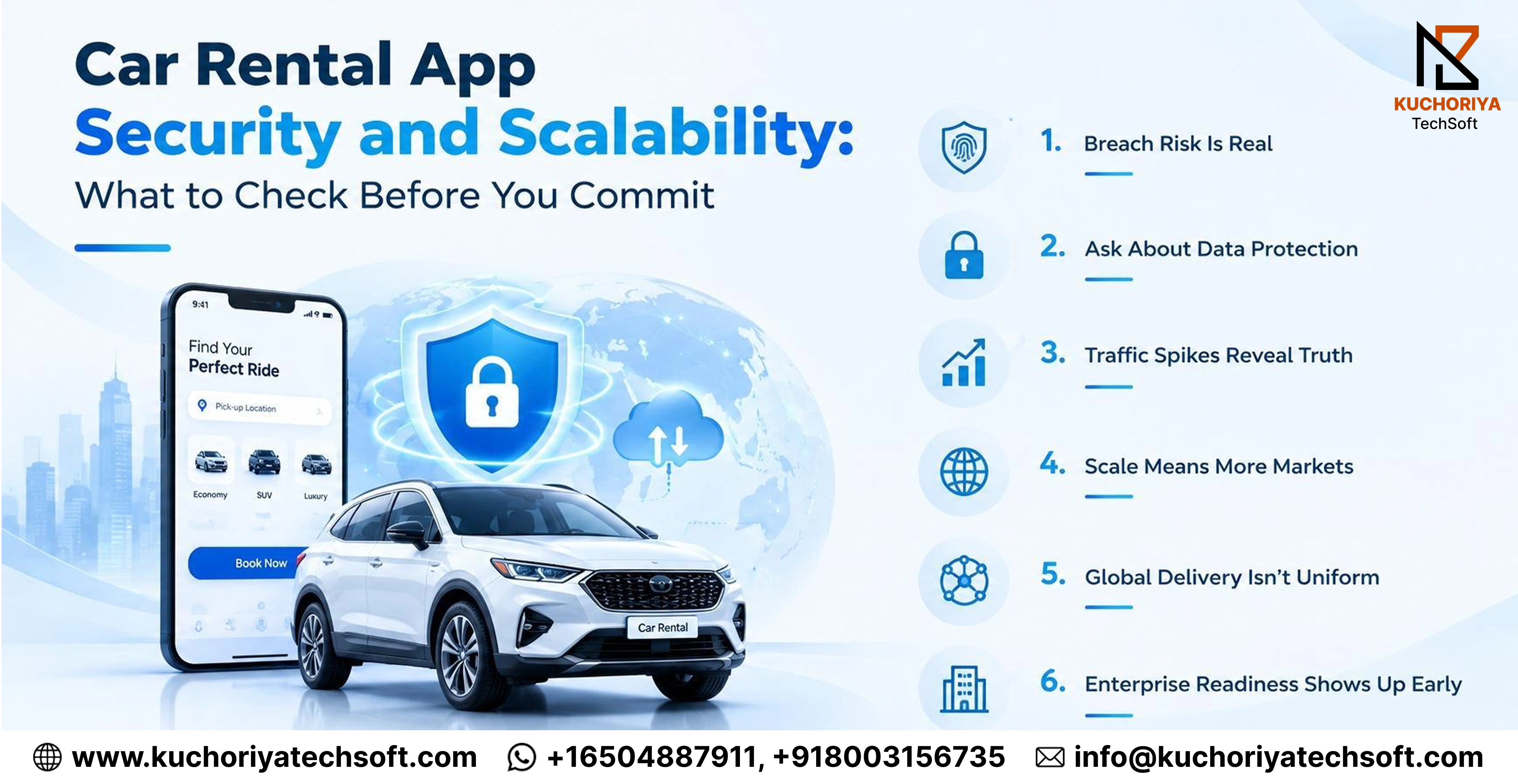
Most rental platforms don't fail because of bad code. They fail because nobody stress-tested them against a real breach or a real traffic spike before launch.
1. Breach Risk Is Real
Zoomcar disclosed a breach in 2025 affecting roughly 8.4 million users, names, phone numbers, and vehicle registration data all exposed at once. Avis had its own incident hitting close to 300,000 customers. Over 35% of all breaches in 2024 traced back to third-party vendors, exactly what a technology partner is.
2. Ask About Data Protection
Encryption at rest and in transit is the baseline, but the real question is whether the team has been through a formal audit like SOC 2 or GDPR before.
3. Traffic Spikes Reveal Truth
Car rental app security and scalability are only proven under load: a booking surge, a holiday weekend, a regional promotion. Ask what happens when traffic triples overnight.
4. Scale Means More Markets
Car rental software for multiple markets means different currencies, tax structures, languages, and compliance running on one core platform, not a patchwork of fixes stitched together.
5. Global Delivery Isn't Uniform
A car rental technology partner USA based business needs isn't automatically equipped for what a car rental technology partner UAE engagement requires, and a car rental technology partner UK project carries its own data rules on top.
6. Enterprise Readiness Shows Up Early
For businesses planning to scale, enterprise car rental technology experience matters, multi-tenant setups, role-based access, and ERP or CRM integrations. Teams built only for small operators tend to struggle here.
Must Read: Advanced AI Car Rental Solutions: Features, Integration, Cost & Monetization
Why Kuchoriya Techsoft Is a Car Rental Platform Development Partner Businesses Trust
Anyone can claim expertise on a homepage. What actually separates a real car rental platform development partner from a team just chasing the AI trend is whether they can walk you through the specifics without vague answers. Some things worth knowing:
1. We work as an AI car rental technology partner to businesses across the USA, UAE, UK, Canada, and Australia, which means we've had to build for different compliance rules, currencies, and market expectations from day one, not retrofit for them later.
2. On the technical side, this covers custom car rental software solutions, platforms built around a client's actual fleet size and booking model instead of a generic template stretched to fit. Off-the-shelf rarely survives contact with real operational quirks.
3. For teams still figuring out architecture or scope, we also offer car rental technology consulting, sitting down before any code gets written to map out what actually needs building versus what can be handled with existing integrations.
4. If the business model leans more toward a subscription or multi-tenant setup, that's where car rental SaaS technology partner experience matters, building once and scaling across multiple client fleets instead of starting from scratch for every deployment.
5. Car rental software case studies matter more than marketing copy here. Ask to see how a past platform actually performed after launch, not just how it looked in a pitch deck.
6. Proven car rental app development expertise shows up less in what a team says and more in how they answer hard questions, what broke during a previous build, how long it took to fix, what they'd do differently now.
7. Launch isn't the finish line either. Car rental app post-launch support covers the part most vendors go quiet on: bug fixes, updates, and scaling help once the initial contract wraps up and the platform's live with real users.
Ready to Build With the Right Partner?
Choosing right here isn't a small decision, it's the difference between a platform that scales cleanly and one you're rebuilding in eighteen months.
If you're not ready to build yet but want expert eyes on your architecture and roadmap first, our Virtual CTO services exist exactly for that, technical direction without hiring a full-time executive.
If you're ready to move forward, the next step is simple: contact our car rental technology partner team and walk through your requirements, timeline, and budget honestly, no generic sales pitch, just a real conversation about what's realistic.
We also work with agencies, consultants, and mobility startups through our referral partner program and associate partner program, if you know a business that needs this kind of build, that's worth a conversation too.
The businesses that get this right are usually the ones who hire a car rental technology partner based on proof, not promises. Get in touch to start that conversation.

FAQs: Choosing the Right Car Rental Technology Partner
Q. How long does it actually take to pick the right car rental technology partner?
A. Honestly, longer than most people want. Give it six weeks if you're doing it right, not two calls and a gut feeling. Shortlist a few, dig into actual technical answers instead of the pitch, call up their old clients, and ask what went wrong (something always did). Skip all that, and you'll find out the hard way, usually three months into a build, that the team can't handle half of what they promised.
Q. What makes an AI-focused developer different from someone who just added a chatbot to a booking form?
A. Real difference, actually. One team's genuinely worked with live fleet data, pricing that adjusts on its own as demand shifts. The other slapped a chatbot on a regular app and started calling it AI. Don't ask what they think they could build someday. Ask what they've already shipped and broken and fixed.
Q. Should I go with a SaaS-style build or a fully custom platform?
A. Depends on what the business actually looks like. Planning to scale across multiple fleets, maybe franchise this later? SaaS-style makes more sense from day one. Running one operation with workflows nobody else has? Go custom, templates tend to snap the second something doesn't fit right.
Q. What happens after the platform actually launches?
A. Honestly, this is where you find out who you're really dealing with. A lot of teams disappear the second the app goes live, no more calls returned, no more updates. What you actually want is someone still fixing bugs, watching how it performs under real traffic, and open to adding stuff once the business figures out what it needs next. If the contract quietly ends at launch, that wasn't a partnership. That was a handoff.
Q. How do I know if a partner's expertise is real and not just something on a slide?
A. Make them get specific. What broke on a past project, how long it actually took to fix, and what uptime looked like once things got busy. Anyone can say, "We're experienced." Fewer people can walk you through what actually went wrong without dodging the question.