





What Is Changing in Travel Marketing in 2026?
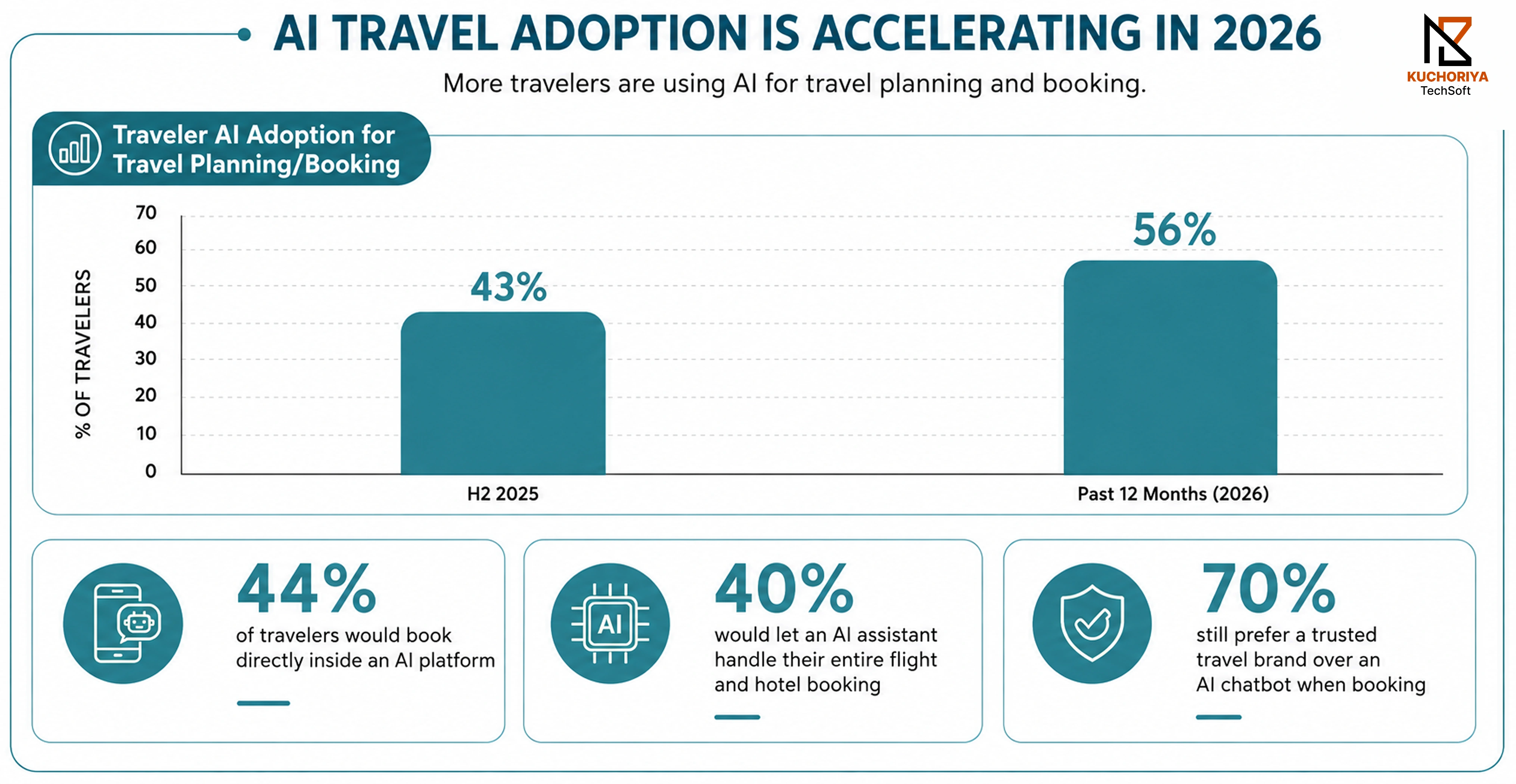
56% of active U.S. travelers used AI for planning, booking, or in-destination help in the past year. That's per Phocuswright, up from 43% just six months back. One number, a huge shift. It's rewriting every travel industry marketing strategy built before this year, whether brands are ready or not.
44% would book directly inside an AI platform. 40% would let an AI assistant run the whole flight and hotel booking, start to finish. Not a niche behavior. One of the clearest AI travel industry trends 2026 has thrown at the industry so far.
So brands are racing toward AI travel marketing services. Makes sense. Discovery lives inside AI overviews and chatbots now, not just Google's blue links anymore. Travelers price-compare, skim review summaries, build whole itineraries this way, sometimes without ever landing on a travel site.
Traditional marketing didn't die, though. Expedia Group's 2026 research found nearly 70% of travelers still trust an actual brand over a chatbot when it's time to pay. AI wins the research phase. Humans still close the deal.
Which is the real question behind AI vs traditional travel marketing this year. Not which one wins outright. Where does AI push travel marketing ROI higher, and where does a trusted brand still seal the booking? Get that wrong, and a competitor walks off with the customer.
What Is Traditional Travel Marketing?
Before AI entered the picture, travel brands built their entire pipeline on traditional travel marketing channels, and plenty still lean on them today.
- SEO and content that ranks travel pages on Google over months, not days
- Paid search and display ads aimed at broad traveler segments
- Email newsletters sent to the full list, not individual behavior
- Print, radio, and outdoor ads for regional visibility
- Trade shows, travel expos, and in-person agent partnerships
- Referral and word-of-mouth marketing built on past trust
- Static websites and brochure-style digital marketing for travel companies are still used today by travel companies
A traditional campaign can't personalize an offer the second a traveler starts searching. It can't reprice overnight when a flight drops. That single gap is steering the travel marketing strategy trends of 2026 away from fixed campaigns toward something that reacts in real time.
What Is AI Travel Marketing?
It's marketing built on data instead of gut feeling. An AI in travel marketing guide usually starts here, systems that predict what a traveler wants before they say it out loud.
- Recommendation engines that surface the right hotel first
- Predictive tools flagging who's ready to book this week versus who's just browsing
- AI-powered travel marketing solutions handling this without a marketer touching a single setting
- AI chatbot for travel bookings answering questions at 2 AM, no human shift required
- Automatic repricing the moment a flight drops
- Follow-ups on abandoned bookings sent without anyone lifting a finger
Most travel brands already run at least one of these. They just haven't called it what it is. By 2026, AI travel marketing services aren't the upgrade anymore, they're the baseline competitors are already operating from.
AI vs. Traditional Travel Marketing: A Side-by-Side Comparison
Any top travel marketing strategy for 2026 starts with knowing exactly where each approach wins, not picking a side out of habit.
Six months in, brands running AI consistently report a lower cost per booking than brands still running traditional channels alone. That gap keeps widening every quarter as AI stays untouched.
Why Does AI Deliver More Bookings?
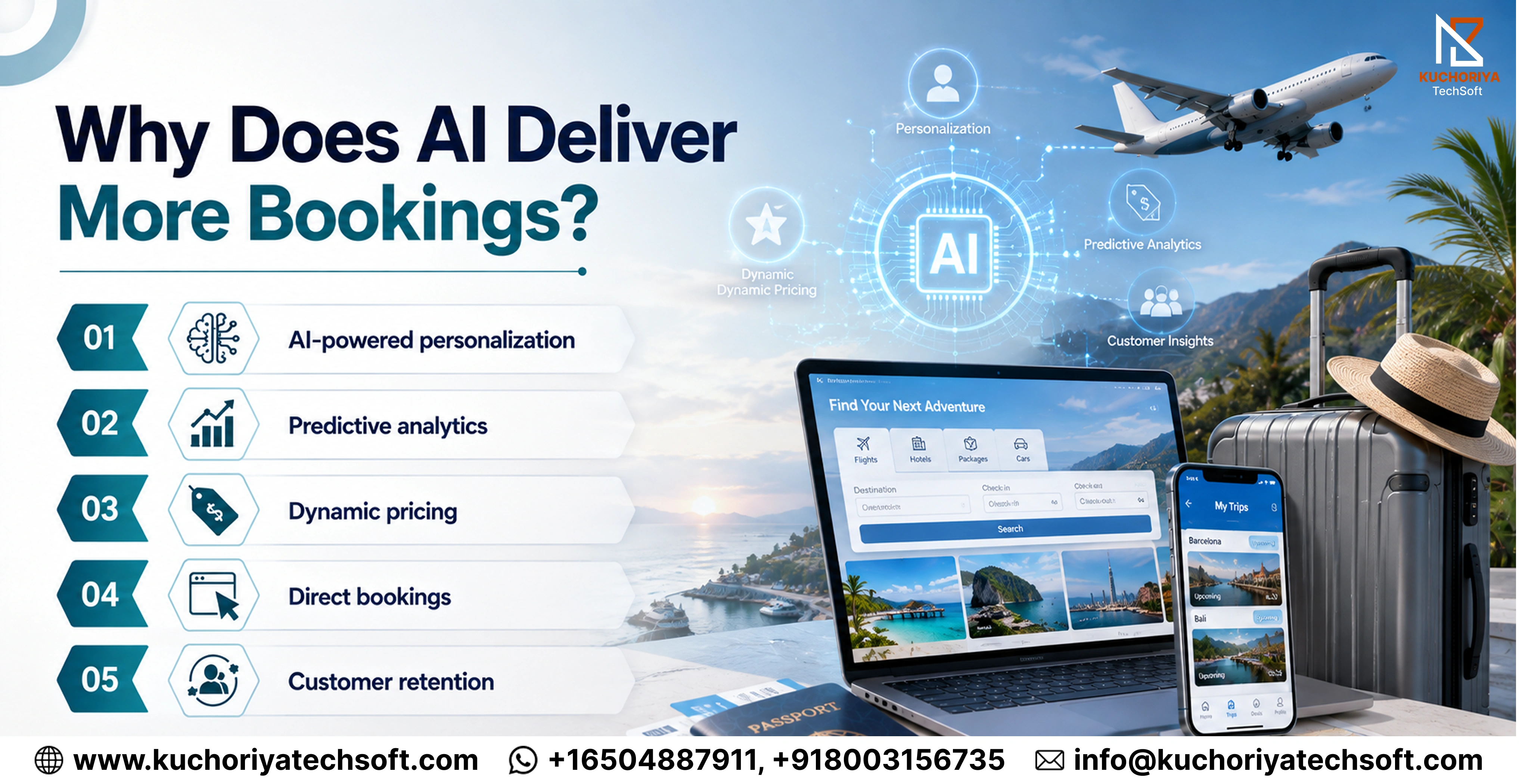
There's a reason how AI increases travel bookings keeps coming up in every 2026 marketing conversation. It's not one feature, it's five things working together.
1. AI-Powered Personalization
Recommendations shift based on what a traveler actually clicked, not a generic segment they got dropped into. That's the core of any real AI personalization strategy in travel marketing.
2. Predictive Analytics
Systems flag who's ready to book this week versus who's still browsing. Predictive analytics for travel marketing turns guesswork into a ranked list of real buyers.
3. Dynamic Pricing
Prices and offers adjust the moment demand shifts, not once a quarter. A solid dynamic pricing strategy for travel catches revenue that static pricing leaves on the table.
4. Direct Bookings
AI nudges travelers away from third-party sites and back to the brand's own channel. A working direct booking strategy for travel brands protects margin that OTAs would otherwise eat.
5. Customer Retention
Post-trip follow-ups, loyalty triggers, and personalized re-engagement run without anyone manually tracking who came back. That's what a real travel customer retention strategy looks like at scale.
Where Does Traditional Marketing Still Work Best?
AI doesn't win everywhere, and pretending it does is how brands waste budget. Some of the best travel agency marketing strategies still lean hard on channels AI hasn't touched.
- Billboards, sponsorships, and airport placements that build recognition long before a traveler ever searches the brand name
- Trade shows and travel expos that close high-value group and luxury bookings through actual face time
- Community partnerships and regional print that convert on destination-specific campaigns AI targeting can't localize as well
- Repeat bookers who trust the brand itself, not the platform that showed them the ad, a pattern that shows up clearly in any real travel customer journey mapping exercise
- Long-term brand loyalty built slowly, often outside whatever travel marketing funnel strategy an AI system is running
None of this disappears just because AI handles discovery faster. It just means the win isn't always about who shows up first; sometimes it's about who a traveler already trusts by the time they're ready to book.
Which AI Marketing Channels Generate the Best ROI?
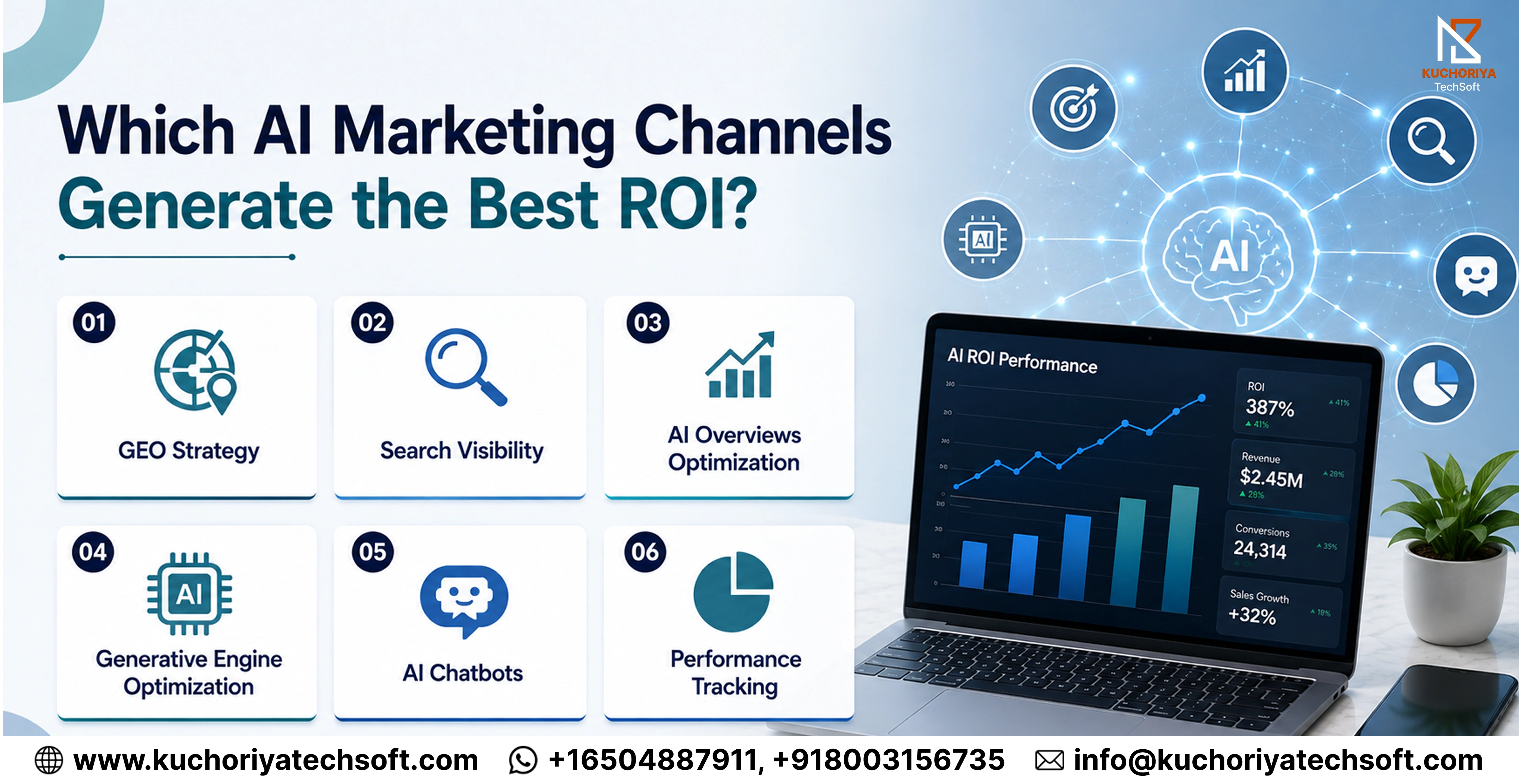
Six channels are actually driving bookings for travel brands right now; most competitors haven't touched half of them.
1. GEO Strategy
Generative engines sit above search results now. A real GEO strategy for travel marketing gets a brand cited inside those answers, not buried below them.
2. Search Visibility
Structured, direct-answer content is what earns real AI-powered search visibility for travel companies, vague marketing copy gets skipped every time.
3. AI Overviews Optimization
Getting picked up here is structure, not luck. AI Overviews optimization for travel brands means answering the exact question within the first two lines.
4. Generative Engine Optimization
This is the core discipline behind it all, generative engine optimization for travel industry means writing for the answer, not just the ranking.
5. AI Chatbots
Chatbots close bookings and answer pricing at 2 AM, with no waiting for business hours and no lost leads overnight.
6. Performance Tracking
A real travel marketing analytics dashboard shows exactly which channel drove which booking, a precision traditional analytics never offered.
Together, these six are quietly doing more for improving AI visibility for travel brands than any single traditional campaign ever could.
What Are the Top AI Marketing Trends for Travel Businesses in 2026?
Every segment of travel is using AI a little differently this year, five patterns keep showing up.
1. Hotels
Dynamic pricing and personalized upsell offers now drive most AI marketing strategies for hotels work, triggered the moment a guest starts browsing rooms.
2. Airlines
Real-time fare alerts and automated rebooking when a flight changes, that's the backbone of most airline marketing automation strategy builds right now.
3. Cruise Lines
Matching travelers to the right itinerary length and cabin type based on past browsing, that's where a solid cruise line digital marketing strategy earns its keep.
4. Tour Operators
Quote generation and follow-ups running on autopilot, cutting the lag between inquiry and booking from days down to minutes, this is what real tour operator AI marketing solutions actually look like in practice.
5. Across The Board
One thing ties every best AI marketing strategy for travel companies 2026 conversation together: they act on intent the second it shows up, not three days later once a marketer finally notices.
How Can You Transition From Traditional to AI Travel Marketing?
Moving away from traditional channels doesn't happen overnight, most travel brands get there through the same five steps.
- Audit the current marketing stack before adding anything new, most teams skip this and end up duplicating tools.
- Build a real travel agency digital transformation strategy with clear goals, not just "we should use AI more."
- Pick travel marketing automation tools that actually match the business size, an enterprise platform is wasted on a five-person agency.
- Connect a travel marketing automation platform with the systems already in place, running it standalone kills half the value.
- Set up proper CRM integration for travel businesses so customer data flows both ways instead of sitting in two disconnected systems.
- Use lead scoring for travel businesses to rank who's ready to book now versus who needs another six months of nurturing.
What Mistakes Should You Avoid With AI Travel Marketing?
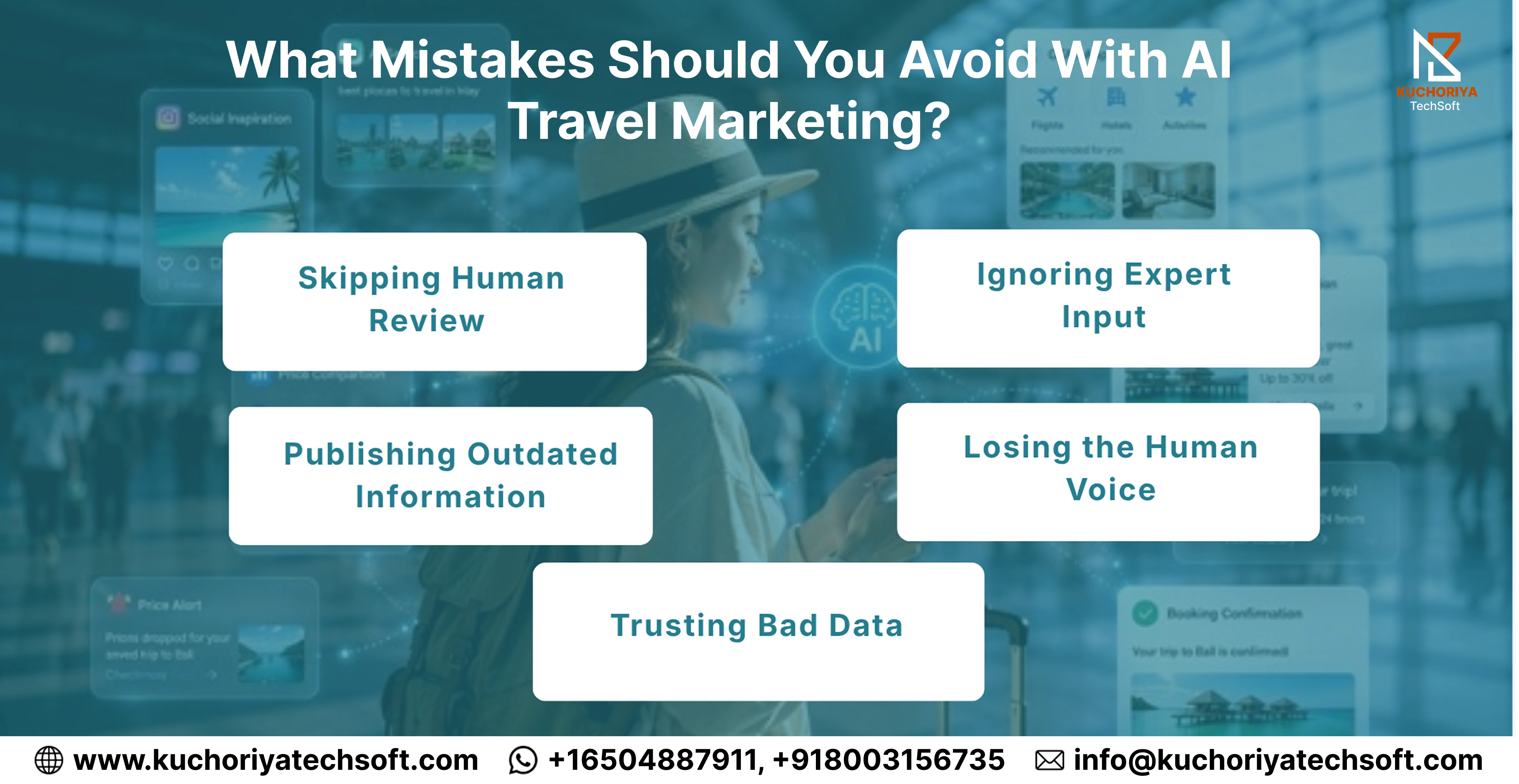
Most AI marketing failures come down to five repeatable mistakes, not bad tools.
1. Skipping Human Review
Publishing AI output straight from the tool, no edits. Human-reviewed AI content for travel brands catches the tone-deaf lines and factual slips before a traveler ever sees them.
2. Trusting Bad Data
Feeding AI systems outdated or incomplete data. Without trustworthy travel marketing data sources, every prediction and personalized offer built on top is wrong from the start.
3. Publishing Outdated Information
Letting old pricing or destination details sit live for months. An accurate travel marketing information guide needs regular updates, not a one-time setup.
4. Losing the Human Voice
Letting AI write everything with zero first-hand travel industry marketing experience behind it. Generic output reads generic; travelers notice.
5. Ignoring Expert Input
Skipping real travel marketing expert insights in 2026 in favor of pure automation. AI executes fast; it still needs a person deciding what's worth executing.
Best AI Tools and Practices for Maximizing Travel Marketing ROI in 2026
Nine things separate travel brands actually getting ROI from AI, and brands still just experimenting with it.
1. AI Content Creation (Jasper, Copy.ai style tools)
Destination guides, ad copy, email drafts, generated in minutes instead of days. Frees the marketing team to focus on strategy, not first drafts nobody reads twice.
2. CRM and Marketing Automation (HubSpot, Salesforce Travel Cloud)
A connected setup means a lead's data updates once and shows up everywhere. No manual syncing, no two systems quietly disagreeing.
3. AI Chatbots for Travel Marketing
Modern chatbots do more than answer questions now. They nudge an undecided browser toward the exact offer they've already been eyeing.
4. Analytics and Reporting Platforms
Shows which campaign, channel, and offer actually drove revenue. Not clicks. Not impressions. Actual bookings, tracked back to the source.
5. AI Personalization Engines
Adjusts what a visitor sees in real time, based on past trips and current browsing. A static audience segment can't do that, it just guesses.
6. Combining AI with Human Creativity
AI drafts fast. Someone still has to catch the line that reads fine on paper and lands wrong with an actual traveler.
7. First-Party Data Strategy
Third-party cookies are disappearing either way. Building a strong first-party dataset now is what makes every AI prediction after it worth trusting.
8. Customer Touchpoint Optimization
Search, email, chatbot, checkout, every step gets checked for friction. Usually there's more of it hiding than a team expects.
9. Ongoing Campaign Testing
Skip monthly testing and even the best AI setup goes stale fast. Continuous testing is the only thing keeping these tools earning their spend instead of running on autopilot.
Why Choose Kuchoriya TechSoft for AI Travel Marketing Solutions?
Most travel brands don't need another vendor stacking AI buzzwords on old campaigns. They need the team that actually builds what sits underneath.
- Kuchoriya TechSoft runs as a full AI development company for travel industry clients, handling real engineering, not just strategy slides.
- Every build goes through custom travel software development, shaped around the booking flow already in place, never a template forced to fit.
- Brands that hire travel app development company services here work with a team that's shipped booking platforms before, not a concept portfolio.
- AI chatbot development for travel companies covers pricing questions through full booking handoffs, live and tested against real traffic already.
- Travel CRM software solutions connect straight into the marketing stack already in place, so customer data moves both directions instead of sitting locked away.
- Teams that hire AI marketing experts for travel business needs want people who already get seasonality, booking windows, and traveler intent, not generalists picking up travel on the job.
Real engineering paired with real travel industry experience, that's what separates a working AI marketing system from a demo that just looks good in a pitch.
Which Travel Marketing Strategy Wins in 2026?
There's no single winner, blending both is the best AI travel marketing strategy for most travel brands, AI for speed, traditional channels for the trust that still closes bookings.
AI marketing ROI for travel industry 2026 data consistently favors brands running personalization and automation over static campaigns alone. But picking from the best AI marketing tools for travel agencies 2026 without a strategy behind them just adds cost, not bookings.
That's where working with an established AI travel marketing solutions provider like Kuchoriya TechSoft changes the outcome, real engineering paired with real travel industry experience. Businesses can also explore a fractional CTO engagement for senior technical direction without a full-time hire, or join the Referral Partner Program to bring these solutions to their own client base.
Ready to build your AI travel marketing roadmap? Get in touch with our team today.

What Are the Frequently Asked Questions About AI vs Traditional Travel Marketing?
Q. Is AI travel marketing better than traditional marketing?
A. Depends what you're optimizing for. AI wins on speed and cost per booking over time. Traditional still wins on trust. Most brands blend both, and that's usually the right call.
Q. How can AI increase travel bookings fast?
A. Chatbots respond instantly instead of making a traveler wait until Monday. Lead scoring flags who's actually ready to book. That combination alone recovers bookings a slower follow-up process would lose.
Q. How much does AI travel marketing cost?
A. More upfront than a basic traditional campaign, less over time. Cost per booking usually drops within a few months once automation starts cutting wasted spend.
Q. Can AI replace human travel marketers?
A. No. AI executes fast and spots patterns well. It still can't build the relationship that closes a high-value booking; that part stays human.
Q. What is the best AI marketing strategy for travel agencies?
A. Personalization, predictive analytics, automated follow-ups. For complex itineraries, pairing that with AI marketing services for tour operators covers what a generic campaign misses.
Q. How do I choose the right travel marketing partner?
A. Check for real travel industry experience first. Confirm they offer genuine travel marketing consulting services. Then check if they actually use travel marketing personalization tools, not just manage ad spend.