






The Rise of AI in Travel Marketplaces
AI travel marketplace development is already changing how platforms get built in 2026, not something waiting on the horizon.
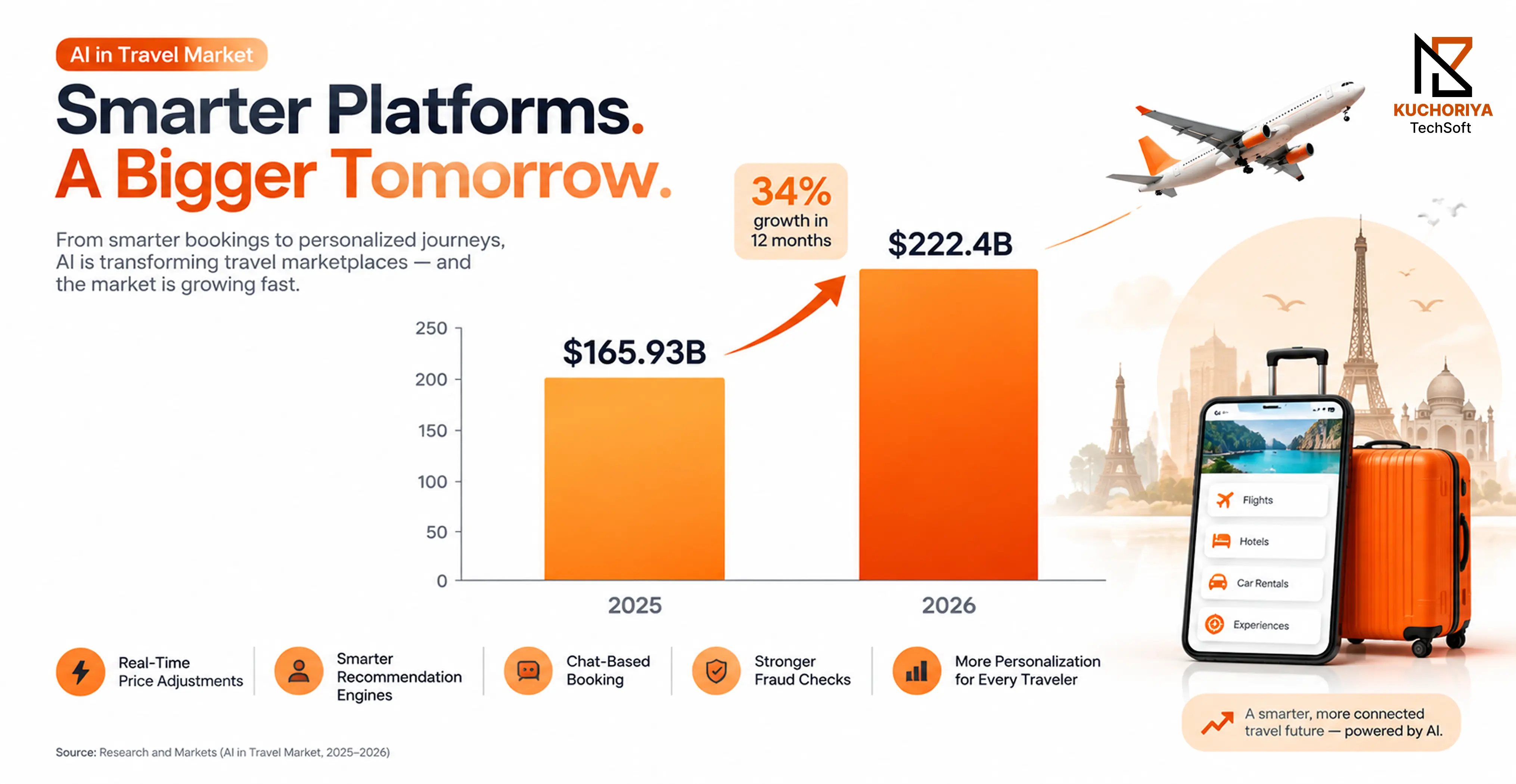
The AI in travel market went from $165.93 billion in 2025 to $222.4 billion this year. That's a 34% jump in twelve months. A big chunk of that growth comes down to how AI is used in travel marketplaces today, real-time price adjustments, recommendation engines that actually learn from a user's clicks, and chat-based booking that skips the usual back-and-forth. (Source)
Artificial intelligence in travel used to mean one thing: a chatbot stuck onto a contact form. That's changed. Current AI travel industry trends point toward AI running underneath the whole platform, pricing, fraud checks, personalization- all working in the background instead of sitting on top as a feature.
Several AI travel marketplace examples already prove this out. What was optional two years ago is quickly becoming the baseline every new platform gets measured against.
What Is an AI-Powered Travel Marketplace?
Ask ten founders what is an AI travel marketplace and you'll probably get ten different answers. Cut through the buzzwords, though, and it really comes down to one thing: the platform gets sharper the more people use it.
An intelligent travel marketplace isn't just a place to store listings and process bookings. AI travel marketplace software watches booking patterns in the background and makes calls in seconds, decisions that would take a human team most of an afternoon to work through.
- AI-integrated booking platforms notice what a traveler keeps coming back to search for, not just the one thing they clicked once.
- Prices shift on their own based on demand, the season, and what competitors are charging that same week.
- Suspicious bookings get caught and flagged before anyone on the team even opens that ticket.
- Chat support handles the routine questions on its own, pulling in a human only when the query actually needs one.
- AI in travel marketplace development company treats all of this as part of the build from the start, not a patch added after launch.
Why AI Is Becoming Essential for Travel Platforms
Founders keep asking the same question, do we really need AI right now, or can it wait a year? Watch how fast competitors are moving, and the answer gets clearer fast.
Travel marketplace AI solutions aren't about looking modern anymore, that phase passed already. They're becoming the reason one platform keeps travelers coming back while another quietly loses them to a competitor that just responds faster.
1. How AI helps travel businesses the most is timing, a decision that used to sit in someone's inbox for two days now happens while the traveler is still scrolling through options.
2. Platforms running on real AI travel technology expertise catch a demand shift early, before bookings actually start dropping, instead of scrambling to explain it afterward.
3. Travel AI solutions take over the repetitive parts, checking prices, flagging risky bookings, answering the same five support questions, so the team can spend time on what actually needs a person thinking it through.
4. The right AI travel platform solutions turn scattered booking data into something a business can act on same day, not something sitting in a quarterly report nobody opens.
None of this means bolting on every AI feature at once. It means finding the one bottleneck that's actually costing bookings and fixing that first.
Key AI Features Transforming Travel Marketplaces
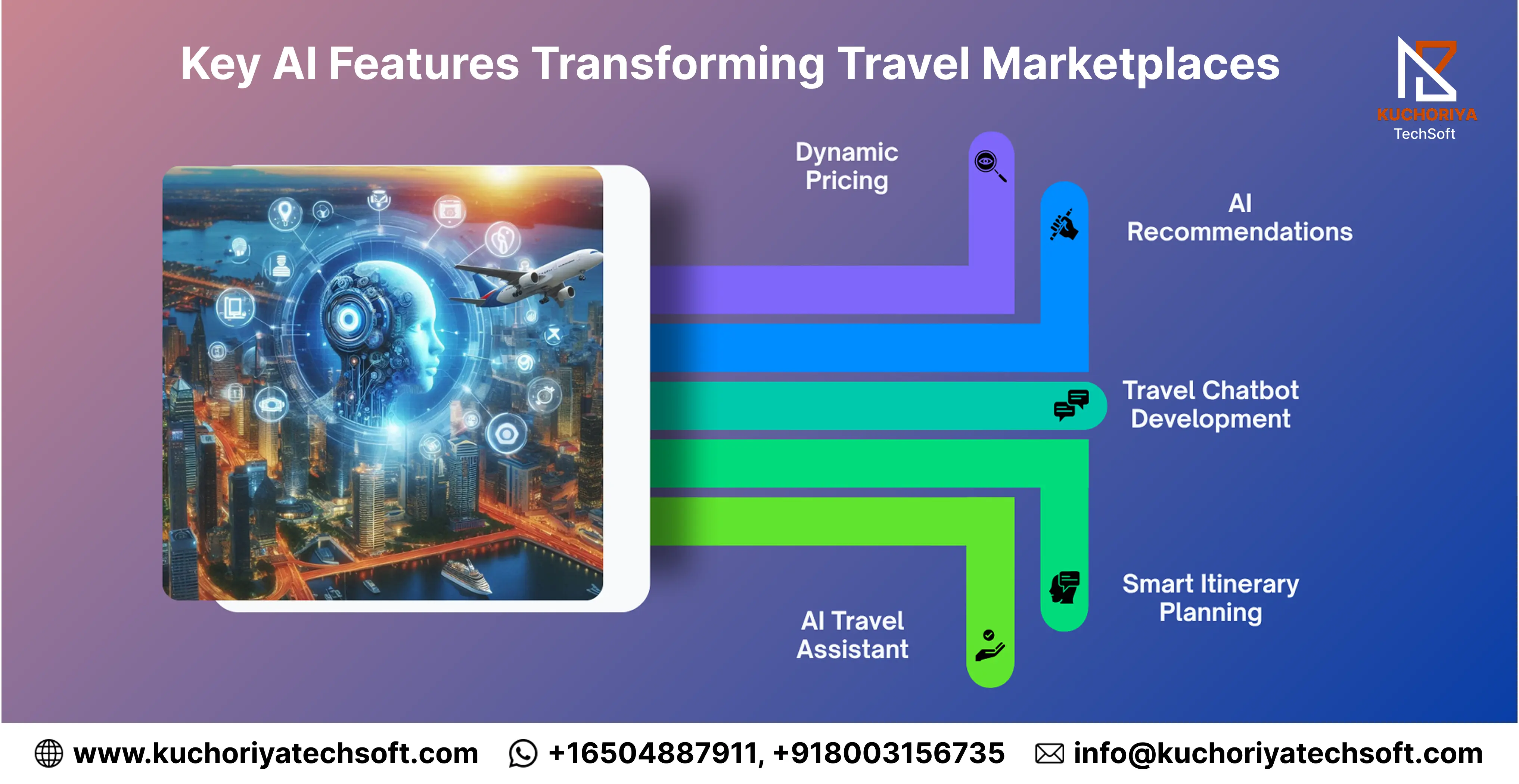
Feature lists are easy to write and hard to build. Out of everything AI can do for a booking platform, these five actually pay off.
1. AI Recommendations
Someone searched three beach resorts and skipped two mountain cabins, that pattern tells the platform more than any dropdown filter ever could. Good recommendations get built from moves like that, not from what's trending across the whole site.
2. Dynamic Pricing
Nobody's sitting there at midnight updating rates by hand anymore. Prices move on their own as demand shifts, a holiday weekend fills up, or a competitor drops their price down the street.
3. Travel Chatbot Development
The decent bots handle the boring stuff, rebooking a flight, checking a cancellation policy, without making someone wait on hold. Anything trickier still needs a person, and it should hand off there without a fight.
4. Smart Itinerary Planning
Nobody wants to keep five browser tabs open just to plan one trip. Feed the platform a few preferences and it stitches flights, hotels, and things to do into something that actually makes sense together.
5. AI Travel Assistant
This one just sits quietly in the background the whole trip, a reminder here, a heads-up there, showing up right when it's useful instead of spamming notifications nobody reads.
Trying to ship all five on day one usually means none of them work well. Pick the one causing the most friction right now and start there.
Real-World Applications of AI in Travel Marketplace Development
Theory sounds convincing until you see it running on a live platform. These aren't hypothetical use cases, they're already happening.
- Expedia's AI engine runs an enormous number of predictions for travelers each year, and Booking.com uses AI to translate tens of millions of property listings in real time. That's an AI-driven travel marketplace at scale, not a pilot project.
- Can AI personalize travel experiences? Booking.com's own AI trip planner already answers that question, building itineraries from a traveler's past searches instead of pushing the same generic package to everyone.
- Machine learning travel applications are catching fraud before it ever reaches a chargeback. TripAdvisor's AI flags roughly one in ten reviews as fraudulent, work that used to take a moderation team days to sort through manually.
- Predictive analytics in travel helps a vacation rental business or tour operator see which weeks are about to sell out, days before the calendar actually fills up, instead of finding out after the fact.
These aren't isolated wins either. Multiple AI travel marketplace case studies across hotel groups and OTAs point the same direction, platforms using AI-driven pricing and personalization are converting more browsers into bookings.
Top AI Technologies Used in Travel Marketplaces
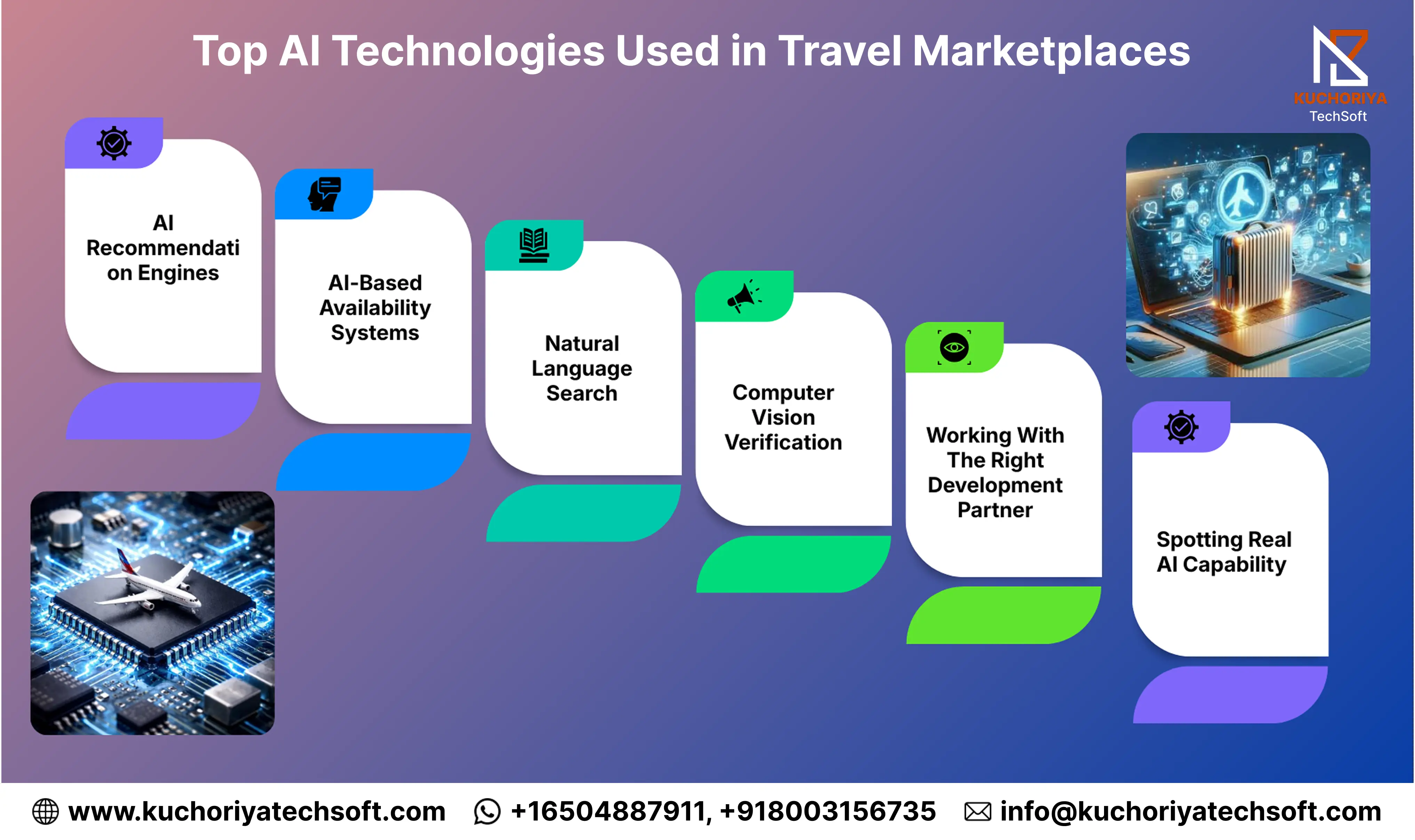
Not every AI tool is worth the build time. These are the ones actually showing up across serious platforms right now, the rest is mostly noise.
1. AI Recommendation Engines
AI travel platform development today leans heavily on recommendation engines trained on real booking behavior, not just page views, the difference shows up in conversion, not just engagement.
2. AI-Based Availability Systems
AI-based travel booking solutions now handle real-time seat and room availability checks across dozens of suppliers at once, something a manual system just can't keep up with during peak season.
3. Natural Language Search
Natural language processing sits behind most AI-powered travel software today, letting someone type "cheap beach trip in March" instead of clicking through five dropdown filters.
4. Computer Vision Verification
Computer vision is quietly showing up too, TripAdvisor uses it to catch fraudulent reviews, and several booking platforms use it to verify property photos match what's actually listed.
5. Working With The Right Development Partner
Partnering with an AI travel platform development company that's already solved GDS and payment integration saves months compared to building that groundwork from scratch.
6. Spotting Real AI Capability
If you're wondering which companies build AI travel marketplaces well, look at teams with both travel-domain experience and real ML engineering depth, not just a generic software shop bolting AI onto a template.
Chasing every technology on this list at once usually backfires. Pick the two or three that solve an actual bottleneck first, the rest can wait.

Benefits of AI-Powered Travel Marketplace Solutions
Ask a founder how does AI improve travel booking, and speed is usually the first thing that comes up. It's a fair answer, just not the whole one.
The advantages of AI in travel technology don't land evenly across every platform, though. The ones treating AI as core infrastructure, not a feature bolted on last quarter, are the ones actually seeing this pay off.
Challenges and Considerations When Implementing AI
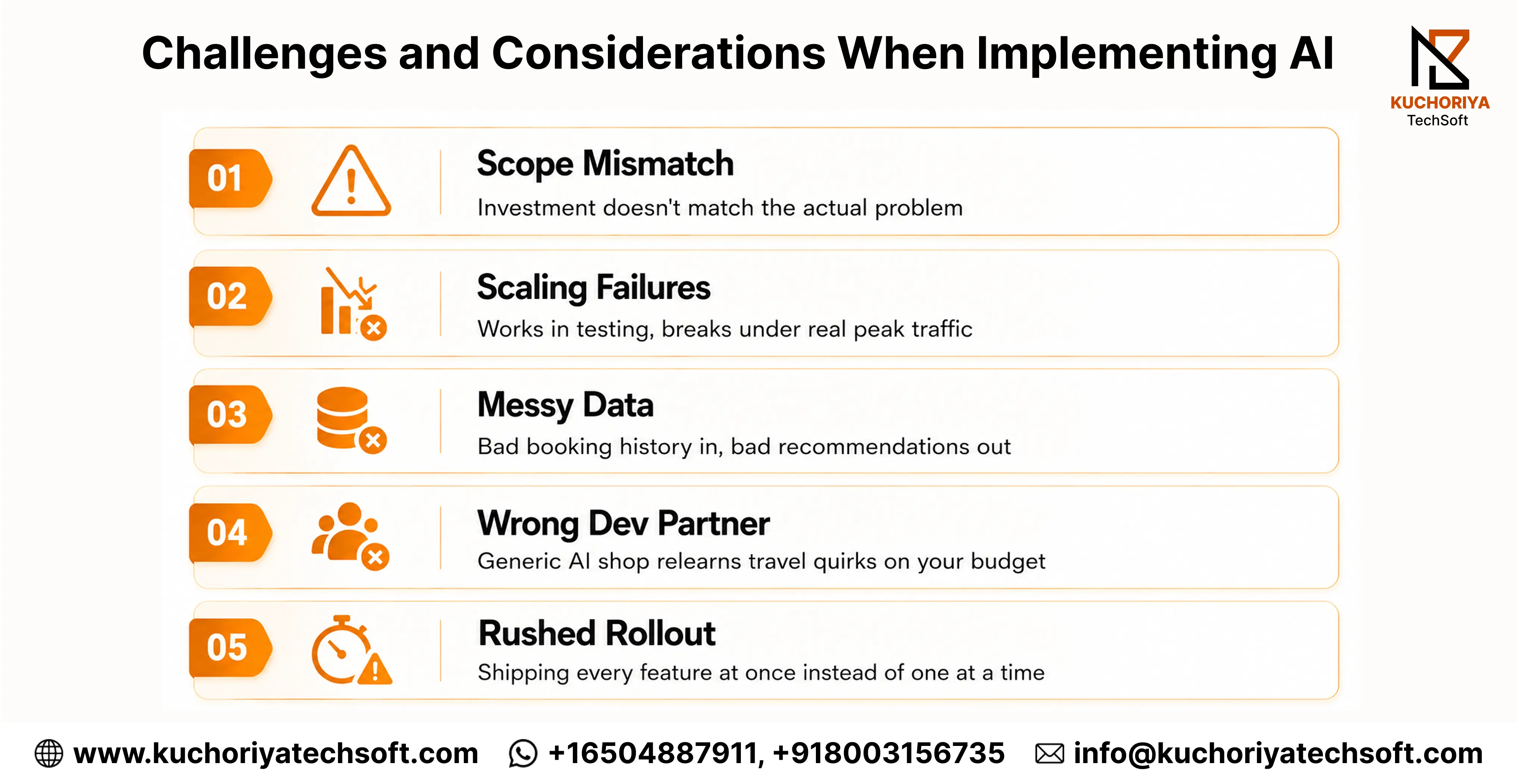
- Is AI worth it for travel platforms? Depends on what you're solving. A recommendation engine pays off fast. A full AI overhaul before you've validated demand is usually not worth it.
- Scalable AI travel infrastructure breaks in ways testing never catches. Runs fine at low traffic, then a long weekend hits, volume triples, and suggestions start getting weird.
- Data is the boring problem that actually bites. How does AI work in travel marketplaces? It learns from your booking history. Feed it messy records, get messy recommendations back.
- A trusted AI travel development partner matters here more than usual. GDS quirks, currency swings, seasonal demand spikes, and a generic AI shop relearn all of it on your budget.
- Figuring out how to add AI to a travel marketplace without breaking everything? Ship one feature, watch it run against real traffic for a few weeks, then move to the next.
Must Read: Top 10 Travel Marketplace Development Companies in 2026
How to Choose the Best Travel Marketplace Development Company in 2026
How Much Does It Cost to Add AI to a Travel Marketplace?
Costs vary a lot depending on what you're actually adding, not the platform as a whole.
Most AI travel software development services price by feature complexity, not a flat rate, so a simple recommendation widget costs far less than a full itinerary engine trained on real booking data.
An established AI travel marketplace development company usually bundles two or three features together for a better rate than building each one separately. Rates also shift by region, an AI travel marketplace development company USA team typically charges more per hour than a similarly skilled team offering AI travel technology solutions Canada, though quality gaps have narrowed a lot in the past two years.
Before signing anything, ask what's actually included. Some vendors selling AI travel technology solutions quote a low number, then bill separately for training data prep, testing, and post-launch tuning, costs that should've been in the estimate from day one.
Future Trends in AI Travel Marketplace Development
Trends move fast in this space, and last year's "emerging tech" is already standard on serious platforms. Here's what's actually shaping up next.
1. Multi-agent AI systems
Bots are starting to specialize, one handling search, another managing pricing, another running support, working together instead of one bot trying to do everything at once.
2. Voice-first booking
Teams doing AI travel platform development UK projects are leaning into conversational booking flows, letting travelers plan a trip by talking instead of clicking through filters.
3. Hyper-local personalization
An AI travel software company Australia side is increasingly testing recommendations that factor in weather, local events, even currency swings.
4. Rising demand in the Gulf
Demand for AI travel marketplace developers Dubai businesses trust is growing fast, driven by the region's push into luxury and experiential travel tech.
5. Predictive rebooking
Providers offering AI travel solutions Singapore wide are piloting systems that flag a likely flight delay and suggest alternatives before the traveler even checks their app.
Not every trend here will stick. But custom AI travel marketplace development built with room to add these later, rather than a rigid system, is what separates platforms that adapt from ones stuck rebuilding from scratch.
How to Build an AI-Powered Travel Marketplace
Getting this right usually comes down to who you build it with, not just what features you pick.
Start by deciding whether to hire AI travel marketplace developers in-house or work with an AI travel software development company that's already solved travel-specific problems before. The second route is faster for most teams, no learning curve on GDS quirks or payout logic.
Look for travel technology consulting upfront, before any code gets written, to map out which AI features actually solve your bottleneck first. Some AI travel app development company teams also run a referral partner program, worth asking about if you're working through an agency or consultant.
If you need ongoing technical direction without hiring full-time, ask about virtual CTO services too, many travel app development partners offer this as a lighter-weight option for early-stage platforms.

Frequently Asked Questions
Q. Do I need a team with travel portal development experience, or can any dev shop handle it?
A. Any decent team can technically build a portal. The difference shows up later, GDS timing quirks, multi-currency edge cases, seasonal traffic spikes, things a team without real travel portal development background usually learns the hard way, on your budget and your timeline.
Q. How is OTA development different from just adding AI features on top?
A. OTA software development is the foundation, listings, bookings, payment flow. AI sits on top of that, recommendation engines, dynamic pricing, chat support. You're not rebuilding the platform, you're layering intelligence onto what's already working.
Q. Can I add AI to a hotel booking system I already have, or does it need a full rebuild?
A. Usually no rebuild needed. AI-integrated hotel booking platform development typically means connecting AI to your existing availability and pricing data, assuming that data's clean enough to actually train on.
Q. Does flight booking need a different kind of AI than hotels or vacation rentals?
A. Yes, actually. Flight booking software development deals with seat inventory and fare rules that change by the minute, so the models behind it look nothing like ones built for hotel or rental bookings, which move a lot slower.