






Why Choosing the Right Travel Marketplace Development Company Matters
Picking a travel marketplace development company is the one decision that decides whether your platform actually launches, or quietly stalls somewhere between "almost ready" and "still fixing bugs."
The global online travel agency market is set to grow from $718.9 billion in 2026 to $1,316.8 billion by 2033. That growth is pulling in founders fast, but most obsess over features, search filters, payment flow, vendor dashboards, while the platform rarely fails because of the idea.
It fails because of the partner. Missed deadlines, broken API integrations, support that vanishes right after go-live.
A real travel development partner brings something no generic agency can fake, actual travel industry experience. GDS quirks, payout disputes, seasonal traffic spikes, they've seen it before you have.
This guide breaks down exactly how to spot that kind of partner, before you sign anything.
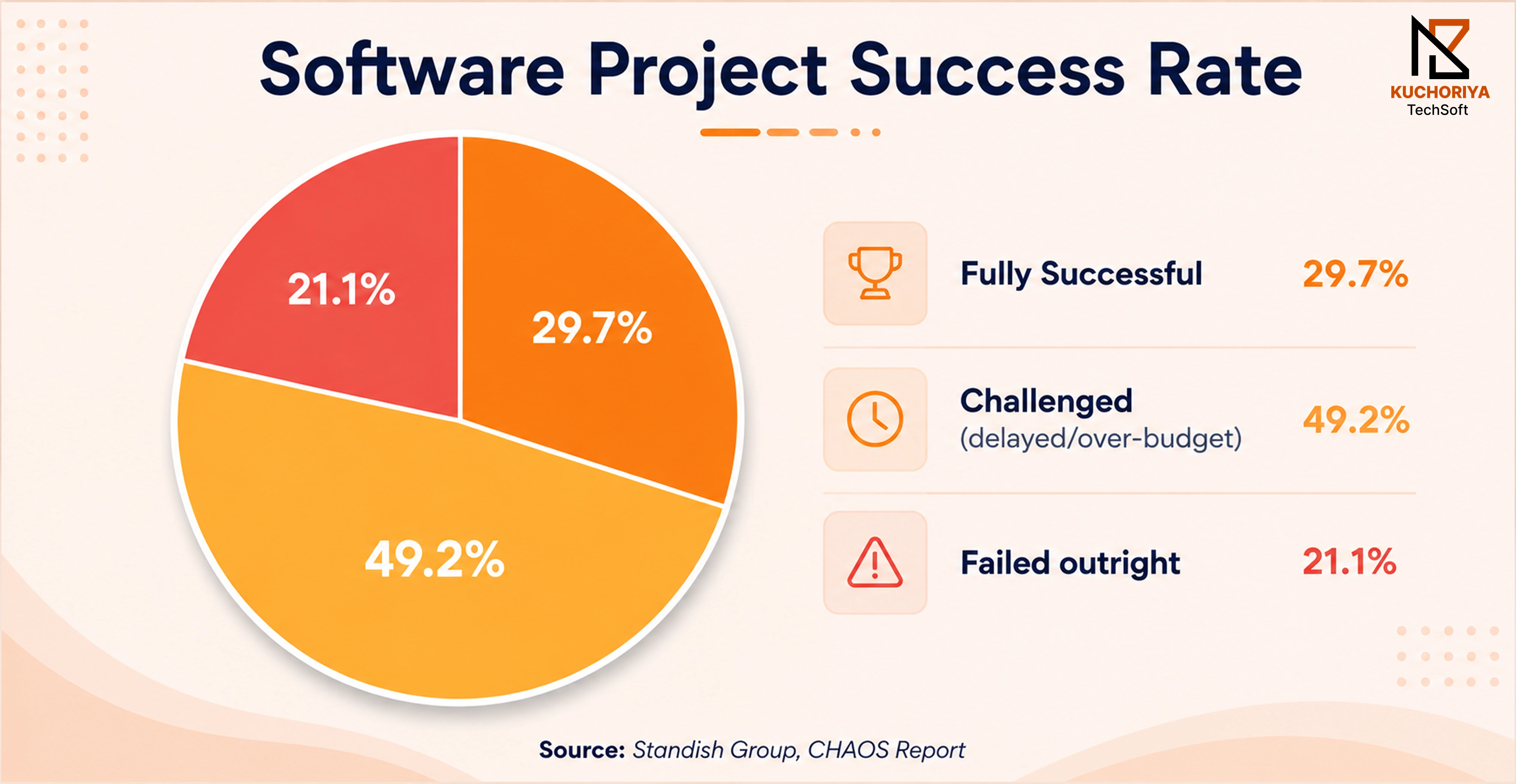
Signs You Need a Specialized Travel Marketplace Development Partner
Not every business needs to search for the best travel marketplace development company. But a few signs make it non-negotiable.
- You're running online travel agencies, doing multi-vendor bookings, or aggregating suppliers, not just selling your own inventory
- Hotel groups managing multiple properties need real-time sync across booking channels, something a generic dev shop rarely gets right the first time
- Your current platform breaks during peak season, or vendors keep calling about payout mismatches
- You need GDS/API integrations (Amadeus, Sabre, Travelport) and nobody on your current team has touched them before
- Commission splitting, multi-currency payouts, or vendor dashboards keep getting patched instead of built properly
If any of this sounds familiar, that's usually the moment to ask what should I look for in a travel development company instead of settling for whoever's cheapest or fastest.
Define Business Goals Before Shortlisting Development Companies

Most founders skip this part. They go straight to comparing vendors, without first figuring out what they actually need from one. Before you build any vendor evaluation framework, get your own goals sorted out.
1. MVP or Full-Scale Platform?
Testing an idea and building something meant to last five years are two different projects. They need different budgets, different tech choices, and often different teams. Figure out which one you're doing before the first sales call, because vendors pitch differently depending on which one you say.
2. Know Your Business Type
A travel agency moving commission-based bookings online has different needs than a destination management company managing local tours, transport, and supplier packages together. A vendor who's only built one kind of platform will often try to fit your business into that same mold, whether it fits or not.
3. Must-Haves vs Nice-to-Haves
Make this list on your own, before anyone pitches you anything. Left alone, most vendors lead with whatever feature demos well, not necessarily what your platform needs first.
4. Set a Real Budget Range
Not a rough guess you're unsure about, an actual number decided internally. Vendors can tell when a budget is soft, and that's usually when scope quietly starts expanding beyond what you planned to spend.
5. Define Your Timeline
Three months and nine months aren't close to the same project. Saying this early filters out vendors who were never going to match your pace anyway.
Sort these five out first, and every vendor conversation after that becomes shorter and a lot more useful.

Essential Qualities of a Trusted Travel Marketplace Development Company
Not every vendor calling themselves a travel technology company actually has the background to prove it. A few qualities separate the ones worth trusting from the ones just chasing the contract.
- They can show proven travel technology expertise, not just a portfolio of generic e-commerce apps with a travel logo slapped on.
- Real travel domain knowledge shows up in small things, they'll already know how GDS integration usually breaks, what a payout dispute actually looks like from the vendor side, and why platforms crash the moment seasonal traffic spikes if they weren't built to handle it.
- Ask a trusted travel software provider a technical question on a call and they'll just answer it. No "let me check with the team and circle back."
- Go-live isn't where support ends. If a booking flow breaks on a Saturday night, someone still picks up.
- References check out. Ask for two or three, and actually call them, don't just skim testimonials on their homepage.
- Location matters less than experience, but a travel development company USA based team often means overlapping working hours and fewer delays waiting on time-zone replies.
Questions Every Business Should Ask Before Hiring a Development Partner

Shortlist done? Good. Before you sign anything, ask these. If you're figuring out how do I hire a travel technology partner the right way, start here.
1. Have You Built for Travel Before?
Not marketplaces in general, travel specifically. Ask which platforms they shipped and what broke along the way.
2. What's Your Experience With Integrations?
GDS, payment gateways, third-party APIs, this is usually the first question that separates real experience from a good pitch. It's exactly what questions should I ask a travel software vendor, and integrations is where most builds fall apart.
3. Who Owns the Code After Launch?
Get it in writing. Some vendors quietly hold onto rights or lock you into their support plan. Any real travel development company checklist has this as a line item, not a footnote.
4. What Does Support Look Like After Go-Live?
Ask for actual numbers, response time, who handles escalations, dedicated person or shared inbox. Vague answers here usually mean vague support later.
5. Can I Talk to a Past Client?
Case studies are edited. A real client isn't. If they hesitate to connect you, that says enough.
Treat this as your travel technology partner checklist before you hire travel technology experts, not a formality after the decision's already made.
Must Read: Travel Marketplace Development: A Complete Guide to Platforms, Apps, and Software Solutions
How to Evaluate Industry Experience, Portfolio, and Client Success Stories
A polished portfolio page proves someone can build. It doesn't prove someone understood the problem. A few things actually matter when evaluating travel development companies.
- Almosafer, a travel booking app built for the UAE market, replaced five separate apps with one. Flights, hotels, airport transfers, local payment methods, and Qitaf points all sit in a single flow now, that only happens when the team understands how people in that region actually book trips.
- An AI-powered hotel booking engine, built for a hospitality client stuck relying on OTA platforms with inconsistent customer data and rising cancellations. The fix was a custom booking engine with dynamic pricing and personalized offers, and direct bookings went up 35% because of it.
- These are the kind of travel software case studies worth asking for, not "we built an app," but what problem existed first, and what changed after.
- When setting travel technology partner selection criteria, look past screenshots. Ask what stack was used, what industry the client came from, and whether the results held up months later, not just at launch.
- An enterprise travel technology partner should walk you through actual numbers, not just names on a slide.
- Running closer to tour operators? Ask for that exact kind of project. A hotel booking engine and a multi-supplier tour platform solve different problems, even if both get filed under travel tech.
If a case study can't answer what changed and by how much, it's a portfolio piece, not proof.
Key Technical and Business Capabilities to Look For

Past projects show what a vendor has already done. This part is about what they need to actually be capable of, on your build, not someone else's.
1. Are They a Real Web Development Company, or Freelancers Stitched Together?
Ask who's actually working on your project, not who's smiling on the "our team" page. A proper web development company has QA, a project manager, and developers assigned to you specifically. Not one guy juggling five clients and hoping nothing slips.
2. Do They Have Real Mobile Experience?
A lot of teams that build websites well have never actually shipped a mobile app. Ask to see one they built, and look it up yourself on the App Store or Play Store while you're on the call. If all they can show is a Figma file, that's your answer.
3. Can They Actually Handle Scale?
Some platforms run fine right up until they don't. 500 users, no problem. 5,000, and suddenly everything's slow or down. That usually traces back to someone skipping the scale conversation early on. Ask what their cloud consulting services setup actually looks like before you're the one finding out the hard way.
4. Do They Run Proper Technical Due Diligence?
Watch how fast they give you a number. If a price shows up before they've asked a single question about your current stack, your data, or what you're already integrated with, they're guessing. Good technical due diligence means the questions come first.
5. Where Does Their Software Development Expertise Actually Sit?
Nobody's equally strong at backend, frontend, DevOps, and security all at once. Ask which parts they own directly, and which parts they'd bring someone else in for. Real software development expertise sounds like specifics, not "we do it all."
6. Is Design an Afterthought, or Part of the Process?
Some vendors treat design like decoration, something to add once the "real work" is done. Ask instead to see their process for UI/UX design services, wireframes, user flows, decisions they made and why, not just the final polished screen that looks nice in a pitch deck.
Six straight answers here usually tell you more than an hour-long pitch would.
Understanding Pricing, Project Scope, and Long-Term Value
Cheapest quote and best value are rarely the same thing. Before comparing numbers, it helps to know what you're actually paying for.
The lowest bid usually means the fewest people on your project, or the most corners cut somewhere you won't see until later.
Common Mistakes Businesses Make When Choosing a Development Company
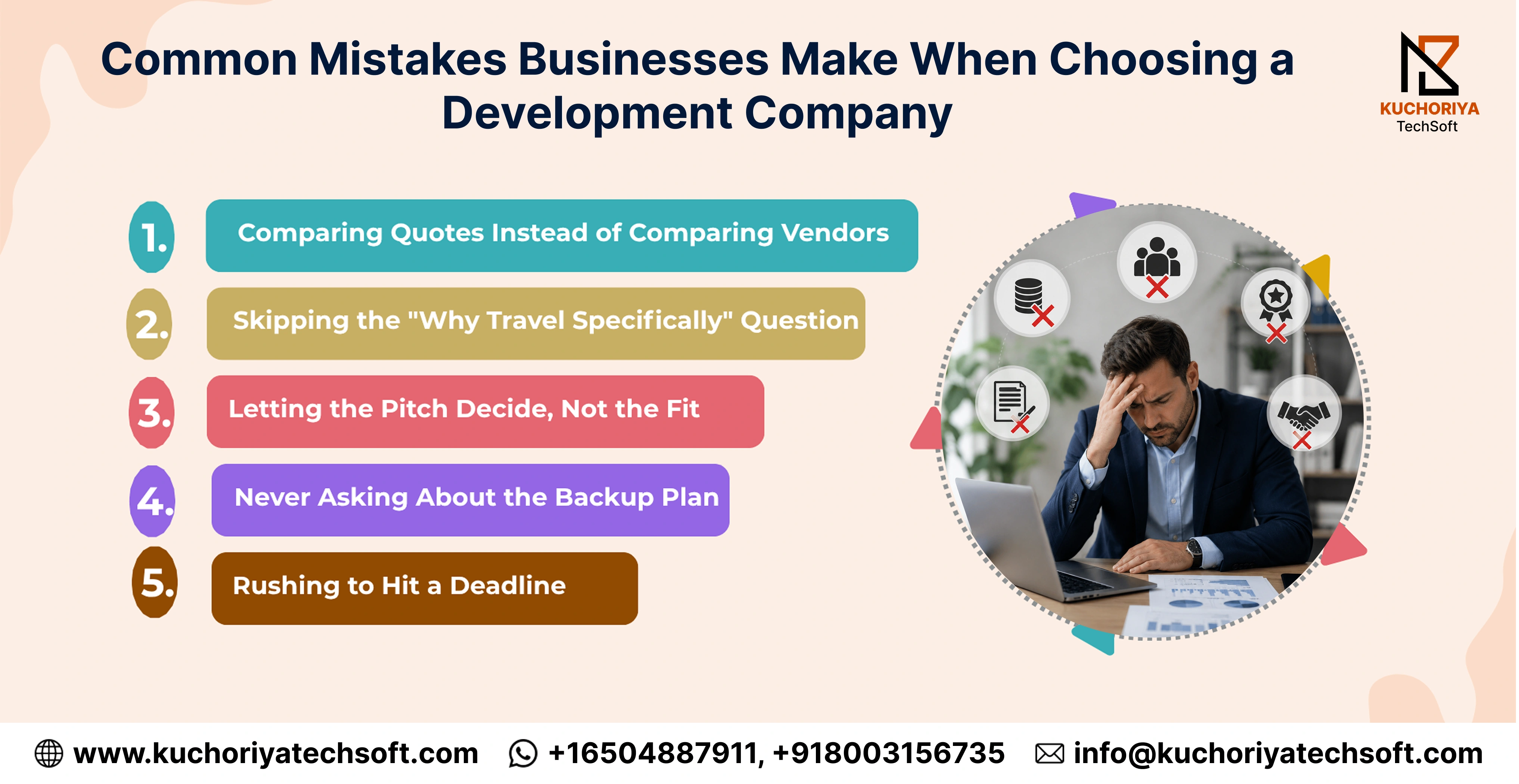
Most bad hires don't happen because someone picked the wrong vendor. They happen because someone skipped a step while comparing them. Here's what usually goes wrong.
1. Comparing Quotes Instead of Comparing Vendors
A proper travel software company comparison looks at team structure, past travel projects, and support terms, not just the number at the bottom of the proposal. Two quotes can look identical and mean completely different things.
2. Skipping the "Why Travel Specifically" Question
Knowing how to evaluate a travel marketplace company starts with asking why they work in travel at all. A generic dev shop that took on a travel project once isn't the same as a team that's dealt with GDS integrations and payout disputes for years.
3. Letting the Pitch Decide, Not the Fit
The most polished sales call doesn't tell you which travel software company is right for my project. Slides and confidence are easy to fake. Ask instead who's actually building it, and whether they've built something like yours before.
4. Rushing to Hit a Deadline
A launch date is not a reason to sign with whoever's available fastest. Software partner selection done in a rush skips the boring questions, the ones that actually matter, and those come back later as expensive surprises.
5. Never Asking About the Backup Plan
Nobody wants to think about what happens if a deadline slips or something breaks post-launch. Ask anyway. Who owns it when things go wrong, and is that actually written into the contract, or just something they said on a call?
Most of these mistakes only show up after signing. Catching them before that is the entire point of this list.
Why Travel Businesses Choose Specialized Development Partners Over General Agencies
A general agency can build software. A travel marketplace consulting company brings something else to the table, they've already seen the problems specific to this industry before your business runs into them.
- A travel marketplace development partner that's only worked in travel already knows what breaks during peak booking season, and builds around it instead of patching it after launch
- Hospitality businesses managing rooms, rates, and availability across channels need a team that understands inventory sync, not one learning it for the first time on your project
- Airline technology providers deal with constraints, like fare rules, GDS behavior, real-time seat inventory, that a general software team has likely never touched
- A dedicated travel development company brings prior context into every conversation; fewer explanations are needed, fewer assumptions that turn out wrong later
- Travel marketplace consulting services go beyond writing code, they help shape the product itself, based on what's actually worked for similar platforms before
A team that's specialized in travel isn't guessing what your business needs. They've already built for it, more than once.
Travel Marketplace Development Company Selection Checklist
Everything covered so far, condensed into one travel marketplace vendor assessment you can actually run through before signing anything.
- Do they have travel-specific experience, not just general technology consulting services?
- Have they worked as a product engineering partner, not just a code-for-hire vendor?
- Can they show real software product development work, start to finish, not just a portfolio of screenshots?
- Do they understand SaaS product development, if your platform runs on a subscription or recurring model?
- Is their team capable of enterprise software development, if you're planning to scale past a basic MVP?
- Did they ask about your business goals before pitching a solution, or did the solution come first?
- Do they have GDS or third-party API experience relevant to your platform?
- Is code ownership after launch clearly defined in writing?
- Does their pricing model match your actual scope, not just look good on paper?
- Can they connect you with a past client, not just show you a case study?
- Is post-launch support specific, response times, escalation process, not vague promises?
- Does their delivery process include visible milestones, or do they disappear until "the build" is done?
If most of these boxes check out, you've likely found a partner worth signing with. If more than a few don't, that's usually the answer too.
Making the Final Call: Choosing a Travel Marketplace Development Company You Can Trust
At this point, the decision isn't really about finding the biggest name. It's about picking a team that's already run into the problems your platform hasn't hit yet, and knows how to handle them when they show up. That's the real difference when you hire travel marketplace development company talent.
Businesses that outsource travel software development and actually get it right usually aren't the ones who signed fastest. They're the ones who slowed down long enough to ask the questions in this guide.
Whether you're hiring locally or looking at a travel technology provider Singapore businesses go to for cross-border builds, the basics stay the same. Look for scalable travel technology expertise, people who plan for growth instead of scrambling to rebuild for it later.
This matters even more for enterprise travel brands, where downtime doesn't just cost users, it costs trust. At that scale, you're not hiring developers, you're bringing on something closer to CTO consulting services.
Already have a partner in mind, or came here through someone who's worked with us? Our referral program rewards that. Otherwise, the next step is easy, get in touch and talk through your project with a team that's built for travel more than once.

Frequently Asked Questions About Travel Marketplace Development Companies
Q. How do I choose a travel marketplace development company?
A. Check travel-specific experience first, not just general dev skills. Look at GDS work they've done, ask for real references, and understand their pricing before signing. This guide doubles as a full travel software vendor selection guide if you want the longer version.
Q. What's the difference between a travel software company and a general software company?
A. A travel software company has already dealt with seasonal traffic spikes, GDS quirks, and vendor payouts. A general company might build something similar, but you'll likely be the one finding the problems first.
Q. Should I hire a travel technology consulting company or build in-house?
A. Depends on speed versus control. A travel technology consulting company gets you moving faster. In-house takes longer but gives full ownership long-term. Most travel startups start with a partner first.
Q. Do these companies work across different countries?
A. Yes, most do. Whether you need a travel technology consulting company Canada trusts, a travel software company UK teams work with, a travel technology partner Australia relies on, or travel software services Dubai businesses use, time zone overlap matters more than exact location.
Q. What should good post-launch support actually include?
A. Clear response times, a real escalation process, and someone reachable if something breaks after hours. Real post-launch support services are specific, not vague promises.
Q. Is a vacation rental platform different from a full travel marketplace?
A. Yes. Vacation rental businesses deal with calendar sync and owner payouts. A marketplace juggles flights, hotels, and multiple suppliers at once. Know which one you are before you hire travel software developers.