Introduction: Why Businesses Need Custom Inventory Management Software
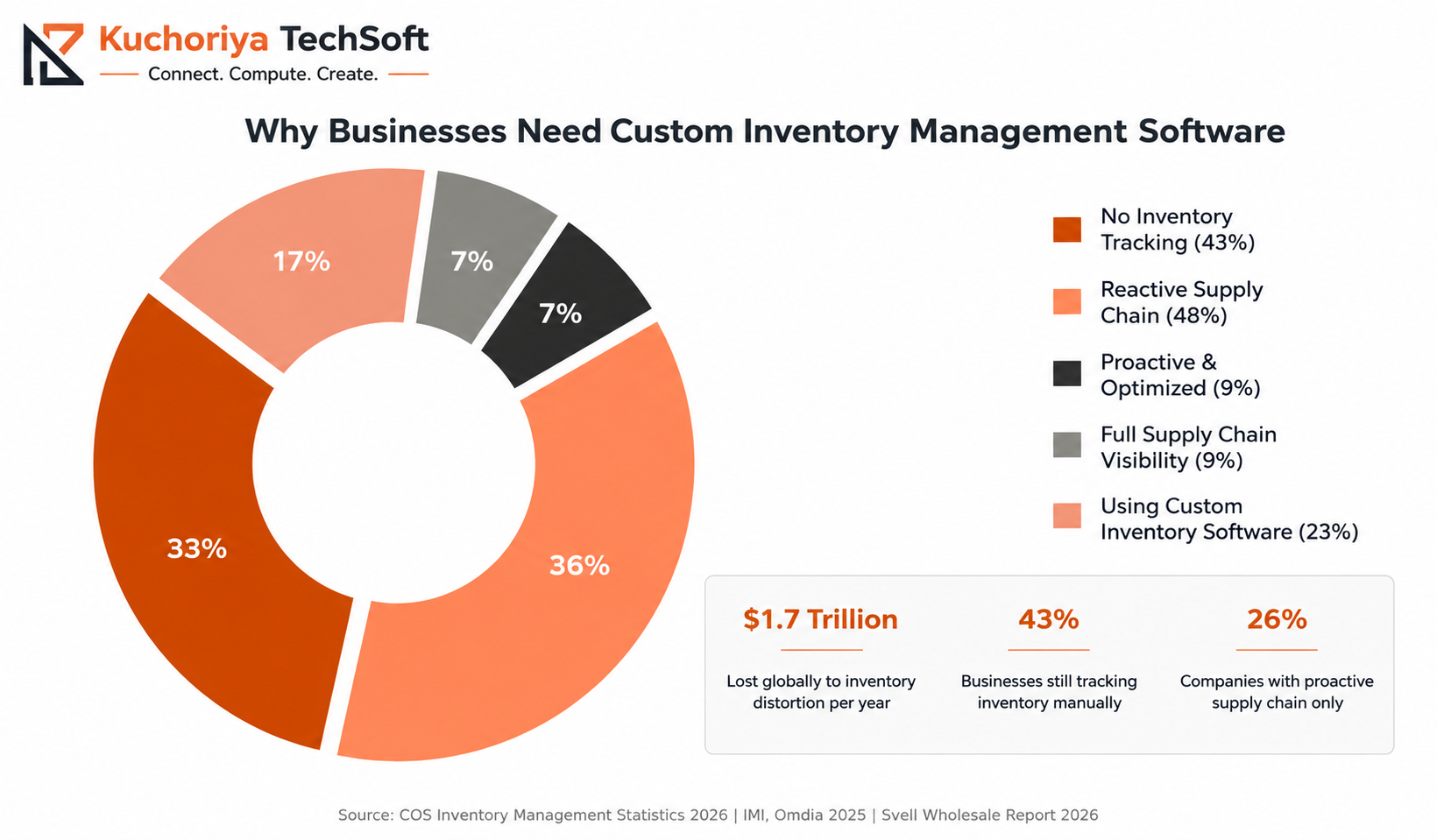
Every year, businesses lose an estimated $1.7 trillion to inventory distortion. Overstocked shelves, missing products, and orders that never go out on time. If you are running a business today without a proper custom inventory management software solution in place, that number should make you stop and think. Most of these losses are not because of bad products or poor teams. They happen because nobody actually knows what is in the warehouse until it is already too late.
Inventory management problems do not show up in one big moment. They bleed quietly, week after week, until the profit margins just stop making sense. Here is what that actually looks like across businesses today:
- 43% of small businesses still do not actively track their inventory at all, running blind on stock levels every single day.
- Only 26% of companies run a proactive supply chain network, the rest are reacting to damage that has already been done.
- $1.7 trillion lost globally every year to overstocking and stockouts combined, and most of it was preventable.
- 91% of customers will not return to a business after experiencing a stockout, one missed item costs you a long-term buyer.
- Around 63% of supply chain managers still rely on Excel for their basic inventory management software needs, a tool never built for this job.
- 54% of wholesale businesses report direct losses from poor demand forecasting, a problem the right enterprise inventory management software solves from day one. (Source)
Common Inventory Management Problems Businesses Face
Businesses do not lose money all at once. It happens in small doses, a late order here, a missing item there, until one day the numbers just do not add up anymore. Stock management challenges are rarely visible until they have already done the damage. Here is what most businesses are actually dealing with on the ground:
1. Manual Stock Tracking Errors
- 67% of inventory managers still use Excel as their primary tracking tool, a software built for numbers, not for live stock movement across multiple locations
- One wrong entry, one missed update, and the entire stock count goes off, triggering wrong reorders and delayed fulfillment
- Business inventory software built for real operations replaces this guesswork with automated, accurate records updated in real time
2. Overstocking and Stock Shortages
- Businesses on average carry $142,000 above actual demand, money sitting in a warehouse doing nothing instead of fueling growth
- At the same time, stockouts generate $1 trillion in lost sales annually worldwide, two opposite problems happening inside the same operation
- Without proper inventory tracking software, there is no way to find the balance between too much and not enough
3. Delayed Order Fulfillment
- 34% of retail businesses have shipped an order late because they sold a product that was already out of stock
- 90% of logistics managers say inefficient inventory planning is the number one cause of delivery delays
- Customers do not wait. One late delivery is often the last order they place with that business
4. Lack of Real-Time Inventory Visibility
- Only 9% of businesses have full supply chain visibility right now, the rest are working with outdated or incomplete data
- Real-time stock visibility is not just a feature, it is the difference between catching a problem early and finding out about it after a customer complaint
- 74% of businesses are still updating inventory data with delays, meaning decisions are made on numbers that no longer reflect reality
5. Poor Warehouse Coordination
- Human error affects nearly 43% of warehouses worldwide, leading to miscounts, wrong placements, and fulfillment mistakes that cost time and money
- When warehouse teams are not working from the same live data, the same item gets picked twice, or not at all
- Inventory management problems at the warehouse level do not stay there, they slow down every department connected to it
How Custom Inventory Software Solves These Business Challenges
Same problems, every single week. That is what happens when the tools do not match the pace of the business. Custom inventory software solution does not patch the issue, it removes it entirely.
1. Automated Inventory Tracking
- Automated inventory management software logs every stock movement the second it happens, no manual counts, no end of day reconciliation
- Businesses switching to automation report up to 25% fewer fulfillment errors within the first quarter
2. Real-Time Stock Updates
- A sale happens in New York, a return lands in Sydney, a transfer goes out from Dubai. Real-time inventory tracking software catches all of it at once, every location, same moment
- No more calling the warehouse to check what is actually there before confirming an order
3. Faster Order Processing
- The moment a sale comes in, inventory tracking software triggers fulfillment automatically, no one needs to manually start the process
- Businesses automating order processing cut fulfillment time by 30 to 40% on average
4. Better Warehouse Control
- Live stock data means warehouse teams stop searching for items and start actually fulfilling orders
- Every movement gets logged, shrinkage drops because nothing leaves without a record
5. Data-Driven Decision Making
- Pattern data shows what sells fast, what sits idle, and what needs reordering before a shortage hits
- Managers across the USA and UAE are cutting excess stock by 20 to 30% without running into a single stockout
Key Benefits of Custom Inventory Management Software
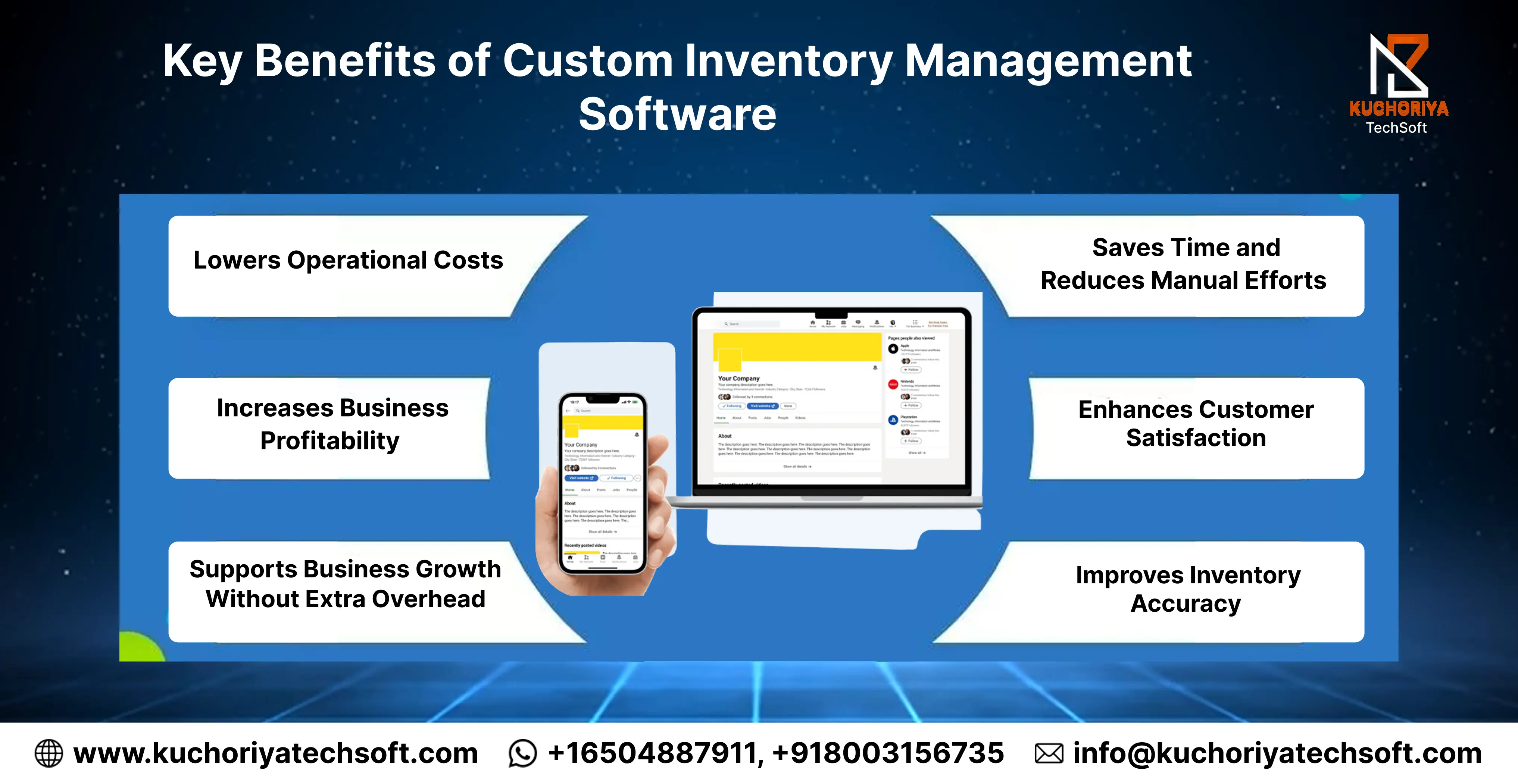
Running a business on outdated stock data costs more than most people realize. Here is what actually changes when the right system is in place.
1. Saves Time and Reduces Manual Efforts
Every week someone is stuck fixing spreadsheet errors and chasing numbers that keep changing. The right automated business inventory software takes all of that off the plate so the team is actually working instead of just tracking.
2. Lowers Operational Costs
Dead stock sitting in a warehouse costs money every single day. Average inventory carrying costs run at 20 to 30% of total value annually and proper demand tracking cuts most of that out fast.
3. Improves Inventory Accuracy
Most businesses sit at 66 to 83% stock accuracy and every gap in that number is a gap in revenue. One wrong entry and the entire count is off before the day even starts.
4. Increases Business Profitability
When stock moves on time and waste gets cut from both ends, the margin finally reflects the effort going in. Businesses using advanced inventory optimization software report 10 to 15% profit increases in the first year alone.
5. Enhances Customer Satisfaction
91% of customers do not return after one bad stockout experience. When the right product ships on time every time, that reliability builds loyalty no ad budget ever could.
6. Supports Business Growth Without Extra Overhead
Hiring more people to manage more stock is just more cost. Scalable cloud-based inventory management software grows with the business automatically, one location in Toronto or five warehouses across the USA, UAE, and Singapore.
Essential Features of Custom Inventory Software
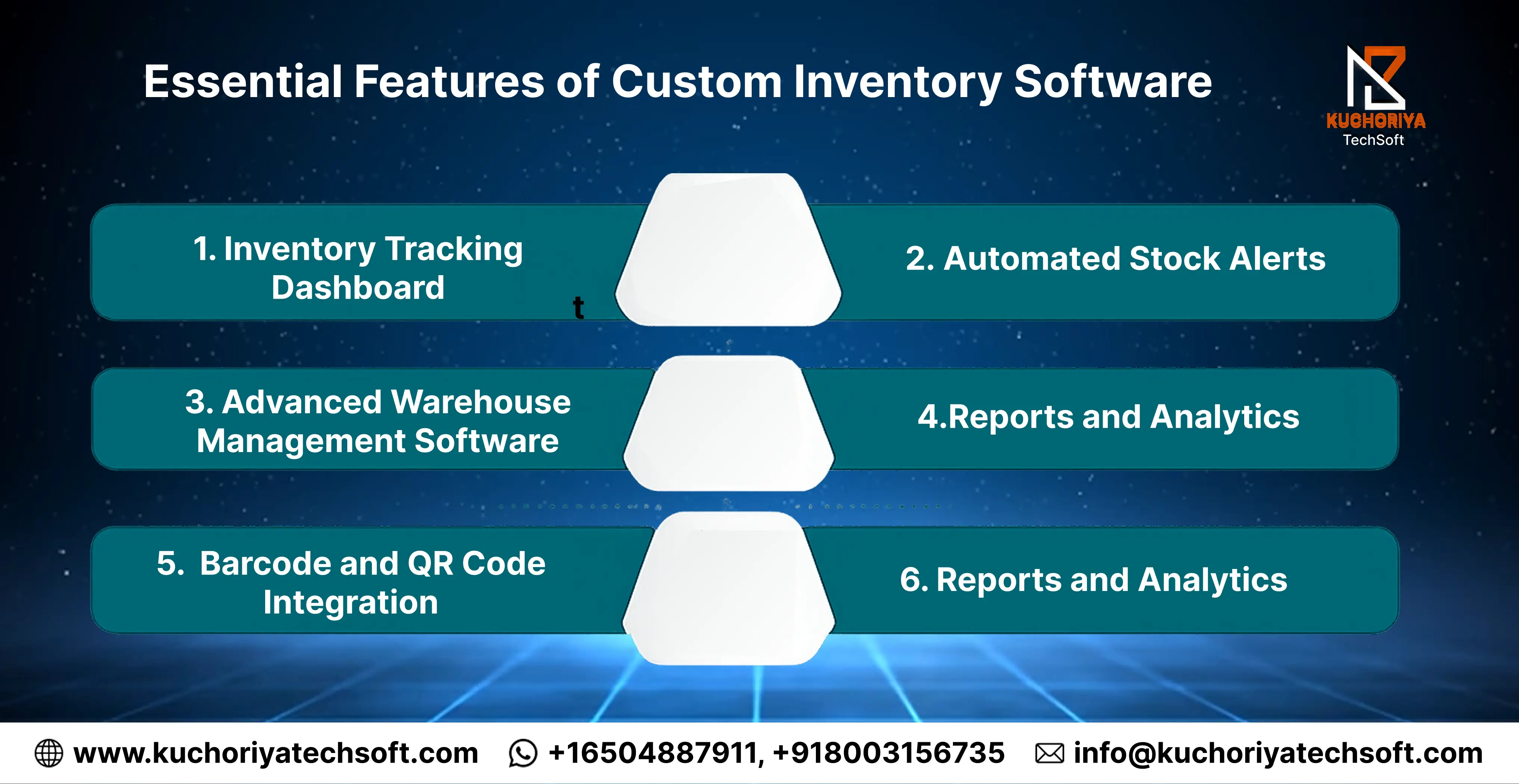
Features make or break a system. A demo looks good until it hits a real warehouse on a Monday morning. These are the ones that actually hold up.
1. Inventory Tracking Dashboard
Every number, every location, every movement sitting in one screen without anyone having to pull it manually. The team stops chasing updates and starts using them.
2. Advanced Warehouse Management Software
A product lands in the wrong aisle and three people spend an hour finding it. Best-in-class warehouse inventory software puts every item in a mapped location so that hour never happens again.
3. Barcode and QR Code Integration
Manual entry is where most errors start. Scan a barcode and the system updates instantly, right item, right quantity, right location, every single time.
4. Automated Stock Alerts
The system flags low stock before it becomes a stockout. Reorder triggers go out automatically so nothing runs dry while someone is waiting for an approval email.
5. Reports and Analytics
What sold last Tuesday, what has been sitting since March, which supplier is always late. Multi-location inventory management software for growing businesses pulls all of it into one report without anyone having to ask.
6. Third-Party System Integration
A sale goes through on Shopify, the warehouse gets the update, the accounts reflect it, all at once. Reliable cloud-based inventory management software solution ties every tool together so nothing needs to be entered twice and nothing gets missed in the middle.
How Much Does Custom Inventory Management Software Cost?
No two businesses are the same, so there is no fixed number here. A single store in Toronto has different needs than a five warehouse operation running across Dubai and Singapore. What drives the cost is how many locations need to be covered, how deep the integrations go, and how much automation the business actually wants running in the background. The right custom inventory software development company scopes all of that before a single line gets written.
Features are where the budget moves the most. Barcode scanning costs less than AI demand forecasting. A single currency system costs less than multi-currency with ERP sync. Businesses that know exactly what they need before development starts end up spending less and getting more out of what gets built.
Professional inventory management software development services do not stop at the build. Hosting, updates, bug fixes, and maintenance come after, and with a custom system that is all in one place with no surprise charges showing up every quarter.
Related Insights: What Does It Really Cost to Build Custom Inventory Management Software?
How to Create an Inventory System: Features, Use Cases, Steps

Custom Inventory Software vs Ready-Made Inventory Solutions
Most businesses start with whatever is cheapest and fastest to set up. That works fine until order volume goes up and the cracks start showing.
1. Built Around the Actual Workflow
A ready-made inventory management system ships with fixed modules that almost fit how a business runs, never exactly. Custom software gets built around the real process on the floor, not the other way round.
2. No Ceiling on Growth
Off-the-shelf tools cap out fast. Add a new warehouse, a new sales channel, or a new region, and the upgrade requests start showing up. Teams running inventory management software for small business operations usually hit this wall within the first year of real growth.
3. Full Control Over Data and Features
Vendor-built tools keep data on their own servers and decide which features get released and when. A custom inventory control software setup keeps that decision with the business, not on someone else's release calendar.
4. Lower Cost Over Time
Subscription tools look cheap on day one. Per-user fees, storage limits, and integration add-ons stack up fast, and a few years in, the "cheap" tool is usually costing more than a custom build would have.
Real-World Use Cases Across Industries
A warehouse problem and a hospital stock problem do not look the same, even though both get filed under "inventory issues." Here is how it actually plays out by industry.
1. Manufacturing and Production Units
A machine stops mid-run because a part nobody reordered in time ran out. Manufacturing inventory software keeps a live count from raw material to finished unit, so a shortage gets caught with enough lead time to actually fix it.
2. Logistics and Supply Chain Companies
A truck leaves the depot and the system still shows yesterday's count for the next two hours. Supply chain inventory software updates the second something physically moves, not whenever someone remembers to check.
3. Retail and eCommerce Businesses
The website shows three in stock, the shelf has zero, and now there is a refund and a customer who probably will not order again. Retail inventory management software tied to an e-commerce inventory management system keeps both counts matching at all times.
4. Automotive and Car Dealerships
A brake pad and an engine part do not sell at the same speed, but most dealership spreadsheets treat them the same. The result is duplicate orders for parts already sitting in the back.
5. Healthcare and Pharma Companies
Expired stock in a pharmacy is not just wasted money, it is a real problem during an audit. Healthcare inventory management software flags batches nearing expiry before they get forgotten on a shelf.
How AI-Powered Inventory Software Improves Business Growth
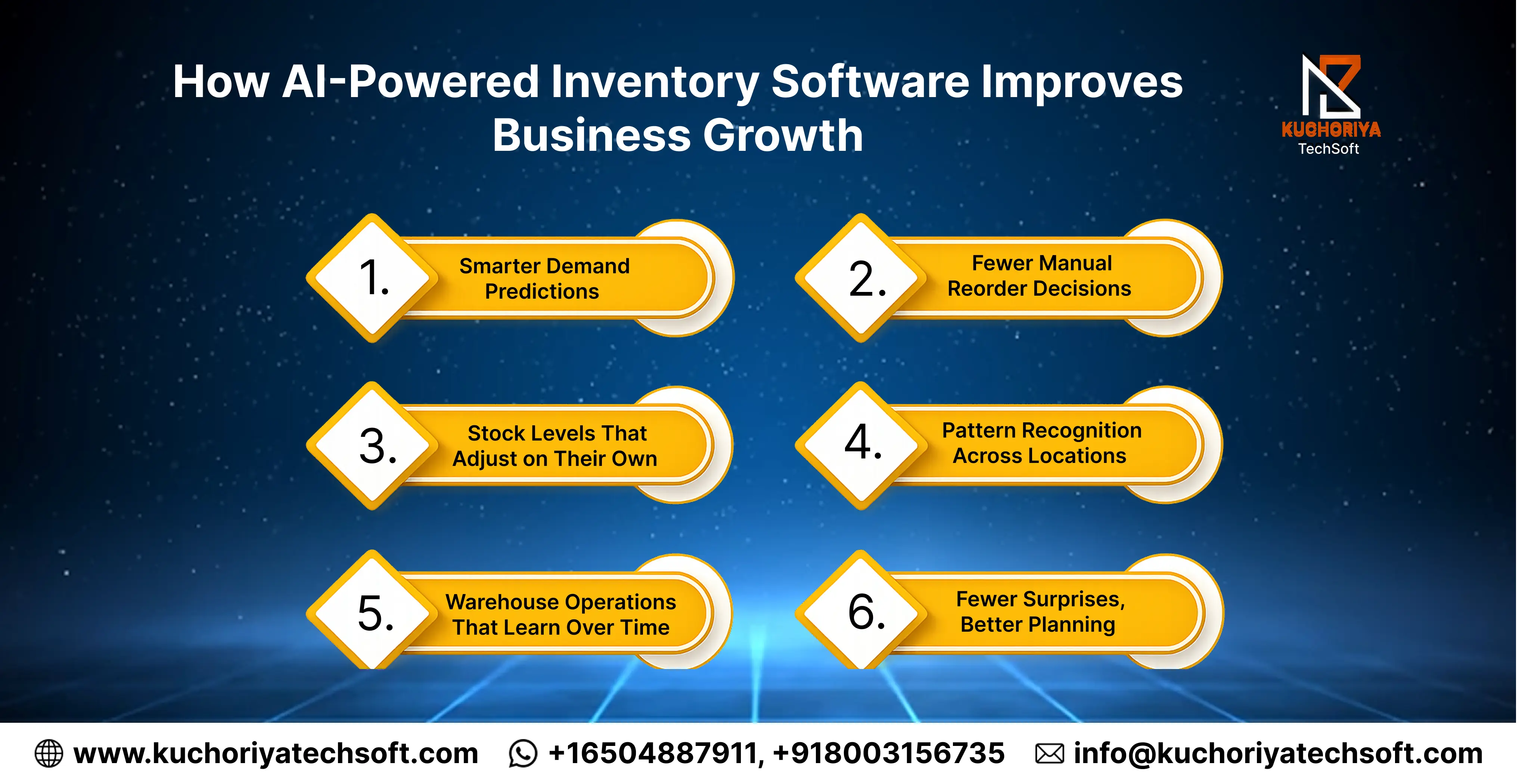
Tracking stock is one thing. Knowing what is going to happen to that stock next week is a different game entirely, and that is where AI actually earns its place.
1. Smarter Demand Predictions
Sales patterns from last year, last season, even last Tuesday all feed into one thing. AI demand forecasting software catches a spike before it happens instead of after the shelf is already empty.
2. Fewer Manual Reorder Decisions
Someone guessing how much to reorder is how overstock happens in the first place. AI inventory management software calculates the number based on actual sales velocity, not gut feel.
3. Stock Levels That Adjust on Their Own
A slow week and a busy week need different stock levels, and most systems do not adjust for that automatically. Predictive inventory management software shifts reorder points based on what is actually happening right now, not last quarter's average.
4. Pattern Recognition Across Locations
One store sells fast in summer, another sells fast in winter. A smart inventory management system picks up on these differences across every branch instead of treating all locations the same.
5. Warehouse Operations That Learn Over Time
The more data a warehouse runs through, the better its predictions get. AI warehouse inventory software gets sharper at flagging slow movers and fast movers the longer it is in use.
6. Fewer Surprises, Better Planning
A machine learning inventory software setup does not just react to what already happened, it flags what is likely to happen next so the team has time to actually plan instead of scramble.
Must Read: How Much Does It Cost to Develop Inventory Management Software?
How to Choose the Right Inventory Management Software Development Company
Why Choose Kuchoriya TechSoft for Custom Inventory Software Development
Plenty of teams can write code. Fewer have actually shipped inventory systems that survive a real warehouse floor across different countries and regulations.
1. Built and Tested Across Markets
A team running custom inventory software USA wide and an inventory management software Australia based retailer are not solving the same compliance or shipping problem. Kuchoriya TechSoft builds for that difference instead of forcing one template on every client.
2. A Process That Starts With Numbers, Not Guesses
Every engagement starts with a clear scope and an honest inventory software development cost estimate before a single screen gets designed, so there are no surprise invoices halfway through the build.
3. Solutions That Scale Beyond One Warehouse
From a single store to a custom inventory software Canada operation running five locations, the same system grows without a rebuild. Wholesale teams running wholesale inventory management software needs alongside retail counters get one setup that handles both without duct-taping two tools together.
4. Support That Does Not Stop at Launch
A client running inventory management system Dubai based operations or an AI inventory software Singapore deployment gets the same ongoing support, not a handoff and a goodbye email. That is what actually drives improve warehouse efficiency results long after the contract is signed.
Conclusion: Transform Your Inventory Process With the Right Software
Stock problems do not fix themselves on their own, and a spreadsheet was never going to carry a growing business past a certain point. Once the right system is in place, the guessing stops. Stock counts match reality, orders go out on time, and the numbers at the end of the quarter actually reflect the work that went in.
It does not matter if the starting point is one location running on outdated tools or an operation spread across multiple countries trying to scale without piling on more headcount. Custom inventory management software built around how the business actually works is what makes that growth hold up instead of falling apart six months in.
Contact us today to talk through what your business actually needs, no generic templates, no forced features. And if recommending the right solution to other businesses sounds like something worth exploring, ask about the Kuchoriya TechSoft referral partner program, where it can also turn into a recurring income stream.
FAQs About Custom Inventory Management Software
Q. What exactly is custom inventory management software?
A. Most tools ship with fixed features that almost work. This gets built around how the business actually runs, so nothing needs a workaround from day one.
Q. What does it cost?
A. Depends on what is needed. Basic builds start around $5,000. A full system with AI and multi-location support can hit $80,000 or more.
Q. Can it handle stock across multiple warehouses?
A. Yes. Every location shows up on one screen, live, no calling around to check what is actually there.
Q. How long does the build take?
A. Simpler systems take 4 to 8 weeks. Bigger builds with integrations and AI run 3 to 6 months.
Q. Is there support after launch?
A. Yes. Fixes, updates, new features, all handled after go-live. No handoff email and disappear.
Q. Is the data secure on a cloud system?
A. Encrypted storage, access controls, regular audits. Compliant whether the business runs in Dubai, Canada, or Singapore.