
The Rise of Fintech App Development in 2026
Money moves differently than it did five years ago. A payment clears in seconds, a loan gets approved without a branch visit, and an investment portfolio rebalances itself overnight, all running on fintech app development built for how people actually manage money now.
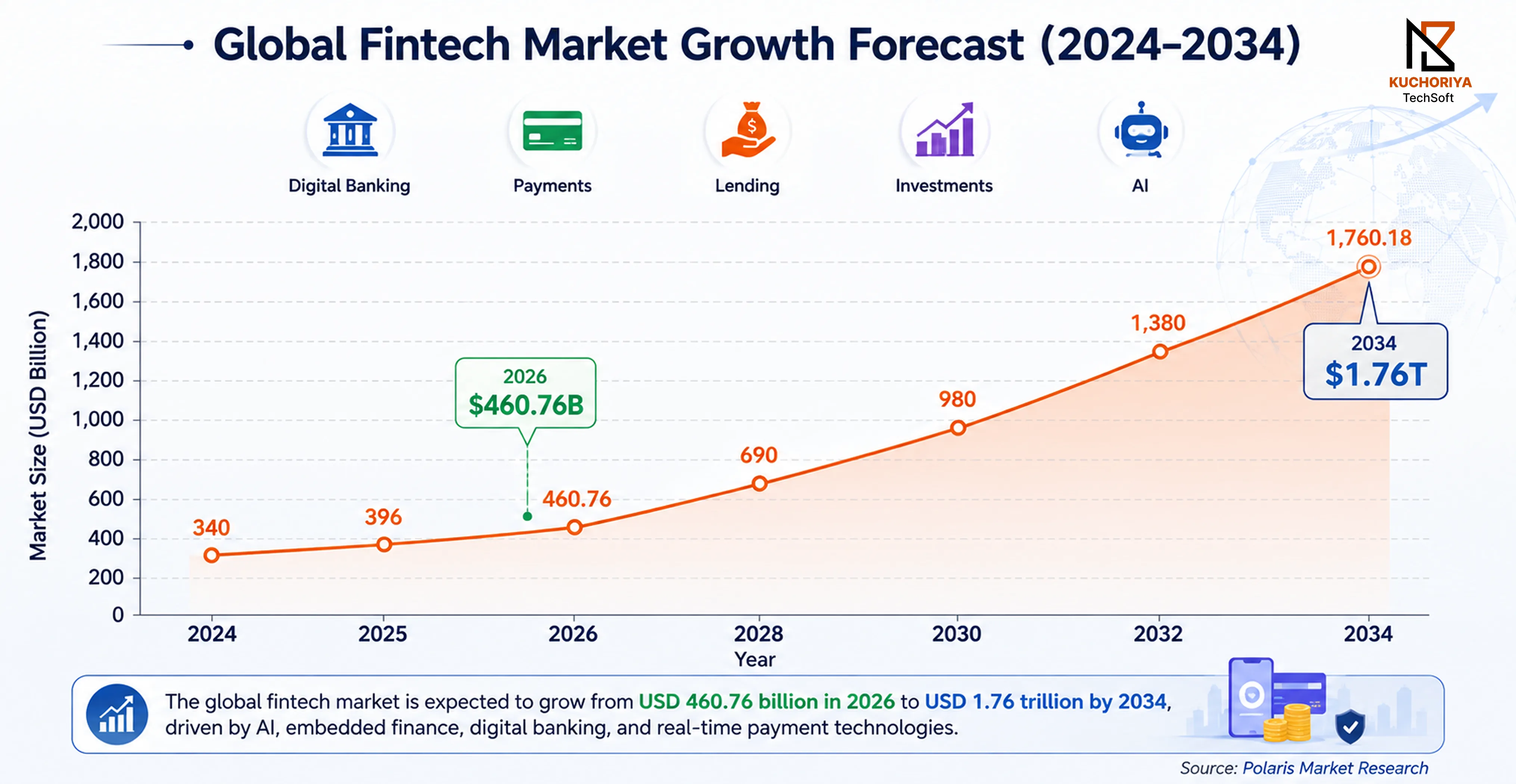
The scale behind that shift is bigger than most people realize. The global fintech market is projected to be worth 460.76 billion dollars in 2026, growing toward 1,760.18 billion dollars by 2034, a pace driven largely by embedded finance, real-time payments, and AI-driven risk tools reshaping what users expect from any app that touches their money. That growth is spread unevenly too, North America still leads adoption, while regions like the UAE and broader GCC are becoming some of the fastest-growing markets for new fintech products. (Source)
The fintech industry has moved past simple payment apps into something far broader, banking, lending, investing, and insurance, all running through software built for speed and security at once. AI in fintech plays a bigger role in that shift than most guides admit, from fraud detection running silently in the background to personalized recommendations built on real spending behavior rather than generic categories.
This fintech app development guide covers what actually goes into building one of these apps in 2026, the features that matter, the technology choices that hold up under real usage, and the true cost involved, without the vague ranges most guides give.
What Is Fintech App Development?
Fintech app development means building software that handles money, payments, transfers, lending, investing, in a way that's fast, compliant, and trustworthy enough for people to rely on daily.
- Any fintech app development company blends strict compliance with everyday usability
- Rooted in financial technology applied to real banking and payment workflows
- Spans the full range of types of fintech apps, from wallets to lending platforms
- Built around security first, features second, not the other way around
- Handles real-time transactions where a delay of even seconds matters
- Designed to scale from a few thousand users to several million without a rebuild
Why the Fintech Industry Is Growing Rapidly
Growth in this space isn't slowing down, it's shifting into new categories entirely. Watching the current fintech app development trends 2026 shows where that momentum is actually heading.
- Wider adoption of online payment solutions across markets that skipped traditional banking infrastructure
- Machine learning in finance now handling fraud detection, credit scoring, and spend analysis in real time
- Rising demand for embedded finance, where non-financial apps add banking features directly
- More businesses hiring a best fintech app development company instead of building in-house, cutting launch time significantly
- Regulatory sandboxes making it easier for new fintech products to test and launch faster
- Smartphone and mobile internet penetration continuing to push fintech into markets with limited branch banking
Types of Fintech Apps and Where They're Used in Practice
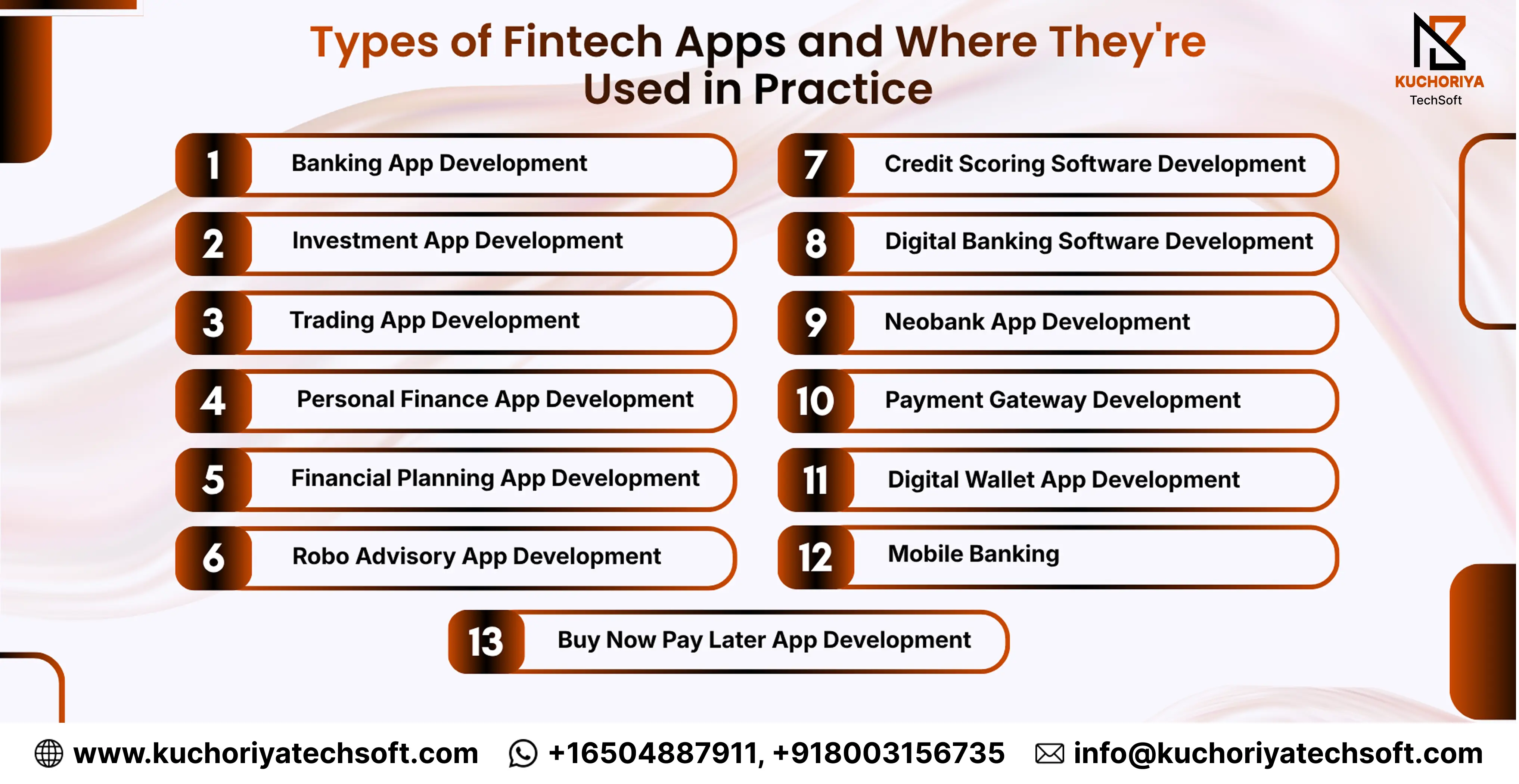
1. Banking App Development: Replaces the physical branch for most day-to-day banking, account checks, transfers, statements, without the wait in line.
Use case: a regional bank moving its entire customer base off branch counters and onto mobile-first account management.
2. Investment App Development: Puts real-time asset pricing on the same screen where a user actually places the trade.
Use case: a retail investor building a stock portfolio without ever calling a broker.
3. Trading App Development: Execution speed decides everything here, a one-second lag can turn a profitable trade into a loss.
Use case: day traders running multiple positions where order speed directly affects returns.
4. Personal Finance App Development: Pulls spending data across accounts automatically instead of asking someone to type in every transaction.
Use case: a household tracking joint spending across five different cards and accounts in one view.
5. Financial Planning App Development: Runs projections for retirement, education, and big purchases that update as a person's situation actually changes.
Use case: a family adjusting a college savings goal after a change in income.
6. Robo Advisory App Development: Handles investment decisions based on risk tolerance, no advisor call required to rebalance a portfolio.
Use case: a first-time investor with a small balance who can't justify a human advisor's fee.
7. Buy Now Pay Later App Development: Splits a purchase into smaller payments right at checkout, something shoppers now expect by default.
Use case: an online retailer adding installment checkout to reduce cart abandonment.
8. Credit Scoring Software Development: Looks at more than a traditional credit bureau file, useful for people who haven't built up standard credit history yet.
Use case: a lender evaluating gig workers with irregular but verifiable income.
9. Digital Banking Software Development: The engine running online-first banks behind the scenes, doing what a branch used to.
Use case: an online-only bank onboarding thousands of new accounts with zero physical branches.
10. Neobank App Development: Builds a bank with zero physical branches, everything happens inside the app.
Use case: a startup launching a bank account product without banking licenses or branch overhead.
11. Payment Gateway Development: Links a store's checkout page to the systems that actually move money between accounts.
Use case: an e-commerce platform processing thousands of daily transactions across multiple currencies.
12. Digital Wallet App Development: Holds cards, loyalty points, sometimes crypto, built around tapping a phone instead of pulling out a wallet.
Use case: a transit system letting commuters pay fares directly from their phone wallet.
13. Mobile Banking App Development: The category most of the above sits under, banking that never needs a branch visit at all.
Use case: a rural customer accessing full banking services without a nearby branch.

Must-Have Features of a Fintech App
Most fintech apps fail on trust, not design. A user checks their balance, sees a delay, and starts wondering if the app lost their money. That's the bar these features need to clear.
- Embedded finance tools so a retail or delivery app can add payments or lending without building banking infrastructure in-house.
- AI-powered risk assessment catching fraud mid-transaction, before money actually moves, not in a report the next day.
- Fingerprint or face login instead of yet another password users will forget or reuse.
- Balance updates that show instantly. A five-minute delay is enough to make someone call support.
- Peer-to-peer lending features connecting individual borrowers and lenders without a bank taking a cut in between.
- Full encryption on transactions, start to finish, not just the login page.
- Compliance settings that switch automatically based on the user's country, because one set of rules doesn't work everywhere.
- Transaction history in plain words. Nobody wants to decode banking jargon to check what they spent.
How to Build a Fintech App: Step-by-Step Development Process
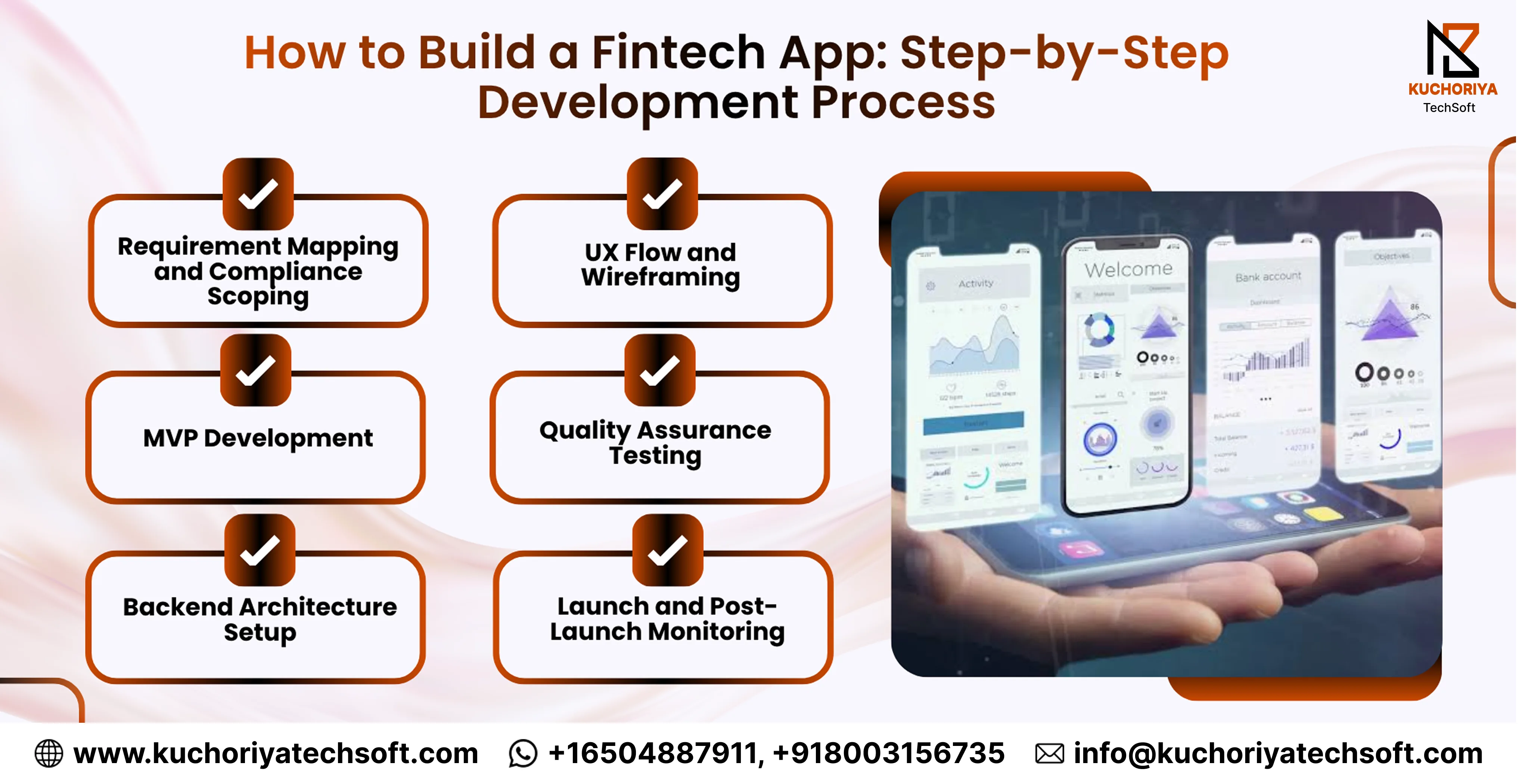
A fintech app development process that skips steps almost always shows up later as a blown budget or a missed launch date. Here are the steps to build a fintech app that actually hold up, whether it's built in-house or handed to an outsource fintech app development partner.
1. Requirement Mapping and Compliance Scoping
Defines what the app needs to do and which regulations apply, this happens before a single screen gets designed. It's the foundation any solid custom fintech app development engagement gets built on.
2. UX Flow and Wireframing
Maps out how money actually moves through the app. A confusing flow drives people away faster than a missing feature ever will.
3. Backend Architecture Setup
Built for security and fintech app scalability right from day one. Fixing this later almost always costs more than doing it properly the first time.
4. MVP Development
Focuses on core banking or payment logic first. Extra features get added once a working version is actually live and being used.
5. Quality Assurance Testing
Tested against real transaction volume and messy edge cases, the kind that never show up in a clean demo.
6. Launch and Post-Launch Monitoring
Goes live with active monitoring running. Fintech problems tend to surface under real user load, not during testing.
Best Technology Stack for Fintech App Development
Picking the right fintech app technology stack isn't about chasing trends, it's about what actually holds up once real transaction volume hits. So what is the best tech stack for this kind of build, and which technology stack is best, depends on what the app needs to do and how the underlying fintech app architecture gets structured from day one.
At this level of build, the fundamentals stay consistent across serious fintech products, cloud-native infrastructure, message queues for real-time sync, and a strict separation between the parts of the system that touch money and the parts that don't. That's the same foundation we build on here.
AI in Fintech App Development
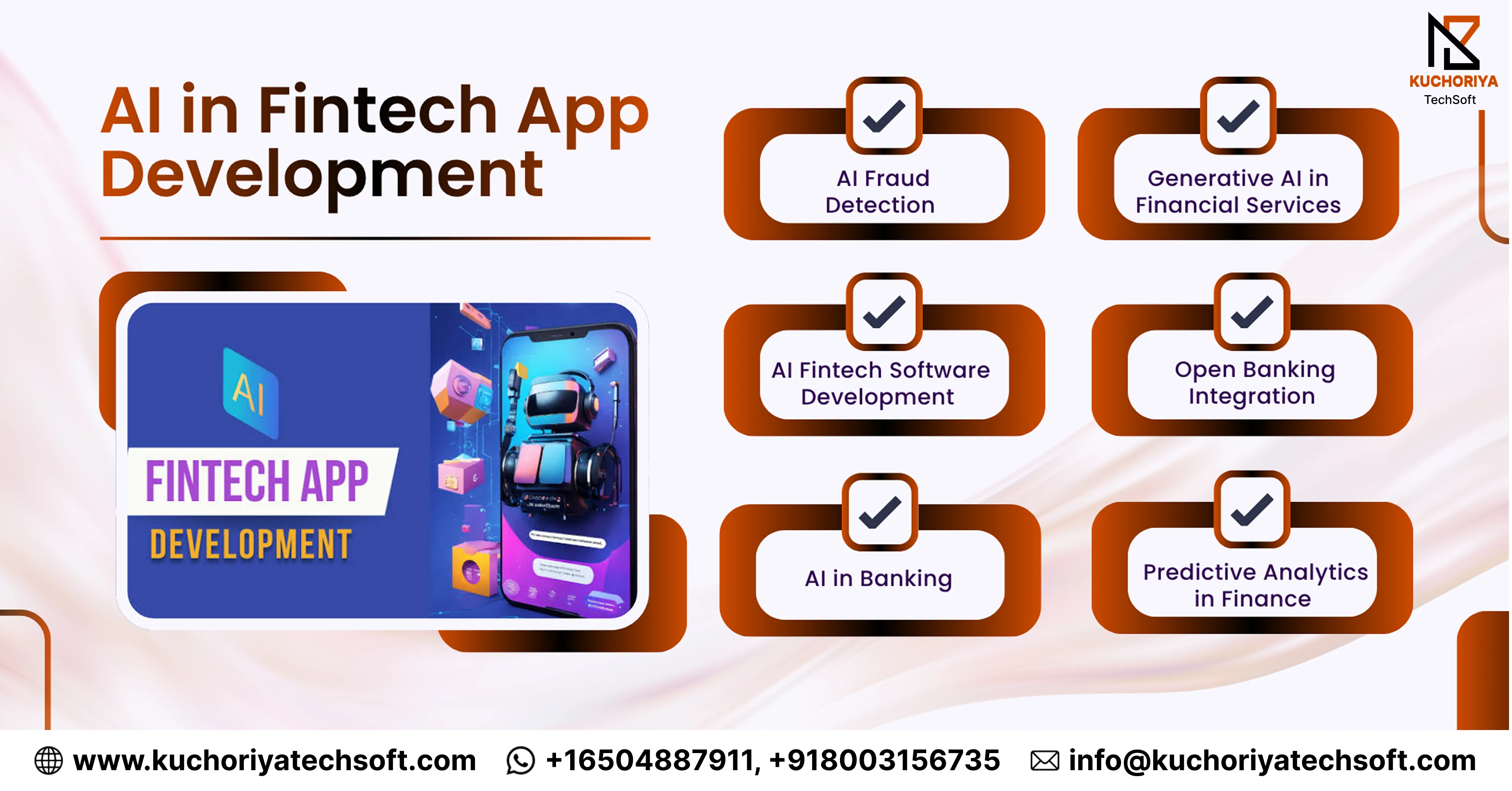
AI isn't a bonus feature in fintech anymore, it's doing work that used to take entire compliance and support teams. Here's where it's actually showing up in builds heading into 2026.
1. AI Fraud Detection
Flags unusual transaction patterns in real time, catching fraud before money moves instead of after a customer files a dispute. This is now standard in most AI-powered fintech solutions, not an optional add-on.
2. Generative AI in Financial Services
Handles support chats, writes up spending summaries for users, and cuts down the hours an analyst used to spend reading compliance documents one by one.
3. AI Fintech Software Development
Building AI into the app from the first sprint works better than adding a chatbot after the product is already done. Teams that plan for it early avoid rebuilding half the backend later.
4. Open Banking Integration
Lets AI pull data across every connected bank account, giving a fuller financial picture than any single account view.
Powers everything from teller-free branches to instant loan approvals, extending the same fraud and risk models into traditional banking systems.
6. Predictive Analytics in Finance
Forecasts cash flow and spending trends before they happen, the same underlying logic behind an AI travel recommendation engine predicting a traveler's next booking.
Security & Compliance in Fintech App Development
Security is the foundation of every successful fintech application. Whether you're building a digital banking platform, payment app, lending solution, or investment platform, strong security controls and regulatory compliance protect customer data, reduce fraud, and build long-term trust.
Key Security & Compliance Essentials
- PCI DSS Compliance to secure cardholder data and protect online payment transactions.
- GDPR Compliance for responsible collection, storage, and processing of customer data.
- KYC (Know Your Customer) verification to validate user identities and prevent identity fraud.
- AML (Anti-Money Laundering) monitoring to detect suspicious financial activities and meet regulatory requirements.
- End-to-End Encryption for securing financial transactions, user credentials, and sensitive information.
- Multi-Factor Authentication (MFA) and biometric login for stronger account protection.
- Real-Time Fraud Detection powered by AI to identify unusual transactions and minimize financial risks.
- Secure API Integration using OAuth 2.0, API gateways, encryption, rate limiting, and continuous monitoring when connecting third-party banking, payment, or financial services.
- Regular Security Audits & Penetration Testing to identify vulnerabilities before attackers can exploit them.
- Real-Time Payment Security with tokenization, fraud monitoring, transaction validation, and continuous risk analysis to protect instant payment systems.
Fintech App Development Cost in 2026
One of the most common questions businesses ask before starting a fintech project is: How much does it cost to build a fintech app?
The answer depends on several factors, including the type of fintech solution, feature complexity, security requirements, AI integration, compliance standards, and the platforms you choose to support. A basic digital wallet app will cost significantly less than a feature-rich neobank platform or AI-powered lending solution.
For startups, MVP development is often the most cost-effective approach, while enterprises typically invest in advanced security, AI-powered automation, and large-scale integrations to support long-term growth.
Estimated Fintech App Development Cost
Key Factors That Affect Fintech App Development Pricing
Modern fintech applications require more than just attractive interfaces. Features such as AI fraud detection, biometric authentication, KYC verification, AML compliance, real-time payments, open banking APIs, and predictive analytics can significantly influence development costs while improving security and user experience.
For businesses planning a scalable financial product, investing in a secure and future-ready architecture from the beginning often reduces long-term maintenance expenses and compliance risks.
Pro Tip: Start with an MVP focused on your core value proposition, then scale with advanced capabilities such as AI-powered risk assessment, embedded finance, digital lending, and personalized financial insights as your user base grows.
Fintech App Development Timeline & Key Challenges
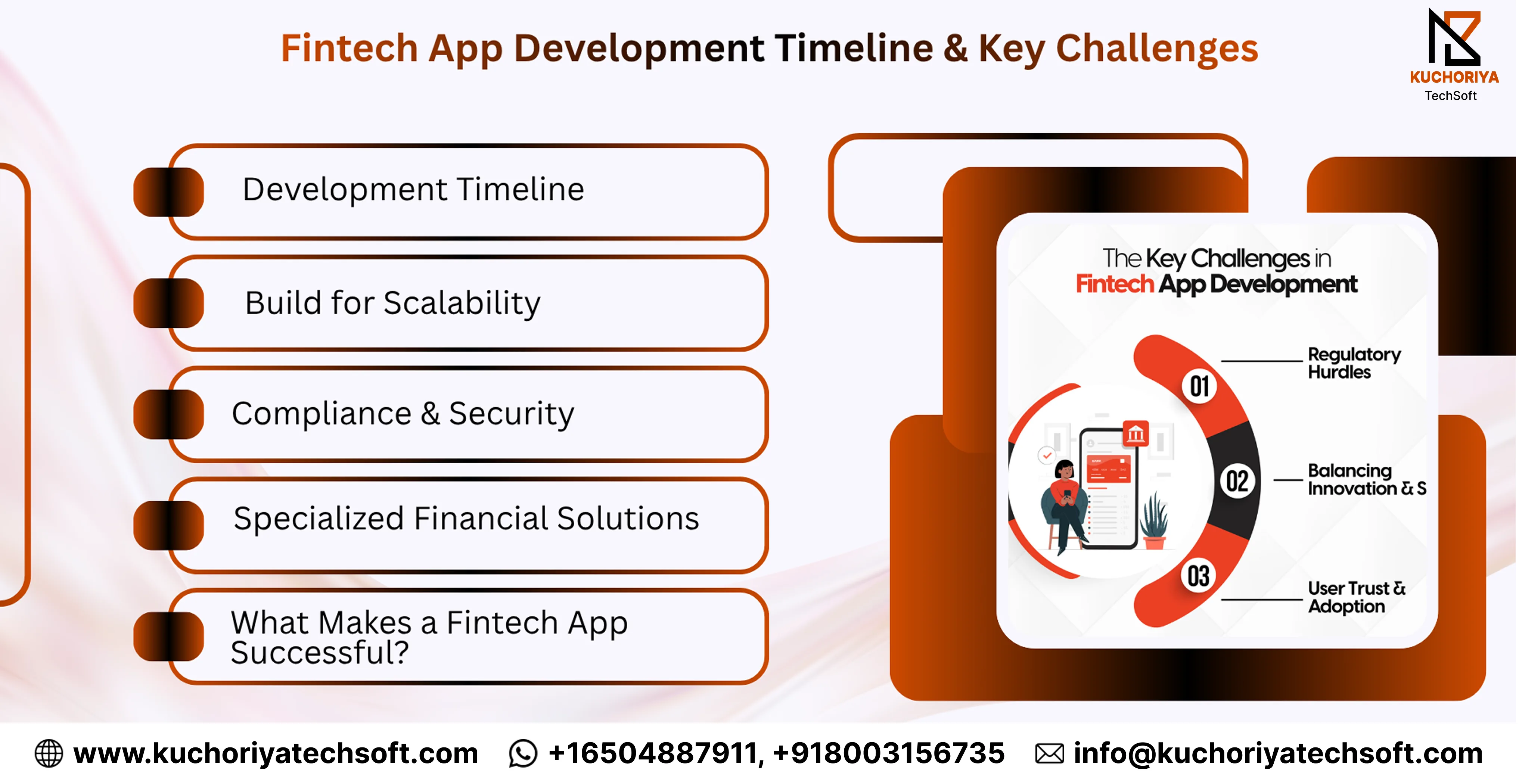
The success of a financial app development project depends on realistic planning, scalable architecture, regulatory compliance, and a seamless user experience. Here's what businesses should know before getting started.
1. Development Timeline
A fintech app typically takes 3–12 months to build, depending on features, integrations, compliance requirements, and overall project complexity.
2. Build for Scalability
Your fintech app should support growing users, higher transaction volumes, and future features without affecting speed, security, or performance.
3. Compliance & Security
Meeting standards like PCI DSS, GDPR, KYC, and AML while protecting financial data is one of the biggest development challenges and a key factor in long-term success.
4. Specialized Financial Solutions
Building products such as loan management software and wealth management software development platforms requires secure architecture, automation, and accurate financial workflows.
5. What Makes a Fintech App Successful?
A successful fintech app combines strong security, fast performance, intuitive UX, real-time payments, scalable infrastructure, regulatory compliance, and reliable third-party integrations to build user trust and support business growth.
Fintech App Development Trends for 2026
The fintech industry is evolving rapidly with AI, automation, embedded finance, and stronger security standards. Businesses that adopt modern technologies today will be better prepared for tomorrow's digital financial ecosystem.
1. AI-Powered Financial Services
AI is improving fraud detection, customer support, credit scoring, and personalized financial experiences.
2. Modern Fintech App Architecture
Cloud-native, API-first, microservices, and scalable fintech app architecture enable faster development, better performance, and easier upgrades.
3. Embedded Finance & Real-Time Payments
Businesses are integrating banking, lending, insurance, and instant payment capabilities directly into digital platforms.
4. InsurTech Innovation
InsurTech software development is transforming claims processing, policy management, underwriting, and customer engagement through AI and automation.
5. Best Way to Build a Fintech App in 2026
Partner with an experienced fintech development company that delivers secure architecture, regulatory compliance, AI integration, and scalable solutions from day one.
How to Choose the Right Fintech App Development Company (Why Kuchoriya TechSoft Fits)
Choosing the right fintech app development company is just as important as your app idea. The ideal partner should have proven experience in financial technology, regulatory compliance, security best practices, and the ability to build scalable digital products that support long-term business growth. Whether you plan to outsource fintech app development for a startup MVP or an enterprise-grade financial platform, evaluating technical expertise, industry knowledge, and delivery capabilities is essential.
Why Businesses Choose Kuchoriya TechSoft
- 16+ years of software development experience
- Expertise in AI-powered fintech applications and intelligent financial solutions
- Secure, scalable, and compliance-ready fintech software development services
- Custom development for banking, lending, payments, wealth management, and investment platforms
- End-to-end support from strategy and design to deployment and maintenance
- Dedicated teams of fintech app developers, architects, and consultants
- Experience delivering solutions for global businesses across the USA, UAE, Canada, Australia, and Singapore
- Flexible engagement models for startups, enterprises, and growing fintech companies
As a trusted fintech app development partner, Kuchoriya TechSoft helps organizations transform innovative ideas into secure, future-ready financial products while reducing development risks and accelerating time-to-market.
Conclusion: Building a Future-Ready Fintech App
As financial services continue to evolve, businesses need intelligent, secure, and scalable solutions that can adapt to changing customer expectations and industry regulations. Whether you're building a digital banking platform, payment solution, lending software, wealth management application, or InsurTech product, success depends on the right strategy, technology, and execution.
Choosing an experienced fintech app development company can help accelerate innovation, strengthen security, and create seamless financial experiences for users. By leveraging AI-powered fintech solutions, modern architectures, and industry best practices, businesses can stay competitive in a rapidly transforming market.
At Kuchoriya TechSoft, we help organizations build next-generation financial products through custom fintech software development, strategic technology consulting, and Virtual CTO Services. Ready to turn your idea into a market-ready solution? Contact our experts for a free consultation or join our Referral Partner Program to explore new business opportunities in the growing fintech ecosystem.

Frequently Asked Questions (FAQs)
Q. How long does fintech app development take?
A. The fintech app development timeline typically ranges from 3 to 12 months, depending on your app's complexity, security requirements, third-party API integrations, compliance standards, and custom features. Enterprise banking and payment platforms may require additional development time.
Q. What is the best way to build a fintech app in 2026?
A. The best way to build a fintech app in 2026 is to use a scalable cloud-based architecture, AI-powered automation, secure API integrations, and compliance-ready development. Partnering with an experienced fintech app development company helps ensure faster delivery, stronger security, and long-term scalability.
Q. How much does fintech app development cost?
A. The cost of fintech app development depends on factors such as application type, feature set, UI/UX design, AI capabilities, payment gateway integration, compliance requirements, and ongoing maintenance. Custom fintech software generally costs more than basic MVP solutions.
Q. Which compliance standards are required for fintech apps?
A. Most financial app development projects must comply with PCI DSS, GDPR, KYC, and AML regulations. Modern fintech applications also use end-to-end encryption, secure authentication, role-based access control, and continuous security monitoring to protect sensitive financial data.
Q. Why choose Kuchoriya TechSoft for fintech app development?
A. Kuchoriya TechSoft is a trusted fintech app development company that builds secure, scalable, and AI-powered financial solutions. Our team specializes in digital banking apps, payment platforms, lending software, investment applications, and custom fintech software with a strong focus on security, compliance, performance, and long-term business growth.