Why Are Healthcare Platforms Like Practo Redefining Digital Healthcare?
Patients don't wait in clinic queues anymore if they don't have to. A healthcare platform like Practo puts booking, consults, and records in one place, and the market numbers show this shift isn't slowing down.
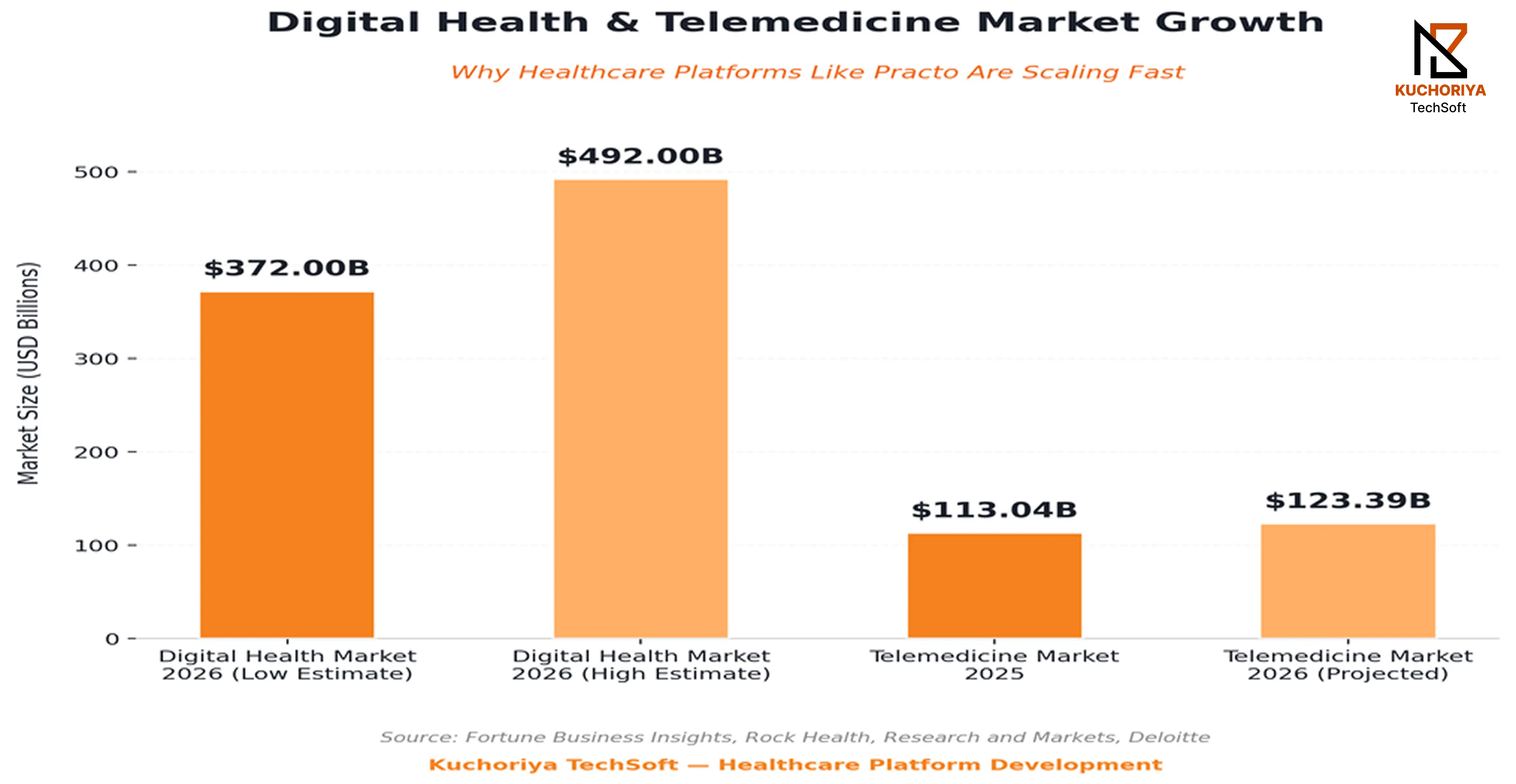
Global digital health platform estimates for 2026 range between $372 billion and $492 billion, with every major research firm projecting double-digit growth through 2030. Digital healthcare platform development is pulling in serious capital too, since telemedicine alone is projected to hit $123.39 billion in 2026, up from $113.04 billion in 2025. (Source)
This is exactly why founders across regions are betting on the space. A healthcare app development company USA sees demand from clinics chasing faster patient throughput, while healthcare software development UK teams are fielding requests from the NHS-adjacent private sector. Deloitte found 44% of U.S. adults used a virtual visit in the past year, and 94% said they'd use one again, proof this isn't a one-time trend.
Healthcare technology solutions built around this demand aren't optional anymore; they're the baseline patients expect.
What Makes Practo One of the Most Successful Healthcare Platforms?
Most healthcare apps launch, get some downloads, then fade. Practo didn't. It built something patients kept coming back to, and that pattern is worth studying before starting any Practo clone app development project.
- Practo didn't rely on a single revenue stream. Consultation bookings, subscriptions, and diagnostic partnerships all ran side by side.
- Its healthcare business model wasn't an afterthought added after user growth. Revenue was part of the platform's structure from day one.
- Doctors and patients stayed active on the same platform instead of two separate apps needing a bridge between them.
- The patient engagement platform didn't stop at booking. Reminders, follow-ups, and record access kept people coming back.
- Practo proved on-demand healthcare app development actually scales. Hospitals and independent clinics saw it hold up at real volume, not just in a pitch deck.
- Its approach is now something other healthcare startup solutions study and adapt when shaping their own platforms.
Planning a Healthcare Platform? Define Your Business Model First
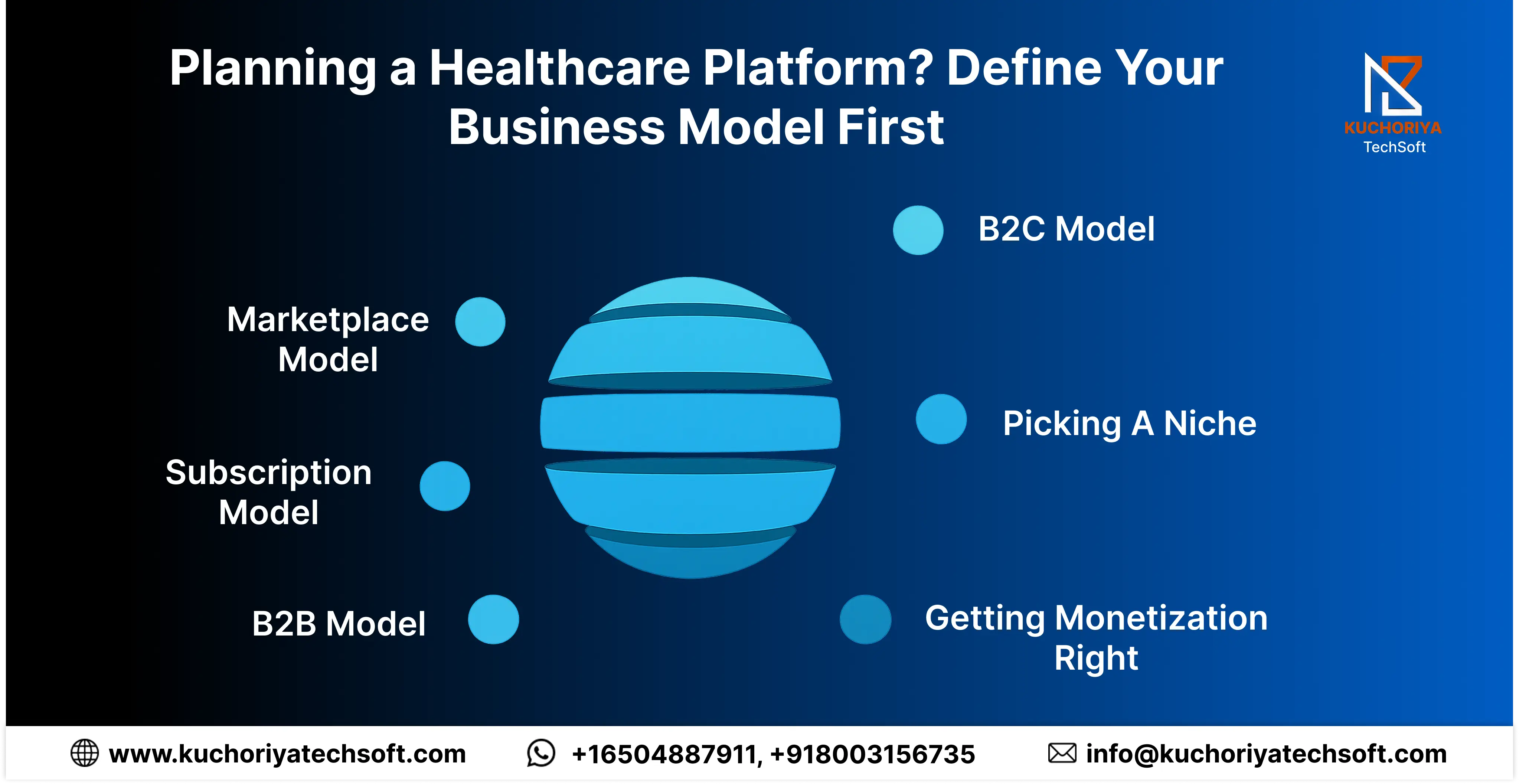
Before any screen gets designed, the business model needs to be locked. This decides whether you build a healthcare platform like Practo that actually makes money or one that just looks good in a demo.
1. Marketplace Model
Doctors list their services, patients book directly, and the platform earns a cut on every consultation. This works well when you're connecting many providers to many patients at once.
2. Subscription Model
Patients pay a recurring fee for ongoing access instead of paying per visit. A healthcare SaaS platform built this way earns steadier, more predictable revenue over time.
3. B2B Model
Hospitals and clinics license the platform to run their own booking and consultation systems. This route usually means fewer clients but larger, longer-term contracts.
4. B2C Model
Patients use the app directly without a hospital or clinic in between. Online healthcare platform development built for B2C needs stronger branding since patients are choosing you over a dozen competitors.
5. Picking A Niche
General checkups, mental health, chronic care, or diagnostics, each niche has different patient behavior. Picking one early shapes every feature decision that follows.
6. Getting Monetization Right
A weak telemedicine business model shows up only after the app is live and revenue doesn't match usage. Healthcare platform monetization needs to be tested against real numbers, not assumptions, before development even starts.
Essential Features Every Healthcare Platform Like Practo Should Have
A platform is only as good as what it actually lets people do. Here's what needs to be built in from day one, organized by who's using it.
Patient App
Doctor Portal
Admin Dashboard
AI Features
Security & Compliance
How to Build a Healthcare Platform Like Practo: Step-by-Step Development Roadmap
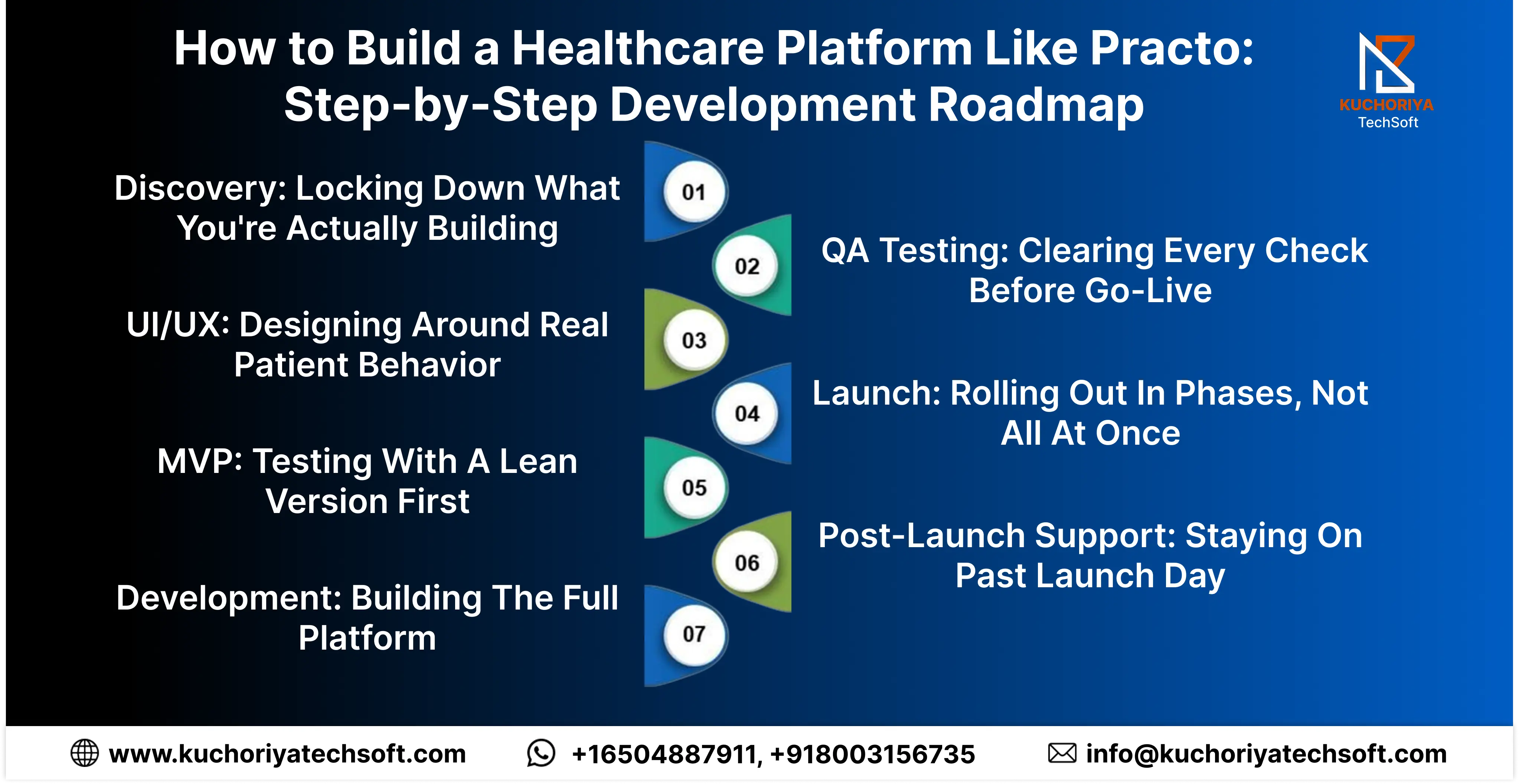
A working platform doesn't happen by jumping straight into code. Every healthcare platform development company worth hiring follows a clear sequence, and skipping steps is exactly how projects stall halfway through.
1. Discovery: Locking Down What You're Actually Building
Specialty focus, target patients, and revenue model get mapped out first through proper healthcare application development, before any screen gets designed.
2. UI/UX: Designing Around Real Patient Behavior
Screens get shaped around real booking and consult behavior, not guesswork, the same approach used across every healthcare mobile app development project we've shipped.
3. MVP: Testing With A Lean Version First
A lean version goes out first to test what patients actually use, keeping custom healthcare app development grounded in real feedback instead of assumptions.
4. Development: Building The Full Platform
Full features get built on top of the MVP, with medical software development treated as core infrastructure, not something patched in later.
5. QA Testing: Clearing Every Check Before Go-Live
Nothing reaches real patients without clearing functional and security checks, whether it's a doctor appointment app development build or a full telemedicine app development platform.
6. Launch: Rolling Out In Phases, Not All At Once
The platform goes live in phases, tested first with a smaller patient base before scaling to full traffic. This is where every online doctor consultation app development project proves it can hold up outside a demo.
7. Post-Launch Support: Staying On Past Launch Day
We stay on through bug fixes and updates long after go-live, the same commitment we bring to every telemedicine app development Dubai, healthcare platform development UAE, and doctor appointment app development Canada build we take on.
Must Read: Why Are Healthcare Startups Building Platforms Like Doctor On Demand?
How to Build a Telemedicine App Like Teladoc Health: Features, Cost & Development Guide
How Much Does It Cost to Develop a Doctor On-Demand App Like Practo & Teladoc?
Which Technologies Power a Modern Healthcare Platform?
Most booking screens look the same on the surface. The real difference shows up underneath, in whatever's holding the platform together once real traffic hits it.
- Healthcare API Integration stops booking, records, and payments from running as separate, disconnected systems.
- HL7 Integration Services work with older hospital systems that are still running on legacy infrastructure, so nobody needs a full rebuild.
- Patient data moves faster and cleaner through FHIR Integration than it does through older data standards.
- Doctors get a patient's full history before the consult even starts, thanks to Electronic Health Record (EHR) Integration.
- Charting, prescriptions, and visit notes stay synced across every provider through EMR Software Integration.
- Cloud Healthcare Solutions keep the platform running smoothly as patient traffic grows, instead of slowing down under it.
- Once patients outside the US enter the picture, a GDPR Compliant Healthcare Platform stops being optional. Adding compliance after launch always costs more than building it in from the start.
- Diagnostic Center App Development means lab results land directly on the platform, so patients see their reports the moment they're ready.
How Much Does It Cost to Build a Healthcare Platform Like Practo?
Three agencies, three quotes, three completely different numbers. That's not agencies overcharging, it's healthcare platform development cost depending on scope, compliance depth, and how many integrations you're pulling in.
What Actually Moves The Number
- Skipping compliance work at the start seems cheaper. It never is. HIPAA-ready architecture built in from day one costs less than bolting it on after launch, every single time.
- Epic, Cerner, or any EHR connection isn't a checkbox on a feature list. Budget $20,000 to $60,000 for it, and treat it as its own project, not a side task.
- Clinic Management Software and multi-provider scheduling logic eat real engineering hours, not just design time.
- Yearly maintenance sits at 15 to 30% of the original build cost. Healthcare runs higher than most industries because coding standards and compliance rules don't stay still for long.
How Do Healthcare Platforms Like Practo Make Money?
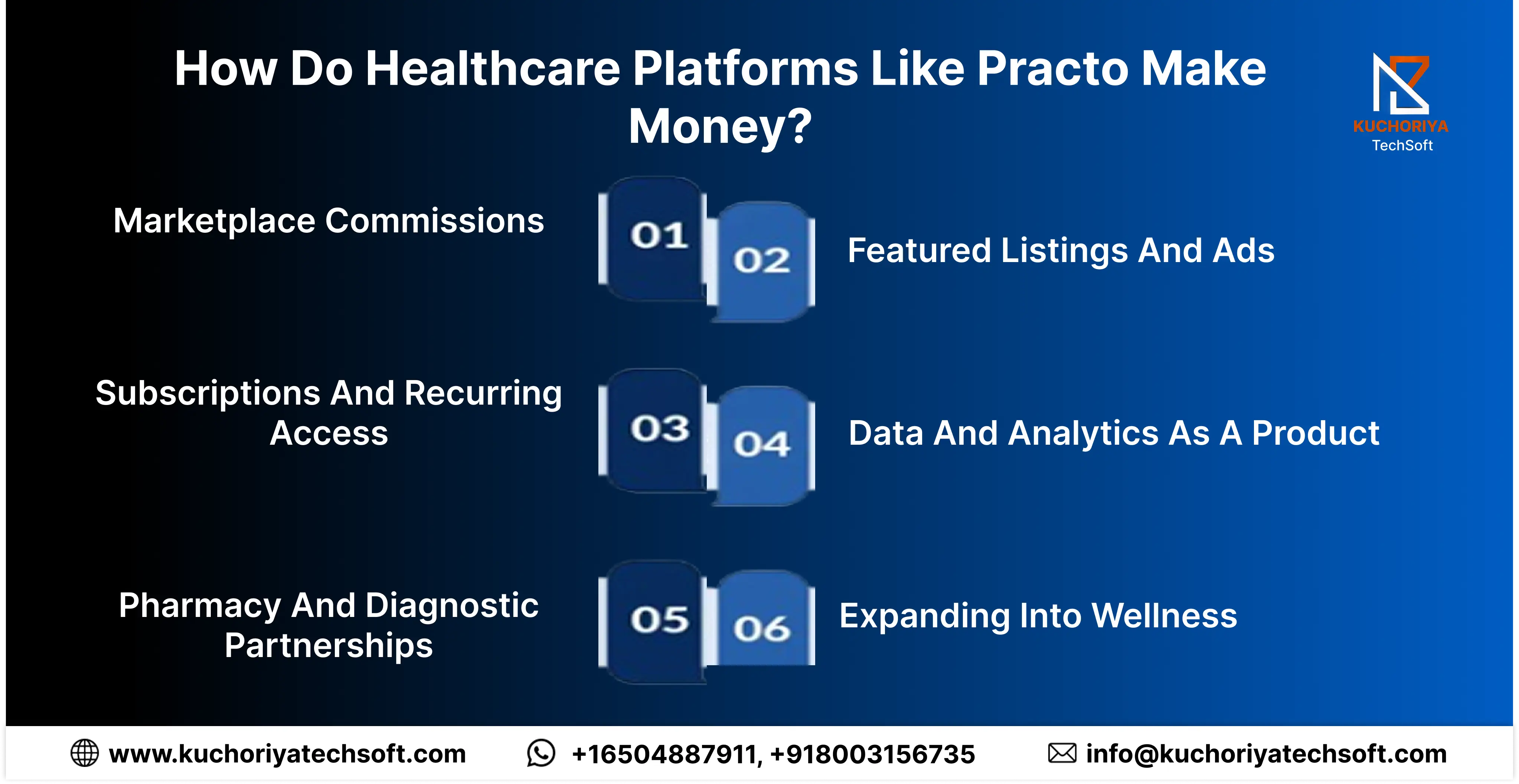
Booking fees alone don't cover a platform's costs. The real money comes from stacking multiple revenue streams on top of each other, the same way Practo built theirs.
1. Marketplace Commissions
Doctors and clinics pay to list on the platform, and every consultation booked earns a cut. This is the core of most healthcare marketplace development revenue models, and it's usually the first stream that goes live.
2. Subscriptions And Recurring Access
Pay-per-visit gets replaced with a flat monthly fee, and patients get unlimited access in exchange. The platform's income stops swinging with how busy a given week is.
3. Pharmacy And Diagnostic Partnerships
A reference value goes back to the platform each time a participating pharmacy fills a prescription. Labs run on a similar setup, paying a small fee each time a patient books a look-through the app as opposed to a trip to the health center.
4. Featured Listings And Ads
Clinics pay extra to appear higher in search results once a virtual care platform development project has enough organic traffic to make visibility worth paying for. Sponsored banners and health brand placements add a separate stream on top.
5. Data And Analytics As A Product
Clinics buy the Healthcare Analytics Dashboard to see patient trends they'd otherwise have to guess at, and hospitals pay separately for Predictive Healthcare Analytics to plan staffing before a shortage actually hits. This tends to be the highest-margin line on the whole platform.
6. Expanding Into Wellness
Some platforms don't stop at treating illness. Moving into fitness and wellness app development lets them sell preventive care and wellness tracking as a paid add-on to patients who are already active on the app.
Related Reads: AI in Healthcare Cost Guide 2026: Pricing, Development, Implementation & ROI Explained
Top 10 AI Development Companies in the USA for HIPAA-Compliant Healthcare Solutions
Custom EHR & EMR Software Development Services: Complete 2026 Guide for Healthcare Providers
Common Challenges in Healthcare Platform Development (And How to Solve Them)
The build itself is only half the battle. Most healthcare platforms hit the same five walls somewhere between launch and scale.
1. Staying Compliant Without Slowing Everything Down
HIPAA and GDPR don't bend for a tight deadline. Skip medical records management early, and half the backend gets rebuilt the moment an audit flags a gap.
2. Keeping Patient Data Actually Secure
Hospital apps are worth more to attackers than most assume. Healthcare automation running quietly in the background catches what manual processes miss.
3. Getting Doctors To Actually Use It
A great demo means nothing if doctors route around it. A hospital management system only sticks if it fits how the clinic already runs its day.
4. Handling Growth Without Breaking
500 patients is a demo; 50,000 is a different problem. Healthcare platform scalability either gets designed in from sprint one, or someone rebuilds under pressure later.
5. Keeping Patients Coming Back
The first booking is easy. A real healthcare software company earns the second and third visit without chasing patients down manually.
Future Trends Shaping Healthcare Platforms Beyond Practo
Practo set the standard years ago. What's coming next builds on top of it, not around it.
1. Monitoring Beyond The Clinic
Wearables now feed vitals straight into the platform. A flagged reading can trigger a check-in before the patient even realizes something's off, which is why remote patient monitoring is turning into something insurers expect rather than a nice extra.
2. Virtual Care As The Default
Virtual healthcare stopped being a pandemic workaround a while back. Online medical consultation is now often the first option patients reach for, with an in-person visit as the fallback.
3. Self-Scheduling Systems
No-shows drop when the system predicts which slots are likely to get cancelled and rebooks them on its own. That's the shift AI appointment scheduling is driving, instead of leaving empty gaps until someone notices.
4. Focused Not Generic Platforms
Mental health, chronic care, dermatology, each needs a different build. Telehealth platform development is moving away from one app trying to cover every specialty at once.
5. Video Built For Weak Networks
A Video Consultation Platform that drops calls on shaky connections loses trust fast. Newer builds compress video intelligently so rural and low-bandwidth patients aren't left out.
6. Growth Outside The US
Healthcare App Development Australia projects are picking up as reimbursement policies loosen, and Healthcare Software Development Singapore is seeing similar momentum as the region pushes harder into digital health.
Why Choose Kuchoriya TechSoft for Healthcare Platform Development?
Anyone can promise a working platform. What actually separates a reliable build shows up once real patients and doctors depend on it every day.
1. Real Experience, Not A First Attempt
Our developers at Kuchoriya TechSoft have already delivered projects through a proven healthcare app development company track record across multiple markets. Your build won't be anyone's learning curve.
2. Full-Cycle Delivery, Not Just Code
Healthcare software development services cover the entire build, planning, design, development, testing, and support, not just handing over a codebase and disappearing.
3. Deep Domain Knowledge
HealthTech Development takes more than general app-building skill. Our team understands Medical Practice Management workflows well enough to build around how clinics actually operate, not around assumptions.
4. Global Reach, Local Understanding
From healthcare platform development company London projects to telemedicine app development Sydney builds, our teams adapt each platform to local compliance and patient expectations instead of shipping the same product everywhere.
5. Talent That's Shipped This Before
Working with Healthcare App Developers New York clients has meant navigating US healthcare regulations directly, experience that carries over into every new market we enter.
Ready to Build a Healthcare Platform Like Practo?
A great idea only goes so far without the right team behind it. Whether you're starting from scratch or scaling an existing app, solid healthcare platform development comes down to the same thing, getting the fundamentals right before chasing every feature at once.
We've helped founders turn early concepts into platforms patients actually use, with a healthcare platform launch strategy built around real market data, not guesswork. And once you're live, our healthcare platform growth strategy keeps the momentum going instead of letting it plateau after launch week.
If your project also touches hospital management software development, we handle that under the same roof, no need to bring in a second team halfway through.
Already working with clients and want to bring us in on their next project? Our Referral Partner Program rewards exactly that.
Contact us today and let's talk about what you're building.
Frequently Asked Questions
Q. What exactly is a healthcare platform like Practo?
A. One app handles what usually needs five separate calls. Book a doctor, hop on a video consult, get a prescription, check old records, all without switching between clinics and paper files.
Q. How much does it actually cost to build one?
A. Scope decides everything here. A basic MVP can start near $25,000, but add full compliance and deeper integrations, and the number easily crosses $450,000.
Q. How long before it's actually live?
A.. An MVP takes about 8 to 14 weeks. Bring in EHR integration or multi-specialty support, and that stretches to somewhere around 20 to 36 weeks.
Q. What features can't the platform skip?
A. Booking, video visits, e-prescriptions, and record access are non-negotiable. Real-time scheduling that actually holds up matters more than people think, since that's usually the first thing to break.
Q. Do I need HIPAA or GDPR compliance?
A. If US patient data or EU patients are involved, compliance stops being optional. Adding it after launch almost always costs more than building it in early.
Q. How do these platforms actually make money?
A. Mostly through consultation commissions, subscriptions, pharmacy and lab partnerships, paid specialist listings, and premium analytics add-ons.
Q. Can I earn by referring a client?
A. Yes, and it's straightforward. Any project sent through the Referral Partner Program gets rewarded, no extra forms needed.