Introduction – Why 2026 Is a Defining Year for Enterprise Software
Six months to deploy. Budgets are bleeding midway. A development cycle that felt more like damage control than delivery. That was the old reality of enterprise software development – and for businesses still running on traditional models, not much has changed. But for enterprises that have moved to generative AI development services, the gap is now impossible to ignore.
The global generative AI market was valued at USD 67.18 billion in 2024 and is projected to hit USD 967.65 billion by 2032 at a CAGR of 39.4% (Source). McKinsey's 2025 State of AI report confirms 78 percent of organizations now use AI in at least one business function – up from 55 percent two years ago (Source). Enterprises are not piloting anymore. They are rebuilding.
At Kuchoriya Techsoft, we have seen this shift firsthand across healthcare, finance, logistics, retail, and manufacturing. This blog covers how generative AI tools, platforms, and enterprise software solutions are changing the game in 2026 – and what your business needs to know before making any move around custom enterprise software development.
What Is Generative AI and Why Enterprises Are Paying Attention
For years, enterprise software ran on one principle – if this, then that. Every rule is written by hand. Every workflow is mapped by a developer. That model worked when business moved slowly. In 2026, it is a liability.
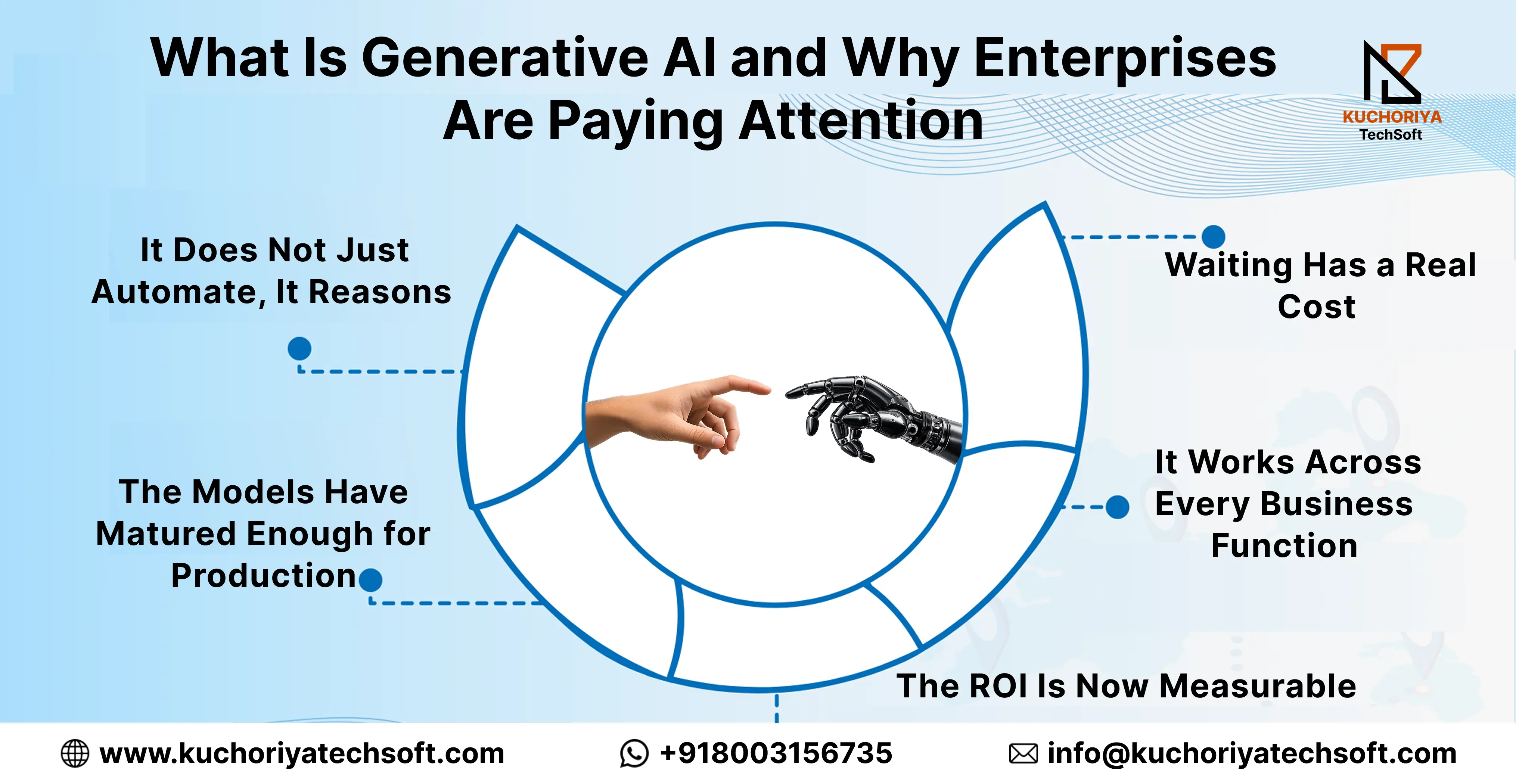
1. It Does Not Just Automate, It Reasons
Traditional automation followed scripts. Generative AI models understand context, read unstructured documents, extract what matters, and act on it without a developer writing a rule for every variation.
2. It Works Across Every Business Function
Finance, HR, legal, operations, customer service. Generative AI applications are not limited to one department. Enterprises are deploying generative AI services across the entire business stack simultaneously.
3. The Models Have Matured Enough for Production
Early generative AI platforms were impressive in demos and unreliable in production. That changed in 2025. Today's models meet the accuracy, latency, and compliance thresholds that enterprise software solutions require.
4. The ROI Is Now Measurable
Gartner's 2025 report found enterprises deploying generative AI integration saw a 40 percent reduction in manual processing time within the first six months. IDC projects 65 percent of enterprise AI software will have generative capabilities built into core architecture by end of 2026.
5. Waiting Has a Real Cost
Every quarter an enterprise delays generative AI implementation is a quarter a competitor uses to widen the gap. AI development services that took 12 months two years ago are now delivered in 6 to 8 weeks. The window is narrowing fast.
How Generative AI Tools Are Changing the Way Enterprises Work
Enterprises are not adopting generative AI solutions because it is trending. They are adopting it because every department that has not is visibly slower than the one that has. Here is what is shifting on the ground.
1. Reporting Cycles That Took Days Now Take Minutes
Three analysts, two data pulls, one presentation deck. That was the standard cycle for any business intelligence request. AI-powered enterprise software has collapsed that cycle entirely. Non-technical teams get structured answers from raw enterprise data without touching a single spreadsheet.
2. Back Office Operations Are Running Leaner
Invoice processing, compliance checks, and contract reviews. Every task that lives in a human queue is being handled by generative AI-powered applications that process hundreds of documents simultaneously with higher accuracy than manual review. McKinsey estimates enterprises save up to 70 percent in processing time across back office functions.
3. Support Teams Are Handling More With Less
AI agent development inside customer-facing enterprise systems is resolving tier-one queries before they reach a human. Gartner's 2025 data shows enterprises using AI-assisted support cut average handle time by 35 percent while maintaining higher satisfaction scores.
4. Developers Are Shipping Faster Without Bigger Teams
Deep learning development embedded into engineering workflows means one developer is now doing the output of three. Boilerplate, documentation, unit tests – handled. Stack Overflow's 2025 survey confirmed 41 percent of all code written last year was AI-assisted.
5. Automation Is No Longer Fragile
Old rule-based automation collapsed the moment a process changed. Generative AI enterprise solutions adapt to context, handle exceptions, and complete multi-step tasks without a developer rewriting logic for every variation.
6. Legacy Systems Are Finally Connecting
Integration debt has been the silent killer of enterprise software development services projects for decades. NLP development services are now acting as intelligent middleware between CRM, ERP, and HRMS systems, resolving data conflicts and keeping stacks synchronized without custom connectors.

Top Generative AI Platforms Enterprises Are Betting On in 2026
Picking the wrong generative AI platform costs more than money. It costs months of rebuilding. The platforms below are what enterprise teams are actually deploying in production right now, not just piloting.
- Microsoft Azure OpenAI Service: Enterprises already on the Microsoft stack are not switching infrastructure. Azure plugs generative AI enterprise tools directly into Microsoft 365 and Dynamics, with security and access controls IT teams already understand.
- Google Vertex AI: Finance and retail teams running massive datasets trust Vertex. It sits on top of BigQuery, so AI-driven manufacturing solutions and supply chain teams get real-time reasoning without moving their data anywhere new.
- AWS Bedrock: No lock-in, multiple model choices, same AWS compliance umbrella. Teams building AI healthcare solutions and AI insurance software development projects pick Bedrock because their legal teams have already approved the infrastructure.
- IBM watsonx: Banks, government clients, and AI in oil and gas industry teams need audit trails and explainability built in. watsonx delivers that without compromise, which is why regulated industries keep choosing it over flashier alternatives.
- Salesforce Einstein GPT: Sales and support teams do not want a separate AI tool. Einstein GPT puts generative AI for business directly inside the CRM workflow, cutting the gap between insight and action for AI-driven retail solutions teams.
- Meta Llama 3: Enterprises that want full control over their models without licensing costs are fine-tuning Llama 3 on proprietary data. AI development company teams building internal tools prefer it for the flexibility that open-source brings.
Related Insights: AI Application Development Tools vs Custom AI Development
AI Development Cost for Businesses in 2026: Complete Pricing Breakdown
Top 10 AI Development Companies in the USA for HIPAA-Compliant Healthcare Solutions
Generative AI Development Services: What to Expect and What to Demand
Enterprises have burned budgets on generative AI development services that looked great in the proposal and fell apart in production. The problem is rarely the technology. It is what happens before the first line of code gets written and what nobody talks about after the last deployment.
- Discovery Before Development: Most vendors skip this. A good generative AI development company in India or anywhere else will spend the first two weeks understanding your workflows, your data quality, and your actual business problem before recommending anything. If a vendor opens with a tech stack conversation, walk away.
- RAG Over Generic Models: A generative AI consulting company that hands you a generic ChatGPT wrapper and calls it enterprise software is not solving your problem. Real generative AI enterprise development connects models to your internal data through retrieval-augmented generation so every output is grounded in what your business actually knows.
- Security Is Not a Feature, It Is a Requirement: AI software development company in the USA teams working with healthcare, finance, and legal clients know that data residency, role-based access, and audit logging are non-negotiable. If compliance is being treated as a checkbox, that is a problem.
- Your Existing Stack Stays: The best machine learning development services work around what you already have. ERP, CRM, HRMS, legacy databases. A good partner connects to all of it without asking you to rip and replace.
- Fixed Milestones, Not Open Retainers: AI agent development services without defined checkpoints turn into open-ended projects nobody can explain to a CFO. Every sprint needs a deliverable attached to it.
- Support After Go-Live: Generative AI consulting services that disappear after launch are the ones whose clients are back in the market six months later, looking for someone else. Models need monitoring, prompts need tuning, and usage patterns shift faster than anyone plans for.
At Kuchoriya Techsoft, every custom enterprise software solutions project starts with a discovery sprint before any technical decision is made. That one step alone has cut rebuild cycles for our clients by more than half.
The Role of Generative AI Models in Building Smarter Enterprise Software
Enterprises are not short on data. They are short on systems that know what to do with it. That is the gap that generative AI models are closing right now.
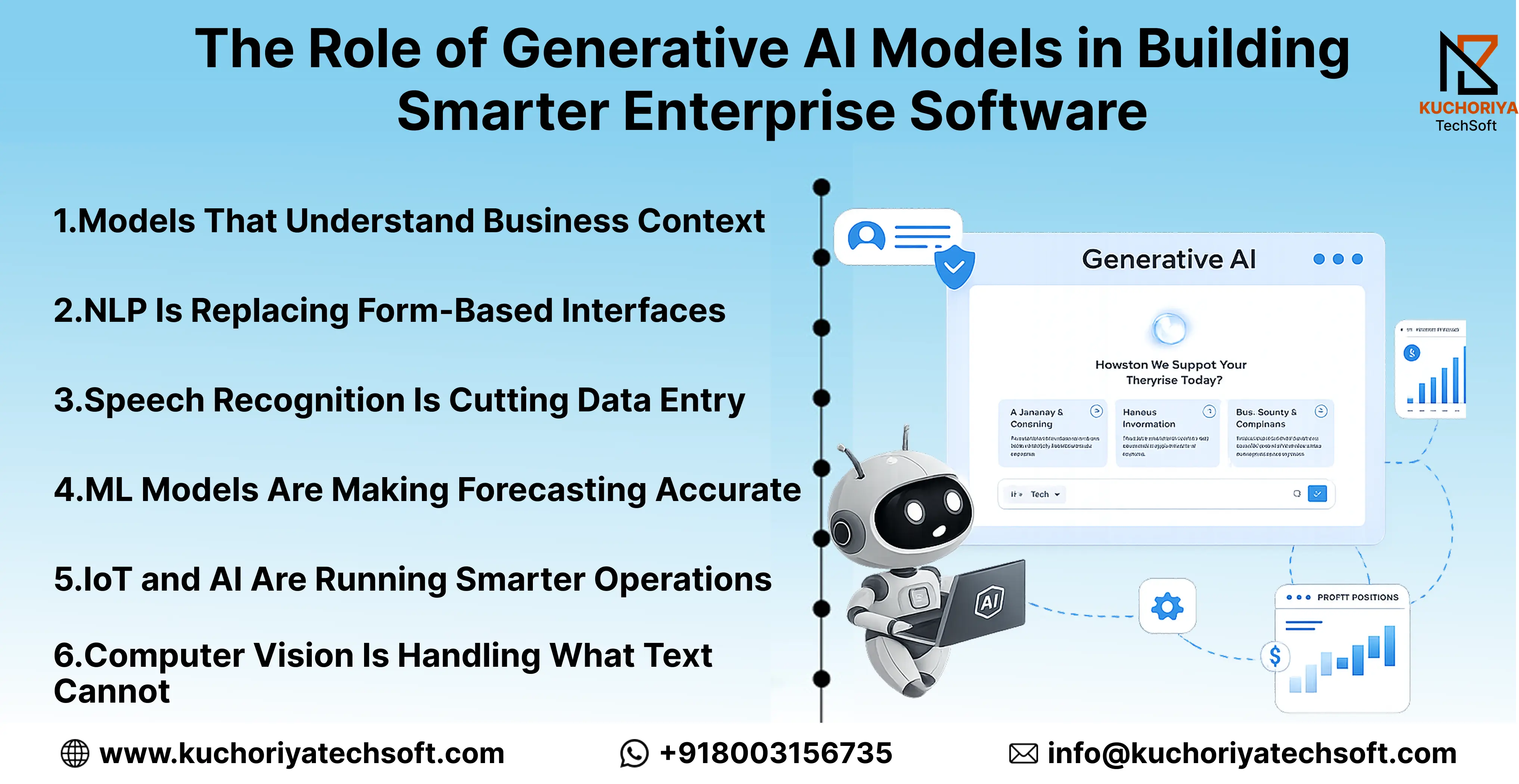
1. Models That Understand Business Context
A fine-tuned model trained on your industry data knows that a compliance flag in a healthcare contract needs escalation while the same language in a vendor NDA does not. That distinction used to take a senior analyst. Now it happens automatically.
2. NLP Is Replacing Form-Based Interfaces
Nobody wants to fill a 14-field form to raise a procurement request. NLP development services inside enterprise software modernization projects are replacing rigid interfaces with conversational inputs that capture the same data in less time.
3. Computer Vision Is Handling What Text Cannot
A quality inspector cannot catch every defect on a fast-moving production line. Computer vision development inside AI in logistics and AI-driven manufacturing solutions scans, flags, and logs visual data across entire facilities without stopping the line.
4. Speech Recognition Is Cutting Data Entry
Field teams and warehouse staff are not stopping to type. Speech recognition development inside enterprise software solutions captures data from voice input in real time, cutting manual entry errors across every shift.
5. ML Models Are Making Forecasting Accurate
Demand planning, risk scoring, churn prediction. ML development inside enterprise application development replaces gut-feel decisions with models that learn from historical patterns and update automatically.
6. IoT and AI Are Running Smarter Operations
IoT development services feeding data into AI development company built systems means enterprises are catching equipment failures before they happen and running operations that self-correct without waiting on a human decision.
Custom Enterprise Software Development in the Age of Generative AI
Two years ago, custom enterprise software development meant 6 to 12 months of scoping, building, testing, and hoping the business had not changed direction by the time anything went live. That timeline has been cut in half and the quality has gone up, not down.
1. AI Is Writing the Code Nobody Wanted To
Boilerplate, unit tests, documentation, repetitive logic. The parts of enterprise software development services that slowed teams down and burned senior developer hours are now handled automatically. Engineers are spending time on architecture and business logic instead.
2. Stakeholders See Working Products Earlier
Waiting three months to show a client something clickable is how scope creep starts. Custom enterprise software solutions teams are now putting working builds in front of stakeholders inside the first two weeks. Feedback comes earlier, changes cost less, and the final product actually reflects what the business needed.
3. Smaller Teams Are Delivering Bigger Projects
A custom enterprise software development company running AI-assisted delivery does not need a team of fifteen to do what a team of six can now handle. That directly reduces cost without touching scope or quality.
4. Legacy Systems Are Getting a Practical Path Forward
Most enterprises have years of code locked inside systems nobody fully understands anymore. Touching that infrastructure used to mean months of risk assessment before a single change was approved. AI-assisted refactoring inside enterprise software modernization projects has changed that.
5. Industry-Specific Builds Are Getting Faster Too
Whether it is AI-powered e-commerce platform development, AI education software development, or AI fleet management software, domain-specific custom enterprise software is being delivered faster because generative AI handles the repeatable parts while developers focus on what makes each industry different.
At Kuchoriya Techsoft, our enterprise software development company teams have cut average delivery timelines by 40 percent across projects in the last 12 months using AI-assisted development models without reducing team size or compromising on quality.
Generative AI Consulting Services: When You Need an Expert in the Room
Most enterprises know they need generative AI consulting but hire too late, after a failed pilot, a blown budget, or a vendor that delivered a demo instead of a product. Here is when bringing in a generative AI consulting services partner actually makes a difference.
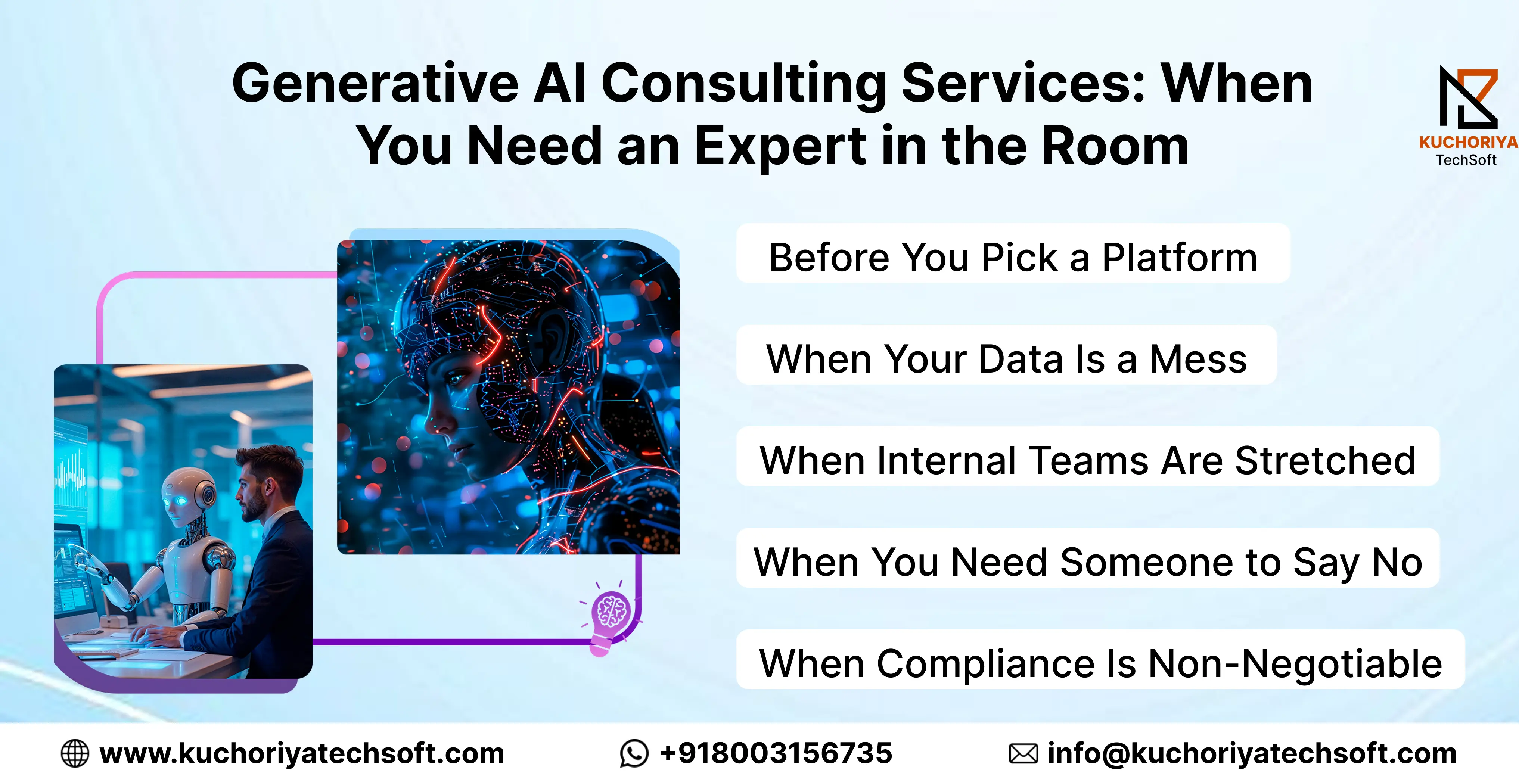
1. Before You Pick a Platform
Every generative AI platform vendor will tell you theirs is the right one. A good AI consulting service has no stake in that decision. They match your data environment, compliance requirements, and budget to the right infrastructure before anyone signs anything.
2. When Your Data Is a Mess
Generative AI consulting services teams spend more time fixing data pipelines than most clients expect. Bad data going into an AI development company built system means bad outputs coming out. Getting that right before development starts saves months of rework.
3. When Compliance Is Non-Negotiable
AI consulting company teams working in AI in healthcare, AI in finance and banking, and government sectors know that a powerful model means nothing if it cannot pass a compliance audit. Consultants who have done this before know where the bodies are buried.
4. When Internal Teams Are Stretched
Generative AI consulting services for business fill the gap between what an internal IT team knows and what generative AI enterprise consulting actually requires. Most enterprises do not need a full-time AI team. They need the right external partner for the right phase.
5. When You Need Someone to Say No
The most valuable thing a leading AI development company consultant does is tell a client when a use case is not worth building. Not every problem needs generative AI solutions. The ones that do need to be identified clearly before budgets get committed.
At Kuchoriya Techsoft, our AI consulting services for business practices start with a no-cost discovery call that tells clients exactly where generative AI will move the needle and where it will not.
Deep Dive: Agentic AI Development Guide: How to Build Autonomous AI Agent Systems from Scratch
Why Custom Web Applications Are Being Built Faster Than Ever – with AI‑Led Delivery Models
Industry-Wide Impact: Healthcare, Finance, Retail, Manufacturing & More
No industry has been left untouched. Here is where generative AI in healthcare, finance, retail, and beyond is making the biggest dent in 2026.
1. AI Healthcare Software Development: Less Paperwork, More Patient Time
Clinical notes, pre-authorizations, and diagnostic flagging. Generative AI in healthcare is handling the administrative work that keeps doctors away from patients. Hours saved per shift, every shift.
2. AI Banking Solutions: Compliance Without the Backlog
Fraud detection, underwriting, and regulatory reporting. Generative AI in finance processes in minutes what compliance teams spent days on. AI retail software development teams in banking are also seeing faster customer onboarding.
3. AI Manufacturing Software Development: Downtime Is Becoming Rare
Predictive maintenance, defect detection, and production scheduling. Generative AI in manufacturing is catching failures before they happen and keeping lines running without adding staff.
4. AI Transportation Software Development: Smarter Routes, Lower Costs
AI in transportation and AI logistics software development teams are cutting fuel costs and improving delivery times through real-time route adjustments across fleets of every size.
5. AI-Powered Telecom Solutions: Networks That Fix Themselves
AI telecom software development teams are using generative AI to predict network failures, automate customer support, and reduce churn before it shows up in monthly reports.
6. AI Insurance Software Development: Claims in Hours
AI for insurance solutions has cut claims cycles from weeks to hours. Generative AI in insurance is also improving fraud detection accuracy without manual review queues.
7. AI Real Estate Software Development: Transactions Without the Paperwork
Generative AI in real estate is automating valuations, lead scoring, and document processing. Agents are closing faster because the admin is handled before they even open a file.
8. AI Media Software Development: More Output, Lower Production Cost
Generative AI in media teams is producing more content at lower cost. AI in car rental industry, AI in the fantasy sports industry, and AI in taxi booking industry platforms are using the same content personalization models to keep users engaged longer.
9. AI Travel Solutions: Personalisation at Scale
AI travel software development teams are building recommendation engines that adapt to traveler behavior in real time. AI parking finder solutions and AI-powered fleet management are running on the same location-aware intelligence underneath.
10. AI Dating App Development and Beyond
AI in dating industry, AI parking software development, and AI in fantasy sports industry platforms share one common thread. They are all using generative AI to personalise user experience at a scale that manual curation never could.
Real Challenges Enterprises Face While Adopting Generative AI
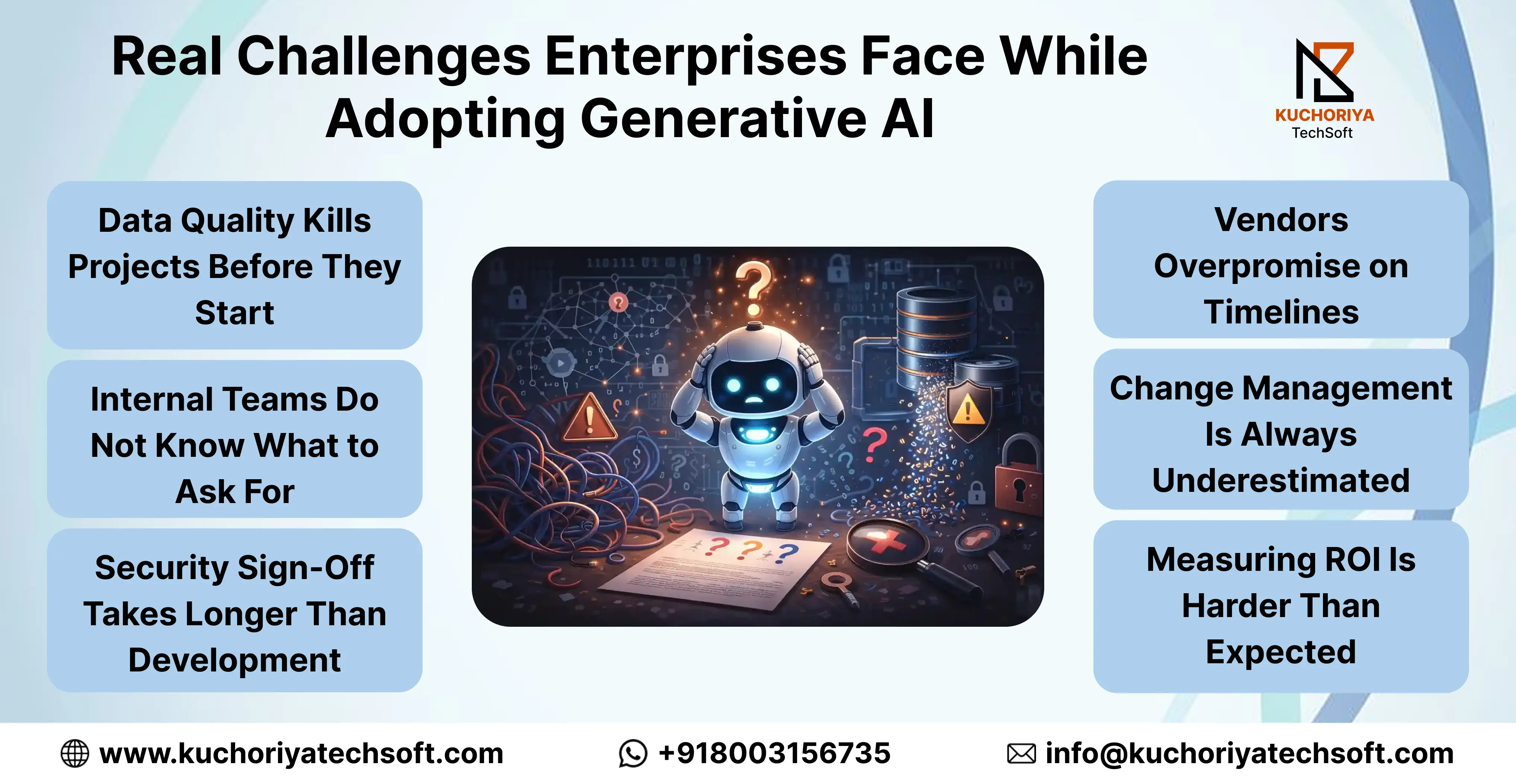
Every enterprise that has moved past the pilot stage will tell you the same thing. The technology was not the hard part. Here is what actually slows adoption down.
1. Data Quality Kills Projects Before They Start
Generative AI in ecommerce, finance, and healthcare deployments fail at the same point. The data feeding the model is incomplete, inconsistent, or siloed across systems that have never talked to each other. No model fixes bad data. That work has to happen first.
2. Internal Teams Do Not Know What to Ask For
Most enterprises have no shortage of budget or ambition. What they lack is someone who understands both the business problem and the generative AI in banking or operations context well enough to translate between them. That gap is where most projects stall.
3. Security Sign-Off Takes Longer Than Development
Enterprise software integration involving AI touches data that legal, compliance, and IT security all have opinions about. Getting those teams aligned before a vendor is selected saves months. Most enterprises learn this after the fact.
4. Vendors Overpromise on Timelines
A generative AI development company in UK, a generative AI development company in Australia, or anywhere else that quotes a six-week delivery for a complex enterprise software automation project without a discovery phase is guessing. Enterprises that have been burned once now demand fixed milestones before signing anything.
5. Change Management Is Always Underestimated
The software can be perfect and the rollout can still fail. Staff who feel replaced rather than supported push back quietly in ways that kill adoption metrics without ever appearing in a project report. Generative AI in telecom, retail, and logistics deployments that skipped proper change management are the ones getting rebuilt right now.
6. Measuring ROI Is Harder Than Expected
Enterprise AI solutions USA and global teams alike, struggle to connect AI deployment to business outcomes that finance teams recognise. Efficiency gains are real but diffuse. Defining the right metrics before deployment, not after, is what separates a project that gets funded again from one that gets quietly shelved.
How to Pick the Right Generative AI Development Company for Your Business
Most enterprises do not lose money on bad technology. They lose it on the wrong partner. Here is what actually separates a generative AI development company in Canada that delivers from one that just pitches well.
1. Industry Experience Over Generic AI Claims
A generative AI development company in UAE that has built for healthcare looks very different from one that has only done retail. Ask for case studies from your specific industry before any conversation about the technology stack begins.
2. Discovery Process Is Non-Negotiable
The best generative AI development company worth hiring slows down before speeding up. If a vendor skips structured discovery and jumps straight to timelines, that is the project that comes back for a rebuild six months later.
3. Check How They Handle Data Security
Enterprise AI solutions in Canada and regulated market deployments need vendors who have handled compliance before, not ones learning it on your project. Ask directly how they manage data residency, access controls, and audit requirements.
4. Delivery Model Matters as Much as Tech Stack
Top generative AI development services teams work in fixed sprints with defined outputs at every stage. Open-ended retainers with no milestones are how budgets disappear without results.
5. Post-Launch Support Is Part of the Deal
Best AI consulting services do not end at go-live. Models drift, prompts need tuning, and usage patterns shift. A top AI development company in the USA or anywhere else that does not offer structured post-deployment support is handing you a problem they will not help you fix.
6. References From Enterprises, Not Startups
Enterprise AI solutions in the UAE and large-scale deployments have different requirements than a startup MVP. Ask specifically for references from enterprise clients, not just logos on a website.
At Kuchoriya Techsoft, we have delivered generative AI enterprise solutions for clients across healthcare, finance, logistics, and retail as the best enterprise software development company that treats post-launch support as a core part of every engagement, not an optional add-on.
What Enterprise Software Looks Like Beyond 2026
The shift happening right now is not a feature update. It is a platform change. Here is where enterprise software development company in Singapore, UK, and Australia are already building toward.
1. Agents Replace Applications
The next wave of intelligent enterprise software is not software you open. It is software that acts. Multi-agent systems that plan, execute, and self-correct across complex workflows without waiting on a human decision at every step.
2. Natural Language Becomes the Default Interface
Forms, dashboards, and dropdown menus are being replaced. AI-enabled enterprise software in 2027 and beyond will be operated through conversation, not navigation. The interface is already changing faster than most enterprise IT roadmaps account for.
3. Every Industry Gets a Specialized Model
Generic foundation models are giving way to domain-specific ones. Generative AI development company in India teams are already fine-tuning models for legal, medical, and financial use cases that outperform general models on narrow tasks by a significant margin.
4. Real-Time Everything
Top enterprise AI solutions provider teams are building systems where decisions, forecasts, and recommendations update continuously as new data arrives. Batch processing is becoming a legacy concept faster than most enterprises planned for.
5. AI Governance Becomes a Core Function
Enterprise AI solutions in UK regulatory environments are already pushing compliance frameworks for AI systems. Enterprises that build governance into their stack now will not be scrambling to retrofit it when legislation catches up.
Conclusion: The Enterprises That Move Now Will Lead Tomorrow
The enterprises pulling ahead in 2026 are not the ones with the biggest budgets. They are the ones who stopped waiting and started building.
Generative AI in transportation, retail, healthcare, and finance is no longer a future investment. Every quarter spent evaluating is a quarter a competitor spends deploying.
At Kuchoriya Techsoft, we have helped enterprises across the USA, UK, UAE, Canada, and Australia move from strategy to production without the false starts that come from picking the wrong partner.
Need someone to own the technical vision that your internal team cannot carry? Our Virtual CTO and Fractional CTO services give you senior technical leadership at the decisions that matter most, without the full-time cost.
For agencies and consultancies looking to expand what they offer, our Referral Partner Program is built around long-term relationships, not one-time commissions.
The window is open right now. Contact us today and let us show you exactly what is possible.

FAQs
Q. What is the difference between a generative AI development company and a regular AI development company?
A. A regular AI development company in USA or anywhere else typically builds rule-based systems, predictive models, and automation workflows. A generative AI development company in Canada or UAE goes further, building systems that generate content, write code, draft responses, and reason across unstructured data. The outputs are not just predictions. They are actions.
Q. Which Industries Benefit Most From Generative AI Development Services?
A. Healthcare, finance, and logistics see the fastest returns because document volume and decision complexity are both high. But the spread is wider than most expect. AI travel software development, AI car rental software, AI fantasy sports app development, AI dating app development, and AI parking finder solutions teams are all running generative AI in production in 2026 and seeing real numbers, not just pilot results.
Q. How Long Does a Typical Generative AI Enterprise Project Take?
A. A focused NLP solutions for enterprise build or AI chatbot development services project runs six to eight weeks from discovery to deployment. Larger enterprise AI solutions Canada or enterprise AI solutions UAE integrations sit between three and six months. Data readiness and compliance sign-off are what move that number more than the technology itself.
Q. What Makes Kuchoriya Techsoft Different From Other Generative AI Development Companies?
A. We have delivered for AI development company in UK, AI development company in Australia, and AI development company in UAE clients across healthcare, finance, retail, and logistics. Discovery before development is non-negotiable on every project. Our Virtual CTO and Fractional CTO services exist for enterprises that need senior technical leadership at the right moments without carrying that cost full time.
Q. What AI Technologies Does Kuchoriya Techsoft Work With?
A. Deep learning solutions, computer vision solutions, machine learning solutions, IoT solutions for enterprise, speech recognition software development, AI chatbot development company builds, and NLP solutions for enterprise. Which ones we use depends entirely on what the business problem actually needs, not what is trending.
Q. How Do I Get Started With Generative AI for My Enterprise?
A. Book a discovery call. Our AI development company in Canada teams map your workflows, identify where AI e-commerce solutions or AI parking software development or any other application makes sense, and give you a clear delivery picture before any contract is signed. No fluff, no commitment. Contact us today to get started.