
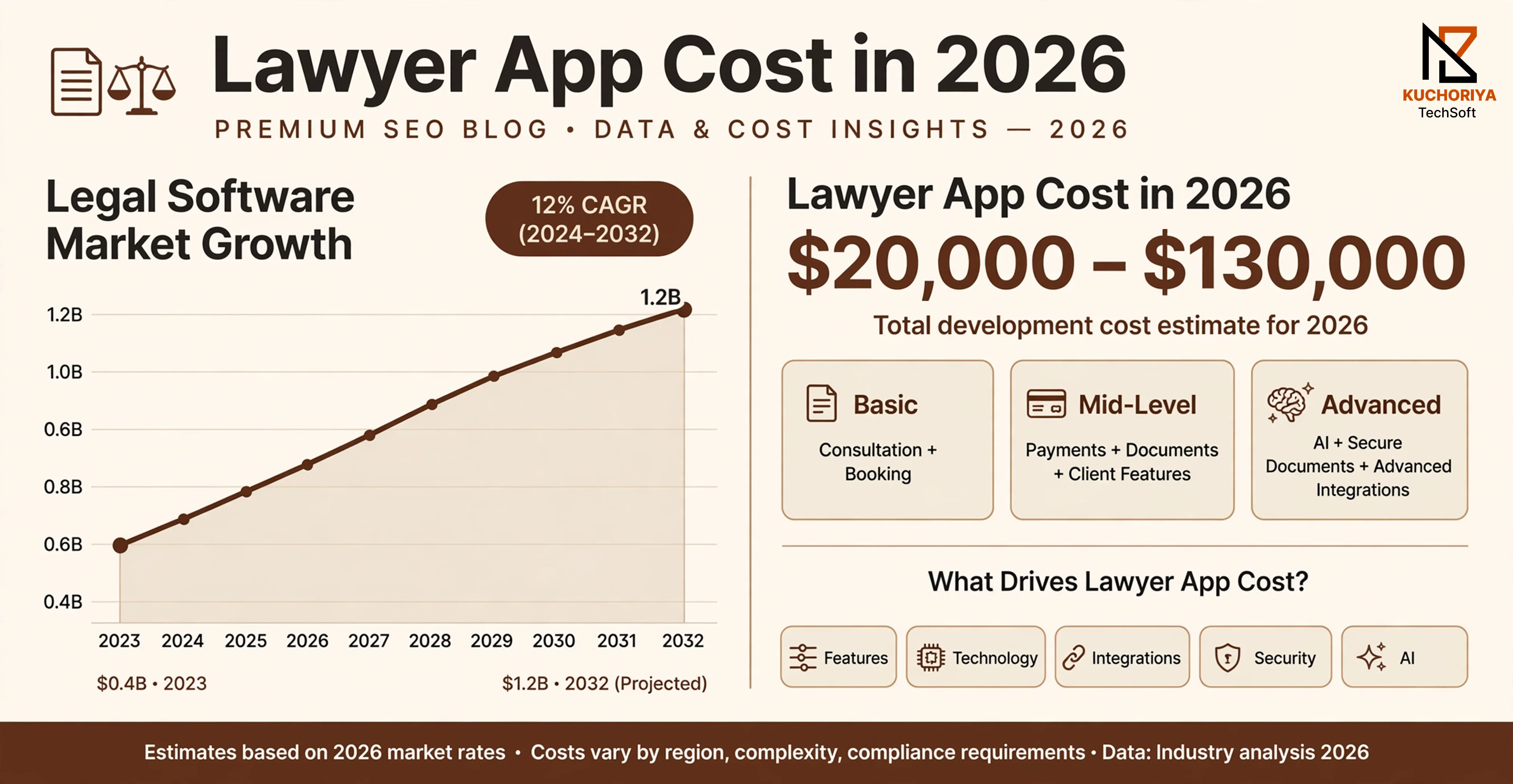
By 2032, the legal software market hits $1.2 billion. It was $0.4 billion in 2023. That's a 12% CAGR, and a chunk of it belongs to firms that stopped guessing and actually budgeted for a lawyer app.
The lawyer app cost isn't one number. Ask a solo attorney building a simple booking tool and a legal-tech startup building an AI platform, and you'll get two totally different answers to the same question: how much does a lawyer app cost?
Short answer for 2026: legal app cost runs $20,000 to $130,000. Basic consultation and booking sit near the bottom. Add document management, secure payments, AI features, and the number climbs fast. Wide range. This guide narrows it down to your project, not a generic average.
What's ahead: what pushes the lawyer app price up or down, how legal app pricing shifts by app type, where firms quietly overspend, and how to walk away with a lawyer app cost estimate you can actually plan around.
Building for a small practice? A multi-office firm? Or just trying to answer how much does a legal app cost before that first developer call? This breakdown gets you there. Once lawyer app cost 2026 benchmarks are clear, everything else about your legal technology decision gets easier.
Lawyer app pricing doesn't stay flat for long. Let's start with the number everyone wants first.
What Factors Affect Lawyer App Cost?
Ask ten developers how is lawyer app cost calculated, and you'll get ten different answers. Here's what actually moves the needle.
1. App Complexity
More moving parts, higher build time, higher bill. A basic app with login, search, and booking costs far less than one stacked with video consultations, document workflows, and AI. App complexity and pricing move together in a straight line.
2. Technology Stack
Technology stack pricing shifts based on what you build with. React Native or Flutter trims cost by using one codebase for Android and iOS. Custom AI integrations, real-time video, and payment gateways each add their own layer on top.
3. Project Scope
Project scope and pricing go hand in hand. A tightly scoped MVP with five core features stays predictable. A scope that keeps expanding mid-build is where budgets quietly blow past their original number.
4. Developer Location and Rates
Developer hourly rates swing widely by region. US-based teams run higher, Eastern Europe sits in the middle, South Asia comes in lower without necessarily cutting quality. A lawyer app hourly rate and a legal app developer hourly rate shift with experience level and team size.
5. Security and Compliance
Handling client data, case files, and payments means encryption, access controls, and audits aren't optional, and none of that is free.
These are the lawyer app cost factors worth planning for before a single line of code gets written. Next: what this actually looks like by app type and complexity level.
Lawyer App Cost by Complexity and App Type
Legal app cost by complexity and legal app cost by app type don't move together. A simple MVP and a full legal marketplace sit worlds apart on price, even before platform choice enters the picture.
By Complexity
Why does an MVP lawyer app cost number stay low? Because it only covers the basics, signup, attorney profiles, search, scheduling, messaging. Nothing fancy. Add video consultations and document sharing, and the build moves into mid-level pricing. Throw in AI features, multi-role dashboards, and enterprise infrastructure, and now you're paying for advanced territory.
By App Type and Platform
A lawyer consultation app cost stays moderate. Mostly chat, video, scheduling, nothing that balloons the budget. Trim it down to just a calendar and payment flow, and that's your lawyer booking app cost, cheaper by nature. Then things jump. Multi-lawyer profiles, ratings, filters, commission-based payouts, and a legal marketplace app cost (or lawyer marketplace app cost) carries all of that weight, and it shows in the price. Law firm app cost sits somewhere between the two, mostly depending on how much internal tooling like case management or CRM gets bundled in.
Single-platform builds keep things simple. iOS lawyer app cost and Android lawyer app cost land close to each other either way. Go cross-platform and the upfront number ticks up, but cross-platform lawyer app pricing buys you both app stores off one codebase, usually cheaper than building native twice.

Lawyer App Cost Breakdown by Features
Ask for a quote and most agencies hand you one number. Rarely do they break down what's actually inside it. That's the gap the legal app feature cost is supposed to fill.
Two features get mixed up constantly. Legal document management cost handles storage and sharing. Legal case management software costs go further, tracking where a case actually stands. Same word, "documents," on the surface. Different job underneath.
Video is where lawyer consultation app pricing usually takes its biggest hit. Nothing else on the list demands the same level of real-time infrastructure.
Then there's the back-office side. A legal practice management app cost, a legal client portal cost, a law firm CRM app cost, none of these face the client directly, yet stacked together they can outweigh every visible feature on the app.
Pick enough of these, and the number stops looking small. That's also why the tech stack underneath deserves just as much attention as the features sitting on top of it.
How Does the Tech Stack Affect Legal App Pricing?
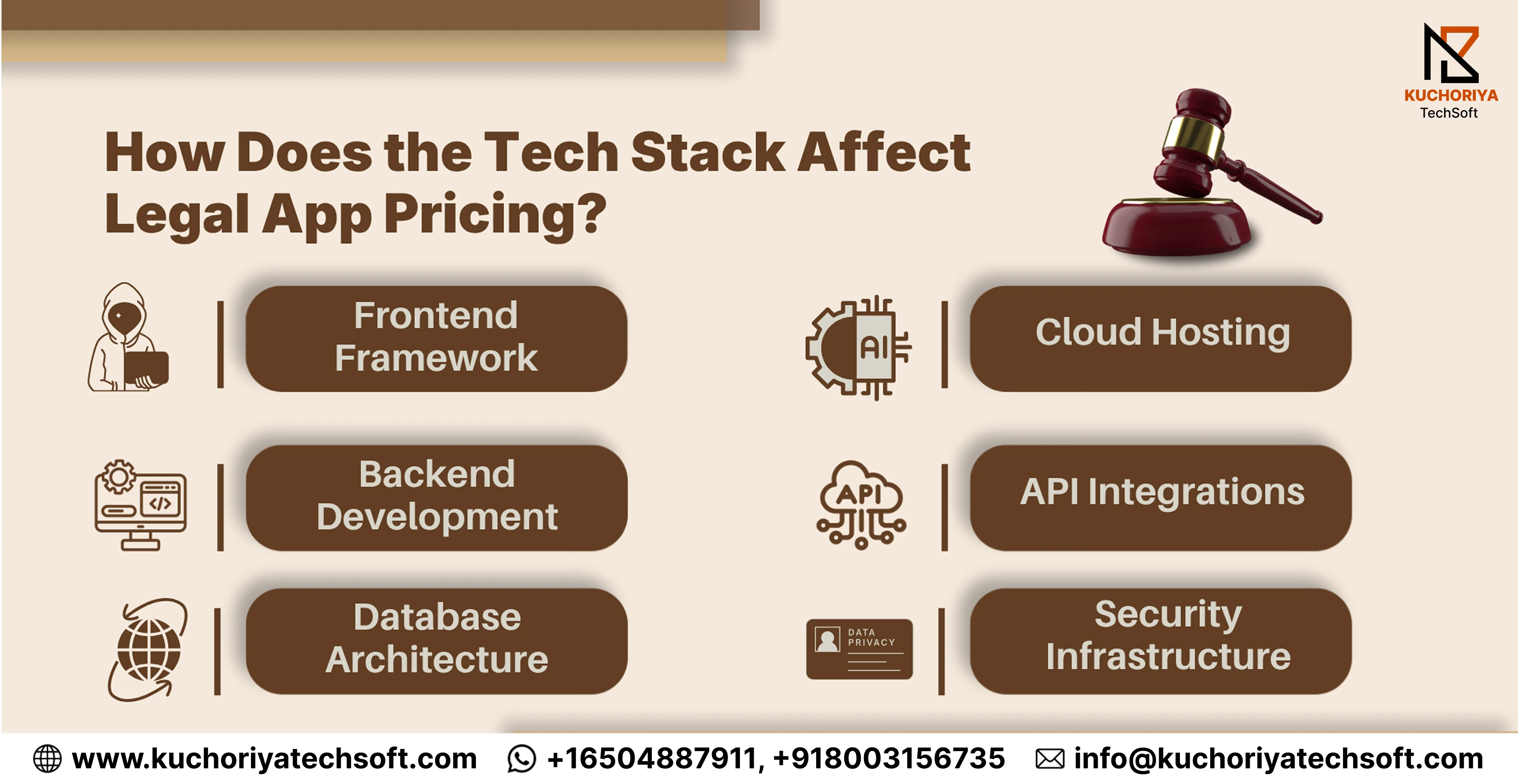
Two apps can look identical on the surface and still land $20,000 apart, and that gap usually comes down to legal app tech stack cost.
1. Frontend Framework
Flutter and React Native both trim cost by sharing one codebase across platforms instead of building twice. Picking between Flutter legal app cost and React Native legal app cost is often what decides your overall law firm mobile app cost.
2. Backend Development
Complexity scales with how many user roles the backend has to handle, lawyer, client, admin. Each role adds its own logic layer, and that layer adds its own build hours.
3. Database Architecture
Case files and client records need structure a basic app schema just doesn't offer. Getting this layer right early saves rework once the data volume grows.
4. Cloud Hosting
Legal app cloud hosting cost depends heavily on traffic and how much data stays stored long-term. Legal app hosting cost only turns into a real number once video sessions and case files start piling up.
5. API Integrations
Every third-party connection, payment, e-signature, calendar, adds its own line item, and that's why legal app API integration cost (also called legal app API cost, or legal app integration cost) climbs quietly. Payment gateway integration cost alone can run $2,000 to $5,000 depending on how many providers get supported.
6. Security Infrastructure
Encryption, access control, and audit logging aren't optional for legal data. This layer stays non-negotiable no matter what the rest of the budget looks like, and it feeds directly into overall legal app infrastructure cost.
Must Read: How to Build a Lawyer App in 2026: Features, Cost, Technology & Development Process
What Are the Additional Costs of a Lawyer App?
Most quotes only cover the build, and what comes after is where legal app hidden costs usually surface.
- Security implementation cost covers encryption and role-based access layers.
- Legal app security costs rise once audit trails and monitoring get added.
- Legal data security costs stay ongoing as client records keep growing.
- Legal data protection cost covers backups and data-retention policies.
- Legal compliance costs go toward audits and certifications.
- Secure legal app costs climb once every layer above gets stacked together.
- Secure payment implementation cost covers PCI-level safeguards for payments.
- Law firm app pricing rarely accounts for this post-launch stretch.
- Add it all up, and that's your real legal app total cost of ownership.
How Much Does AI Add to Lawyer App Cost?

AI features push the budget up, but not evenly across the board. Does AI increase legal app cost depends entirely on which features get picked, a basic chatbot barely moves the number, while deeper automation can double it.
1. AI Legal App Cost
Starts climbing once natural language search or smart matching gets added to the base app. Every extra model call behind the scenes adds to the running bill, so scope decides the range more than the app size does.
2. AI Lawyer App Cost
Covers attorney-side tools like case summarization and workload prediction. These features save hours once live, but they need training data and testing before launch, which is where most of the early spend goes.
3. Legal Chatbot Cost
Runs on the lower end, mostly intake questions and appointment routing. Keeping it rule-based instead of fully conversational is usually what keeps this line item small.
4. AI Document Analysis Cost
Sits higher, since contract review and clause extraction need heavier processing. Accuracy requirements in legal documents push this cost up further, since errors here carry real consequences.
5. LLM Integration Cost for Legal Apps
Usually the biggest single line item, covering model access and the fine-tuning it takes to keep answers legally sound. Ongoing usage fees add to this too, since most models charge per query rather than a flat rate.
How Much Does It Cost to Maintain a Lawyer App?
Nobody budgets much time thinking about what happens after launch. But the app doesn't stop needing money once it's live, it just starts needing a different kind. Legal app maintenance pricing is basically everything that keeps the thing running day to day, hosting, patches, fixes, the boring stuff nobody notices until it breaks.
A decent rule of thumb: plan for around 14 to 19% of the build cost every year just for upkeep. So if an app ran $50,000 to build, expect another $7,000 to $9,500 a year to keep it running properly, that's not a one-time thing, it repeats every year the app stays live. This ongoing number is what people usually mean by lawyer app maintenance expenses, and it's separate from the original build quote. Many firms fold it into general legal software or legal technology costs instead of tracking it separately, which is usually why the renewal bill catches them off guard.
How Can You Reduce Lawyer App Development Costs?

Cutting corners isn't the goal here, spending smarter is. Legal app budget planning done early saves more than any discount negotiated later.
1. Start With an MVP
Building the core features first and adding the rest after launch is the fastest way toward cost-effective legal app development, since you're only paying for what users actually test first.
2. Go Cross-Platform
One codebase across iOS and Android is one of the simplest ways to reduce legal app development cost, cutting frontend work nearly in half compared to building native twice.
3. Consider Offshore Development
Offshore legal app pricing often runs lower without cutting quality, since experienced teams in regions like South Asia or Eastern Europe charge less per hour than US-based ones.
4. Reuse Proven Components
Pulling from tested modules instead of custom-building every feature from scratch keeps affordable lawyer app development realistic without sacrificing reliability.
5. Prioritize Ruthlessly
A tightly scoped feature list is what actually keeps a budget-friendly legal app on track, scope creep is where most budgets quietly blow past their original number.
6. Phase Compliance Work
Rolling out security and compliance features in stages rather than all at once spreads the cost over time, making low-cost legal app development more manageable for smaller firms.
How to Make Money From a Lawyer App?
Building the app is one investment. Turning it into a working business is the next one. Here's what actually brings in revenue once the app is live.
1. Commission on Consultations
The platform takes a cut of every booked consultation, a commission-based lawyer app model that scales naturally as more attorneys join.
2. Subscription Plans
Lawyers pay a recurring fee for premium visibility or extra tools, which is where lawyer app subscription model revenue tends to stay the most predictable.
3. Featured Lawyer Listings
Paid placement at the top of search results gives attorneys more visibility, one of the simpler legal app revenue streams to set up early on.
4. Consultation Fees
A direct pay-per-session charge, split between the platform and the lawyer, keeps cash flow steady without needing a large user base first.
5. Premium Client Services
Add-ons like priority support or document review at an extra charge round out a broader lawyer app monetization strategy once the core app has traction.
Most platforms don't lean on just one of these, they stack two or three depending on the market. That's also where a development partner matters, picking a legal app monetization strategy early affects how the app gets built, not just how it gets priced later. Kuchoriya TechSoft builds revenue logic like this directly into the app architecture from day one, so monetization isn't bolted on after launch, it's part of the original lawyer app business model the app is designed around.
Conclusion: Planning Your Lawyer App Budget in 2026
Every number in this guide moves with scope. A basic consultation app sits at the low end, add document management, payments, and AI, and the range climbs. That's the real shape of a lawyer app budget in 2026, a range, not a fixed figure.
Law firm app development cost shifts even between firms wanting the same core features, since platform, compliance, and upkeep all factor in. That's why custom lawyer app pricing works better as a conversation than a checklist.
Lawyer app development pricing varies enough between vendors that a written lawyer app development quote is worth having before any build starts. Request a lawyer app quote directly, or run your feature list through a lawyer app cost calculator first for a rough range.
Kuchoriya TechSoft works with law firms and legal-tech teams at every stage. Agencies already working with law firms can bring projects our way through the referral partner program. Firms after a longer, strategic tie-up usually fit the associate partner program. And for ongoing technical leadership without hiring in-house, there's legal app CTO services.
The earlier the budget conversation happens, the fewer surprises later. Get Your Lawyer App Cost Estimate Now. Talk to our team and walk away with a real number for your project, not a guess.

FAQs About Lawyer App Cost
Q. What is included in the total cost of a lawyer app?
A. Design, development, the backend that runs everything, security and compliance work, whatever integrations get connected, and the testing that happens right before launch. Hosting and maintenance come later and aren't part of this number.
Q. Why are some legal apps more expensive than others?
A. Mostly features. Add AI tools, separate dashboards for lawyers and clients, or live video, and the build hours stack up fast compared to a plain booking app.
Q. Does the lawyer app cost change by location?
A. Yes. Lawyer app costs in the USA and lawyer app costs in the UK both sit toward the higher end due to developer rates and compliance requirements. The lawyer app cost in the UAE depends more on vendor choice, while the lawyer app cost in India stays well below Western pricing for the same feature set.
Q. Does the type of legal practice affect the cost?
A. Yes. Immigration lawyer app costs and family law app costs tend to stay lower, while corporate law app costs and real estate law app costs climb with document-heavy workflows. Personal injury lawyer app costs and insurance legal app costs often land higher too, mainly due to claims tracking features.
Q. Is legal tech the same thing as legal software?
A. Not quite. Legal tech is the umbrella term for anything built for the legal industry. Legal software is one piece under that umbrella, a booking tool or a legal consultation platform, for example. Law firm software leans more toward internal use, staff and case tracking rather than anything a client sees.
Q. What's the difference between practice management and workflow automation?
A. Legal practice management is how a firm runs day-to-day through software, billing, files, client messages, all in one place. Legal workflow automation takes the repetitive parts of that, intake forms, status updates, and lets them run without someone triggering each step by hand.