





What Is Revenue Cycle Management (RCM) Software?
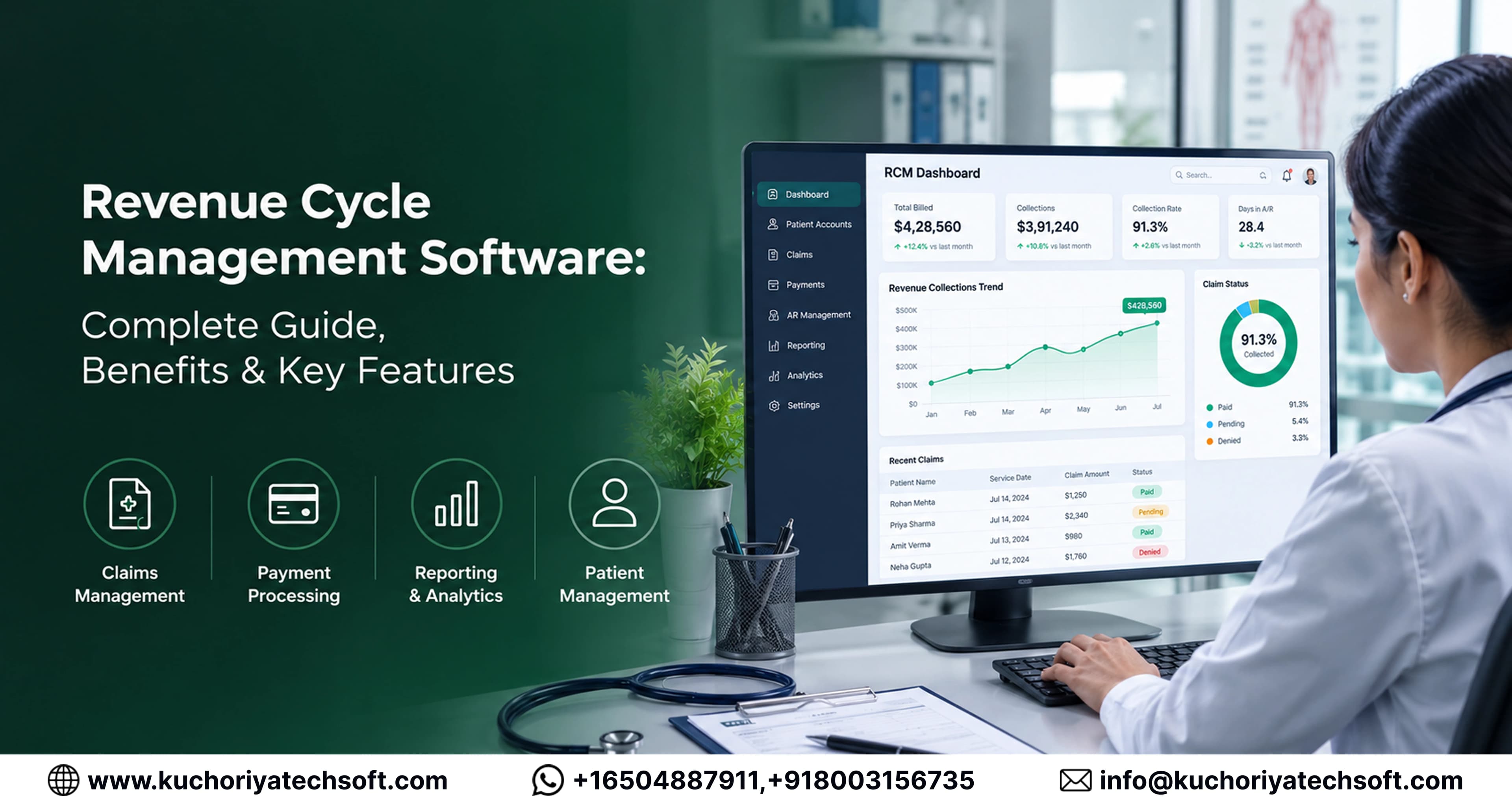
Money follows the patient. That's the whole idea behind revenue cycle management software. Book an appointment, get treated, pay the bill, done. One system tracks it start to finish instead of five disconnected spreadsheets fighting each other.
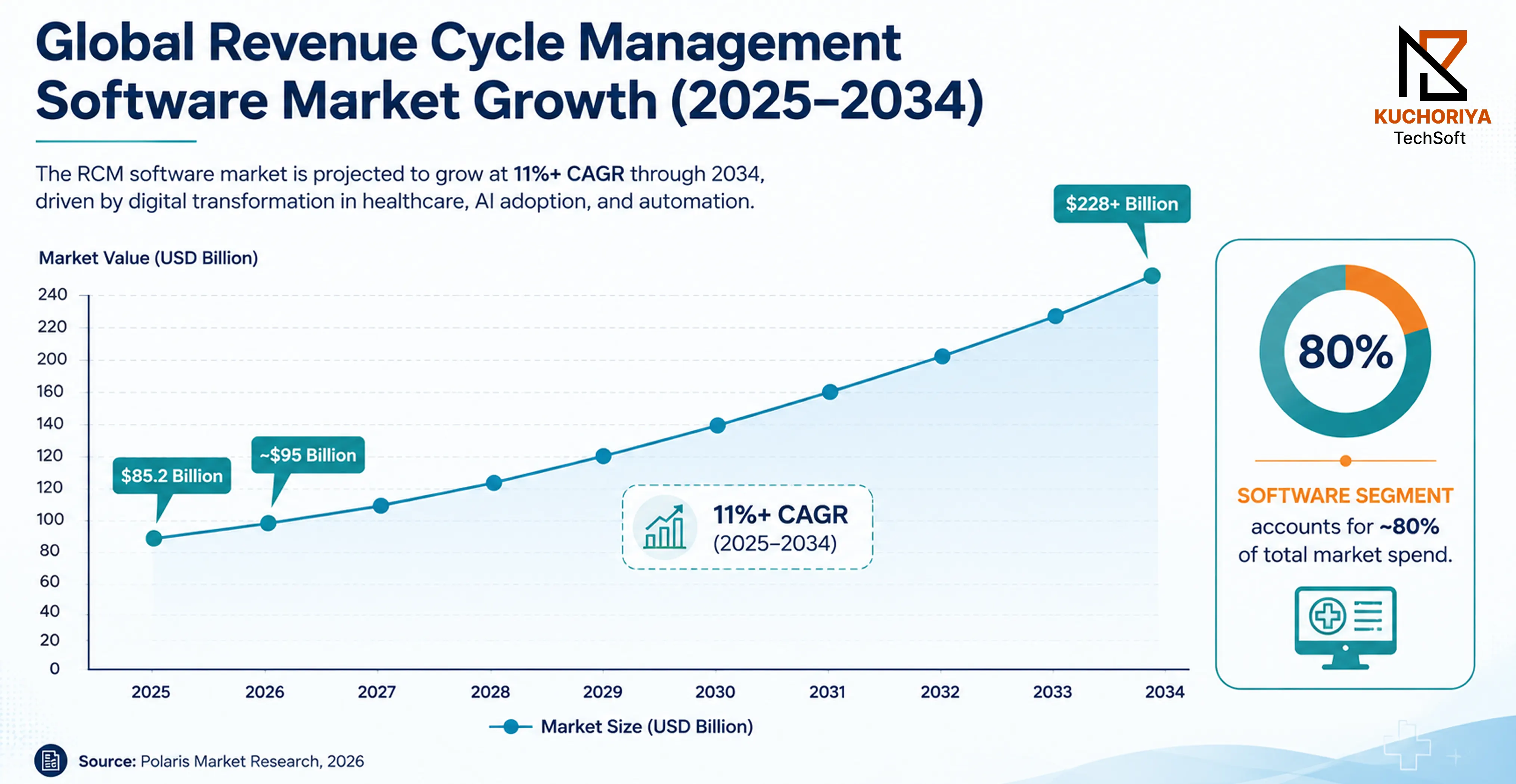
Hospitals aren't dabbling in this anymore; they're pouring money into it. The global market surpassed $85.2 billion in 2025 and is projected to continue climbing at over 11% per year through 2034. Software alone eats up almost 80% of that spend. (Source)
So what's actually inside a revenue cycle management system? Patient registration. Eligibility checks. Medical Billing. Medical Coding. All wired together instead of living in separate silos. Smaller clinics just call it "RCM software." Bigger hospital networks run a full healthcare revenue cycle management suite because they've got more moving parts to track.
Here's what separates the good platforms from the rest: Healthcare Compliance isn't an afterthought, it's baked in from day one. One wrong code, one missed regulation, and a claim sits in limbo for weeks. That's why picking the right revenue cycle management software company matters more than most providers realize until something goes wrong.
How Does Revenue Cycle Management Software Work?
Every dollar moves through a chain of steps before it lands in the hospital's account. Here's how a solid revenue cycle management solutions platform handles it, stage by stage.
- Patient Registration – captures demographics and insurance details the moment someone books
- Eligibility Verification – confirms coverage before treatment even starts, cutting down surprise denials
- Charge Capture – logs every service rendered so nothing slips through unbilled
- Claims Processing – packages and submits claims to payers, fast and clean
- Payment Posting – matches incoming payments against claims, flags mismatches instantly
- HL7 Integration – keeps clinical and financial systems talking the same language
- EHR Integration – pulls patient records straight into billing without manual re-entry
Hospitals running a revenue cycle management software USA-based platform lean hard on this automation. Fewer manual handoffs. Fewer errors. Faster cash flow.
Key Features of Revenue Cycle Management Software
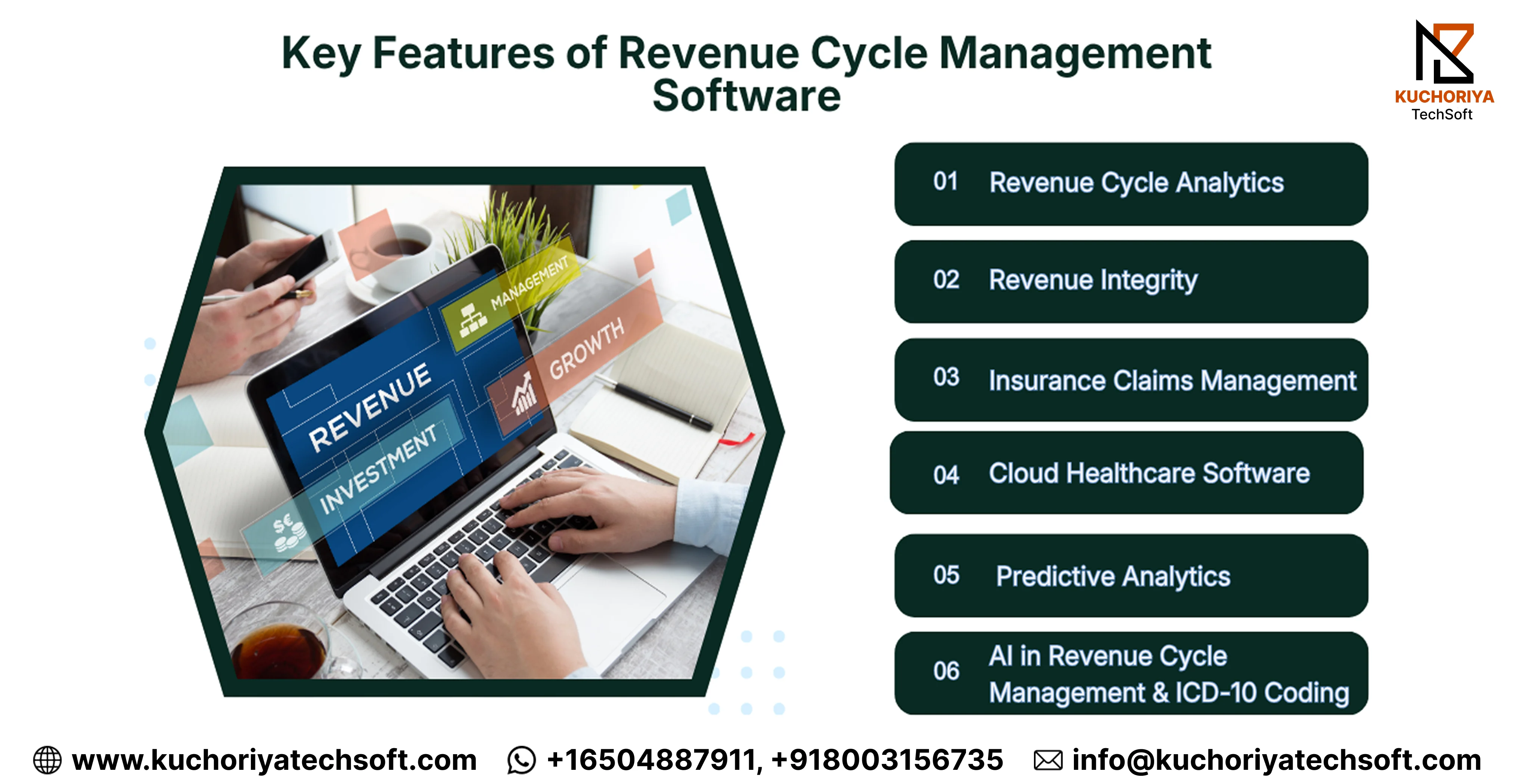
Not every platform on the market actually delivers results. The ones that do, the real healthcare RCM software and healthcare RCM software USA builds, tend to share the same core set of features.
1. Revenue Cycle Analytics
Denial rates, payment delays, revenue trends, a proper analytics setup puts all of it in front of the billing team the moment it happens, not weeks later buried inside some static monthly report.
2. Revenue Integrity
Small billing errors add up fast across thousands of claims. This feature catches undercharges and mistakes before a claim ever leaves the building, so revenue stops slipping through unnoticed.
3. Insurance Claims Management
Every claim gets tracked from the moment it's submitted until payment actually lands. Anything that stalls or gets flagged triggers automatic follow-up instead of sitting untouched.
4. Cloud Healthcare Software
Billing staff pulls up financial records from any location once the platform runs on the cloud. No on-site server to maintain and no IT ticket every time something needs updating.
5. Predictive Analytics
Before a claim even goes out, the system checks it against historical denial patterns. Anything that looks likely to bounce gets flagged early, saving the rework later.
6. AI in Revenue Cycle Management & ICD-10 Coding
Feed the system clinical notes and it maps out the right ICD-10 code on its own. Hospitals running this have seen coding errors drop and reimbursements move noticeably faster.
Benefits of Revenue Cycle Management Software
Switching to a real medical revenue cycle management software platform does more than tidy up the billing desk. It changes how fast a hospital gets paid, and how much revenue quietly slips away in the process.
Add it all up, and the picture is simple. Staff spends less time chasing paperwork. Payments show up weeks earlier than before. And finance teams finally have numbers they can trust instead of guessing where the money went.
Interesting Dive: AI-Powered Revenue Cycle Management (RCM) Software
AI in EHR/EMR Software Development: Benefits, Use Cases & Future Trends

Common Revenue Cycle Management Challenges & Their Solutions
A solid revenue cycle management platform exists to fix exactly these recurring headaches.
1. Problem: Claims keep bouncing back due to small errors before submission.
Fix: Claims Denial Management catches mistakes early, before a payer has any reason to reject.
2. Problem: Denials only get noticed after the rejection letter arrives.
Fix: AI Claims Denial Management flags risky claims days in advance using past rejection patterns.
3. Problem: Confusing bills delay patient payments.
Fix: Clear patient billing with itemized statements speeds up collections.
4. Problem: Unpaid balances sit uncollected for months.
Fix: Accounts Receivable Management actively tracks and follows up on every outstanding claim.
5. Problem: Billing, coding, and collections work in disconnected silos.
Fix: A unified healthcare financial workflow keeps all three moving together.
6. Problem: Staff waste hours on repetitive manual tasks.
Fix: Robotic Process Automation handles data entry and status checks automatically.
Hospitals using a Revenue Cycle Management Software UK-based system catch these issues before they escalate.
Top 5 Revenue Cycle Management Software Solutions
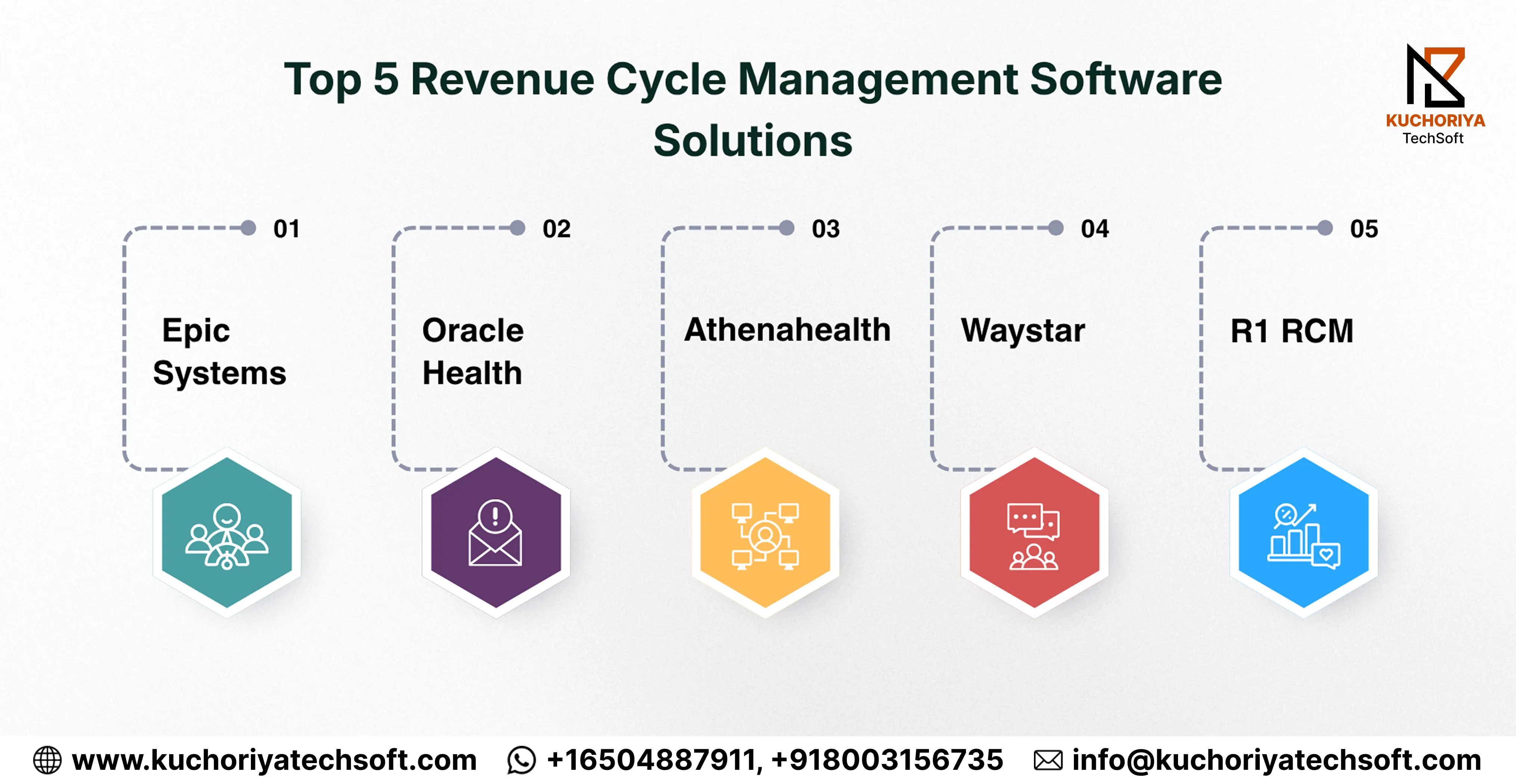
Picking the best revenue cycle management software usually comes down to five names that dominate hospital and clinic conversations right now.
1. Epic Systems
Runs deep inside large hospital networks already using Epic's EHR. Its RCM module ties clinical and financial data together natively, which is why so many enterprise health systems never look elsewhere.
2. Oracle Health
Formerly Cerner, now backed by Oracle's cloud infrastructure. Strong fit for hospitals wanting an enterprise revenue cycle management software setup that scales across dozens of locations without breaking.
3. athenahealth
Built as cloud-based revenue cycle management software from the ground up, not retrofitted later. Popular with mid-size practices that want fast implementation over heavy customization.
4. Waystar
Known for claims scrubbing and denial prevention. Handles CPT coding validation before submission, catching errors that would otherwise bounce a claim back weeks later.
5. R1 RCM
Often brought in for revenue cycle management software development projects and full outsourced RCM. Health systems lean on R1 when they need a custom revenue cycle management software approach built around specific workflows rather than a one-size-fits-all package.
Outside the US, providers building for the Gulf region often need a Revenue Cycle Management Software UAE-compliant setup, one that handles local insurance regulations that none of the above five were originally built for. That gap is exactly where custom Healthcare Financial Management platforms, built specifically for regional compliance, tend to outperform the big US-first names.
Revenue Cycle Management Software Cost: Key Factors to Consider
Ask five vendors for pricing and you'll get five different answers. That's because RCM software isn't priced one way, it depends on what's included and how a hospital wants to pay for it.
Quick range: Basic platforms start around $130 a month per provider. Enterprise setups can climb past $1,000. Full-service outsourced RCM usually costs 3-10% of whatever gets collected; most providers land somewhere between 5 and 8%.
Here's the part vendors don't put on the pricing page: setup, training, and data migration stack on top of whatever number gets quoted. A $130 plan can easily cost double that in the first few months. The real math isn't the sticker price, it's whether the platform pays for itself through fewer denials and faster payments down the line.
There's one more cost hospitals tend to skip past. Building a custom system means finding a healthcare custom software development company that's HIPAA compliant from the first line of code, not patched in later. That upfront investment costs far less than rebuilding a non-compliant platform after it's already live.
Security, Compliance & Data Privacy in Revenue Cycle Management Software
Patient financial data is exactly the kind of target hackers go after. Here's what a solid RCM platform needs to have locked down.
- HIPAA Compliance – the baseline requirement; without it, a platform isn't viable in a US healthcare setting at all
- CMS Compliance – keeps billing rules current, since coding regulations shift constantly and outdated tracking means denied claims
- FHIR Integration – lets systems share patient data securely across providers without exposing raw records mid-transfer
- Healthcare Interoperability – stops data from getting stuck in one system, useless everywhere else
- Healthcare Data Security – encryption, access controls, audit trails, running constantly, not just checked once a year
- Natural Language Processing – reads unstructured clinical notes and pulls out billing-relevant details automatically
- Machine Learning in Healthcare – flags unusual billing patterns early, before they turn into compliance problems
- OCR for Medical Billing – converts scanned paper records into usable data without manual retyping
- Revenue Cycle Management Software Canada – providers working across the border need a platform built for Canadian privacy law, not a US system stretched to fit
How to Choose the Right Revenue Cycle Management Software
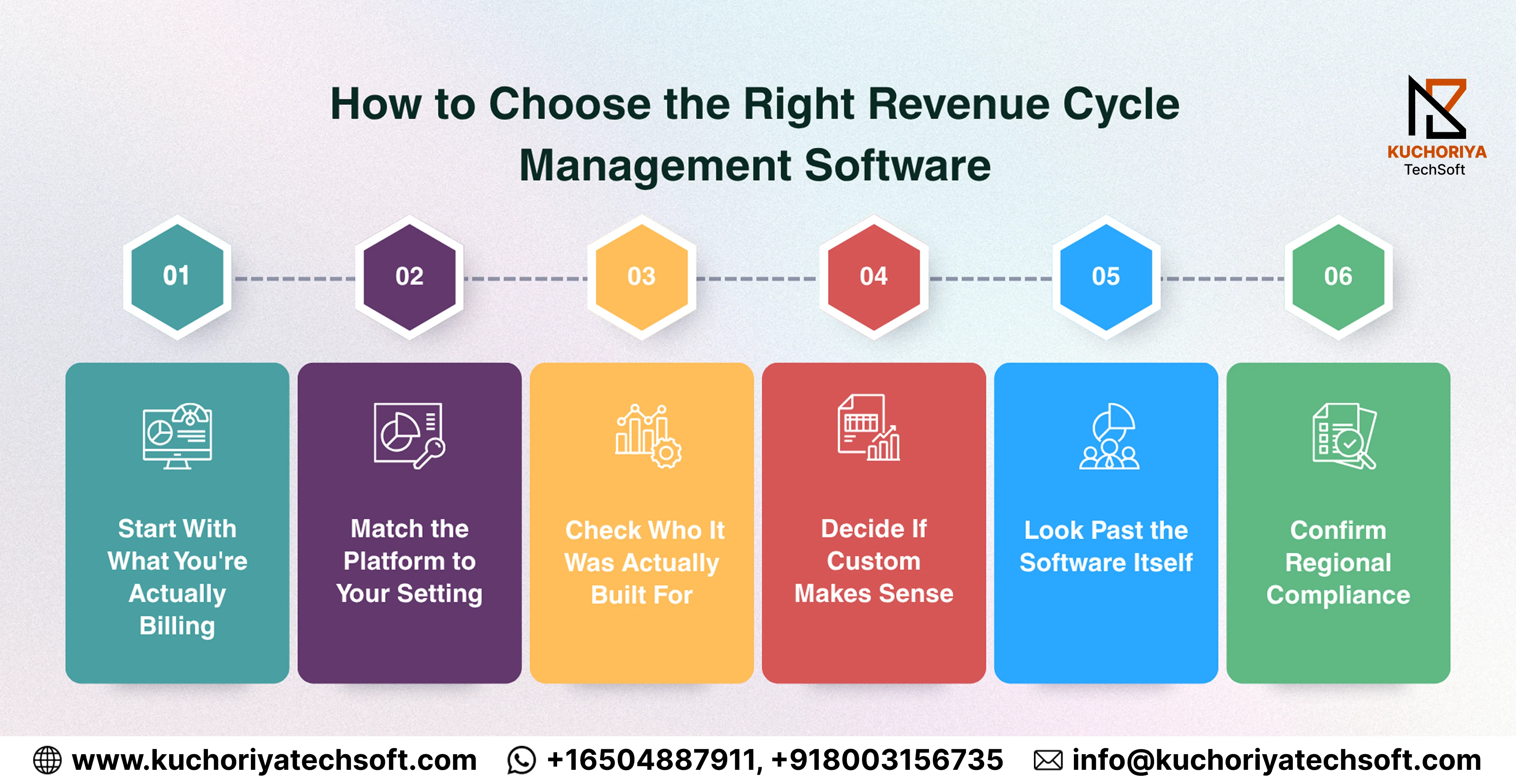
Picking the right platform comes down to matching the tool to the setting it'll actually run in. Here's how to narrow it down.
1. Start With What You're Actually Billing
Medical Billing Software and Medical Coding Software aren't always the same product. Some platforms handle both natively, others need a separate coding tool bolted on. Know which one you're buying before signing anything.
2. Match the Platform to Your Setting
A Revenue Cycle Management Software for Hospitals setup needs to handle multi-department billing at scale. A Revenue Cycle Management Software for Clinics setup usually doesn't, and paying for hospital-grade complexity in a small clinic just adds unnecessary cost.
3. Check Who It Was Actually Built For
Some platforms market themselves broadly as Revenue Cycle Management Software for Healthcare Providers, but were really designed around one specialty. Ask for references from practices similar in size and specialty to yours.
4. Decide If Custom Makes Sense
Off-the-shelf tools work for most practices. But if billing workflows are unusual enough that nothing fits cleanly, a Custom Healthcare RCM Software build might cost more upfront and save money over years of forcing a generic tool to work.
5. Look Past the Software Itself
Good Healthcare Provider Revenue Management isn't just about the platform, it's about the support team behind it. Ask how fast they respond when a claim gets stuck.
6. Confirm Regional Compliance
Providers operating in Australia need a Revenue Cycle Management Software Australia-compliant platform, one built around local privacy and billing regulations rather than a US system adapted after the fact.
The Future of Revenue Cycle Management Software: Trends Shaping Healthcare
AI stopped being a pilot project in RCM. It's now standard operating procedure, though results vary a lot depending on how deep the deployment goes.
- AI Revenue Cycle Management Software – 63% of healthcare organizations now use AI or automation somewhere in their revenue cycle, though only 27% run it at scale across multiple functions
- AI Medical Billing – automated coding and documentation lead adoption, cited by 48% of organizations as their top AI use case
- AI Medical Coding – reduces the manual coding errors that used to delay reimbursement by weeks
- AI Claims Processing – catches formatting and eligibility mismatches before submission, relevant given commercial payers reject 15-20% of claims on first try
- Intelligent Revenue Cycle Management – connects denial patterns across departments instead of treating each claim as an isolated case
- Generative AI in Revenue Cycle Management – drafts appeal letters and payer correspondence automatically, cutting response time on denied claims
- Revenue Cycle Workflow Automation – handles the repetitive steps end to end, from eligibility checks through payment posting
- Revenue Cycle Management Platform Development – vendors are rebuilding platforms around AI-native architecture instead of bolting automation onto legacy systems
- Revenue Cycle Management Software Saudi Arabia – Gulf-region providers are adopting AI-driven RCM tools built around local compliance requirements rather than adapted US platforms
Adoption is real, but so is the gap. Only 15% of organizations report positive ROI from their AI investments so far, which means the platforms that get implementation right, not just the ones with the most AI features, will separate themselves over the next few years.
Final Thoughts: Choosing the Right Revenue Cycle Management Software
Getting this decision right isn't just about picking software with the most features. It's about matching Revenue Cycle Optimization Software to how a practice actually operates day to day.
Good Revenue Cycle Automation Software removes the manual busywork. Solid Healthcare Revenue Management keeps cash flow predictable instead of unpredictable. And strong Revenue Performance Management turns scattered billing data into decisions a finance team can actually act on.
None of it matters, though, if patients feel lost in the process. The Patient Financial Experience is the part most platforms overlook, and it's usually the first thing patients complain about when a billing system fails them.
Providers expanding into new regions, including a Revenue Cycle Management Software Singapore-compliant setup, need a development partner who understands both the technical build and the regulatory landscape on the ground, not a generic platform stretched to fit.
That's exactly where Kuchoriya Techsoft comes in. Beyond building custom RCM platforms, the team offers Fractional CTO and Virtual CTO services for healthcare organizations that need technical leadership without a full-time hire, along with a Referral Partner Program for agencies and consultants who want to bring RCM development to their own healthcare clients. Practices weighing their options can reach out directly to talk through what actually fits their workflow.

Frequently Asked Questions About Revenue Cycle Management Software
Q. What does RCM software actually include?
A. Everything from patient registration to final payment, billing, coding, claims, collections, tied together instead of living in five different tools.
Q. What features actually matter when picking one?
A. Denial management and real-time analytics matter more than most of the extras vendors try to upsell you on.
Q. What changes once a practice switches?
A. Cash flow, mostly. Fewer denied claims, faster payments, usually noticeable within the first couple months.
Q. How do you actually evaluate a provider?
A. Look at their history with practices your size. And read the pricing fine print; setup and training shouldn't be a surprise line item later.
Q. Is custom software worth building, or should I just buy something off-the-shelf?
A. Depends on how weird your workflows are. If nothing fits cleanly, custom pays off. If a standard tool covers 90% of what you need, save the money.
Q. How does better software cut down on denials in the first place?
A. It catches the missing info before the claim ever leaves the building. Fixing the cause beats fighting the rejection after it happens.