






What Is Telemedicine Software Development?
A patient with a midnight fever, a parent who can't take a day off, or a senior citizen with no specialist nearby, all face the same gap. This is why telemedicine software development matters so much right now. Mordor Intelligence pegs the global market at $156.31 billion for 2026, climbing to $317.26 billion by 2031. (source)
At a basic level, telehealth app development lets a patient talk to a doctor without stepping into a clinic. More businesses are putting money into telehealth software development because patients simply expect this option now, not as a backup, but as a first choice.
Telemedicine vs Telehealth
Diagnosis, treatment, prescriptions- all delivered through virtual consultations; that's telemedicine in a nutshell. Telehealth stretches wider than that, pulling in staff training and coordination between clinics too.
Why It Matters Today
Home has quietly become the new front desk for a lot of patients, and remote healthcare solutions are stepping in where specialists just aren't available locally. That shift is pushing healthcare app development and healthcare software development onto the priority list for providers in the US, UAE, India, and Australia alike.
Why Healthcare Businesses Are Investing in Telemedicine
Virtual care used to be a side experiment. Now it sits right in the middle of the strategy, whether you're running a hospital chain or a single clinic.
- Telemedicine app development opens a direct line to patients who'd otherwise put off care because of distance or a packed schedule.
- No-shows drop and chronic patients stay on track when a solid remote patient care app is part of the routine.
- In Canada, telemedicine platform development is picking up speed, helped along by strong digital health funding.
- Clinics looking into telemedicine software development USA usually want something built compliance-first, given how tangled US healthcare regulation gets.
- More hospitals are now on the hunt for the best telemedicine software development company in UAE as their patient base grows fast.
- A telemedicine app development company Australia gets called in once a practice starts outgrowing a single city.
- Healthcare app development Ney York is booming right now, riding on smartphone growth and government-backed digital health programs.
- Teams weighing healthcare software development USA are often stuck on one question, build it in-house or bring in a partner.
Types of Telemedicine Software
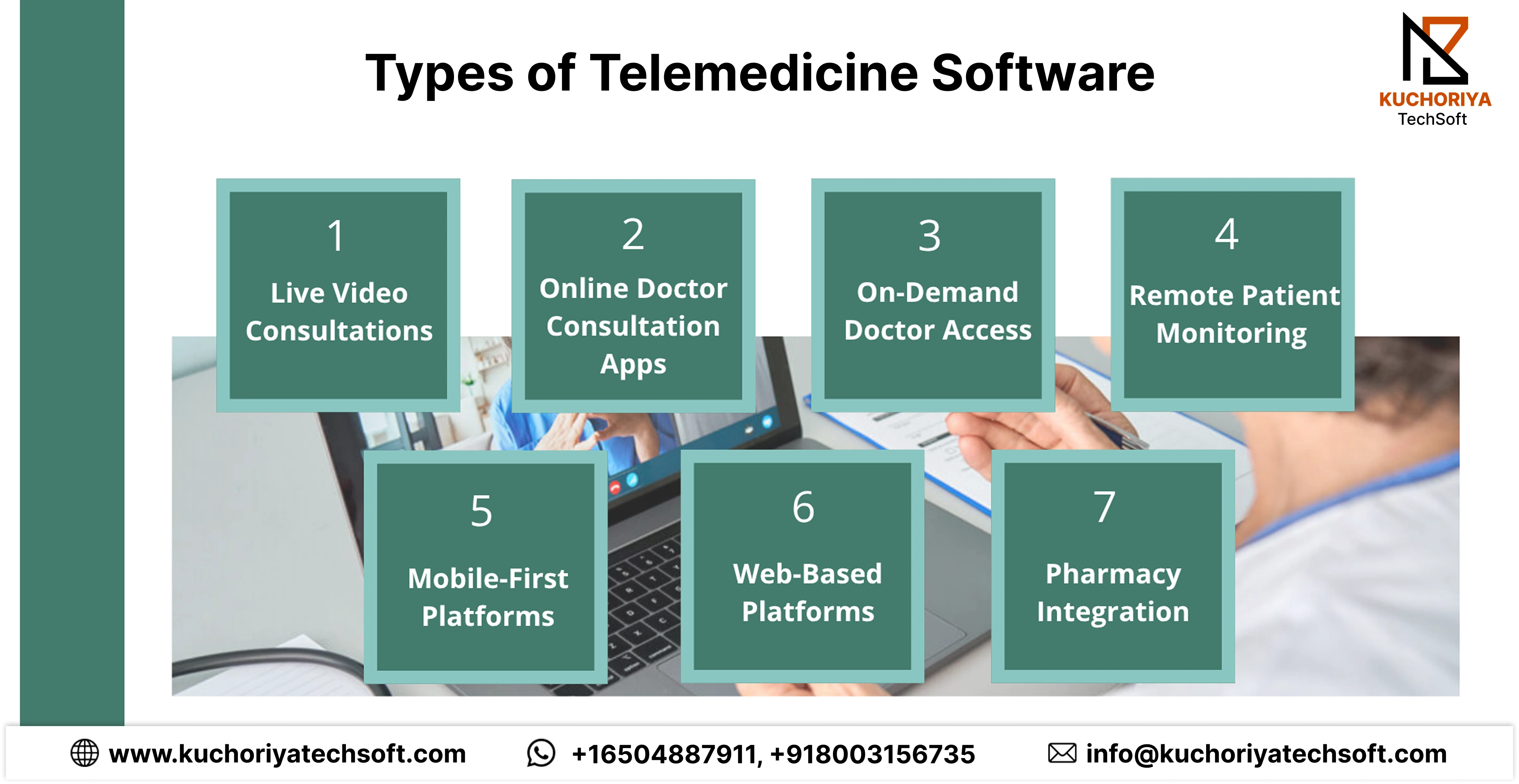
Not every telemedicine platform looks the same. What a provider builds depends entirely on what patients actually need from them.
1. Live Video Consultations
This is the backbone of most platforms, built around video consultation app development so patients and doctors can talk face to face in real time. Get the patient-doctor video call app wrong, laggy video, dropped calls, and patients won't come back for a second session.
2. Online Doctor Consultation Apps
Browse a doctor, pick a slot, get seen, that's the whole promise of an online doctor consultation app. Routine check-ups and follow-ups fit this model well, especially when no physical exam is needed.
3. On-Demand Doctor Access
Skip the calendar altogether. On-demand doctor app development puts patients in front of the next free doctor within minutes, ideal for urgent but low-risk concerns.
4. Remote Patient Monitoring
Blood pressure spikes, glucose swings, these don't wait for a scheduled visit. Remote patient monitoring software catches them early by tracking vitals between appointments.
5. Mobile-First Platforms
Patients live on their phones now, so telemedicine mobile app development isn't an add-on anymore, it's where most platforms start.
6. Web-Based Platforms
Smaller clinics don't always need a native app on day one. Telemedicine web app development gets them live faster and cheaper.
7. Pharmacy Integration
Diagnosis is only half the job. Online pharmacy app development lets patients order their prescribed medicine right from the same app, no extra trip needed.
Must-Have Features of Modern Telemedicine Software
A platform lives or dies by what each type of user actually gets from it. Here's the breakdown by panel, so nothing gets missed during healthcare mobile app development.
A few things outside this list still decide whether people stick around. Choppy secure video conferencing on a bad connection kills trust in one call, and a well-timed reminder often brings a patient back more than any new feature would.
Technology Stack Behind Telemedicine Platforms
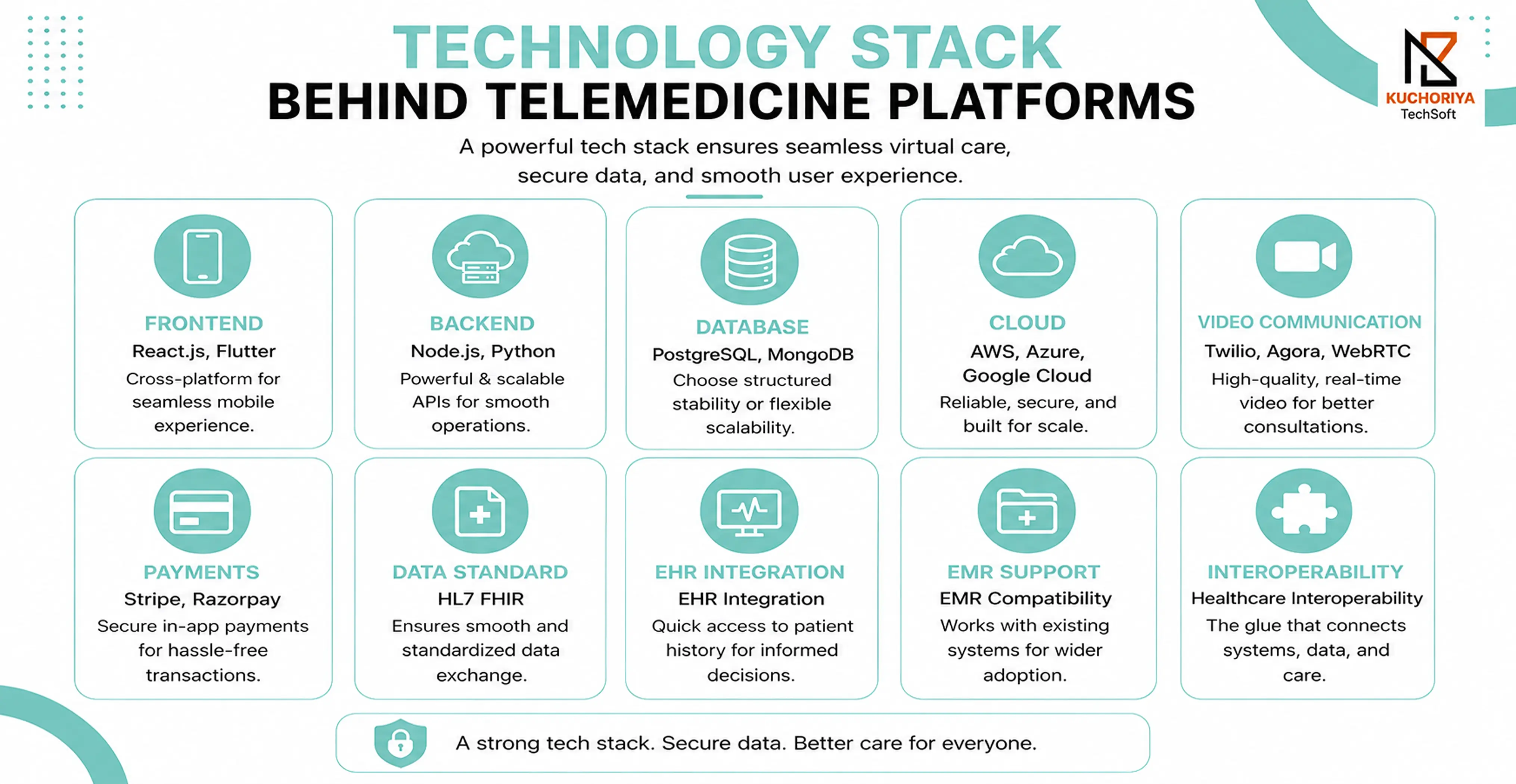
A telemedicine app development tech stack looks solid on paper until real patients start hammering it, and that's usually when the cracks show up. Here's what teams actually reach for.
- React.js and Flutter dominate frontend work right now, one codebase covering both iOS and Android cuts dev time in half.
- Backend mostly comes down to Node.js or Python, and honestly the choice between PostgreSQL and MongoDB depends on how clean or chaotic the data already is.
- AWS, Azure, and Google Cloud do the heavy lifting behind cloud-based telemedicine software, nobody's racking physical servers in a closet anymore.
- Video is where teams pick sides fast, Twilio, Agora, or raw WebRTC, depending on what the dev team's already used before.
- The in-app payment gateway for telemedicine, Stripe or Razorpay mostly, has to hold up too, or patients just leave mid-booking the moment it glitches.
- HL7 FHIR telemedicine integration handles the tricky part, getting two unrelated systems to actually understand each other's data.
- Telemedicine software integration with EHR saves a doctor from wasting five minutes hunting through old notes before every call.
- Older clinics haven't all moved on, electronic medical records (EMR) setups are still common, even while platforms pull fresher electronic health records (EHR) data for faster diagnosis.
- Strip away the buzzwords and it's one thing: healthcare interoperability is the glue holding this entire stack together.
Must Reads: AI in Healthcare Cost Guide 2026: Pricing, Development, Implementation & ROI Explained
Custom EHR & EMR Software Development Services: Complete 2026 Guide for Healthcare Providers
Telehealth Technology Trends: How Virtual Care Is Shaping Modern Healthcare

Compliance, Security & Revenue Models for Telemedicine Software
Getting the tech right means nothing if a platform can't handle patient data legally or make money sustainably. Here's how these three pieces fit together.
1. HIPAA Compliance
A HIPAA-compliant telemedicine app isn't optional in the US, it's the baseline requirement before a single patient record gets stored or shared. Skip this early, and a rebuild later gets expensive fast.
2. Data Security & Insurance Checks
Beyond HIPAA, telemedicine data security compliance covers encryption and access logs, while insurance verification in telehealth apps confirms coverage before the appointment even begins, saving both sides a headache later.
3. Prescription Handling
Good digital prescription management lets doctors send prescriptions straight to a pharmacy without paper or phone calls in between, and e-prescription software development needs to plug into pharmacy networks directly for this to actually work.
4. Subscription & Pay-Per-Visit Models
A subscription-based telemedicine app fits platforms built around recurring check-ins, like chronic care or therapy, while pay-per-visit telemedicine app development works better for occasional visits, urgent care being the clearest example.
5. Picking the Right Monetization Model
Get the telemedicine app monetization model wrong early, and it drags down almost everything after it, pricing, billing logic, even how support gets structured.
AI in Telemedicine Software Development
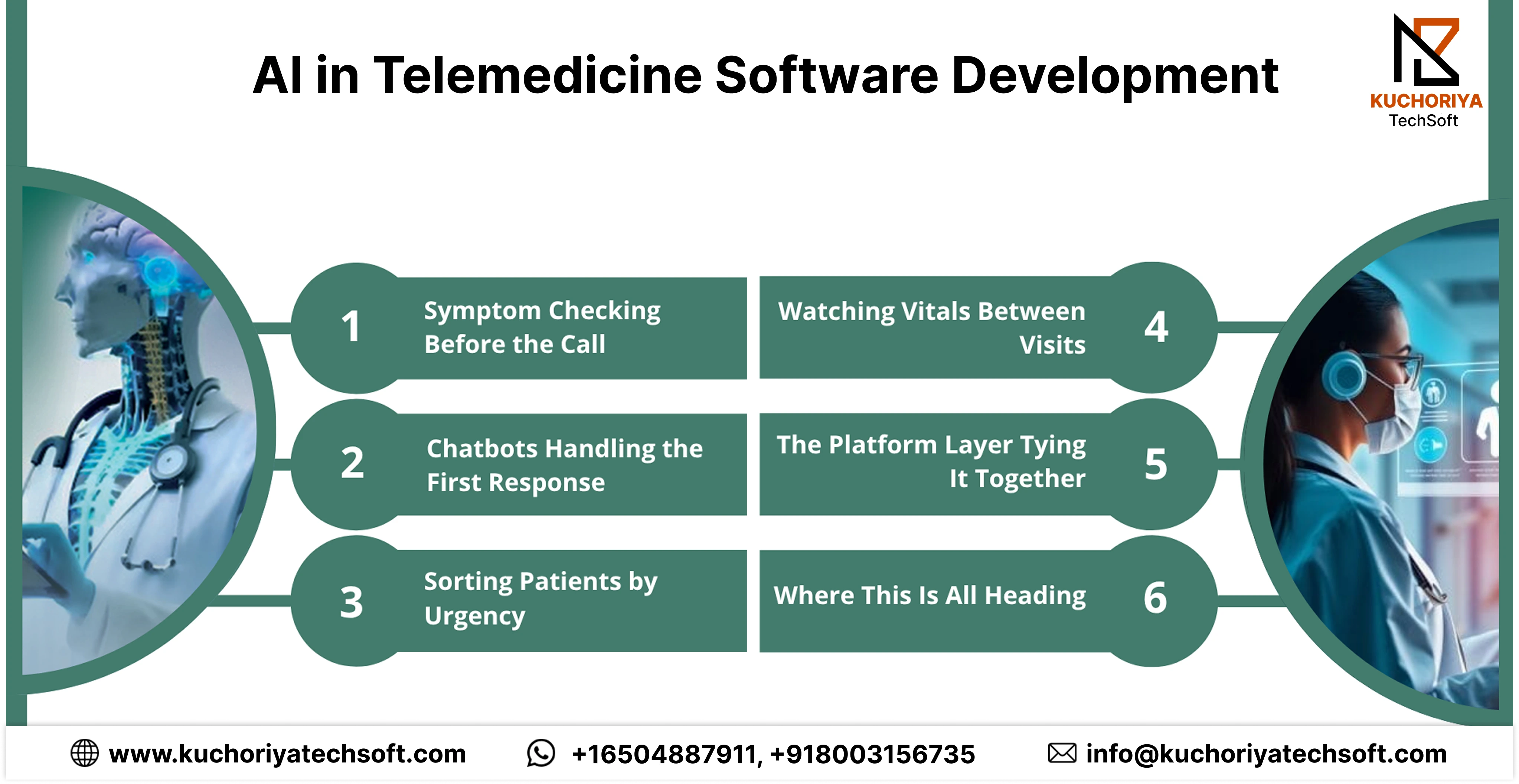
Video calls got telemedicine off the ground, but AI telemedicine software development is what's pushing platforms into something smarter. Here's where AI is actually showing up in production.
1. Symptom Checking Before the Call
Doctors used to start every call blind, asking the same opening questions over and over. An AI symptom checker for telemedicine apps handles that upfront, so by the time the video connects, there's already something to work with.
2. Chatbots Handling the First Response
Half the messages a clinic gets aren't even medical, they're "can I reschedule" or "did my prescription go through." An AI chatbot for telehealth apps takes those off a doctor's plate entirely.
3. Sorting Patients by Urgency
AI-based patient triage software flags who needs a doctor in the next ten minutes versus who can wait for tomorrow's schedule, which matters a lot when a platform is handling volume.
4. Watching Vitals Between Visits
A patient's blood pressure doesn't wait for their next appointment to spike. AI in remote patient monitoring picks up on those shifts early, sometimes days before it would've shown up in a scheduled check-up.
5. The Platform Layer Tying It Together
All of this runs on top of an AI-powered telehealth platform, which is really just a regular telehealth platform with these smarter pieces wired directly into how it operates.
6. Where This Is All Heading
Put it all together and it's AI-driven virtual care solutions, less waiting, faster triage, and doctors spending time where it actually counts instead of on repetitive questions.
Telemedicine Software Development Process
A telemedicine software development process without clear phases is exactly how projects end up dragging three extra months past deadline. Here's how it plays out step by step.
- Step 1: Discovery – Requirements, compliance planning, and mapping the telemedicine software development roadmap before anyone touches code.
- Step 2: UI/UX Design – Telemedicine app UI/UX design covering patient, doctor, and admin flows separately, since each one needs a different experience.
- Step 3: MVP Development – Most teams get telemedicine software MVP development right by building video, booking, and basic records first, then adding the rest later.
- Step 4: Third-Party Integrations – EMR software development and RCM software development modules get wired in here, handling records and billing.
- Step 5: Testing – Security checks, load testing, compliance review, all before anything touches a real patient.
- Step 6: Launch & Maintenance – The work doesn't stop at launch, monitoring and updates run continuously once people actually start using it.
Timelines shift a lot depending on who you ask. A telemedicine app development timeline for a basic build, video plus scheduling, can wrap in two to three months. Throw in EMR integration and AI triage on top, and that same build easily runs five to six months instead.
How Much Does Telemedicine Software Development Cost?
Ask five agencies about telemedicine app development cost, and the answer is always "it depends." Fair enough, but here's what that actually breaks down to by build type.
Location swings the price more than most people expect. Quote a team for telemedicine software development UK and hourly rates run noticeably higher than a team working on telemedicine app development UAE, and that gap has nothing to do with project complexity, just where the developers are based.
What Actually Drives the Price Up
More telemedicine software features doesn't mean cost climbs evenly. A basic video call is cheap to build. AI triage or deep EHR syncing costs a lot more, since it drags in compliance, security, and third-party APIs all at once.
Choosing Between an Agency or a Team
A general healthcare software development company might quote lower upfront, sure. But a healthcare app development company that's actually built telemedicine platforms before tends to skip the expensive rework that shows up later when compliance gets missed the first time.
Telemedicine Software for Different Healthcare Providers
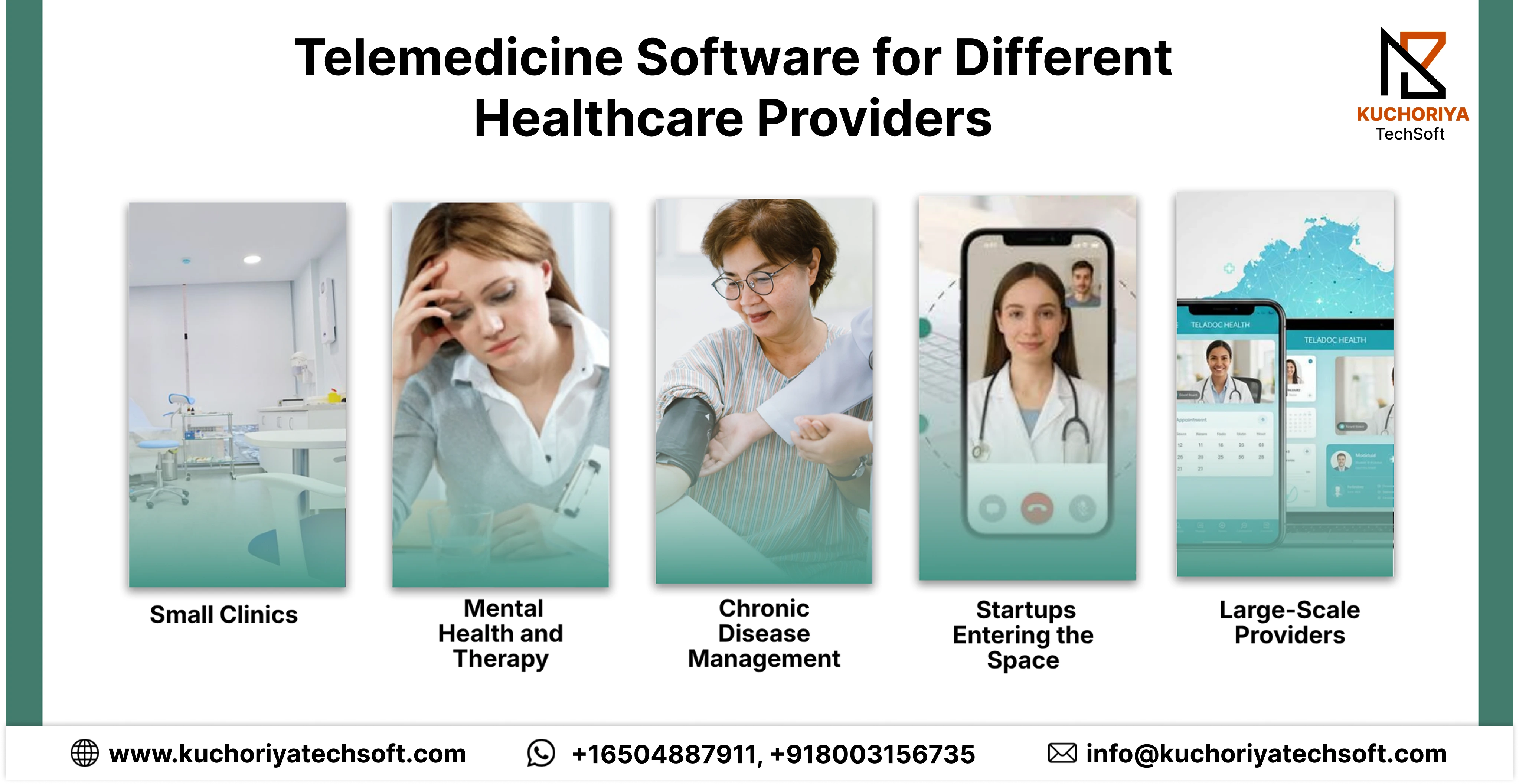
A hospital chain and a solo clinic don't need the same platform, not even close. Scope changes everything here.
1. Small Clinics
Telemedicine software for small clinics skips the heavy enterprise stuff, booking, video, basic records, that's usually it. Enough to get patients online without blowing the budget.
2. Mental Health and Therapy
Privacy and session continuity matter more here than almost anywhere else, which is why teletherapy app development and telepsychiatry software development often break off as their own build track instead of riding on general telemedicine software for mental health infrastructure.
3. Chronic Disease Management
Pair regular check-ins with remote monitoring, and a telemedicine app for chronic disease management starts catching problems between visits instead of only during them, sometimes days earlier than a scheduled appointment would.
4. Startups Entering the Space
Lean first, always. Telemedicine app development for startups typically means an MVP, and only once real usage data backs it up does a multi-specialty telemedicine platform even enter the conversation.
5. Large-Scale Providers
Multi-location support and deeper compliance aren't optional for bigger networks. Hospital groups running telemedicine platform development in Australia, for instance, need these baked in from day one, not added after the fact.
Common Challenges & Best Practices in Telemedicine Software Development
Building the platform is only half the job. Keeping it running smoothly across regions, integrations, and patient expectations is where most teams actually trip up.
- Rural and elderly patients still run into weak connectivity more often than platforms account for, which is why telehealth kiosk software development keeps showing up as a fix, one shared physical access point instead of betting on someone's home internet.
- Compliance rules don't travel well across borders. A telemedicine software development Canada build leans on a completely different framework than one aimed at the Gulf or Southeast Asia.
- Data residency expectations run tight in fast-growing digital health markets too, telemedicine software development Singapore projects usually bake this in from day one rather than patching it in later.
- Telemedicine app development Israel builds tend to lean into AI features early, not as an experiment but because the local health tech scene already moves that way.
- Syncing records across departments is still one of the messiest problems out there, and EHR software development done carelessly just creates duplicate data instead of solving anything.
- Beds, staff, billing, none of that runs on its own. Hospital management software development needs to sit alongside telemedicine from the start, not get bolted on six months after launch.
- One thing holds true almost everywhere: build compliance and interoperability in early. Retrofitting either one after launch costs way more than doing it right the first time, ask anyone who's had to redo it.
Future Trends in Telemedicine Software
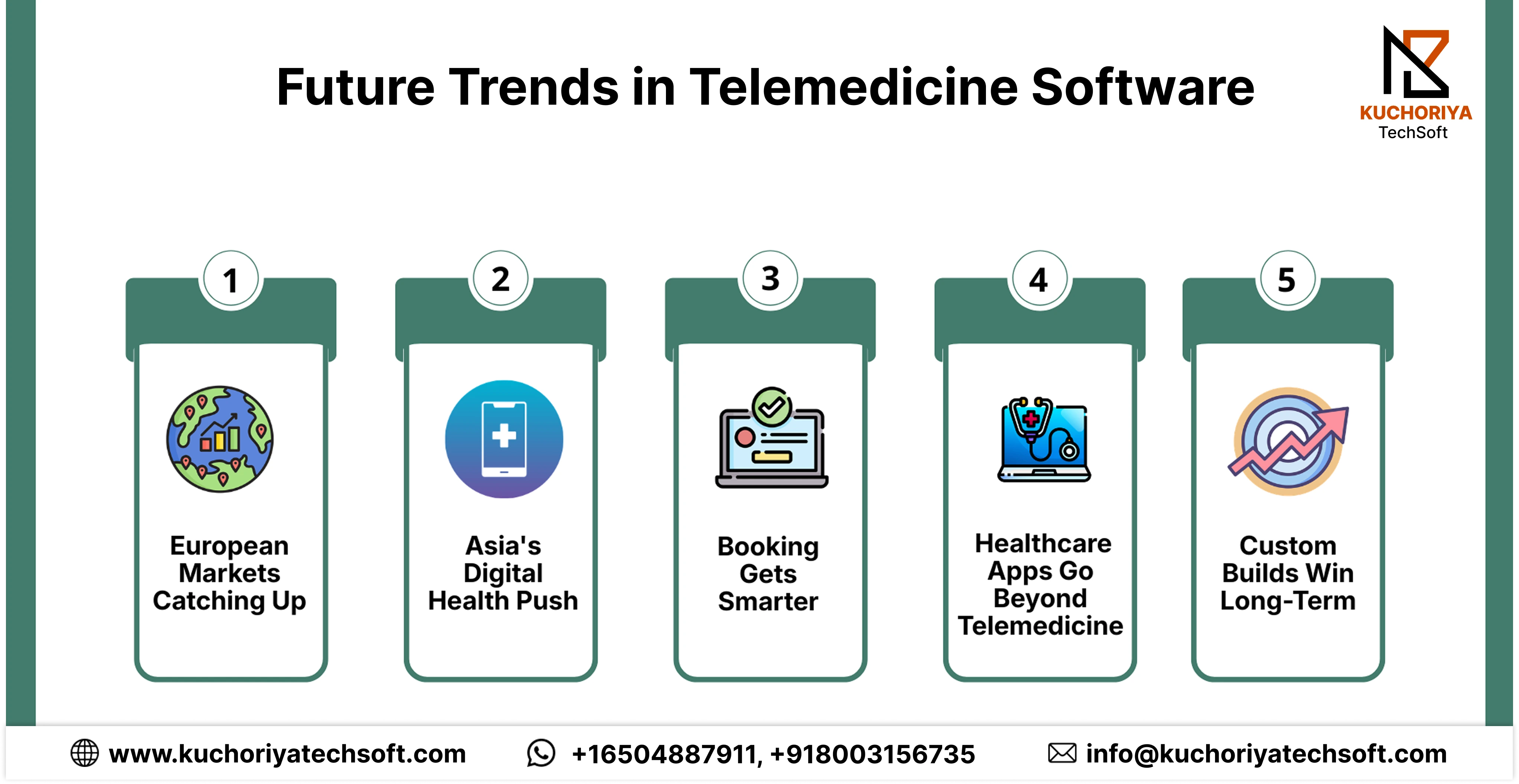
Virtual care isn't slowing down, it's spreading into markets and formats that weren't even part of the conversation a few years back.
1. European Markets Catching Up
Southern Europe is moving fast on this front. Telemedicine software development Italy projects are picking up right alongside telemedicine software development Spain, both pushed along by aging populations and public healthcare systems stretched thinner every year.
2. Asia's Digital Health Push
Telemedicine app development Hong Kong is riding the same wave as the rest of the region. Dense urban populations plus high smartphone penetration make virtual care an easy sell there, not much convincing needed.
3. Booking Gets Smarter
Static calendars are on their way out. Doctor appointment app development is moving toward predictive scheduling instead, systems that learn no-show patterns over time and adjust slot availability on their own, no manual overrides needed.
4. Healthcare Apps Go Beyond Telemedicine
Consultations were just the starting point. Healthcare application development now stretches into wellness tracking, medication adherence, insurance workflows, all folded into the same app patients already open for their virtual visits.
5. Custom Builds Win Long-Term
Generic platforms only stretch so far. Custom healthcare software development keeps winning out once a provider's needs get specific enough, off-the-shelf just doesn't flex the same way a purpose-built system does.
Why Choose a Custom Telemedicine Software Development Company?
Off-the-shelf software fits nobody perfectly, and that tradeoff only gets more expensive the longer a provider lives with it.
- Custom telemedicine software bends around real clinical workflows instead of forcing a clinic to adapt to someone else's defaults, exactly why the custom vs off-the-shelf telemedicine software debate keeps tilting toward custom once platforms start scaling.
- For providers not ready to build from scratch, white label telemedicine software offers a middle path, proven infrastructure with a provider's own branding layered on top, live in weeks instead of months.
- A solid telemedicine software development company brings telehealth platform development services that go well beyond writing code, compliance, integrations, support that doesn't disappear after launch.
- Whether it's a telemedicine app development company or a broader telehealth app development company, the ones worth hiring treat telemedicine software solutions and telehealth software solutions as products they'll keep improving, not something they hand off and forget.
- That same logic holds outside telemedicine too, custom healthcare app development and healthcare IT software development both pay off for providers willing to invest in purpose-built systems instead of settling for generic ones.
Building Your Telemedicine Platform: What Comes Next
Telemedicine isn't optional anymore, it's just how care gets delivered now.
Choosing between a best telemedicine software development company and one of the top telemedicine app development companies comes down to fit, not just a name on a website. Searching for a telemedicine software development company near me works fine locally, but distributed teams, including options in telemedicine software development Mexico, often deliver the same quality for less.
The build rarely stops at telemedicine alone. Electronic health record software development, EMR software development USA, RCM software development USA, and hospital management software development USA all tend to plug into the same ecosystem sooner or later.
Ongoing strategy matters too. Teams without in-house leadership often lean on virtual CTO services to keep architecture sharp as the platform grows.
Ready to Build Your Telemedicine Platform? Our team handles everything from MVP to enterprise-grade compliance, and our referral partner program rewards every introduction that turns into a project. Reach out anytime on WhatsApp to get started.
Frequently Asked Questions: Telemedicine Software Development
Q. What does a telemedicine app actually cost?
A. Depends on scope, mostly. A basic MVP with video and booking starts around $25,000, while a full enterprise build with AI triage and compliance layers can cross $200,000. Location moves the number almost as much as features do.
Q. What HIPAA requirements does a telemedicine platform need to meet?
A. Encrypted storage, secure video, detailed access logs, that's the baseline. Anything touching patient data has to clear these before a single consultation goes live, not patched in afterward.
Q. How much does AI actually do in telemedicine software?
A. Mostly triage and pre-screening for now. It flags urgent cases faster, sorts routine messages before a doctor even opens them, and picks up on vital sign shifts between visits that would've otherwise gone unnoticed until the next appointment.
Q. Where does EHR fit into a telemedicine build?
A. Records need to sync in real time, or doctors end up working blind on every call. This is usually where a dedicated RCM software development company or an EMR/EHR software development company gets brought in, since general dev teams often underestimate how tangled healthcare data integrations get.
Q. Can existing hospital systems be upgraded instead of rebuilt?
A. Often, yes. Custom EMR software development and custom hospital management software both let a provider keep what already works while fixing the parts that don't, rather than starting from zero.
Q. What other software usually gets built alongside telemedicine?
A. Billing and operations rarely stay separate for long. A hospital management software development company typically handles hospital management system development alongside revenue cycle management software development, and medical billing software development tends to follow close behind once patient volume picks up.