






Why Choosing the Right Telehealth Software Development Company Matters
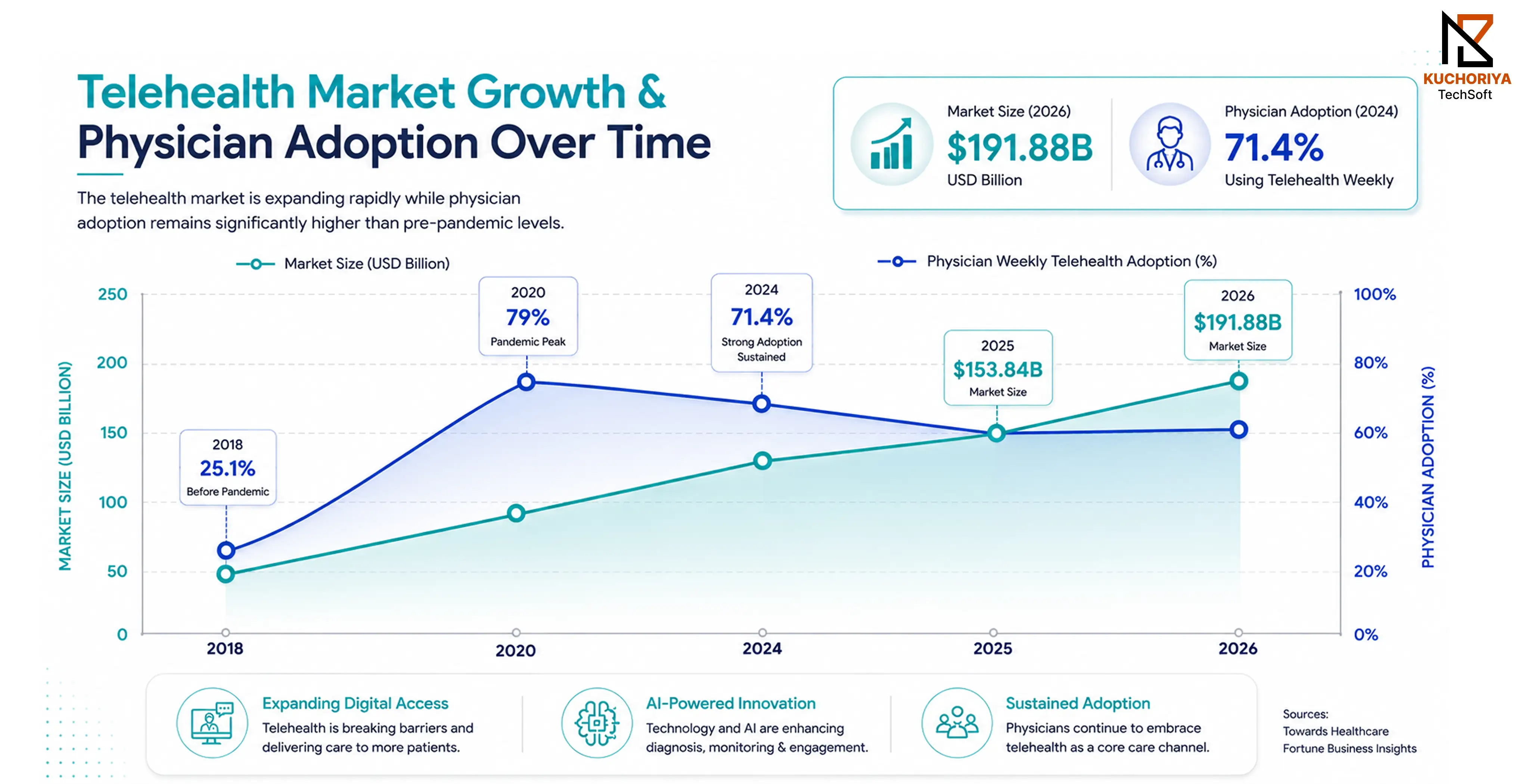
Trying to shortlist a top telehealth software development company and not sure who's actually good versus who just looks good online? You're not alone. With 71.4% of physicians now using telehealth weekly, more businesses are entering this space, and more are picking partners without checking who can actually deliver.
This list skips the recycled rankings and looks at real healthcare technology companies building platforms that hold up under actual patient load. It also covers where AI in healthcare genuinely fits in, not just where it's mentioned for marketing.
If you're comparing telehealth solution providers who can scale with you, tracking real digital health transformation, or specifically searching for top telehealth software development companies USA has to offer, this is where to start.
How We Evaluated the Top Telehealth Software Development Companies
Not every ranking online is built the same way. Here's exactly what we looked at before calling anyone one of the best telehealth software development companies.
- Real project history across multiple healthcare software development companies, not just a handful of case studies on repeat.
- Genuine technical depth behind their AI healthcare platform claims, checked against actual delivered work.
- Track record building for both startups and enterprise clients among leading healthcare SaaS companies.
- Proof of flexibility as custom healthcare software companies, not teams stuck reselling the same template.
- Client reviews and delivery consistency, cross-checked across platforms like Clutch and GoodFirms.
- Regional presence and compliance know-how, including companies ranked among the best telehealth software development companies UK has to offer.
Top 10 Telehealth Software Development Companies in 2026
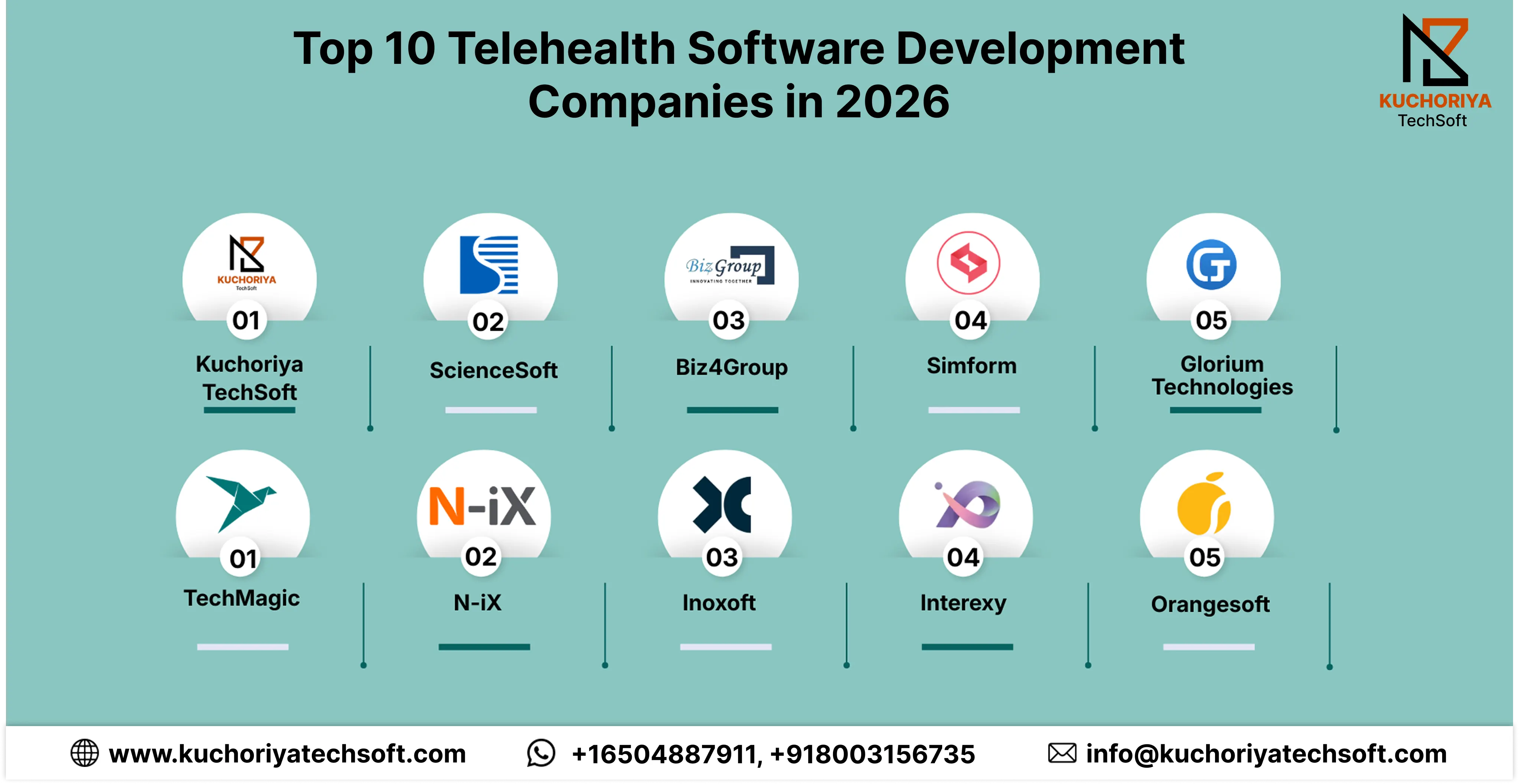
There's no shortage of telehealth software companies claiming to be the right fit for your project. Here are the ten actually worth your shortlist in 2026.
1. Kuchoriya TechSoft
Kuchoriya TechSoft has spent over 15 years building telehealth software development company-grade solutions across telemedicine, EMR/EHR, and hospital management, including on-demand doctor apps built for real clinical loads, not just demos.
Clients pick Kuchoriya for its delivery reach across the USA, UAE, Canada, Australia, and Singapore, backed by real AI healthcare software company-level integration and a Virtual CTO offering for startups needing strategic guidance alongside development.
2. ScienceSoft
Almost four decades in isn't something you fake. ScienceSoft has 150+ telehealth projects behind them, and actual MD consultants sit on their delivery teams, a detail that sets a real telehealth app development company apart from firms that just hire generalists and call it healthcare work.
3. Biz4Group
Biz4Group runs a smaller, more focused team compared to the giants on this list. Their healthcare work leans into AI-assisted patient apps and telemedicine MVPs for startups that need to move fast without enterprise-level pricing, making them a solid pick among practical virtual care software companies for early-stage builds.
4. Simform
Simform's reputation on Clutch didn't happen by luck. Their cloud-native builds, EMR software, medical IoT wiring, and full HL7/FHIR/DICOM connectivity, are why they're consistently named among strong digital health software companies.
5. Glorium Technologies
Glorium holds the number one spot on Clutch's Healthcare Custom Software list, with 80+ industry awards behind them. Their range spans digital health apps, AI diagnostics, and full builds for telemedicine software companies, including a platform serving the transgender and nonbinary community.
6. TechMagic
TechMagic has focused on telemedicine app development since 2014, and Clutch has called them out as a leading health tech developer more than once. HIPAA safeguards, encryption, and audit logs go in from the first sprint, not after launch.
7. N-iX
N-iX has over two decades behind them and a team north of 3,000 engineers, delivering digital healthcare solutions for hospital networks that need real scale. Their edge is legacy systems, they're often the team called in to fix a telehealth platform someone else built years ago.
8. Inoxoft
230+ projects in a decade says a lot. Inoxoft's specialty is remote patient monitoring software built to actually pass a compliance audit, with HIPAA, GDPR, FDA, and ISO 27001 baked into their standard process.
9. Interexy
A perfect 5.0 rating from 120+ reviews doesn't happen by luck. Interexy's virtual healthcare platform development work, especially for chronic disease management and mental health, leans on AI-assisted diagnostics and e-prescriptions.
10. Orangesoft
Fourteen-plus years in, Orangesoft treats compliance as routine, not an add-on. HIPAA, GDPR, FDA, and SOC 2 are standard practice, and their name among AI healthcare software companies comes down to hitting deadlines without skipping the paperwork.
Across this list, the strongest players share real investment in AI-powered healthcare solutions and generative AI in healthcare, not just surface-level automation. A few, like Kuchoriya, also extend into fitness app development companies' work and wellness app development company projects, useful if your roadmap grows beyond pure telemedicine.
Related Reads: How to Choose a Telemedicine Software Development Company Before You Hire
Telemedicine Software Development: The Ultimate Guide for Modern Healthcare Businesses
Comparison of the Top 10 Telehealth Software Development Companies
Reading all ten profiles takes time, so here's the fast version. This quick comparison of leading healthcare software vendors helps you shortlist without scrolling back and forth.
The split among these digital health companies usually comes down to budget versus scale. Smaller virtual healthcare companies like Biz4Group make sense for lean MVPs, while established medical software companies such as N-iX or ScienceSoft fit projects needing serious enterprise healthcare software from day one. Founders searching for the best digital health software companies Australia has to offer will find most names here already serve international clients regardless of where they're headquartered.
Key Features Every Telehealth Software Development Company Should Offer
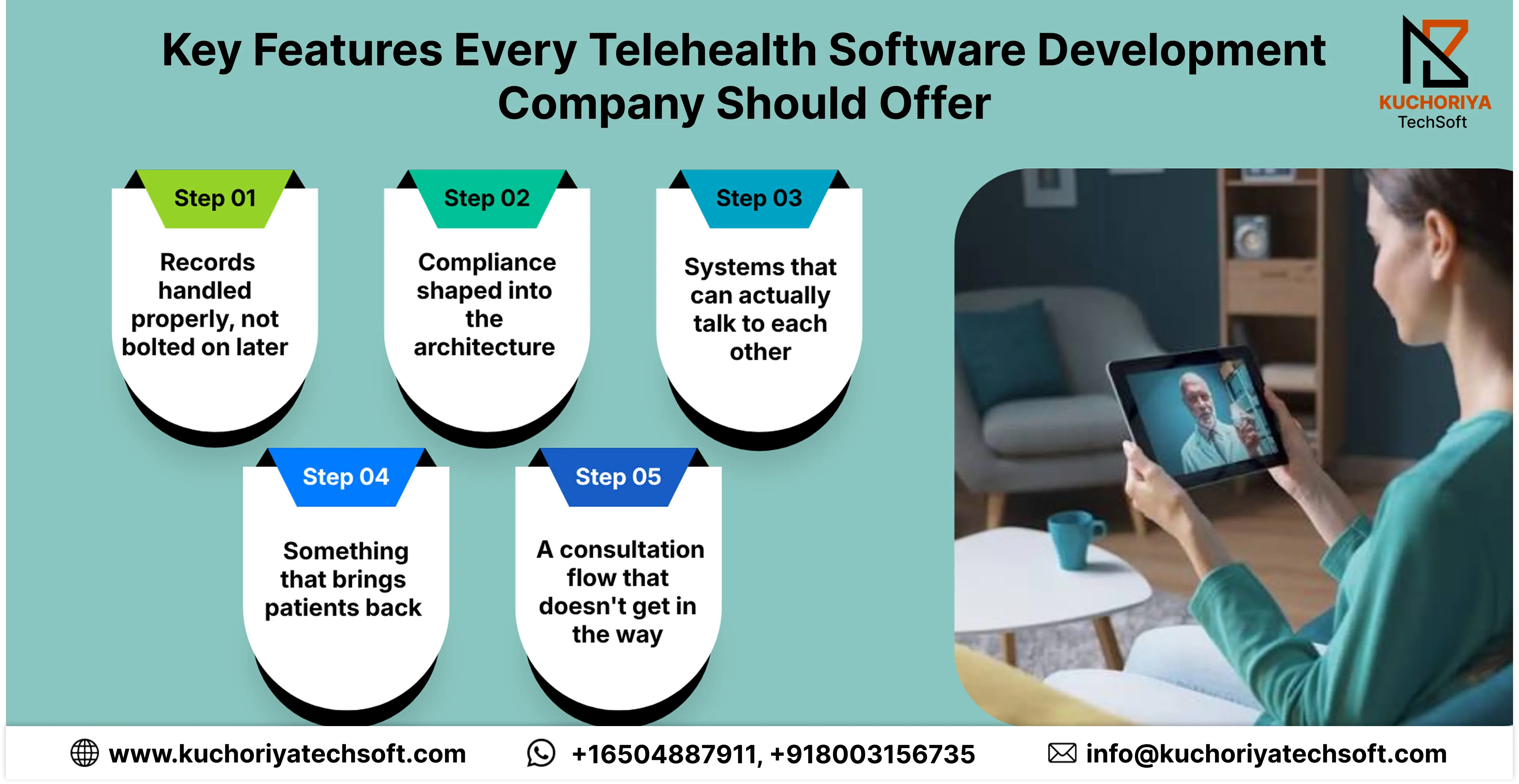
Not every platform needs the same features, but a few aren't optional no matter what you're building. Here's what actually matters.
1. Records handled properly, not bolted on later
Ask how they treat Electronic Health Records (EHR) and Electronic Medical Records (EMR) in a new build. If the answer sounds like an afterthought, that's usually because it was one.
2. Compliance shaped into the architecture
HIPAA compliance has to sit inside the foundation from the first sprint. A team that only mentions it near launch probably scrambled to add it late.
3. Systems that can actually talk to each other
Real HL7 and FHIR integration matters because a platform that can't connect with hospital systems just creates more manual work down the line.
4. Something that brings patients back
A working patient engagement platform counts for as much as the video call itself. Reminders, easy follow-ups, and quick access keep people actually using it.
5. A consultation flow that doesn't get in the way
Online doctor consultation should feel effortless on both sides, with fast booking, clear scheduling, and calls that don't lag or drop halfway through.
Industries That Benefit from Telehealth Software Development
Telehealth isn't just for hospitals anymore. A wider range of businesses are building on this technology than most people expect.
- Health tech companies launching new patient-facing products from the ground up.
- Established healthcare IT companies, adding telehealth capabilities to existing systems.
- Remote patient monitoring companies tracking vitals and chronic conditions outside the clinic.
- Health and fitness app developers blending virtual coaching with medical guidance.
- Healthcare wellness platforms expanding into consultations alongside their existing tools.
- Businesses building broader connected healthcare solutions that tie devices, records, and care together.
AI and Emerging Technologies Transforming Telehealth Software in 2026
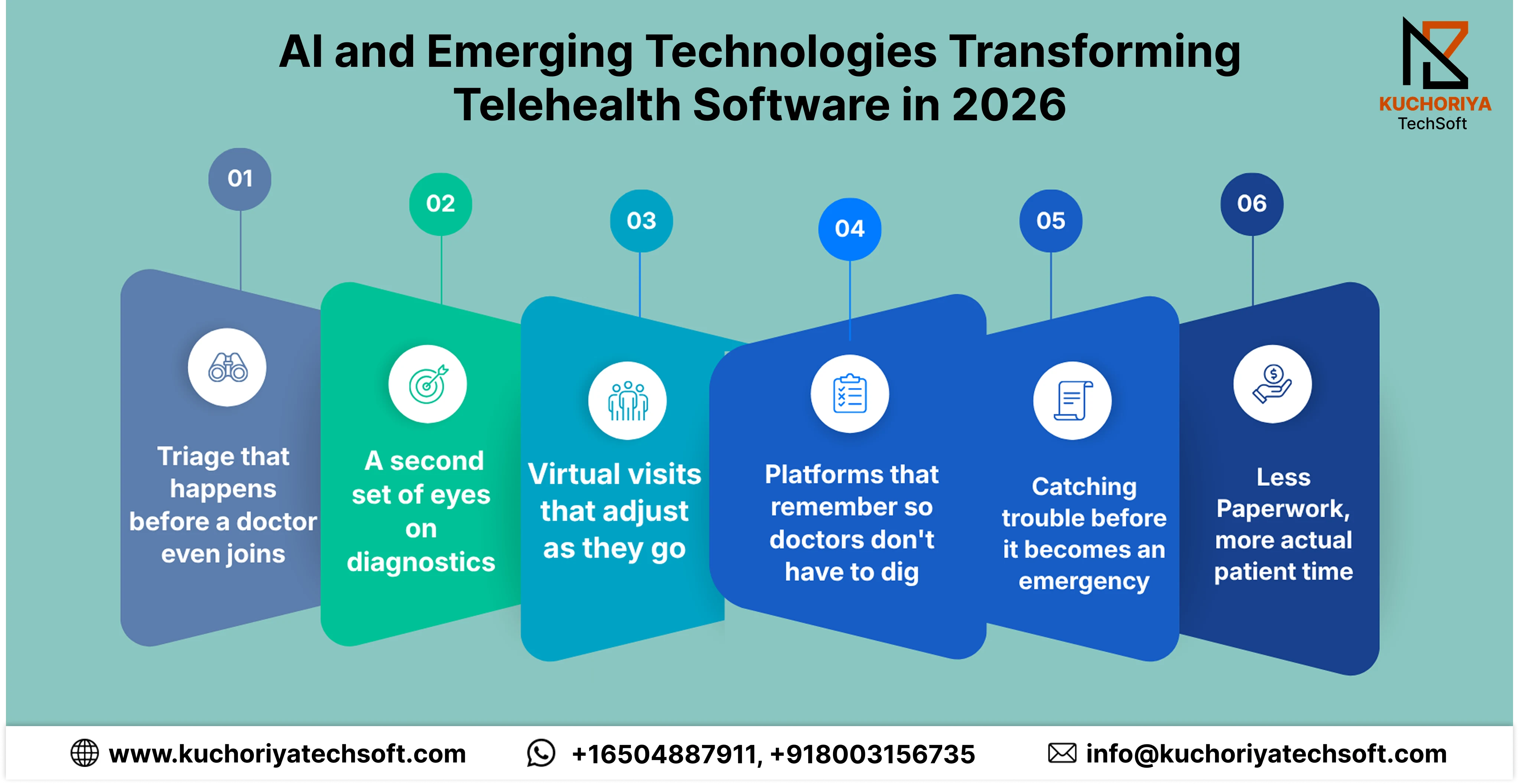
AI in healthcare stopped being a buzzword a while back; it's actually running inside real clinical workflows now. Here's where it's making the biggest difference in 2026.
1. Triage that happens before a doctor even joins
AI in telehealth now handles first-pass symptom checks, catching urgent cases and routing them faster than a person manually sorting through intake forms ever could.
2. A second set of eyes on diagnostics
Healthcare AI solutions now help flag things in scans and lab results that get missed after a long shift of back-to-back appointments.
3. Virtual visits that adjust as they go
AI-powered virtual care is starting to shift the consultation flow based on what a patient describes, steering both sides toward the right follow-up questions.
4. Platforms that remember so doctors don't have to dig
Intelligent healthcare platforms pull up a patient's history the moment the call starts, so nobody's scrolling through old notes while the patient waits.
5. Catching trouble before it becomes an emergency
Predictive healthcare analytics looks at patterns in vitals and past visits to flag risk early, before it turns into a crisis visit.
6. Less Paperwork, more actual patient time
Healthcare automation is quietly cutting down repetitive scheduling and documentation work, freeing up time clinicians used to lose to admin tasks.
Telehealth Software Development Cost in 2026
Cost swings a lot depending on scope, but here's a realistic picture for building on a cloud healthcare platform this year.
Going with established healthcare SaaS development companies almost always costs more upfront, but you're paying for fewer surprises down the road. Building smart healthcare solutions that actually use AI properly add to the budget too, though it usually pays off once the platform needs to scale.
Where you hire matters as well. Rates shift depending on whether you go with leading digital health companies Israel offers, or look toward top healthcare technology companies Hong Kong has for offshore work. Real healthcare innovation rarely comes cheap, but that doesn't mean you have to overpay for it either.
Read Also: Top 10 AI Development Companies in the USA for HIPAA-Compliant Healthcare Solutions
Telehealth Technology Trends: How Virtual Care Is Shaping Modern Healthcare
How to Choose the Best Telehealth Software Development Company for Your Business
Ten strong options is a good problem to have, but it still leaves you picking one. Here's what actually helps narrow it down.
- Match their experience to your actual need, whether that's virtual care solutions for a startup or a larger enterprise build.
- Confirm they understand healthcare interoperability, not just app development in general.
- Compare regional pricing if you're exploring best telehealth software development companies Italy has to offer versus hiring locally.
- Check delivery track record, especially if you're also considering top healthcare software companies in Mexico for offshore development.
- Talk to a past client if you can, not just read the testimonials on their site.
- Get support terms in writing before you sign anything, not as a follow-up question later.
Why Choose Kuchoriya TechSoft for Telehealth Software Development
After going through this whole list, here's the honest case for why we belong on it too.
1. Built around your workflow, not a template
Every custom telehealth software project starts with understanding how your clinic or platform actually operates, not forcing you into a pre-made structure.
2. Full-cycle delivery, not just development
Our healthcare app development services cover everything from architecture planning to post-launch support, so you're not left managing loose ends after launch.
3. Proven delivery across major markets
We've built for clients researching top healthcare software development companies Canada has to offer, with the same compliance rigor applied to every regional build.
4. AI that's actually integrated, not bolted on
Businesses evaluating top AI healthcare software companies UAE consistently find our approach different, AI gets built into the architecture from day one, not added as an afterthought later.
Conclusion: Finding the Right Telehealth Software Development Partner
Ten companies, ten different strengths, and the right choice really depends on what your project actually needs. Whether you're comparing top healthcare software companies Singapore offers or evaluating names closer to home, the decision should come down to real delivery experience, not just a polished sales page.
If your platform is part of a bigger push toward digital health transformation, the partner you pick now shapes how smoothly that transformation actually goes.
Still deciding? Feel free to reach out to Kuchoriya TechSoft; we're glad to talk through what your project actually needs, nothing scripted about it. Book a free consultation, ask about the referral partner program if healthcare clients are a regular part of your work, or look into fractional CTO services when the guidance matters just as much as the build.
Frequently Asked Questions
Q. What is a telehealth software development company?
A. Basically, it's the team that builds your virtual care platform, video calls, records, scheduling, all of it. A proper telehealth software development company treats healthcare compliance as part of the job, not a separate concern.
Q. How much does telehealth software development cost?
A. Depends heavily on what you're building. Simple video consultation apps run around $40,000, while a platform packed with AI and deep integrations can go well past $250,000.
Q. Which features should a telehealth platform include?
A. At minimum, secure video, EHR access, and scheduling. Most platforms now also lean on AI in healthcare for things like symptom triage, it's less of a nice-to-have these days.
Q. How long does it take to build telehealth software?
A. A lean MVP can be ready in 3 to 4 months. Bigger builds with lots of moving parts tend to stretch closer to a year, sometimes longer if integrations get complicated.
Q. Is telehealth software required to be HIPAA compliant?
A. For anything handling US patient data, yes. HIPAA compliance needs to be designed in from the start, adding it later almost always means rework.
Q. What technologies are used in telehealth software development?
A. WebRTC usually handles the video layer, cloud platforms take care of scale, and HL7 and FHIR integration is what actually lets the system talk to hospital records and EHR software.