





_1789744594209.webp&w=3840&q=75)
How to Develop a Fantasy Sports App?
Fantasy sports app development sounds simple until you actually try it. Then the real questions hit, which data provider do you trust, how do you keep scores accurate to the second, why does every cost estimate look different?
The market explains why people keep chasing this anyway. It sat at $27.8 billion in 2025, climbing to $31.4 billion this year, with projections putting it at $75.1 billion by 2033. North America leads with a 38.2% share, but Asia Pacific is growing fastest at 17.3%. (source)
So how to develop a fantasy sports app without guessing your way through it? Start by accepting it's not one build, it's several systems working together. A fantasy sports platform needs a scoring engine that never lags, live data feeding in from outside providers, and a payment layer built for real traffic, not demo traffic.
Enough teams have shipped these now that most of the hard lessons are already known. Good sports technology planning just means learning from what broke for someone else instead of repeating it yourself.
This guide walks through the full thing honestly, planning, tech stack, build stages, testing, security, cost, timeline, and choosing a team that sticks around after launch. Think of it as the fantasy sports app development guide a friend would hand you, not a sales pitch dressed up as one.
One quick note, a fantasy sports app development company USA partner usually means tighter timezone overlap for US founders, though that's not the full picture. Region-by-region tradeoffs come later in this guide.
_(1)_1789744594042.webp)
What Should You Plan Before Developing a Fantasy Sports App?
Most people skip straight to picking a tech stack. Bad move. The planning stage is where half of the expensive mistakes get avoided before they ever cost you anything.
- Whether you're chasing a DraftKings clone app development route or building something original, the first question is still the same, what problem does your platform solve that existing apps don't?
- How to start a fantasy sports app really begins with picking one sport and one contest format, not trying to cover everything on day one.
- Solid fantasy sports app planning means locking your monetization model early, entry fees, subscriptions, or ads, before a single line of code gets written.
- Skip fantasy sports app market research and you're basically guessing what users want instead of building toward something they've already told you they need.
- Deciding whether you're building a season-long fantasy gaming platform or a fast-paced daily format changes almost every downstream decision, so get this settled first.
- If you're weighing where to build, fantasy sports app developers' UK teams often bring strong compliance experience, useful if football's your primary sport.
How to Choose the Right Technology Stack for Fantasy Sports App?
Pick tech because it's trendy and you'll be rebuilding the whole thing in eighteen months, guaranteed. Here's what actually holds up when it comes to the fantasy sports app technology stack, broken down layer by layer.
Tie all five layers together and you get fantasy sports app architecture that doesn't collapse when one piece breaks. Microservices keep scoring, payments, and accounts running as separate pieces, so a single failure stays a single failure instead of taking everything down with it.
Honestly, the best technology for fantasy sports app development was never about picking whatever's trending on Twitter. It's about picking what survives the exact second a big match starts and traffic triples out of nowhere.
Worth glancing at FanDuel clone app development work too, not to copy anything, just to see how a platform running at that scale keeps every layer standing under real pressure. And most of what applies to sports app development generally still holds here, a slow-loading app loses users just as fast as a broken feature does.
Fantasy Sports App Development Process (Step-by-Step)
_1789744594420.webp)
Building a fantasy sports app goes beyond adding features. A structured fantasy sports app development process keeps the build scalable and launch-ready, and answers how does fantasy sports app development work from the ground up.
1. Requirement Analysis
Locks the audience, app model (DFS, season-long, multi-sport), monetization, and compliance needs before any coding starts.
2. UI/UX Design
Fantasy sports app UI/UX design keeps onboarding, team creation, and live rankings simple despite complex backend logic.
3. MVP Development
A fantasy sports app prototype tests core features first, registration, team tools, contests, wallet, live scores, laying out how to build a fantasy sports app without overspending early.
4. API Integration
Sports data feeds, payment gateways, push alerts, and KYC tools plug in here, which is really where how to create a fantasy sports app stops being theoretical.
5. Testing & Security Validation
Load tests, payment security checks, and vulnerability scans run continuously, one of the fantasy sports app development steps that never really finishes even post-launch.
6. Deployment
Store release, cloud setup, and load balancing happen together, often coordinated with hire fantasy sports developers in Canada teams for the QA overlap during launch week.
7. Scaling & Continuous Improvement
Once live, focus shifts to match-day performance, user-requested features, and analytics-driven personalization, closing out the fantasy sports app development process step by step.
How to Integrate Sports APIs and Real-Time Data?
Live scores and player stats are what keep a fantasy app trustworthy, and even a few seconds of lag can break user confidence during a match.
- A reliable sports data platform feeds accurate scores, player stats, and injury updates without delays or mismatched numbers
- Sports API integration usually runs on webhooks instead of polling, pushing updates the moment they happen on the field
- AI sports analytics integration turns raw stats into trends and matchup insights in real time
- AI-powered player recommendations nudge users toward smarter picks without needing to study numbers themselves
- Studying a Yahoo Fantasy Sports app clone shows how multi-sport data gets managed at scale
- A fantasy sports development agency in Australia team often balances cricket and AFL feeds inside the same platform
Get this layer right and scoring, leaderboards, and alerts just run on their own without anyone noticing the work behind them.
How to Test and Secure a Fantasy Sports App?
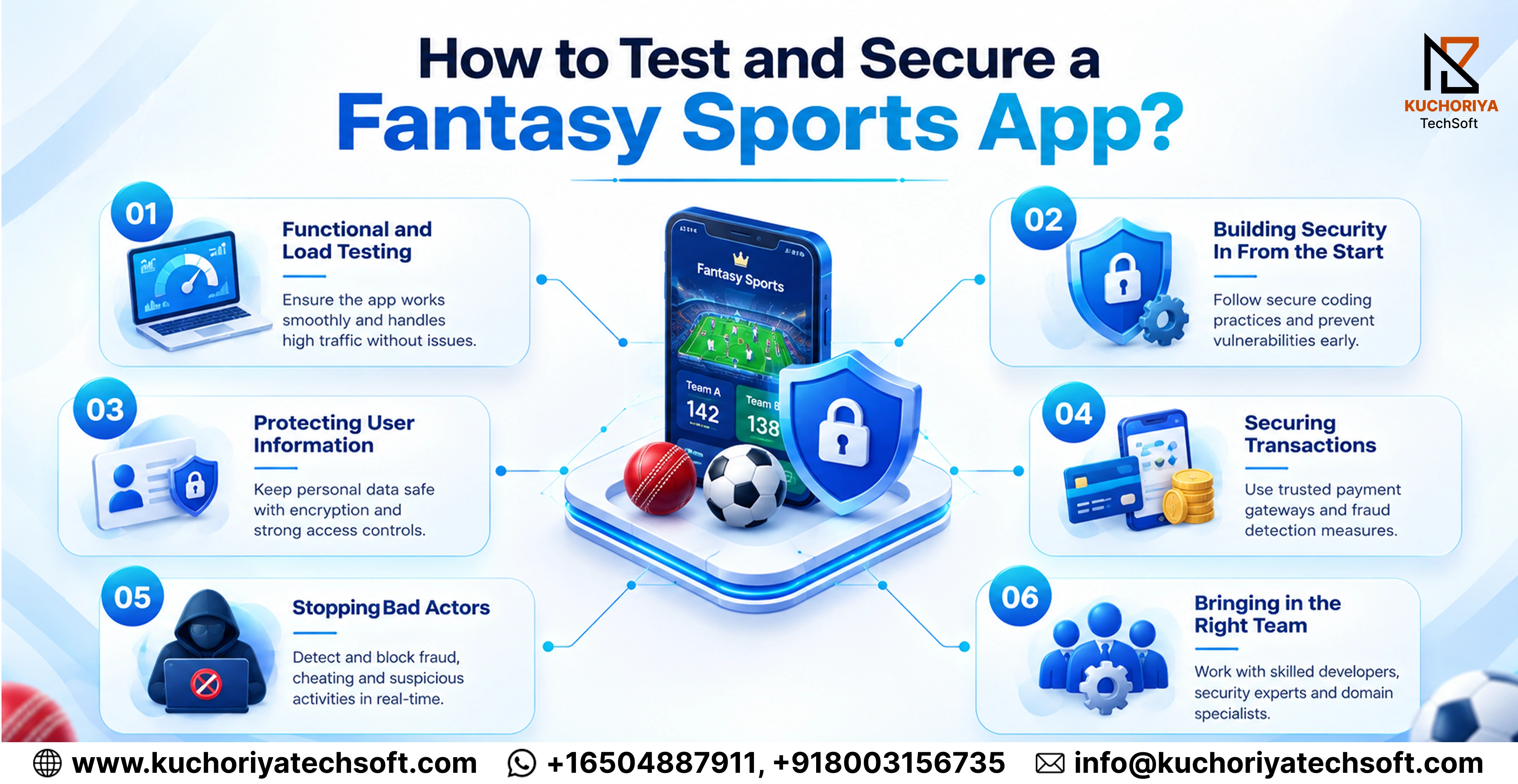
Real money and real user data mean fantasy sports app security can't be an afterthought bolted on right before launch.
1. Functional and Load Testing
Fantasy sports app testing covers everything from team creation flows to handling thousands of users joining a contest the second a match kicks off.
2. Building Security In From the Start
Encryption and access controls need to go in during the build, not after. Secure fantasy sports app development treats regular audits as part of the process itself, catching gaps long before users ever see them.
3. Protecting User Information
KYC documents, personal details, account activity, all of it needs to stay locked down. Fantasy sports data security is what stands between a routine breach attempt and an actual data leak.
4. Securing Transactions
Wallet top-ups, withdrawals, entry fees, none of it should move outside encrypted, PCI-compliant channels. That's the whole point of secure payment integration, keeping money movement airtight even under heavy traffic.
5. Stopping Bad Actors
Fraud prevention in fantasy sports platforms relies on pattern detection to catch multi-accounting, collusion, and payment fraud early.
6. Bringing in the Right Team
A fantasy sports app development team in India often handles this entire security layer, since it overlaps heavily with backend and QA work already in progress.
Skip any one of these checks, and it's the platform's credibility that takes the hit, not just one feature.
Must Read: Fantasy Sports App Features: Latest Trends, Technologies & User Experience
Fantasy Sports App Development: Complete Guide to Building a Fantasy Sports App
Top Fantasy Sports App Development Company
Monetization Models & Legal Compliance for Fantasy Sports Apps
Revenue strategy and legal groundwork usually get planned together, since how you monetize often decides what regulations you're subject to.
Most platforms don't rely on just one of these fantasy sports app monetization models, they stack two or three together. Understanding how do fantasy sports apps make money usually comes down to that mix, and a fantasy sports revenue model locked in early shapes contest structure, wallet design, and even MVP priorities.
How Much Does a Fantasy Sports App Cost in 2026?
_1789744594282.webp)
Ask five agencies this and you'll walk away with five different numbers. Nobody's lying to you, they're just quoting different builds. Fantasy sports app development cost in 2026 runs anywhere from $15,000 to $280,000+, and API fees plus compliance work have pushed fantasy sports app development cost 2026 noticeably higher than what it cost a couple years back.
1. MVP Build ($15,000 – $45,000)
Login, team creation, a couple of basic contest formats, live scores wired in just enough to prove the idea works. Fantasy sports MVP development cost sits at the bottom of the range because you're deliberately leaving half the feature list out for now.
2. Mid-Level Build ($45,000 – $130,000)
Scoring gets tighter, wallets and payments go live, and referral loops start doing their job of pulling people back. Most founders see their first real traction happen somewhere in this tier.
3. Enterprise Build ($130,000 – $280,000+)
Multi-sport support, AI recommendations, fraud detection, the full compliance checklist, it's all in here. A custom fantasy sports app cost this high is paying for infrastructure that holds up under real match-day traffic, not just extra buttons on screen.
Benchmarking Against Known Platforms
Yahoo Fantasy Sports app clone cost, ESPN Fantasy app clone cost, and the SuperDraft clone app cost all sit at different points on this range too, since each handles different sports, contest formats, and payment complexity under the hood.
What Actually Moves the Price
- Feature depth, AI tools, multi-sport coverage, referral systems
- How much real-time data flows through and how fast it needs to update
- Building for iOS, Android, web, or all three at once
- Which outside tools you're plugging in, payments, sports data, KYC
These are the real factors affecting fantasy sports app development cost, and they're exactly why a DraftKings clone app cost rarely lines up with a smaller custom build quote. If you're still asking how much does it cost to develop a fantasy sports app, the tier breakdown above answers that better than a single number ever could, which is basically the whole point behind cost to develop a fantasy sports app and fantasy sports app development pricing.
How Long Does Fantasy Sports App Development Take?
Rushing a launch date rarely ends well here, real-time scoring and payment systems both need proper time to get tested right.
- Fantasy sports app development timeline usually runs 4 to 9 months depending on which tier you're building, MVP, mid-level, or enterprise.
- Fantasy sports MVP development timeline sits at the shorter end, roughly 6 to 10 weeks, since it's only covering core features.
- Asking how long does it take to develop a fantasy sports app really means asking which build tier first, an enterprise platform with AI recommendations takes far longer than a lean MVP.
- Time required to build a fantasy sports app stretches out mainly during testing and security validation, not the initial design phase.
- An ESPN Fantasy app clone timeline works as a decent benchmark for how long multi-sport, high-traffic platforms typically take to stabilize post-launch.
- A fantasy sports technology partner UAE team often builds in extra time for regional payment compliance, shifting the timeline by a few weeks.
How to Launch and Maintain a Fantasy Sports App?
_1789744594138.webp)
Launch day is really just the starting line. Most of the actual work happens in the months after, not before.
1. Going Live the Right Way
Store approvals take longer than people expect, and server load checks matter more than the launch date itself. A rushed fantasy sports platform launch without a rollback plan is how a good app gets a bad first week.
2. AI Doesn't Clock Out After Launch
AI in fantasy sports app development keeps earning its place well past day one. More users means more data, and more data is what actually makes the recommendations worth trusting.
3. The Platform Gets Smarter With Use
Give it a few weeks of real traffic and an AI-powered fantasy sports platform starts catching things it couldn't before, sharper player suggestions, faster fraud flags, fewer false positives.
4. Less Manual Work, More Consistency
Score updates, payouts, fraud checks, nobody wants a person doing these by hand at 2am during a live match. Automation in fantasy sports platforms is what keeps things running when the team's asleep.
5. iOS and Android Can't Drift Apart
A bug fix that ships on Android but not iOS for two weeks is a support ticket waiting to happen. Cross-platform app development keeps both versions moving together instead of one lagging behind.
6. Budget Doesn't End at Launch
People look at something like the FanDuel clone app cost and assume that number covers everything. It doesn't, ongoing maintenance and feature work need their own line item entirely.
How to Choose the Right Fantasy Sports App Development Company? (Why Kuchoriya TechSoft Fits)
This decision carries more weight than any other in the process. Pick wrong and even a great idea ends up buggy and hard to scale.
1. Check Their Track Record
Ask for real examples, live-data apps, real-money platforms, not a generic portfolio. Before you hire fantasy sports app developers, that's the one thing worth checking first. Kuchoriya TechSoft has shipped 1,000+ projects across 100+ industries since 2009, with a 98% client retention rate to back it up.
2. Look for Domain-Specific Expertise
Scoring engines and fraud detection aren't things every fantasy sports development company actually knows well. A 350+ developer team backed by ISO 27001 and ISO 9001 certification makes that gap a lot smaller.
3. Evaluate Technical Depth
A serious fantasy sports app development agency should walk you through real-time architecture and traffic-spike handling, not just show you screen designs.
4. Consider Global Reach and Support
Choosing to outsource fantasy sports app development only works when response speed holds up. Kuchoriya TechSoft runs offices across the USA, Canada, UAE, Australia, Singapore, Israel, Brazil, Mexico, Spain, and Hong Kong, with a 30-minute average response time.
5. Find a Long-Term Technology Partner
The right fantasy sports technology partner doesn't disappear after launch, and that's exactly the kind of partnership Kuchoriya TechSoft builds toward.
So how do you choose a fantasy sports app development company that actually delivers? Check delivery history, domain expertise, and support structure, that's the combination Kuchoriya TechSoft brings to the table.
Conclusion: Turning Your Fantasy Sports Idea Into a Scalable App
Every great fantasy platform starts the same way, someone convinced an idea deserves more than another half-built clone. The difference shows up in the details, live scoring that never lags, payments that never fail, security that holds even when real money's moving through the system.
Fantasy sports mobile app development works best as a series of deliberate calls, not a race to launch first. Whether it's custom fantasy sports app development built from scratch or fantasy sports application development refining something already live, the fundamentals stay the same, solid architecture and a team that's actually shipped this before.
Fantasy sports platform development and fantasy sports software development both come down to one thing in the end, build for match day, not for the demo. A real fantasy sports app development checklist is just knowing which decisions matter early and which ones can wait.
Got an idea worth building right? Let's talk about turning it into something users actually trust.

FAQs About Fantasy Sports App Development
Q. How do you start a fantasy sports app project?
A. One sport, one contest format, that's it for the first version. Everything else, revenue model, compliance basics, target audience, gets locked in before a single screen gets designed.
Q. How do fantasy sports apps integrate sports data?
A. Through live feeds from providers like SportRadar or Genius Sports, wired in through webhooks rather than polling, so a score change shows up the second it happens, not thirty seconds later.
Q. How do you test a fantasy sports application?
A. Traffic spikes during big matches, payment flows, and fraud patterns, all of it needs checking, and not just once before launch. Testing here really never fully stops.
Q. What does it take to develop a fantasy sports app in 2026?
A. A scoring engine that holds up under real load, payments that don't fail mid-transaction, and a team that's already been through this build before. Looking at where fantasy sports app development 2026 is headed, AI recommendations and multi-sport support are showing up more as standard expectations, not extras.
Q. Where can I hire fantasy sports developers?
A. Kuchoriya TechSoft has been building these platforms since 2009, live scoring, fraud prevention, secure payments, all of it, across a fantasy sports platform footprint spanning multiple sports and regions. The UAE Pro League Fantasy App is one example already live, a football fantasy platform where users build squads, join weekly contests, and track real-time match stats.