





Restaurant App Development Cost: What You Need to Know
Every restaurant owner asks the same question before signing off on a build. What's this going to cost.
Skip straight to the number and you'll get burned. Pricing here moves with features, integrations, platform choice, and who's building it. A single-location cafe adding basic ordering pays nothing close to what a five-branch chain spends wiring an app into POS, inventory, and delivery systems.
The global restaurant online ordering system market sits near $14.7 billion in 2026. Growth is tracking at 11.4% a year, all the way through 2035. Read that number correctly. Restaurants are not experimenting anymore. They're committing to the budget year after year because the returns show up fast enough to justify it.
What is the average cost of restaurant app development? A basic build, ordering, menu management, and simple payments, usually lands in the low-to-mid five figures. That's the floor, not the ceiling. Bring in AI features. Add POS syncing. Go multi-platform instead of single. Watch the number move well past where it started.
Restaurant app costs stop feeling like an expense once the numbers behind it show up. Restaurants running online ordering see a 23% jump in average order value. Labor costs drop 12%. Off-peak sales climb for 81% of them. Small operations with 1 to 10 employees that added online ordering post a 40% higher survival rate after three years. (Source)
That's not a sales pitch. That's what happens when the app actually earns its keep.
_1789390588490.webp)
How Much Does It Cost to Develop a Restaurant App?
Every estimate depends on what's actually being built. Break down the real cost to develop a restaurant app by tier, and the guesswork disappears fast.
1. Basic ordering app: Menu display, cart, checkout, and one payment gateway. Sits at the low end of restaurant app development pricing, and it's usually where single-location restaurants start when they're testing digital ordering for the first time.
2. Mid-tier app with integrations: POS sync, loyalty program, push notifications, and order tracking, all bolted onto the base build. How much does it cost to develop a restaurant app once integrations join the picture? Roughly double the basic tier. QA testing alone eats extra time here, since every integration needs its own round of checks before launch.
3. Enterprise or multi-location app: Chains running several branches need something heavier. Real-time inventory across every location. One dashboard controlling all of it. This is exactly where restaurant app development cost USA rates hit their peak, and compliance requirements alone can push hourly rates up before a single feature gets built.
4. Region changes everything: A US or UK team charges more than a team in India or Southeast Asia. Same features, same scope, sometimes the same tech stack. The final price still swings 2 to 3x depending purely on where the developers sit.
Factors That Affect Restaurant App Development Cost
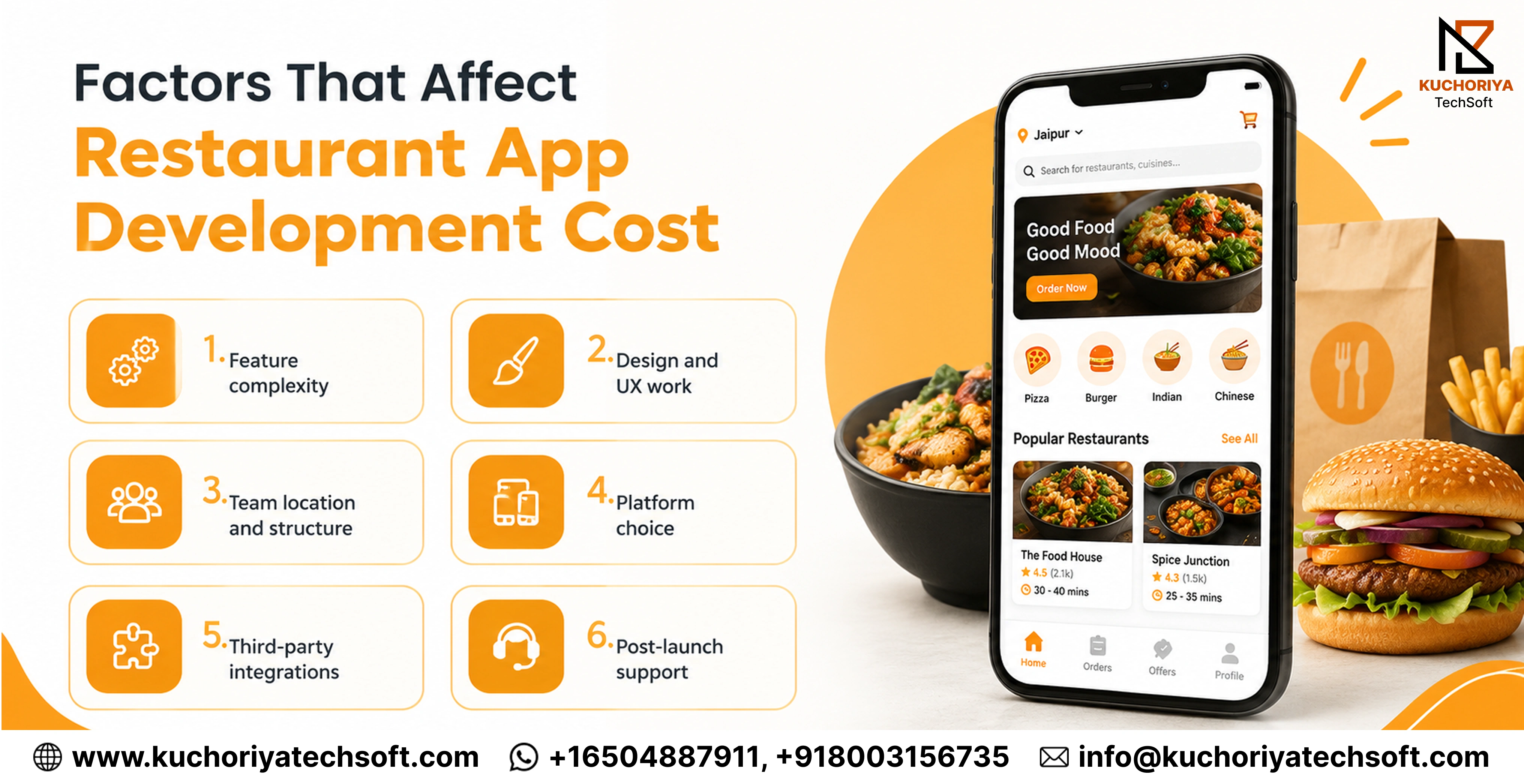
Every build is priced differently because every restaurant wants something different. Here's what actually shapes a restaurant app development budget.
1. Feature Complexity
More features mean more development hours. Live tracking, table booking, AI recommendations, each one adds real work behind the scenes.
2. Design and UX Work
Custom design takes longer than a template, and that time shows up in the invoice. Worth it for a brand that needs to stand out.
3. Team Location and Structure
Restaurant app development rates shift hard by who's building. Agencies, freelancers, and offshore teams price the same scope very differently.
4. Platform Choice
One cross-platform build usually costs less than two native apps. Native still wins for performance-heavy features like camera scanning or GPS tracking.
5. Third-Party Integrations
POS, payments, delivery, loyalty tools, each one adds setup time before launch. Sync three or four systems together and restaurant app development hourly rates climb, since keeping those connections stable becomes its own job.
6. Post-launch Support
The build itself isn't the full cost. Bug fixes, OS updates, and new features after launch keep adding up, which is really what factors affect restaurant app development cost once the app is live.
Restaurant App Development Cost by App Type
App type decides the number more than anything else. Here's where restaurant mobile app development cost actually lands across each build.
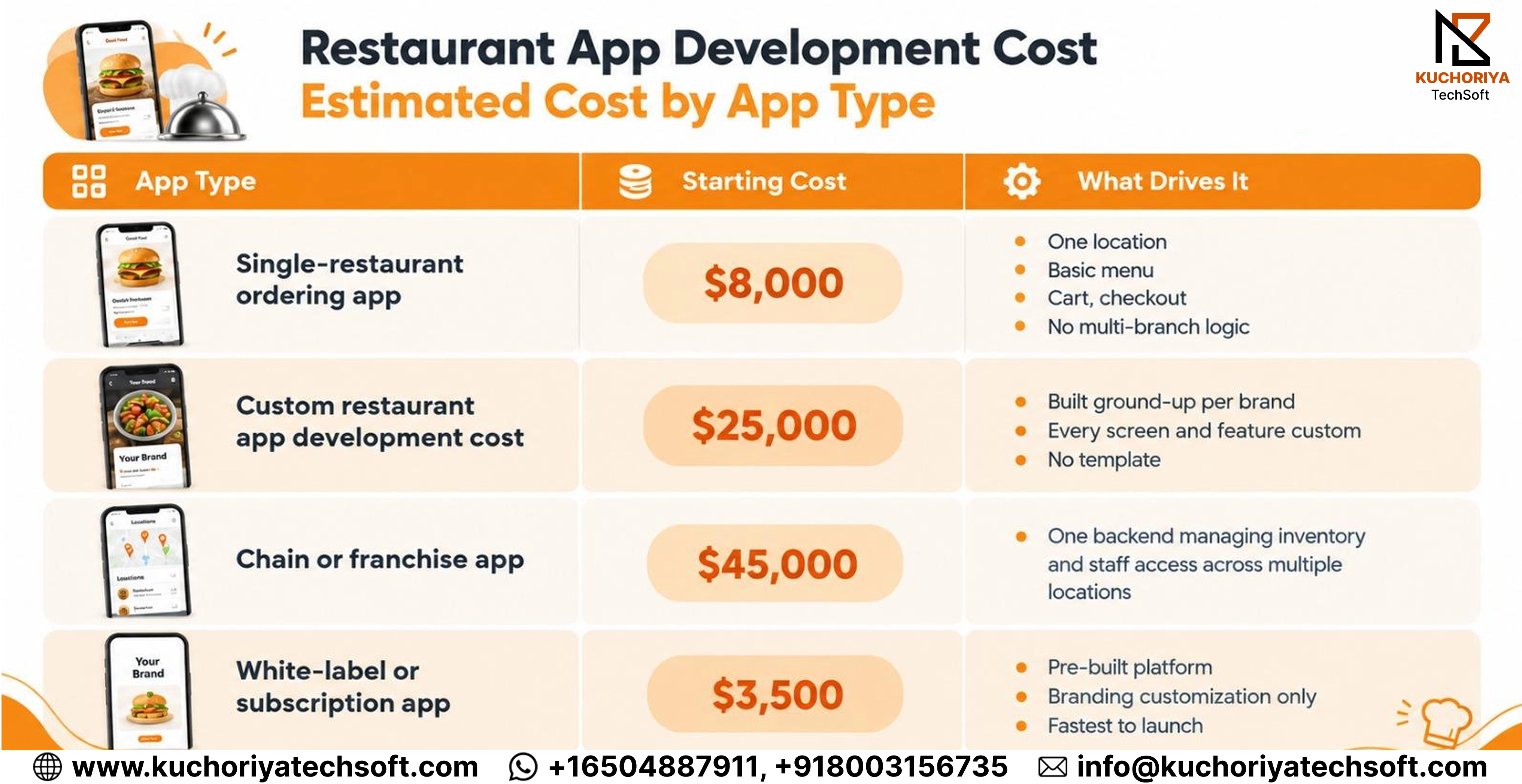
How much does a custom restaurant app cost? Starts around $25,000 and climbs from there once integrations and platform count go up. A real restaurant app development cost estimate only holds once features and platform are locked in, not before. Restaurant app development costs in Canada rates follow the same table above, they just shift a bit depending on whether the team is local or outsourced.
Must Read: How to Build a Restaurant App: Features, Challenges, Solutions & Development Guide
Eatigo Restaurant Reservation App Development

Restaurant App Technology Stack and Development Costs
Every layer of the restaurant app technology stack carries its own cost. Break it down piece by piece and the pricing starts making sense.
Frontend
Flutter or React Native cover most cross-platform builds. Swift and Kotlin step in when native speed matters more than a shared codebase. Customers only see this layer, and it eats the most design and testing hours.
Backend
The restaurant app backend technology usually runs on Node.js or Django, handling orders, menus, and accounts behind the scenes. Weak backend work shows up fast once order volume climbs.
Cloud Hosting
Restaurant app cloud infrastructure runs on AWS, Google Cloud, or Azure, billed by load and storage, not a flat rate. Friday night rush hits, traffic spikes, and the bill moves with it.
Payments
Restaurant app payment gateway integration through Stripe or Razorpay brings setup fees plus per-transaction charges. Those small charges add up fast across a full month of orders.
POS Syncing
Restaurant POS integration cost depends on what system the restaurant already runs. Square and Toast connect easily, older or custom POS setups take real development hours.
Real-time Features
Live tracking and kitchen updates run on real-time restaurant app technology, usually WebSockets or Firebase. This layer is what makes the app feel instant instead of stuck.
Choosing the Right Stack
What technology stack is best for a restaurant app comes down to order volume, number of locations, and how much real-time functionality the business actually needs. That mix decides the right restaurant app development technology, not a fixed template.
AI and Advanced Technology Costs for Restaurant Apps
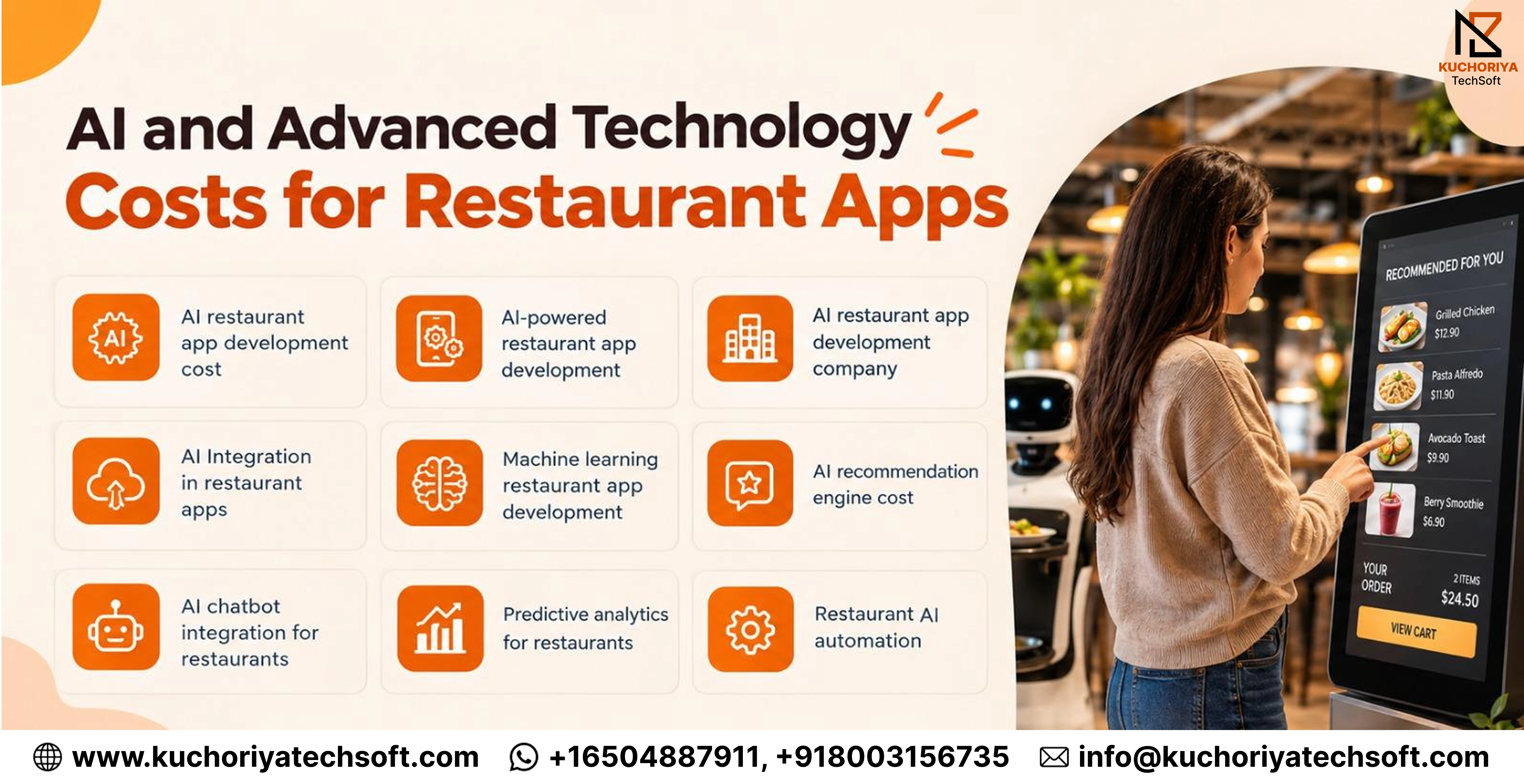
AI isn't one line item on a quote, it's a stack of separate features, and each one moves the price differently. Here's where the money actually goes.
- AI restaurant app development cost starts climbing the moment machine learning enters the picture. A basic app skips this layer entirely. An AI-driven one doesn't get to.
- AI-powered restaurant app development usually means training models on order history, customer behavior, or inventory patterns. That work needs real data science hours, not just standard app development time.
- Not every AI restaurant app development company builds these models from scratch. Some plug in third-party AI APIs instead of training anything custom, and that choice alone can swing the price by a wide margin.
- AI integration in restaurant apps covers a lot of ground, smart menu suggestions, demand forecasting, dynamic pricing. Each use case brings its own development cycle and its own testing round.
- Machine learning restaurant app development gets expensive fast once models need constant retraining as customer data keeps growing. That's an ongoing cost sitting quietly after launch, not a one-time build fee.
- AI recommendation engine cost depends on how personalized the suggestions actually get. Simple "customers also ordered" logic costs far less than an engine that adapts to individual taste over time.
- AI chatbot integration for restaurants starts small, usually a bot answering hours and menu questions. Push it further and it takes full orders, handles modifications, even processes payment through plain conversation.
- Predictive analytics for restaurants looks at past sales to forecast what's coming, demand spikes, staffing gaps, inventory about to run short. Restaurants that throw away food weekly or overstaff slow shifts see this pay for itself fastest.
- Restaurant AI automation pulls several of these features into one system instead of running them separately. Tasks that once needed someone glued to a dashboard all day now run on their own.
So how much does an AI-powered restaurant app cost? Expect 30 to 60% on top of a standard build. Where that number lands depends entirely on how many of these features actually survive the scope cut. In markets like the UK, a restaurant app development company UK team often prices this work higher than offshore teams, purely on labor cost.
Integrations and Platform Development Costs
Every integration and platform decision adds its own line to the final cost. Here's what actually drives that number.
Delivery and Kitchen Integrations
Delivery platform integration hooks the app into services like Uber Eats or DoorDash, so orders sync in real time and nothing slips through during a Friday night rush. Kitchen display system integration pushes those same orders straight to the kitchen screen. Paper tickets disappear, and so do mistakes caused by misreading handwriting under pressure.
Data and Customer Integrations
Inventory management integration keeps stock counts accurate as orders roll in, which matters most for restaurants running tight ingredient margins. CRM integration for restaurants tracks customer history and preferences across visits, and pairs naturally with loyalty program integration for rewards and repeat-visit tracking. Larger operations often need restaurant ERP integration too, tying the app into finance and supply chain systems already running behind the scenes.
Platform Choice
iOS restaurant app development and Android restaurant app development as two separate native builds cost more going in, but each one runs tighter on its own platform, no compromises baked in. Cross-platform restaurant app development through Flutter or React Native flips that tradeoff. One codebase covers both platforms, the price drops, and performance gives up just a sliver in exchange.
Build Approach and Scale
Restaurant app MVP development keeps the first version lean, just enough to test the market before spending on anything bigger. Enterprise restaurant app development sits at the other end, built for heavy traffic and complex operations from day one. Multi-location restaurant app development adds centralized control across every branch, while white-label restaurant app development skips a custom build entirely in favor of a pre-built platform with the restaurant's branding on top.
A restaurant app development company in Australia team pricing includes local labor rates alongside everything above.
Restaurant App Development Timeline and Maintenance Cost
Cost doesn't stop at launch. Here's the full picture of the restaurant app development timeline and what comes after.
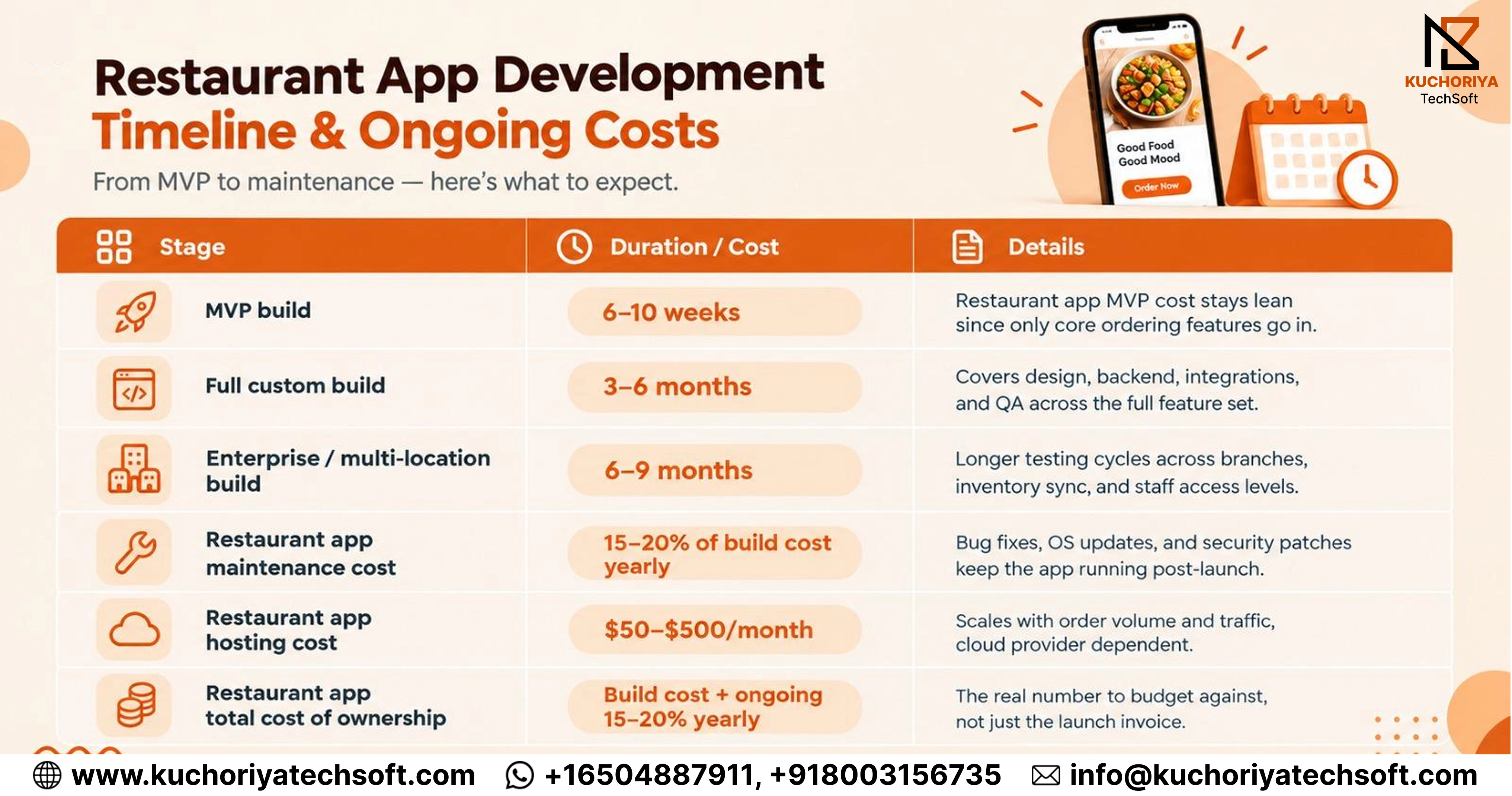
So how long does restaurant app development take? Anywhere from 6 weeks for a lean MVP to 9 months for a full enterprise build, depending on scope. Restaurant app maintenance and support isn't optional either, skipping it is how apps quietly fall behind on security and OS compatibility within a year.
That brings up the real question behind every restaurant app development investment: what is the ROI of a restaurant mobile app? Restaurants running one see measurable gains in order value and repeat visits, which is what turns this from a cost center into a restaurant app ROI story worth tracking.
How to Choose a Restaurant App Development Company
Picking the wrong partner costs more than a bad quote ever could. Here's what actually separates a solid restaurant app development agency from a risky one.
- Check their portfolio for restaurant-specific work, not just generic app builds. A restaurant software development company that's shipped ordering apps before already knows the edge cases a first-timer will miss.
- Compare how each restaurant app development pricing company structures its quotes. Fixed price works for a locked scope. Hourly fits when requirements keep shifting. Milestone-based splits the risk more evenly between both sides, paying out as chunks of work actually get done.
- Ask who touches the code, not just who signs the contract. Some agencies put a dedicated restaurant app developers team on one project alone. Others spread the same five or six developers across five different clients at once, and quality drops the moment that happens.
- Look for a long-term restaurant app development partner, not someone who disappears after handoff. The build is one moment. Post-launch support, updates, and scaling stick around for years after that.
- Weigh outsourcing restaurant app development against keeping it in-house. Is it cheaper to build a restaurant app in-house or outsource? Outsourcing wins on cost almost every time, unless the restaurant already has a full tech team sitting idle and ready to build.
- Decide whether to hire restaurant app developers directly or go through an agency's full restaurant app development team. Direct hires cost less per hour, but the management overhead shifts onto the restaurant itself.
- Factor in location before signing anything. A restaurant app development company UAE team prices differently than one based in the US, UK, or a fully offshore setup, and that gap shows up fast once the final quote lands.
Why Choose Kuchoriya TechSoft for Restaurant App Development?
A good dev partner writes code. A great one tells a restaurant owner where the money's actually going before they spend it.
1. Every engagement opens with restaurant app cost consulting services, breaking the build into features, timeline, and real numbers before anything gets built.
2. One team owns the whole project, POS syncing, delivery integrations, AI features, and multi-location scaling. Nothing gets handed off to a third vendor halfway through.
3. Support scales with the restaurant's actual stage. A single-location cafe testing its first app needs something different from a five-branch chain scaling fast, and the engagement gets structured around that.
4. Working with a restaurant app development company India based team keeps pricing sharp without trading away quality, senior developers, real QA, and direct communication instead of layers of account managers.
What This Means for Your Restaurant's Bottom Line
Cost was never the real question. Return was.
A restaurant that treats its app as restaurant management software, not a marketing afterthought, sees it in repeat orders and fewer missed sales during peak hours.
Labor overhead drops too, once ordering, delivery, loyalty, and kitchen operations all run under one digital restaurant platform instead of five disconnected tools fighting each other.
Manual work is where most restaurants bleed money without realizing it. Restaurant automation software removes that layer quietly, one order and one shift schedule at a time, and it adds up fast across a year. Agencies managing multiple restaurant clients often bring this in through the Associate Partner Program instead of building each app from scratch themselves.
None of this comes from the cheapest quote on the table. It comes from restaurant software development built around what the business actually needs, nothing generic, nothing template-stretched to fit. Consultants and referral sources already working with restaurant owners can also earn through the Referral Partner Program on every project they bring in.
Restaurants ready to see real numbers can talk to our team on WhatsApp for a cost breakdown built around their actual build._(1)_1789390588800.webp)
Frequently Asked Questions About Restaurant App Development Cost
Q. What is the restaurant app pricing model restaurants should expect?
A. Three models show up most. Fixed price, for a scope that's locked before anything starts. Hourly, when features are still getting figured out mid-build. Milestone-based, where money moves as actual chunks of work get done, not upfront in one lump sum. That third one tends to protect both sides better.
Q. What does a full restaurant app development cost breakdown actually include?
A. Design work. Frontend and backend build. QA testing. POS and payment integrations. App store deployment. Maintenance after launch. Leave one of these out of a quote, and it doesn't disappear, it just shows up later as a surprise invoice.
Q. How much does restaurant mobile app cost differ between a basic app and a custom build?
A. Basic starts low five figures. Custom, with AI features and POS syncing and multi-location support baked in, runs several times that. The reason's simple, every screen gets built for one restaurant instead of pulled off a shelf.
Q. Does the cost change based on how many locations the restaurant runs?
A. It does, and by a lot. One location needs a fraction of the backend work that five or ten locations need, running inventory, staff access, and order routing at the same time. Centralized dashboards aren't free, and neither is the extra hosting that comes with them.
Q. Is a cheaper app actually cheaper in the long run?
A. Rarely. Skip proper QA or security testing to save money upfront, and that money comes back around later, usually as downtime, bugs, or a rebuild once order volume outgrows what the app was ever built to handle.