AI-Powered Lawyer Apps: What They Are and How They Work
A client sends a 40-page contract at 6 pm and wants a summary by morning. Used to mean an all-nighter. Now it takes twenty minutes.
That's what an AI lawyer app actually is. Not a chatbot bolted onto a booking form, software where AI handles the parts of legal work that used to eat the most hours, document review, first-draft answers, and routine client questions, before a human steps in.
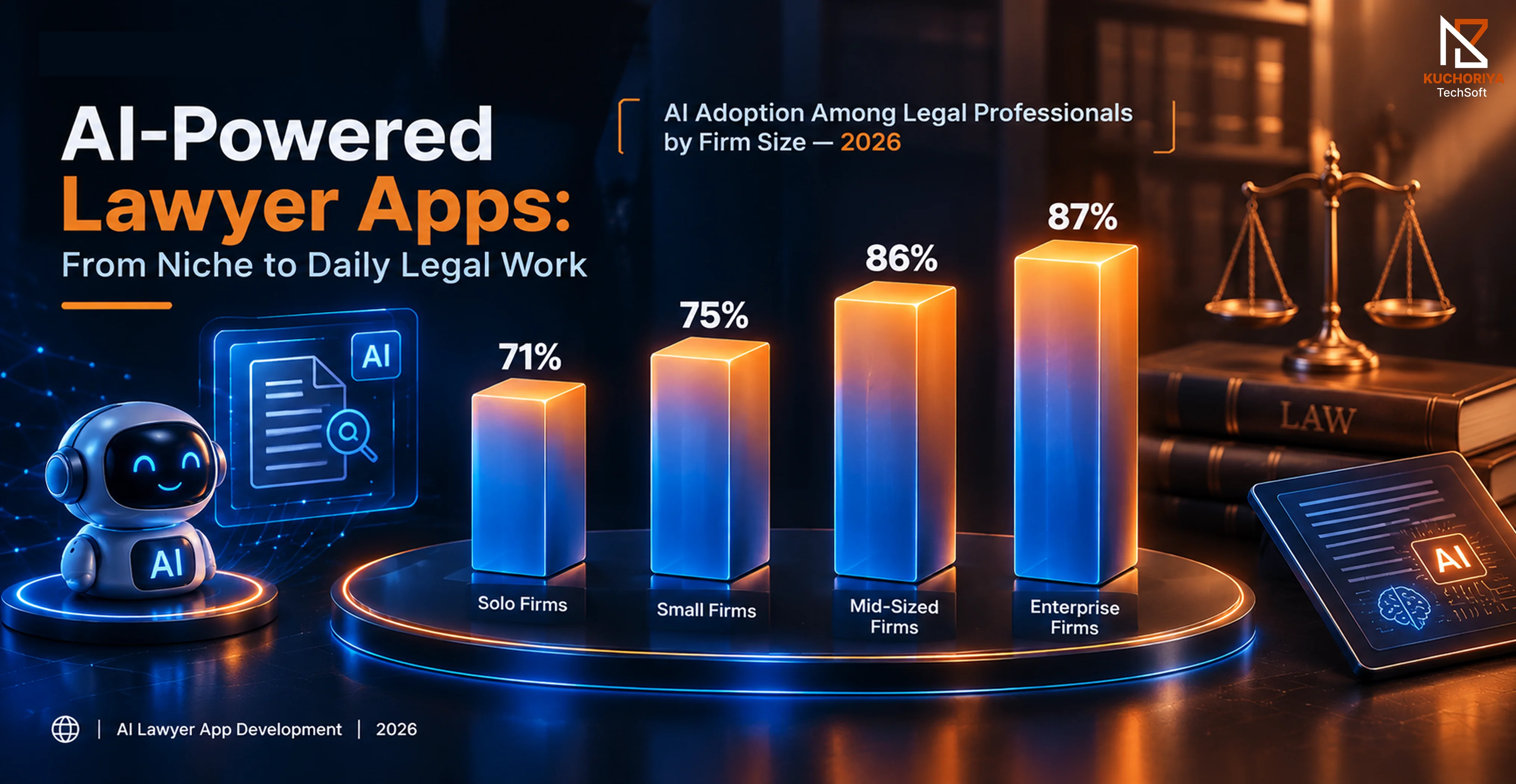
The numbers back this up. AI legal software went from niche to daily use fast, 79% of legal professionals now use some AI tool, up from 19% in 2023 (Clio, 2025 Legal Trends Report).
How does an AI lawyer app work? A language version trained on felony text sits on the middle. Feed it a settlement, it extracts clauses and flags risks in seconds. Connect it to patron chat, and it becomes an AI prison platform answering intake questions before a legal professional opens the record.
None of this replaces legal judgment. It replaces the grunt work in front of it, roughly 44% of legal tasks could be handled by generative AI in some form, one of the highest automation rates of any US industry.
By AI lawyer app 2026 standards, a basic version isn't experimental. It's closer to expected. An AI-powered lawyer app, an AI legal app, whatever the label, the question stays the same: what's actually running under the hood, and what can it do for a firm day-to-day?
Why Are Law Firms Turning to AI-Powered Legal Apps?
Budgets are tighter, cases keep getting more complex, and clients expect answers faster than ever. AI legal technology is how firms are actually keeping up.
- How does AI help lawyers? Mostly by taking the repetitive work off their plate, document review, first drafts, intake calls. Hours that used to disappear into admin now go toward actual casework.
- Clients compare a law firm's response time to every other app on their phone. AI-powered legal services meet that expectation instead of losing clients to voicemail.
- Firms running smart legal software are closing cases faster and taking on more clients without adding headcount. That gap widens every quarter a firm waits.
- Why use AI in legal technology now instead of later? Because legal technology transformation isn't always slow anymore, it is already occurred at most mid-sized and big corporations, and solo practices are catching up fast.
- By AI legal technology 2026 benchmarks, an AI attorney app isn't a differentiator so much as a baseline. AI for law firms has moved from "nice to have" to "expected by the client on the other end of the call."
Key AI Features to Include in a Lawyer App
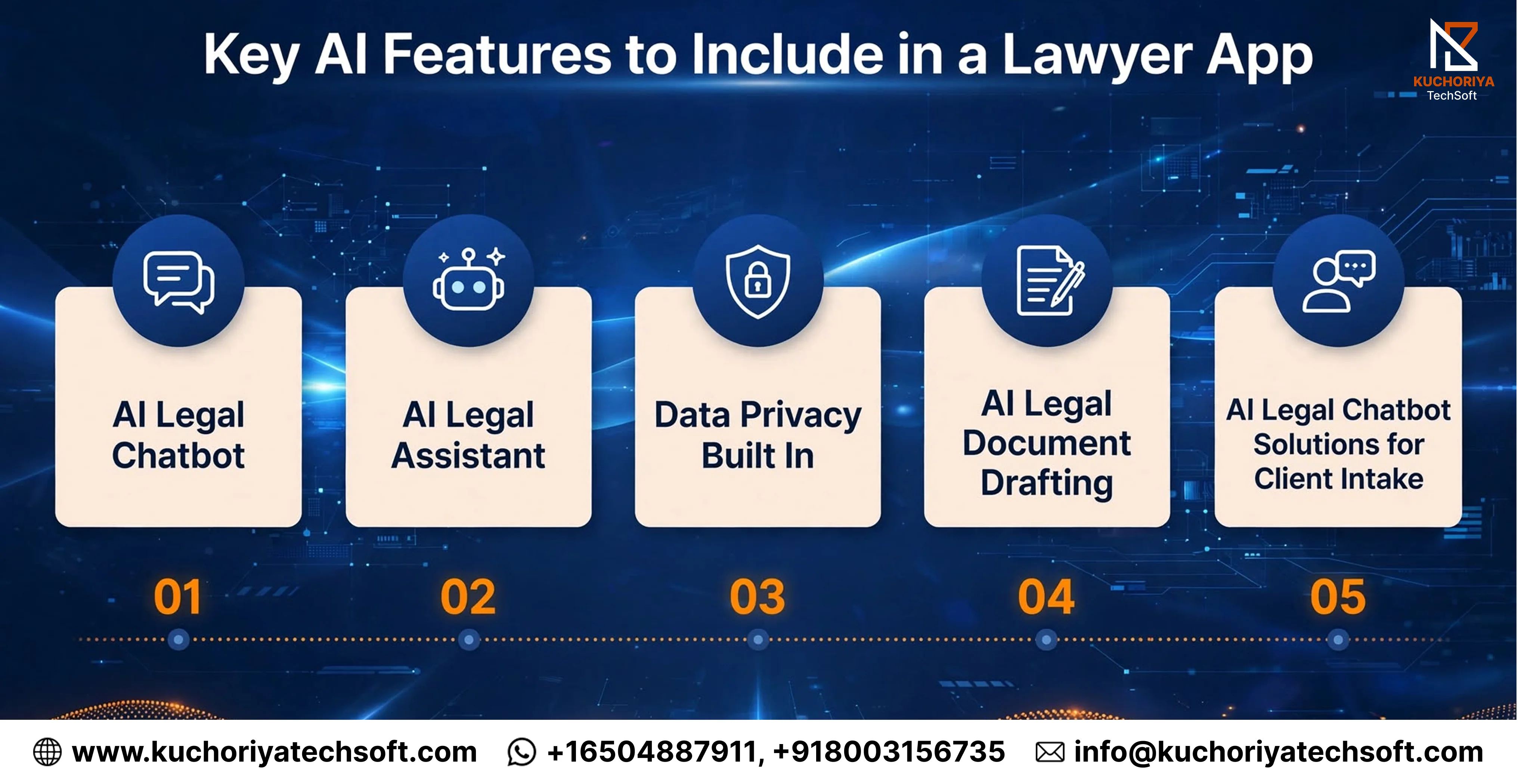
Not every feature belongs in every build. These are the ones that actually change how the app performs, not just how it looks on a features page.
1. AI Legal Assistant
An AI legal assistant handles the questions clients ask before they even talk to a lawyer, case status, next steps, basic legal terms. Runs in the background. Frees up actual attorney time for things that need a real person.
2. AI Legal Chatbot
A legal AI chatbot is not similar to a ordinary customer service bot. Built right, an AI prison chatbot understands felony phraseology, routes urgent questions to a human rapid, and does not bet whilst it is unsure.
3. AI Legal Document Drafting
Blank page, engagement letter due in an hour. This is the exact moment AI legal document drafting earns its place in the app. Rough outline goes in, usable first draft comes out. A lawyer still reviews it, but nobody's staring at a cursor for twenty minutes first.
4. Data Privacy Built In
Here's the uncomfortable truth: most firms bolt privacy on after launch instead of building it in. AI legal data privacy can't work that way, not when client case files and payment details are sitting inside the same system. Encryption, access controls, audit logs, none of it optional once real client data is involved.
5. AI Legal Chatbot Solutions for Client Intake
The strongest AI legal chatbot solutions go beyond answering questions, they qualify leads. A prospective client describes their issue, the bot routes it to the right attorney or practice area, no manual triage sitting in someone's inbox.
So what are AI lawyer app features worth in combination? More than any single one alone. A chatbot without drafting still leaves lawyers writing everything by hand. Drafting without privacy safeguards creates a liability nobody signed up for. Next: where these features actually show up in day-to-day use.
AI Use Cases Across Legal Research, Casework, and Client Services
Picture two associates working the same case. One spends the afternoon scrolling a legal database for precedent. The other has an answer in fifteen minutes and spends the rest of the day building the argument. Same case, same deadline, wildly different afternoon. That gap is where AI lawyer app use cases actually earn their place.
There's a catch most guides skip. AI accuracy in legal services still isn't perfect, research tools have cited cases that don't exist. That's not a reason to avoid AI use cases in law firms, it's the reason every output needs a human check before it goes near a filing or a client.
Treat these AI legal research solutions as a first pass, not a final word, and the time saved is real. Skip that check, and it turns into a malpractice risk fast. Next up: what happens when AI turns to the documents themselves.
AI for Legal Document Analysis and Contract Review
A 60-page vendor contract lands on a Friday afternoon, client needs a risk summary before Monday. Clause-by-clause reading eats the whole weekend. Running it through AI document analysis first cuts that to an hour.
- Structure, key terms, obvious gaps, AI legal document analysis catches those fine. The actual legal meaning of a clause is still a judgment call for a person, not the model. Can AI analyze legal documents on its own? Not reliably enough to skip that step.
- Nobody wants to study all 60 pages just to locate three numbers. AI file summarization grabs the responsibilities, the deadlines, the charge phrases, and hands again something a legal professional can skim in minutes in preference to two hours.
- Clauses get checked against the corporation's preferred templates, and something's off receives flagged, an indemnification clause worded oddly, a termination window shorter than traditional That's how AI is used in contract review in practice. AI contract review isn't making the call, it's pointing at where the call needs to be made.
- AI-powered contract review handles volume manual review can't. Five contracts a week and fifty a week hit the same wall without it, only one of those firms absorbs that load without hiring.
- Contracts carry financial terms, personal data, sometimes trade secrets. Secure AI legal applications need encryption and access controls in place before a document ever gets uploaded, not after.
Business Benefits of AI-Powered Lawyer Apps
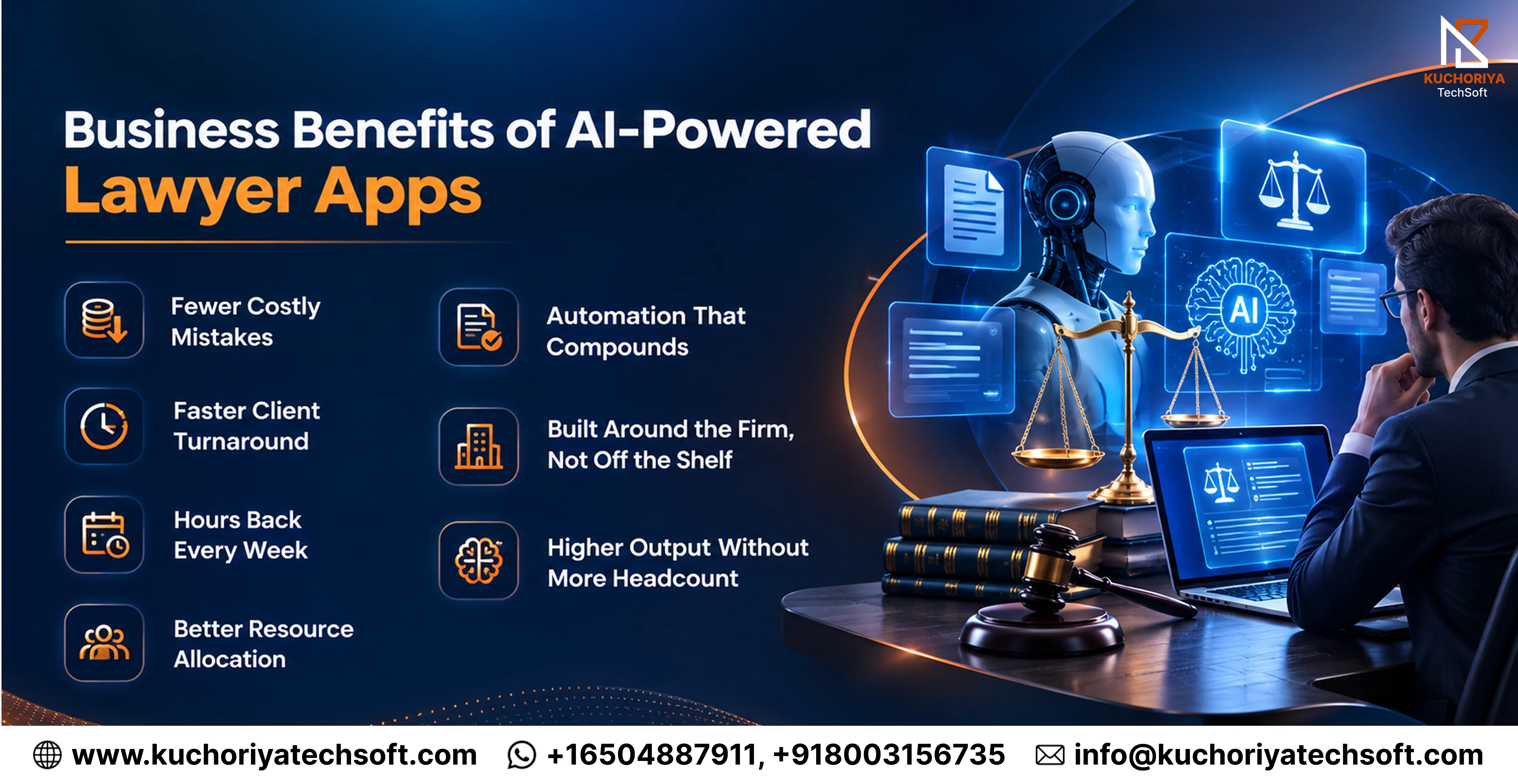
What are the benefits of an AI lawyer app, in numbers a partner actually cares about? Here's where the return shows up.
1. Hours Back Every Week
Document review that took three hours now takes forty minutes. That's not a marginal gain, it's a full extra case a week for a busy associate. The biggest of the AI lawyer app benefits starts here, with time nobody has to fight for anymore.
2. Higher Output Without More Headcount
Same team, more cases, no burnout. AI productivity for lawyers breaks the old math where handling more clients meant hiring more people. Law firm productivity stops scaling linearly with headcount.
3. Fewer Costly Mistakes
A missed clause or a blown deadline costs real money, sometimes a client relationship too. Catching it before filing instead of after a complaint lands is one of the quieter benefits of AI in legal services that rarely makes the sales pitch.
4. Automation That Compounds
Scheduling, reminders, intake forms, once automated, they stay automated. AI legal automation benefits don't reset each month. The hours saved in January are still being saved in December.
5. Better Resource Allocation
When routine work gets handled automatically, senior attorneys spend more billable hours on strategy and less on admin they were overqualified for in the first place. That shift alone changes what a firm can charge for.
6. Faster Client Turnaround
Cases that used to take weeks now move in days, not because the legal work got easier, just faster to process. Clients notice that speed, and it shows up directly in law firm productivity metrics and repeat business.
7. Built Around the Firm, Not Off the Shelf
Custom AI legal software fits how a specific firm already works instead of forcing a generic workflow onto it. That's the difference between a tool people actually use and one that sits unopened after week two.
Add these up, and the case for an AI lawyer app stops being about keeping up with trends. It's about what the numbers do to a firm's bottom line over a year, not a quarter. Next: the technology actually running underneath all of this.

AI Technologies Behind Modern Legal Applications
What can AI do for lawyers? Depends on what's running underneath the app. "AI-powered" gets thrown around loosely, but the tech behind it varies a lot, and so does what it can actually pull off.
Generative AI legal applications rarely run on just one of these. Most AI legal platform solutions combine two or three, an LLM handling drafts, NLP doing the parsing, a vector database powering search. This is the AI layer specifically, general stack choices like frontend or hosting work the same as any lawyer app and live in their own section.
None of this catches its own mistakes though. A model can write a clause that sounds airtight and is wrong. Human oversight in legal AI is the only thing standing between that clause and a client who trusts it blindly.
Security, Privacy, and Responsible AI in Legal Apps
Legal data isn't retail data. A leaked case file can end a client relationship. This section matters more than the rest combined.
- Case files, payments, and personal records, all need encryption and access controls. AI legal data security isn't an add-on, it's the foundation.
- Legal document management through AI means documents get processed and sometimes shared with a model provider. Every step needs locking down, not just storage.
- AI compliance for legal software spans GDPR, HIPAA where relevant, and state bar confidentiality rules, all apply once AI touches client data.
- Someone has to own this. Legal AI governance means clear rules on what AI can access and who reviews its output.
- AI hallucination in legal applications is real, not hypothetical. Research tools have cited cases that don't exist in actual court filings.
- Responsible AI for legal services means planning for that risk upfront, not hoping it won't happen.
- Ethical AI in legal technology includes telling clients when AI drafted something. Most would rather know.
- The best AI legal assistant solutions flag their own uncertainty instead of guessing confidently.
Get this wrong, and every efficiency gain from earlier sections stops mattering. Next: the real challenges firms hit implementing this.
Expert Perspective: How to Choose a Lawyer App Development Company: 10 Factors to Consider Before Hiring
Challenges of Implementing AI in Legal Services (and How to Solve Them)
Most firms don't fail at AI because the technology is bad. They fail because nobody planned for what happens after launch.
None of these are reasons to skip AI. They're reasons to plan for it properly instead of bolting it on and hoping it works. Next: where this is all heading.
Future of AI-Powered Legal Services
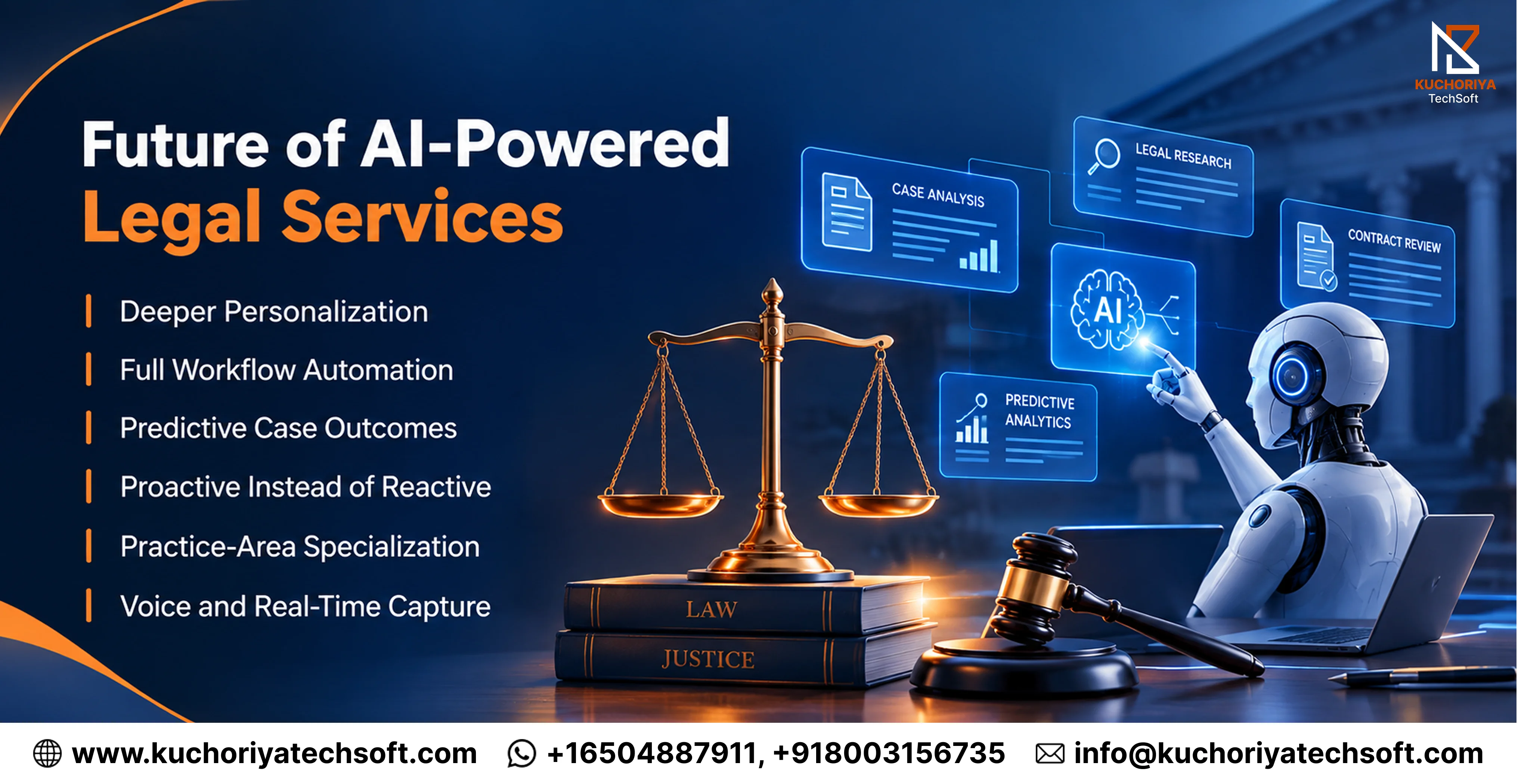
Right now, AI drafts and summarizes. What's coming next moves further into territory that used to be exclusively human judgment.
1. Predictive Case Outcomes
The future of AI in legal services points toward predictive forecasting, not just faster research but pattern-based predictions on how a similar case is likely to resolve, based on thousands of past rulings a person could never manually compare.
2. Proactive Instead of Reactive
AI lawyer app solutions are moving away from waiting for a question. Rather than a lawyer asking, the app increasingly flags a compliance risk or a deadline before anyone thinks to check.
3. Deeper Personalization
AI legal software solutions are heading toward tools that learn a specific firm's writing style and precedent preferences instead of generating generic output every time.
4. Voice and Real-Time Capture
An AI-powered legal platform built today will likely look basic in three years. Voice-driven case updates and real-time courtroom transcription tied directly to case files are already moving from experimental to standard in early-adopter firms.
5. Full Workflow Automation
AI legal automation solutions are extending past document work into connected chains, intake, drafting, review, filing, running as one sequence instead of five separate manual steps.
6. Practice-Area Specialization
AI legal app features are getting sharper by practice area. A generic AI assistant is giving way to versions trained specifically for immigration, family law, or corporate contracts.
None of this changes the core math on AI legal app benefits, still time saved, fewer errors, more cases handled well. What changes is how much of that value compounds as the technology keeps maturing. Firms building now aren't just solving today's problem, they're positioning for what these apps can already almost do.
From AI Features to a Production-Ready Legal Platform
A demo that drafts one decent contract is easy. Getting a firm to run on it daily, securely, at scale, is where most AI projects quietly stall.
- AI features integrated into real legal workflows fit how lawyers already work, not the other way around.
- Secure legal data architecture has to exist before a single line of AI code gets written.
- LLM and API integration connects the model to case files without exposing raw client data to a third party.
- Human-in-the-loop validation: nobody signs off on a clause the AI drafted without a person actually reading it first.
- Templates and precedents specific to the firm, not generic scraped text, that's what legal document and knowledge-base integration actually determine.
- Demos run smoothly with three test files. Scalable AI infrastructure is what keeps things steady when it's fifty case files at once, on the firm's busiest week.
- Model drift happens quietly. Testing, monitoring, and AI governance are how it gets caught before a client notices something's off.
- Integration with existing legal software is the difference between a tool lawyers open every day and one that sits abandoned behind five other logins by week three.
At Kuchoriya TechSoft, AI-powered legal solutions get built around real workflows, secure integrations, scalable architecture, and responsible AI implementation, not just a working demo.
Conclusion: Transforming Legal Services with AI
Legal technology stopped being optional the moment clients started expecting apps, not voicemail. What started as legal tech experiments is now sitting inside daily legal practice management, running legal research faster and keeping legal workflow from piling up on one overworked associate.
The firms getting real value out of this aren't chasing every AI feature. They're pairing a solid legal consultation platform with AI-powered client communication that actually cuts response time, and law firm software that talks to AI-powered case management instead of running as two disconnected systems.
Agencies already serving law firms don't need to build any of this from scratch either. An AI legal referral partner program lets them bring AI-powered legal apps to their own clients without hiring a single developer.
Teams that need senior AI direction without a full-time hire usually turn to fractional CTO services for legal tech, someone who's already solved the architecture and security questions this space keeps raising.
And for firms wanting something longer-term than a one-off project, an AI legal associate partner program is built around exactly that kind of ongoing collaboration.
Whichever stage your firm is at, building, adjusting, or scaling an AI-powered legal app, talk to our team and see where it fits.
FAQs About AI-Powered Lawyer Apps
Q. Does AI lawyer app development work the same across the USA, UK, UAE, and India?
A. Core tech stays similar, compliance shifts by region. AI lawyer app development USA leans on HIPAA and state bar rules. AI lawyer app development UK factors in GDPR. AI legal app UAE often needs Arabic support. AI legal technology India usually prioritizes cost-efficient scaling.
Q. What counts as digital legal services today?
A. Used to mean a website with a contact form. Now digital legal services covers video consultations, e-signatures, and AI doing the first pass on research before a lawyer opens the file.
Q. What is RAG in legal AI?
A. A plain LLM answers from whatever it memorized in training. RAG for legal applications pulls from a firm's own documents and case law first, then generates the response from there.
Q. Why do legal AI tools use large language models?
A. Large language models for lawyers catch phrasing a general model would miss, the gap between a usable draft and one that needs a full rewrite.
Q. How is AI-powered document review different from manual review?
A. AI-powered document review flags risks in minutes instead of hours. Faster, not smarter, a lawyer still makes the call.
Q. What do AI legal process automation and AI legal search actually do?
A. Intake, scheduling, status updates, that's AI legal process automation. AI legal search pulls up a clause across thousands of documents in seconds instead of someone digging through folders.