






Introduction: Choosing an RCM Software Partner Is a High-Stakes Decision
A hospital signs with a vendor promising a smooth billing overhaul. Eight months later, claims still bounce back, staff juggle three disconnected systems, and reimbursements have slowed instead of sped up. This happens when leaders pick a revenue cycle management software development company off a sales pitch, not a real evaluation.
The stakes are only growing. The healthcare RCM software market is set to climb from roughly $48.3 billion in 2026 to $75.1 billion by 2033, per Persistence Market Research. Not every healthcare software development company claiming RCM expertise has actually handled HIPAA-regulated billing data, and not every pitch for the best revenue cycle management software survives past launch day. (Source)
This checklist cuts through that gap. Whether you're eyeing a revenue cycle management software development company USA-based or global, you'll learn what real healthcare compliance experience looks like, why AI-powered revenue cycle management software matters now, and how to judge healthcare data security before signing anything.
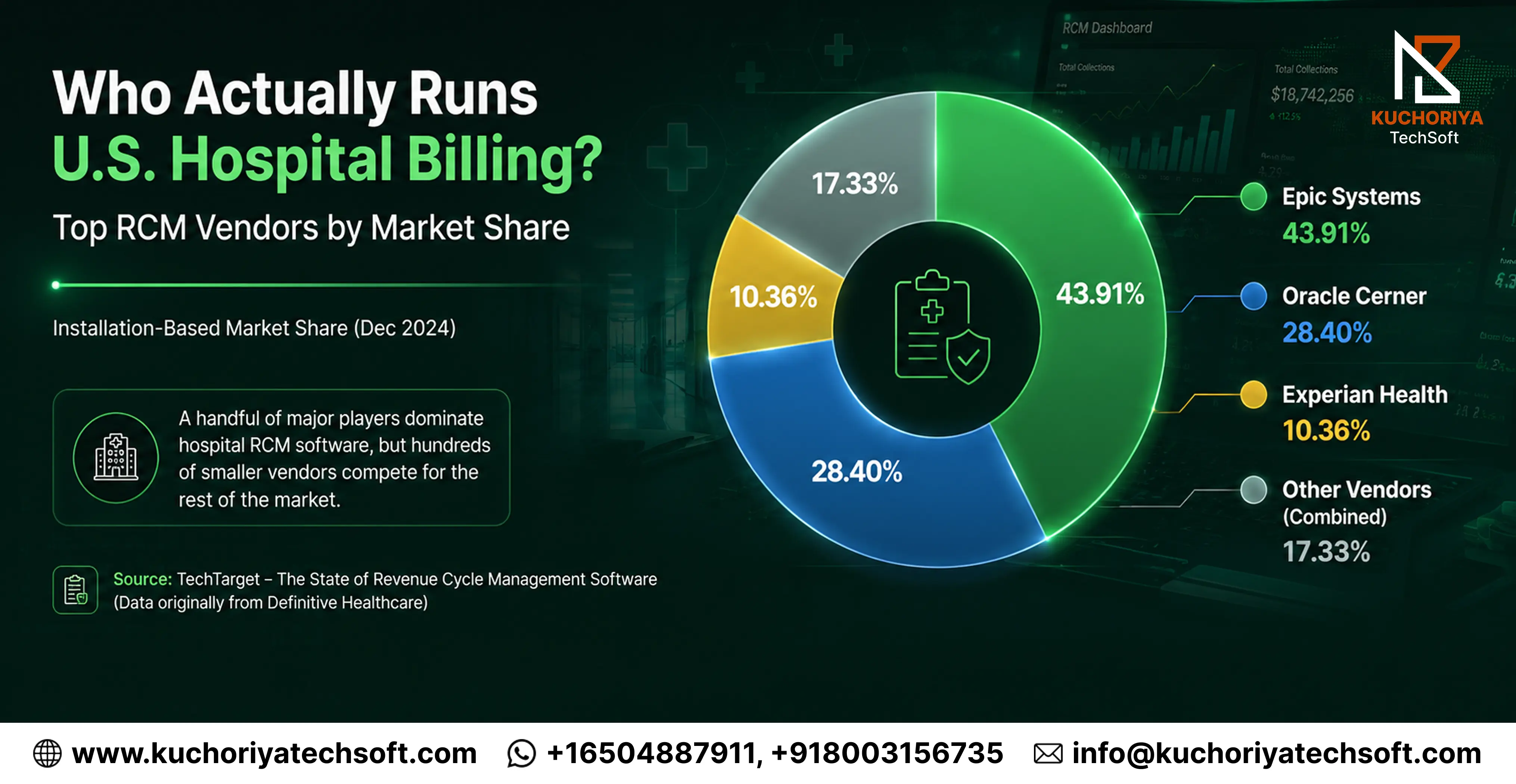
Why the Right RCM Software Development Company Matters
Bad billing software doesn't just slow things down. It bleeds money quietly, one denied claim at a time, until finance teams can't explain where the revenue went.
- The wrong revenue cycle management software development effort can take a hospital's clean claim rate from 95% to under 80% within months, and few teams catch it until the quarter closes.
- A true revenue cycle software development company builds for your specialty and payer mix, not a generic template that breaks the moment your billing rules get complex.
- Partnering with the right healthcare software development partner means fewer handoffs between clinical staff and billing teams, which directly protects revenue optimization across the board.
- Modern platforms built around intelligent revenue cycle management catch coding errors and eligibility issues before claims ever leave the building, not after payers reject them.
- With solid electronic health records integration, a doctor's note from this morning shows up in billing this afternoon, not three days later when someone finally syncs the systems.
- Ask any vendor about secure healthcare software development and they'll say yes. Ask them to show you the last penetration test report, and half go quiet.
- Even location matters. A RCM software development company in Canada faces different privacy laws (PIPEDA) than one operating under HIPAA in the US, so cross-border compliance experience isn't optional if you operate in multiple regions.
RCM Software Development Company Checklist
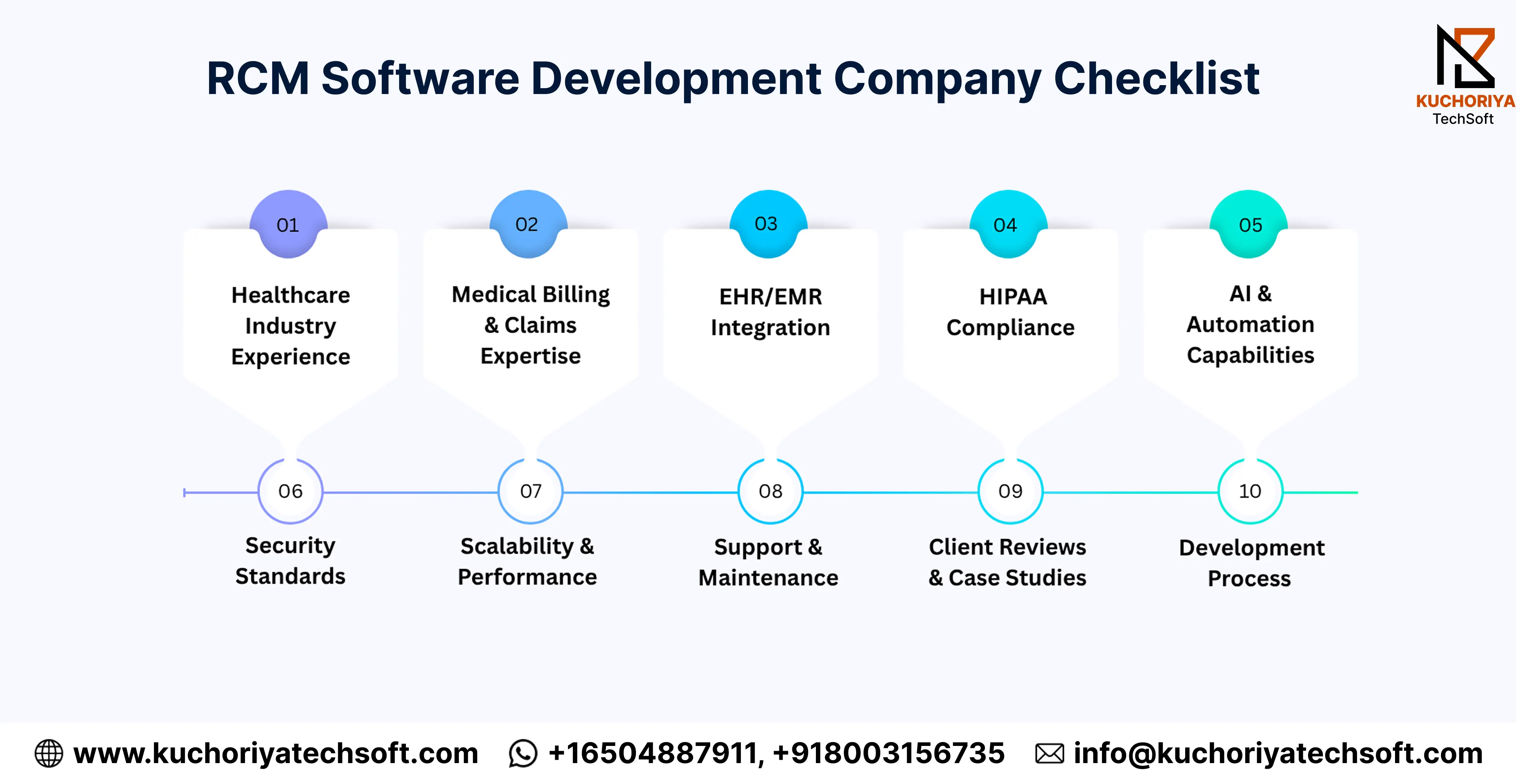
Not every coding shop that says "healthcare" belongs on your shortlist. If you're comparing RCM Software Development Services, run each vendor through these ten points first.
1. Healthcare Industry Experience
Ask how long they've built medical revenue cycle software, not generic apps with a healthcare label. If their team fumbles basic patient registration workflows, that's your answer. A healthcare RCM software Company UK based team should already know NHS billing quirks, not learn them on your project.
2. Medical Billing & Claims Expertise
This is where most vendors fall short. Medical billing software development demands real CPT and payer-rule knowledge. Ask them to walk through actual claims management, from submission to medical claims processing and remittance.
3. EHR/EMR Integration
Confirm real work with EHR integration services and EMR integration services, including HL7 integration and FHIR integration. Vendors who've connected real Electronic Health Records (EHR) and Electronic Medical Records (EMR) systems will have specifics, not vague promises.
4. HIPAA Compliance
Look for proven HIPAA-compliant software development work, prior HIPAA-compliant healthcare software builds, and a clear patient data protection plan. A Custom RCM Software Development Australia vendor should still understand cross-border health data rules.
5. AI & Automation Capabilities
Ask what AI healthcare software development they've actually shipped, especially automated medical coding that reduced real errors, not a dashboard chatbot.
6. Security Standards
Dig into their healthcare cybersecurity practices and documented healthcare compliance solutions. A RCM Software Development Services UAE vendor should also know regional data residency rules.
7. Scalability & Performance
What works for a small clinic breaks at a large hospital system. True enterprise RCM software development handles claim spikes without slowing down.
8. Support & Maintenance
Find out what happens after launch. Real custom healthcare software development partners offer defined SLAs, not a generic inbox. An RCM software company in Dubai vendor serving global clients needs round-the-clock coverage.
9. Client Reviews & Case Studies
Ask any RCM software company for references you can actually call, not just logos on a site.
10. Development Process
A phased custom EHR software development roadmap says more than any pitch. Confirm it fits your existing practice management software, not a full rebuild.
Questions to Ask Your RCM Software Vendor Before Hiring
A polished sales deck won't tell you how a vendor handles a system outage at 2 AM. The right questions will.
- Before you sign anything, ask what questions you should ask an RCM software vendor about their past projects, not just their pitch. Request two client contacts you can actually call.
- If you're evaluating RCM Software Consulting Services, ask whether they audit your existing workflow first or just start building on assumptions.
- Planning to hire RCM Software Developers directly? Ask who stays on your account after launch, because the team that pitches you and the team that builds it aren't always the same people.
- Ask exactly how their platform handles insurance verification and whether it checks eligibility in real time or overnight in a batch job that delays everything.
- If they're pitching AI medical billing software, ask for a real example of a claim it caught before submission, not a generic feature list.
- A vendor offering revenue cycle management software development in Singapore should know MOH data regulations are cold, since compliance rules shift fast across regions.
One good answer builds confidence. A vendor who dodges these questions tells you everything you need to know before the contract is even drafted.
Common Mistakes to Avoid When Choosing an RCM Software Company
Most bad vendor decisions don't look bad on day one. They show up six months later as missed deadlines and billing errors nobody predicted.
- Picking a generalist coding shop over a team with real healthcare IT software development experience usually costs more in the long run than paying for specialists upfront.
- Skipping questions about denial management until after launch means rebuilding that logic later, when it should've been part of the plan from day one.
- Believing "AI-powered" on a slide without asking for a real example of AI denial management catching an actual claim issue before submission.
- Assuming compliance knowledge transfers across borders. A RCM Software Development Company Hong Kong based team still needs to prove they understand PDPO rules, not just HIPAA.
- Trusting glossy case studies over real conversations. What should healthcare leaders look for in an RCM software company ultimately comes down to calling past clients and asking what actually broke.
- Choosing the lowest quote without checking what's excluded. Cheap contracts often skip post-launch support or data migration, and those costs resurface later as change requests.
- Signing before agreeing on measurable outcomes. If a vendor won't commit to specific benchmarks, like faster claim turnaround or lower denial rates, in writing, that hesitation tells you something.
AI Trends Shaping Revenue Cycle Management Software
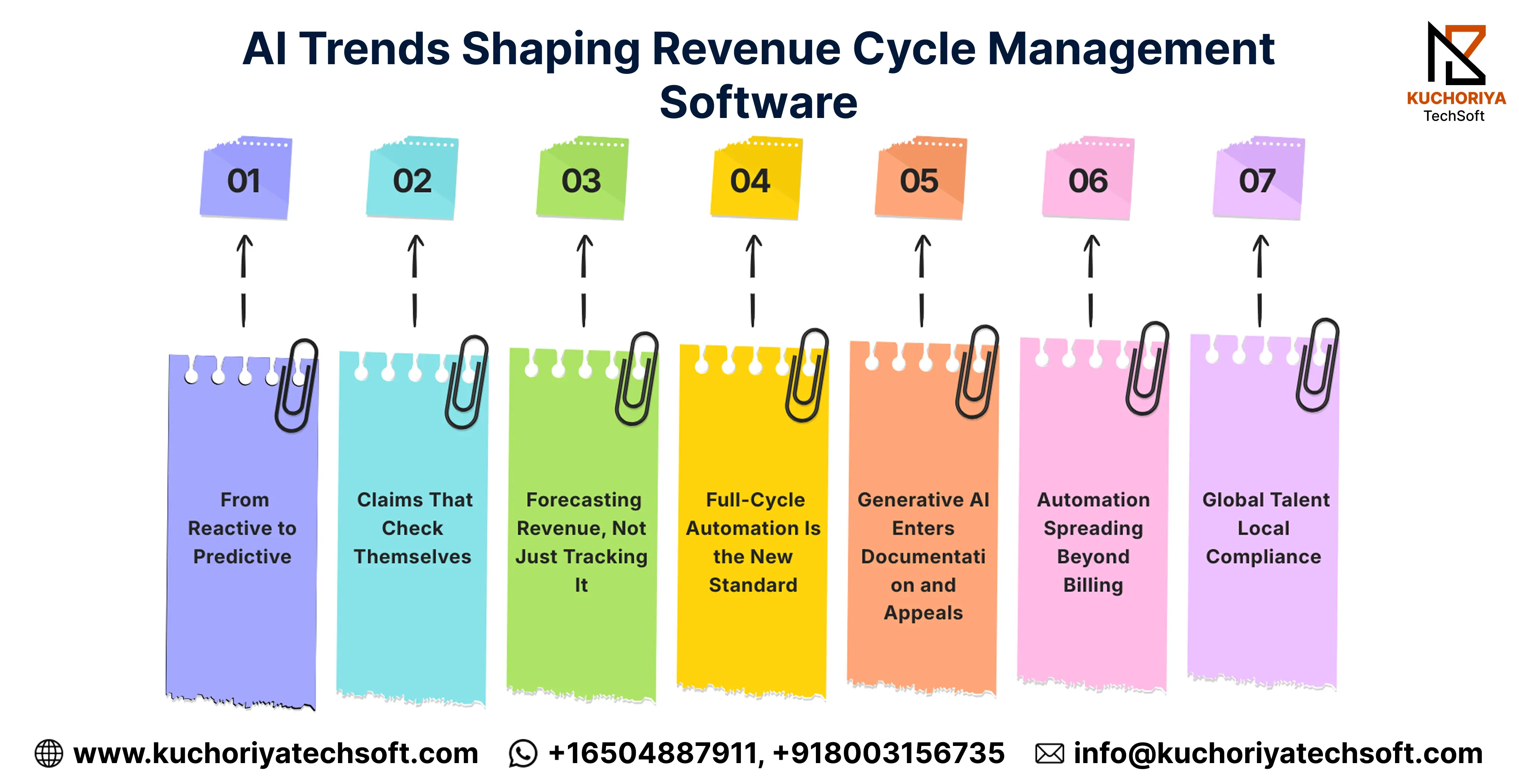
AI stopped being a differentiator in RCM software years ago. Today it's the baseline, and vendors who can't show real deployments are already behind.
1. From Reactive to Predictive
Most legacy systems just process claims. Real progress in AI healthcare revenue cycle management shows up as prediction, flagging which claims are likely to get denied before they're even submitted.
2. Claims That Check Themselves
AI claims processing now catches coding mismatches and missing documentation in seconds, work that used to take a biller ten minutes per claim to manually verify.
3. Forecasting Revenue, Not Just Tracking It
Predictive revenue analytics gives finance teams a real forward view of cash flow, instead of finding out about a shortfall after the month has already closed.
4. Full-Cycle Automation Is the New Standard
Revenue cycle automation software now handles registration verification, coding, and remittance posting as one connected process, not three separate tools duct-taped together.
5. Generative AI Enters Documentation and Appeals
Generative AI in healthcare is starting to draft appeal letters and summarize clinical notes for coding accuracy, cutting hours off tasks that used to sit in someone's inbox for days.
6. Automation Spreading Beyond Billing
AI healthcare workflow automation is expanding past claims into scheduling and prior authorization, and broader healthcare workflow automation is quietly reshaping how front-desk and billing teams actually work together.
7. Global Talent Local Compliance
Some of the sharpest AI-RCM engineering work right now is coming out of teams like a RCM software development Israel-based shop, known for strong health-tech AI research, though local data laws still apply regardless of where the code is written.
So how does AI improve revenue cycle management? Not by replacing billing staff, but by catching what humans miss at scale, before a denial ever reaches their desk.
Must Read: Revenue Cycle Management Software: Complete Guide, Benefits & Key Features
Healthcare Revenue Cycle Management (RCM) Software Solutions
How Much Does Custom RCM Software Development Cost?
Ask five vendors this question, and you'll get five different numbers, mostly because they're all building something slightly different. Here's what actually separates the price tiers for custom RCM software development.
Where the real money goes, usually before anyone budgets for it:
- HIPAA work quietly adds 20-30% to whatever the base build was going to cost.
- Legacy EHR interfaces alone can run $22,000 to $58,000, depending on how many systems you're stitching together.
- A RCM technology partner who actually understands billing workflows costs more upfront than a generalist shop, but you're not paying twice for the same fix six months later.
- Rates from an RCM software development Mexico-based team tend to sit 20-35% below US pricing, though the savings shrink once you factor in timezone-related delays.
There's no single number that answers how much custom RCM software development costs, but $38,400 covers a narrow module while a full enterprise build can pass $637,000. As for how long revenue cycle management software development take, a small project wraps in three months. Something that touches every corner of the revenue cycle can run close to a year and a half.
What Are the Red Flags of a Bad RCM Software Development Company?
Some warning signs show up before you even sign the contract, if you know where to look.
- They can't name a single healthcare client you can actually call, only logos on a slide with no contact attached.
- Every compliance question gets answered with "we follow best practices," never a specific audit date or documented process.
- Their demo shows a polished dashboard but skips how the system handles a denied claim or a failed EHR sync.
- Pricing comes as one flat number with no breakdown, and questions about what's excluded get vague answers.
- There's no clear owner for your account after go-live, just a shared support inbox that takes days to respond.
- They push a rigid, pre-built template and resist adjusting it to your specialty, whether that's a multi-specialty hospital, an ambulatory surgery center, or a diagnostic lab with its own billing quirks.
- A RCM Software Development Company London based vendor that can't speak to NHS billing nuances, or a RCM Software Company Toronto team unfamiliar with provincial healthcare regulations, is signaling the same problem: local market knowledge that was never actually there.
These patterns show up across every related discipline too, from medical billing platforms to insurance verification tools to practice management software. If a vendor cuts corners on one, they usually cut corners on all of them.
If two or more of these show up during evaluation, that's not a coincidence. That's the pattern the rest of this checklist exists to catch.
Why Healthcare Leaders Choose Kuchoriya TechSoft
Every checklist in this guide exists because most vendors fail at least one point on it. Here's where we actually stand.
1. A Real Audit Before Any Code Gets Written
Kuchoriya TechSoft works as a genuine revenue cycle management software provider, starting every engagement with a real audit of your billing workflow, not a template pitch pulled off a shelf.
2. Senior Oversight That Doesn't End at Launch
As a healthcare software development partner, we stay involved past launch through Fractional CTO and Virtual CTO engagements, giving healthcare leaders senior technical oversight without hiring a full-time executive.
3. Built for Multi-Location Clinic Networks
Our teams have shipped RCM platforms for a RCM Software Development Company California based multi-location clinic network, handling everything from patient registration through claims reconciliation.
4. Built for High-Volume Hospital Systems
We've also built for an RCM software company Texas hospital system managing high claim volumes across cardiology, orthopedics, and general medicine simultaneously.
5. Compliance From the First Sprint
We build HIPAA compliance, EHR integration, and AI denial prediction into the first sprint, not the fourth phase after someone asks where they went.
6. Referrals That Keep Paying Off
Send us a client who needs this kind of work, and you're in our Referral Partner Program from that point forward, not just for that one project.
Comparing vendors before you commit to one? Talk to us first and see what a real evaluation call sounds like.
Final Checklist: Choosing the Right Development Partner
One question decides most of it: does the vendor deserve your billing data, or just your budget?
Real Healthcare Revenue Cycle Management Solutions look nothing like a generic dashboard with a healthcare label slapped on. And revenue cycle management software development services are worth paying for to cover the whole cycle, not one patched-up piece of it.
Titles are cheap. If a company brands itself the best RCM software company, its own clients should be the ones saying it, not the website.
Location matters more than it seems. A Revenue Cycle Management Software in New York hospital network runs on a different scale than a small practice, and a Healthcare RCM Software Florida clinic group carries compliance details a copy-paste build will miss.
Support tells the real story. Look for revenue cycle management solutions that hold up months after launch, oversight through a virtual CTO arrangement instead of a team that disappears, and a referral partner program that keeps paying off, not just once.
Why do healthcare organizations invest in RCM software at all? An unresolved claim is money already earned and still not collected. The right partner is what stands between chasing it for months and never having to chase it at all.
Comparing vendors before you commit to one? A quick conversation with the right team usually settles it faster than another round of demos.

Frequently Asked Questions About RCM Software Development Companies
Q. How to choose a revenue cycle management software development company?
A. Ask for two client references you can actually call, confirm real HIPAA experience, and check if compliance is built in from day one, the way a RCM Software Development Company London team would handle it, not bolted on later.
Q. What is the best revenue cycle management software?
A. Honestly, there isn't one answer that works for every hospital. Your patient volume and current EHR setup decide more than any feature list does. What works fine for a small clinic usually falls apart once a hospital's claim volume hits it, so the better move is checking whether a vendor, a RCM Software Company Toronto shop for instance, actually builds around your workflow instead of pushing the same template to everyone.
Q. What features should healthcare revenue cycle management software include?
A. Real-time eligibility checks, automated claims scrubbing, denial prediction, and same-day EHR sync. A RCM Software Development Vancouver build usually layers provincial rules on top, since regions rarely share one checklist.
Q. How do RCM platforms integrate with EHR systems?
A. Through HL7 and FHIR standards, letting records and claims move without manual re-entry. A Revenue Cycle Management Software Sydney deployment still needs this tested against the exact EHR a hospital runs, not assumed to just work.
Q. How long does RCM software implementation usually take?
A. Three to five months for a basic module. Full enterprise builds, like what a RCM Software Development Company Melbourne hospital system needs, often run ten to eighteen months.
Q. Is custom RCM software worth it over off-the-shelf options?
A. For most mid-size and large healthcare orgs, yes. Off-the-shelf tools struggle with complex payer mixes. Custom builds, whether from a RCM Software Development Tel Aviv team or a RCM Software Development Company Mexico City partner, cost more upfront but skip the workarounds off-the-shelf eventually forces.