Why Does Choosing the Right Development Partner Matter?
The wrong hospital management software development company doesn't just waste a budget. It can set patient care back for years.
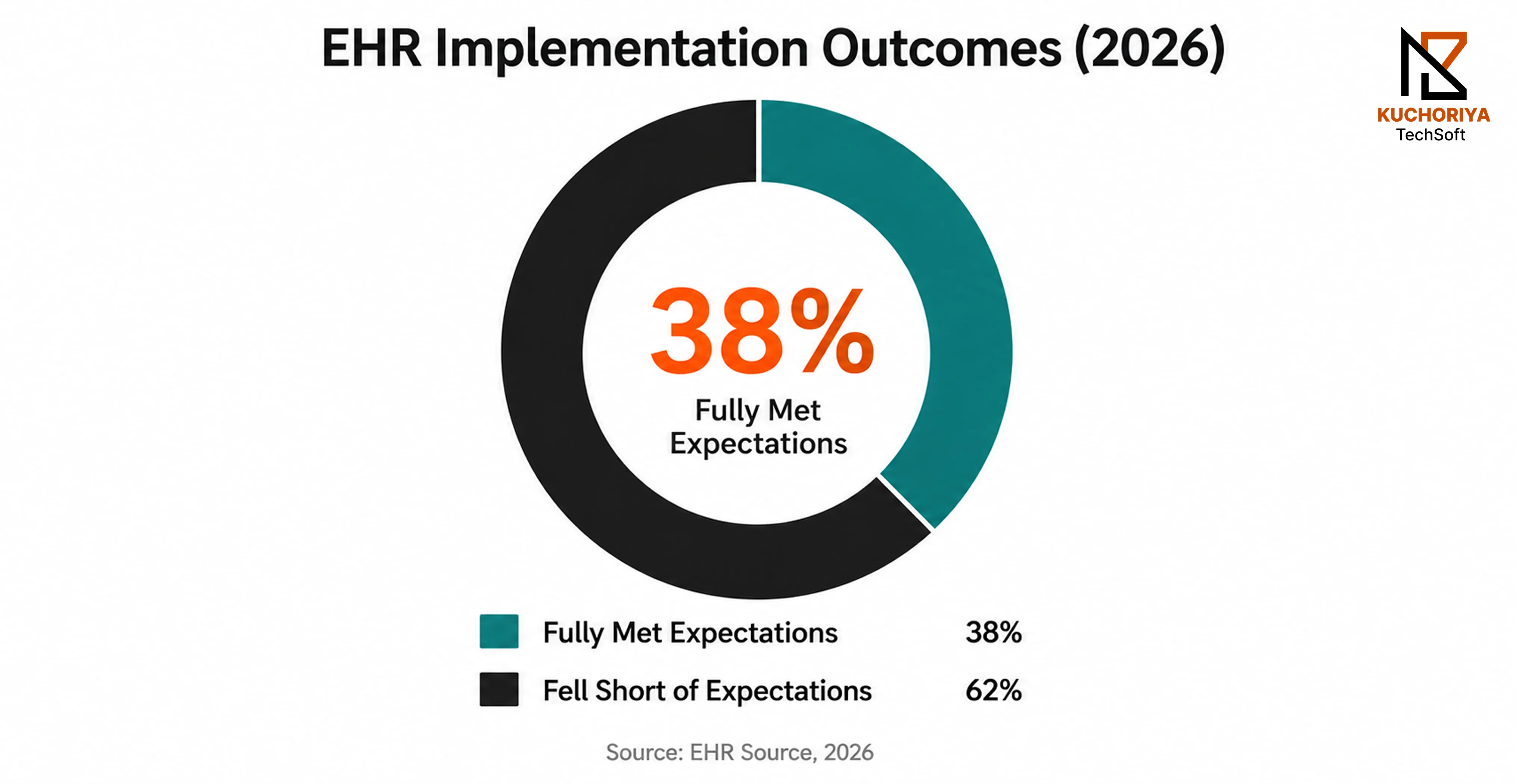
Recent research on EHR rollouts found that 50 to 70 percent of healthcare IT projects fail to meet their original goals, and only 38 percent of organizations say their last rollout fully met expectations. (Source)
That's why how to choose a hospital management software development company matters more than comparing feature lists. A rushed pick shows up later as broken healthcare interoperability, weak healthcare data security, and staff quietly back on spreadsheets.
The right partner treats digital hospital transformation as an ongoing relationship, understands patient management workflows for clinics and ambulatory care software networks alike, and builds a proper hospital information system software, not a template with features bolted on.
That's also the gap between generic vendors and real hospital software development services and why some hospitals choose hospital software outsourcing over hiring in-house.
What Qualities Make a Hospital Management Software Development Company Reliable?
Not every hospital management software development company builds systems the same way. Some show up with a template and a pitch deck. Others actually understand what a hospital floor looks like at 7 AM. Here's what separates the two.
- A genuine healthcare software partner opens with questions about your referral patterns and department bottlenecks, not with a demo.
- Multi-department rollouts are where an enterprise hospital software company proves itself, since a single clinic build doesn't prepare a team for five departments running on five different workflows.
- A children's ward and a radiology department run like two separate operations, even inside the same multispecialty hospital software setup, and good teams design around that instead of ignoring it.
- Walk-ins, referrals, and double bookings collide on the same day in a real hospital, so appointment scheduling needs to handle that mess, not just look clean in a demo.
- HIPAA compliance has to sit inside the architecture from day one, because retrofitting it later usually means rebuilding half the system.
- Telemedicine software development experience matters now, since patients expect a remote option the same way they expect online check-in.
- A dependable hospital software development partner stays involved after go live instead of disappearing once the invoice clears.
- Calling itself a healthcare technology company means little without a verifiable track record, not just homepage testimonials.
- Practical healthcare operations management knowledge is what separates teams who've run hospital systems day to day from teams who've only studied them.
How Do You Assess Experience, Portfolio, and Client Success?
A polished website doesn't prove a hospital management system development company can deliver. Past work and client feedback tell the real story.
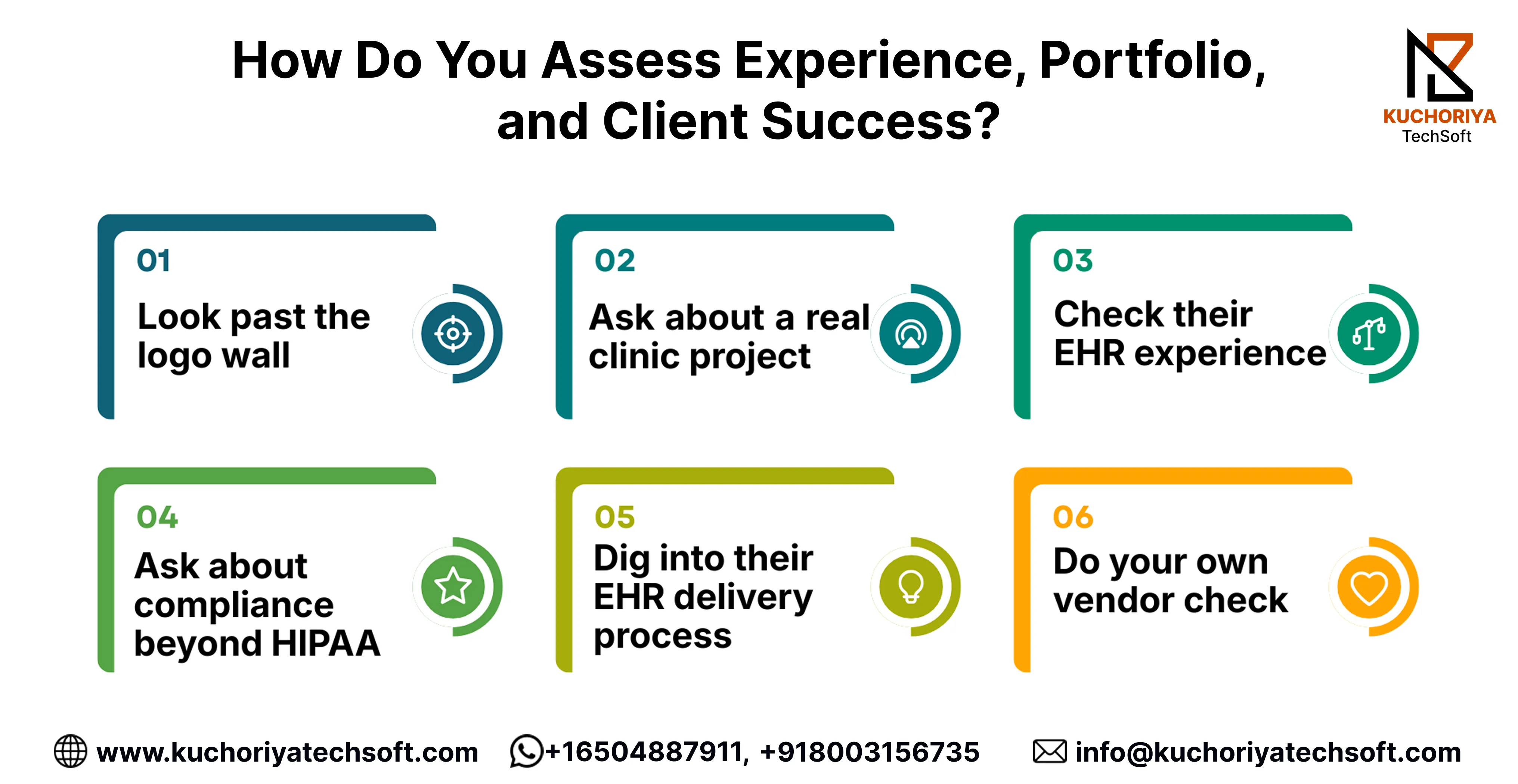
1. Look past the logo wall
Ask a medical software development company what they actually built, not just which names they've worked with. A custom hospital management software company worth hiring shares real specifics, not just a client list.
2. Ask about a real clinic project
If clinic management software development is part of their pitch, have them walk through one project start to finish, including what went wrong.
3. Check their EHR experience
Working with electronic health records means more than a checkbox. Ask how they've handled EHR data structure and legacy migrations before.
4. Ask about compliance beyond HIPAA
If they've worked with Canadian clients, ask about PIPEDA compliance specifically. Teams built only for US rules often miss this.
5. Dig into their EHR delivery process
For EHR software development, ask how they handle interoperability and data accuracy testing before launch.
6. Do your own vendor check
Run a proper healthcare software vendor evaluation by talking to past clients directly. Ask about their doctor management approach and whether their patient engagement platform actually improved patient follow-through.
How Do You Evaluate a Company's Technology Expertise and Innovation?
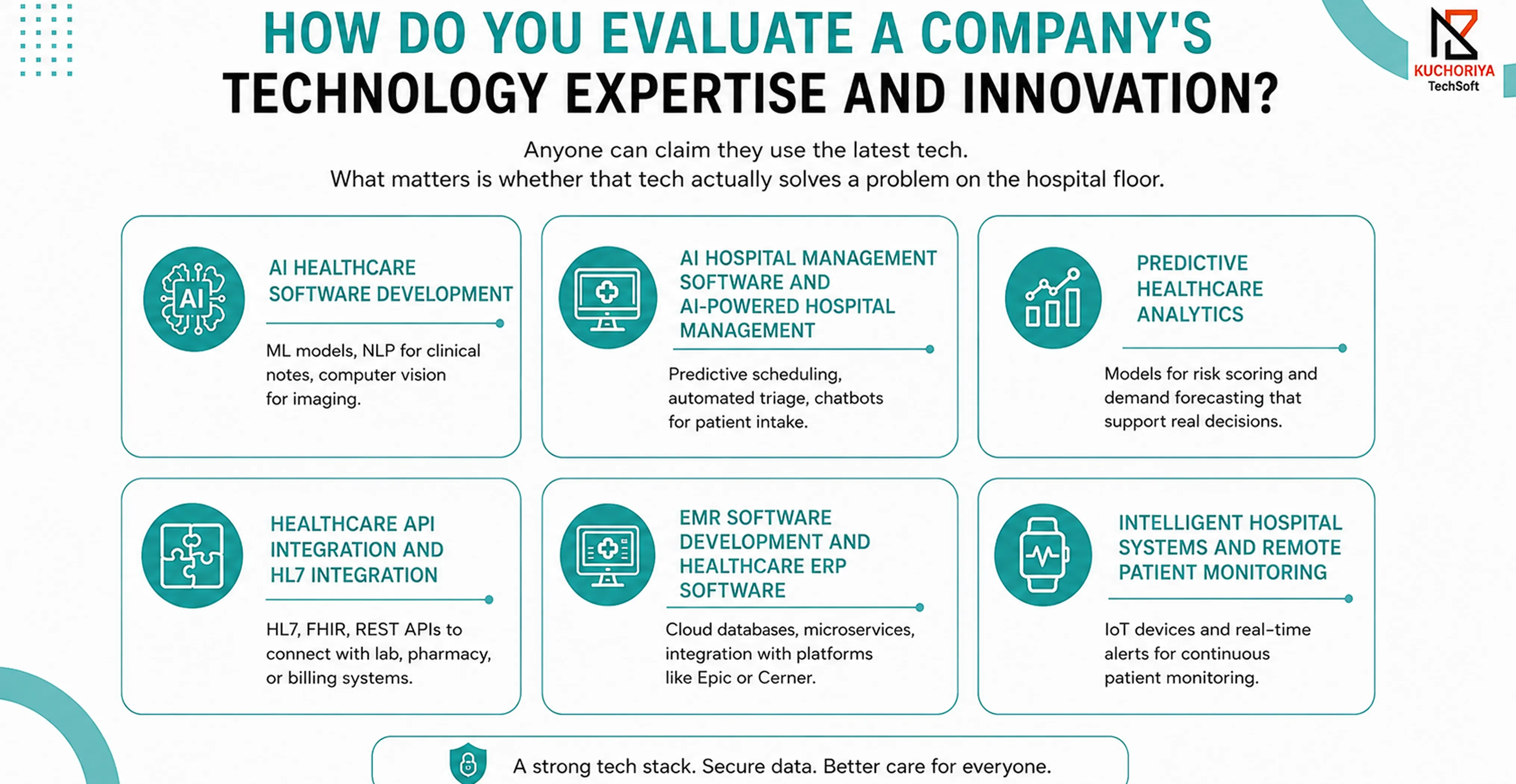
Anyone can claim they use the latest tech. What matters is whether that tech actually solves a problem on the hospital floor.
How Do Pricing Models and Long-Term Development Costs Compare?
Price alone won't tell you whether a company is worth hiring. The pricing model behind that number matters more, along with what it costs a year after launch.
Common Pricing Models for Hospital Management Software
An HMS development company should explain which model they default to and why, since the wrong fit here is usually what causes scope disputes later. Healthcare software consulting upfront adds cost early but tends to catch expensive mistakes before they turn into rework.
The best hospital management software development company rarely wins by being the cheapest; they win by being upfront about what's in the base quote versus what gets billed later, things like Radiology Information System (RIS) integration, extra billing management modules, or Revenue Cycle Management Software that's often quoted separately from the core build. Location matters too; a hospital software development company in California or a Healthcare Software Development New York teams usually costs more than teams elsewhere, while hospital management software Texas vendors sometimes come in cheaper but with fewer specialists on staff, which is worth weighing during hospital management software company selection.
Approximate Cost
These figures shift based on module count, compliance scope, and how many existing systems the new platform needs to integrate with. A detailed proposal from a proven HMS development company beats a ballpark number every time.

What Questions Should You Ask Before Signing a Contract?
A good proposal can hide a lot of gaps. Ask these before you sign anything.
1. "Which FHIR and EMR standards have you actually implemented?"
Don't settle for a general "yes, we do that." Push them to name the actual standards and the project they used them on. FHIR integration and EMR integration look nothing alike from one hospital to the next.
2. "Walk me through an EHR integration that went wrong."
Every vendor says their EHR integration work is clean. Watch how they respond when you ask about the one that wasn't; that's usually where you learn something real.
3. "How exactly do you handle consent and data residency under GDPR?"
If EU patient data is in the picture, don't accept "we're GDPR compliant" as an answer. Ask where the data physically sits and how consent actually gets recorded. That's the real test of GDPR compliance.
4. "What does your healthcare cybersecurity process look like?"
Ask about their incident response plan and when their last security audit happened. Vague answers here are a red flag for healthcare cybersecurity.
5. "Will you stay on as our implementation partner after launch?"
Ask what support looks like in the first ninety days. A real hospital software implementation partner doesn't disappear once the system goes live.
6. "What's your experience with lab and inventory systems?"
Ask about their laboratory management software, laboratory information management software, and inventory management work, and whether they can name real clients as a healthcare IT company.
What Mistakes Should You Avoid When Hiring an HMS Development Company?
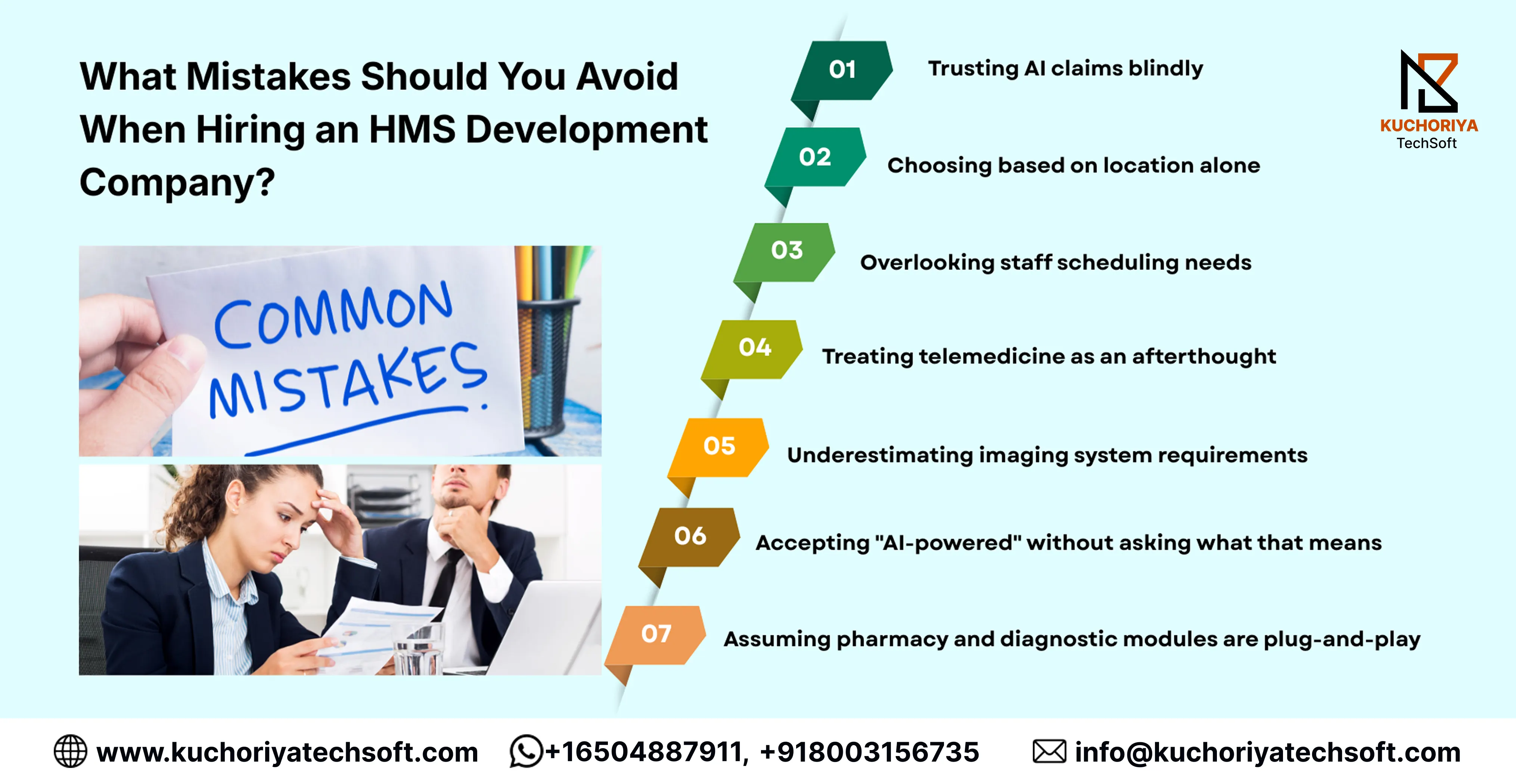
Most bad hires don't come from a lack of research, they come from skipping the same few checks every time.
1. Trusting AI claims blindly
Almost every pitch mentions AI patient management or AI healthcare automation. Push past the slide and ask them to show the feature working, not describe it.
2. Treating telemedicine as an afterthought
Telemedicine integration often gets bolted on near the end instead of planned from the start. That's usually why the video calls feel clunky later.
3. Overlooking staff scheduling needs
Staff management rarely comes up in the first meeting. But shift swaps, coverage gaps, and credentialing are what your team deals with daily once it's live.
4. Assuming pharmacy and diagnostic modules are plug-and-play
Pharmacy Management Software and Diagnostic Center Management Software both need to fit how your hospital actually runs, not a generic template dropped in.
5. Choosing based on location alone
An HMS Development Florida or medical software development Chicago team isn't better just for being nearby. Actual hospital software experience matters more.
6. Accepting "AI-powered" without asking what that means
AI in healthcare software sounds impressive until you ask a follow-up question. What's it trained on, and how do they measure accuracy?
7. Underestimating imaging system requirements
A Picture Archiving and Communication System (PACS) needs to move large imaging files without lag and connect cleanly to radiology workflows. Cheap to get right early, painful to fix later.
Must Read: Hospital Management Software Development: Build a Future-Ready HMS
Why Is Kuchoriya TechSoft a Trusted Hospital Management Software Development Company?
Plenty of companies claim they can build hospital software. Here's what actually backs that claim at Kuchoriya TechSoft.
- As a healthcare software development company, the team builds around how a hospital actually operates day-to-day, not a generic template pushed out to every client.
- Every engagement runs as a custom HMS development company would approach it, starting from your workflows instead of forcing your hospital into a pre-built structure.
- Beyond hospitals, work as a healthcare app development company covers patient-facing apps too, since care now extends well past the hospital walls.
- Hospitals that hire hospital software developers here get a team that's actually shipped multi-department systems before, not just read about them.
- Digital health software development spans everything from patient intake to post-discharge follow-up, built as one connected system rather than disconnected pieces.
- Healthcare CRM development work focuses on keeping patient relationships and communication organized, especially across larger hospital networks with multiple touchpoints.
- Hospital ERP software built here ties together billing, inventory, and staff operations so departments aren't running on separate disconnected tools.
- Medical practice management software gets built for both single clinics and larger multi-specialty practices, scaled to whatever the client actually needs.
- As a hospital management system provider, the relationship doesn't end at launch; ongoing support and updates are part of how the team works.
- Patient Portal Development is built with actual patient usability in mind, not just a checkbox feature added to satisfy a requirements list.
What's the Final Checklist for Choosing the Right HMS Development Partner?
Done with the research, done with the questions. Just one last pass before you sign.
Check that experience spans regions, not one city repeated everywhere, covering Hospital Management Software Los Angeles, Hospital Software Development Toronto, Healthcare Software Development Ontario, and HMS Development Vancouver. Look for real project history in Hospital Management Software Montreal and Hospital Software Development London, and if global reach is claimed, confirm it's backed by actual work in HMS Development Birmingham, Hospital Software Development Sydney, and HMS Development Brisbane.
If home healthcare software matters to you, make sure it's actually built for remote care, not just in-hospital workflows. Beyond that, confirm a written support plan, real references, and a pricing breakdown with no surprise line items later.
Tick all of that, and you've found a real hospital software development partner offering genuine hospital software development services, backed by outsourced CTO services for hospitals that need ongoing technical leadership, not just another vendor with a good pitch deck.
Still deciding? Contact Kuchoriya TechSoft for a free consultation, or ask about the partner and referral program if you're an agency looking to collaborate. Get in touch to talk through your hospital software development services needs.
Frequently Asked Questions (FAQs)
Q. Do you build hospital software for markets outside the USA and UAE?
A. Yes, past work includes hospital software development in Dubai and healthcare software in Abu Dhabi, so regional compliance and workflow differences aren't new territory.
Q. Can you handle projects in Asia and Europe too?
A. Yes, the team has delivered Hospital Software Development Singapore and Hospital Software Berlin projects, each adapted to local regulatory requirements.
Q. What about the Middle East and Latin America?
A. Coverage extends to Hospital Software Riyadh and Hospital Software Mexico City as well, with each build shaped around the local healthcare setup.
Q. Can telemedicine be added into the system?
A. Yes, telemedicine platform development can be built as part of the core system or as a separate module, depending on what fits the hospital's setup.
Q. Do you build for nursing homes, or only acute care hospitals?
A. Both nursing home management software get built around long-term care workflows, which run quite differently from a standard hospital environment.
Q. Is the software custom-built or based on a fixed template?
A. Everything falls under custom hospital management software development, shaped around how a specific facility actually runs rather than forced into a generic structure.
Q. Is a cloud-based option available instead of on-premises software?
A. Yes, Healthcare SaaS Development is offered for hospitals that prefer a subscription model, which tends to work well for smaller facilities that are scaling up.