Top Insurance App Development Companies in the USA: 2026 Overview
Choosing between insurance app development companies is harder than it looks, and a wrong pick can cost months. This list compares vendors on insurance experience, security, and delivery, not on sales pitches.
What does an insurance app development company do for a carrier or broker? It builds and connects the software behind quotes, policy portals, claims intake, and underwriting, then keeps it secure and compliant.
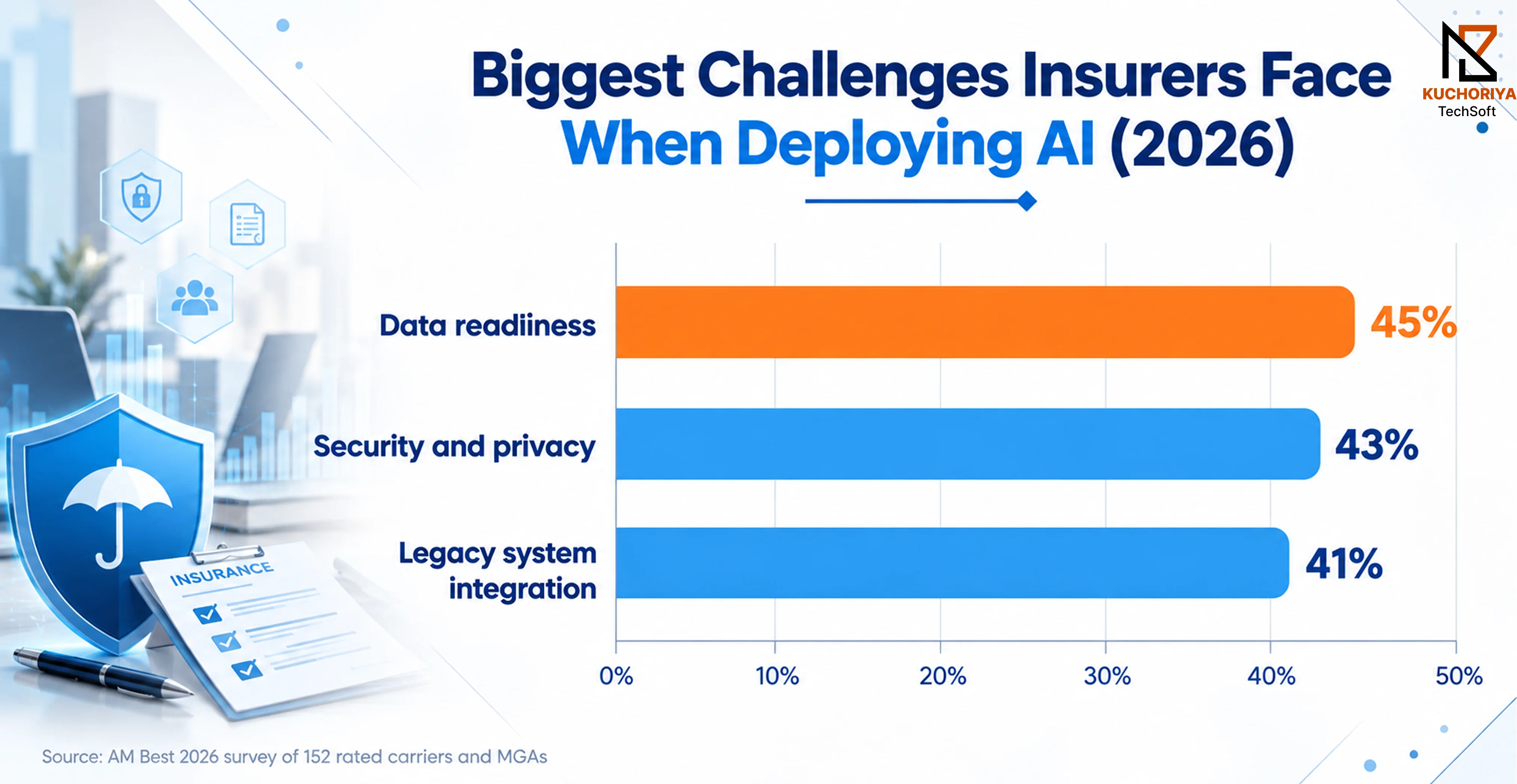
The pressure to modernize is real. AM Best's 2026 survey names data readiness (45%), security (43%), and legacy integration (41%) as insurers' biggest AI hurdles. J.D. Power's 2025 study found 52% of policyholders with a poor digital claims experience are likely to leave, against just 4% of those with an excellent one. Insurity's 2026 survey shows consumer support for insurer AI rising from 20% to 39%.
The fix starts with the right partner. A true insurance technology company connects old systems first, adds AI only to low-risk steps like claims intake, and gives policyholders live claim status.
Digital insurance now decides who keeps customers, and insurance app development in 2026 favors teams that handle data, compliance, and user experience together. The list below ranks insurance app development companies in the United States on exactly that. Searching for an insurance app development company USA wide? You can share your project scope and get a shortlist matched to your goals.
Why Insurance App Development Is Growing in 2026
InsurTech has moved from a startup experiment to core insurance infrastructure. In 2026, money, AI adoption, and customer demand all point the same way. Here is what is pushing the growth.
- Global venture funding hit $2.44 billion in Q2 2026, the best quarter since 2022, per Gallagher Re.
- AI-focused firms took 99.1% of that money.
- Grant Thornton finds 62% of insurers are scaling AI across several functions.
- Conning's 2025 survey placed 90% of carriers somewhere on the generative AI path, so generative AI in insurance is past the lab stage.
- Only about half of policyholders trust insurers to use AI responsibly, so AI in insurance 2026 needs visible guardrails.
- The US embedded insurance market is estimated at $53.8 billion in 2026, as retailers, banks, and apps sell cover at checkout.
- Venture money for pure embedded platforms fell to about $20 million so far in 2026, so vendor stability deserves a check.
- US insurance IT budgets are projected at $173 billion in 2026, up 7.8% year over year.
- That spend keeps InsurTech development companies busy, especially where legacy systems block AI rollouts.
- North America logged 20 funding deals worth about $816 million so far in 2026, which keeps insurance technology companies in the USA in demand.
How We Evaluated These Insurance App Development Companies
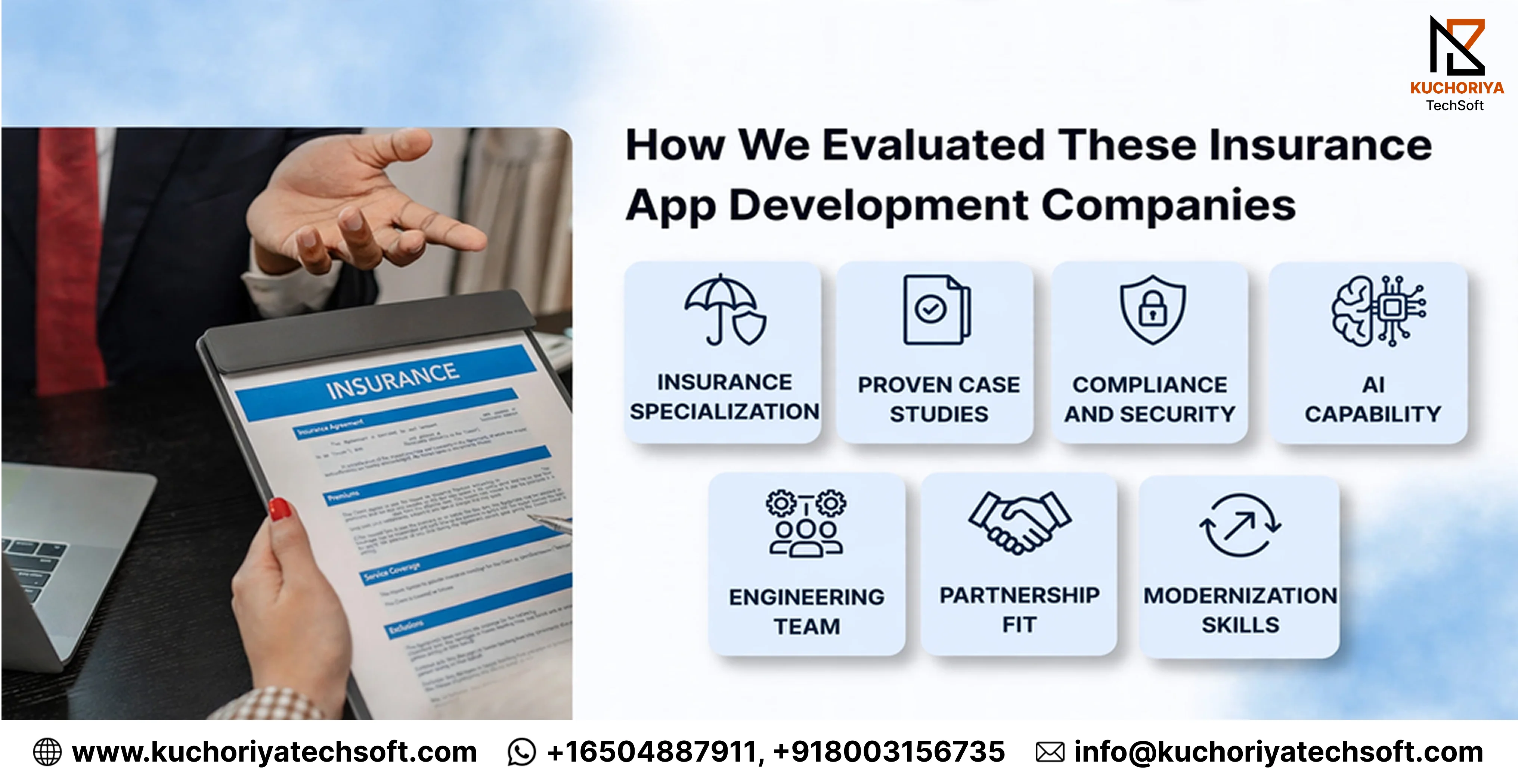
Wondering what to look for in an insurance app developer? We used seven checks, each tied to a risk buyers face after signing. Every company below was scored on the same list.
1. Insurance Specialization
We looked for real insurance domain expertise first. Teams that know policy, claims and underwriting flows do not learn them on your budget.
2. Proven Case Studies
Published insurance technology case studies with clear outcomes counted more than logos. No results shown, no credit given.
3. Compliance and Security
We checked how each firm handles insurance compliance software development, from audit trails to access controls. Sensitive policyholder data leaves no room for shortcuts.
4. AI Capability
Firms had to show working machine learning insurance applications, such as fraud scoring or claims triage, running in production. A demo alone did not count.
5. Engineering Team
We checked who actually builds the product. Experienced insurance software developers matter more than a polished sales team.
6. Partnership Fit
A good insurance app development partner shares roadmaps, flags risks early and stays involved after launch. Vendors who vanish after go-live lost points.
7. Modernization Skills
Carriers with aging systems need an insurance technology partner for digital transformation who connects legacy platforms through APIs first. That order saves costly rework.
Top 10 Insurance App Development Companies in the USA for 2026
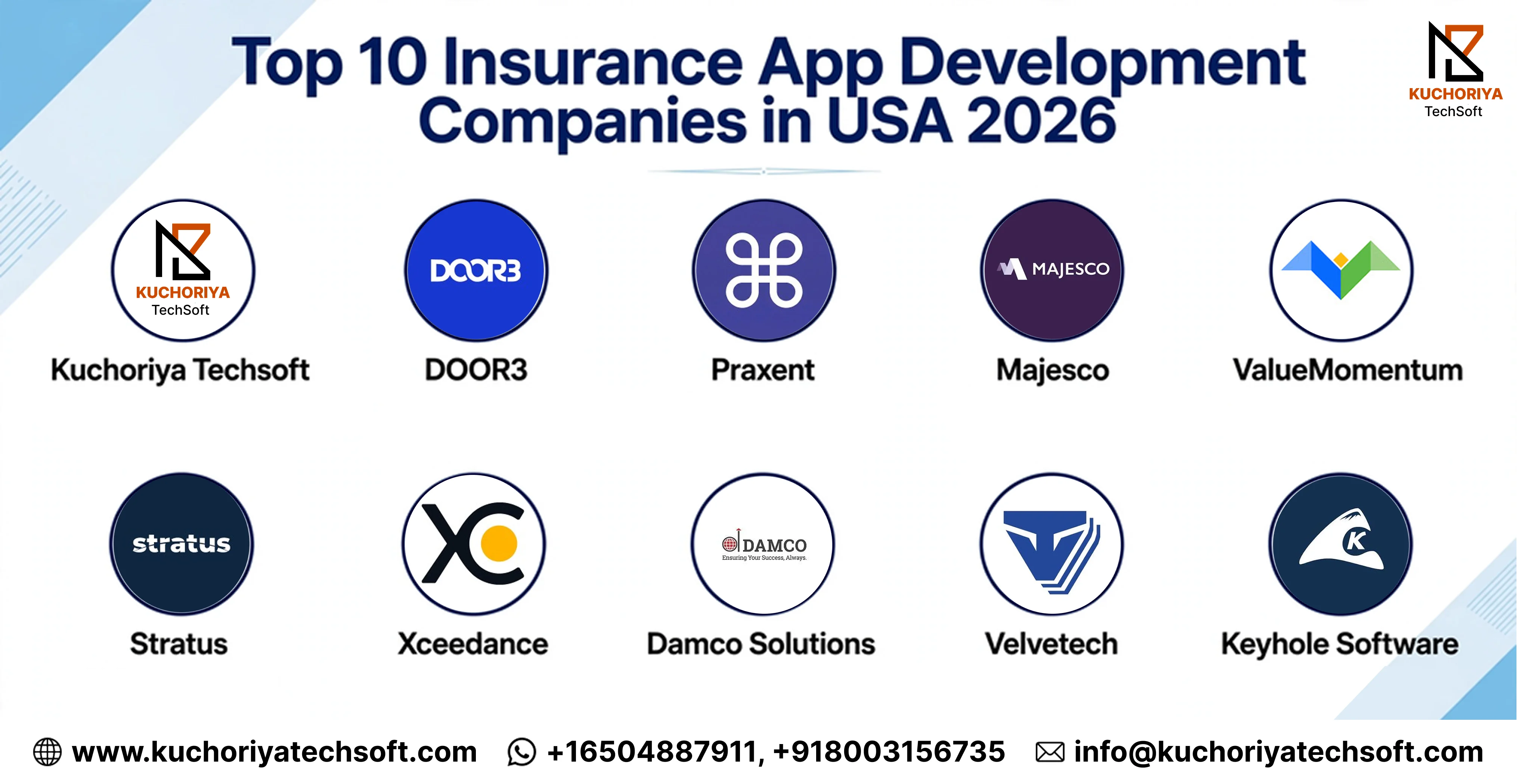
Ten teams made this list, and each one has real insurance work behind it. All of them were checked against the seven criteria from the previous section, so you can compare them side by side.
1. Kuchoriya Techsoft: AI-Led Insurance App Development
Overview: Kuchoriya Techsoft is an insurance app development company that builds software for carriers, brokers and InsurTech startups. The team works from offices in the USA and Dubai and has served clients in more than 50 countries. Their focus is custom insurance app development, so each product fits the client's own policy, claims and customer flows. Their AI insurance app development work cuts manual steps and keeps policyholders engaged after the first login. Clients get one team from planning to launch and support.
Notable Projects:
- An AI-powered insurance platform that raised customer satisfaction and cut claim processing time by 40%.
- Personalized policy suggestions built into customer-facing apps.
- Predictive analytics that help teams make faster, better-informed decisions.
2. DOOR3
Overview: DOOR3 was founded in 2002 and is headquartered in New York City, so it is a natural pick for anyone searching for an insurance app development company in New York. It offers secure insurance application development for policy administration, client management and carrier integrations.
Notable Work: Built quote generation and claims tools for insurance clients, including Surex Direct, a Canadian broker.
3. Praxent
Overview: Praxent is based in Austin and is one of the better-known names when buyers look for an insurance app development company in Texas. It pairs UX design with engineering and often shows up on shortlists of insurance mobile app development companies that build policyholder apps, customer portals and broker platforms.
Notable Work: More than 450 digital transformation projects for insurance and financial clients, including Texas Mutual and Ameritas.
4. Majesco
Overview: Majesco is based in Morristown, New Jersey, and has been in the insurance software business since 1982. It offers cloud-native suites for P&C and life, annuity and health carriers, with strong insurance claims management alongside policy and billing.
Notable Work: Majesco Claims, plus Majesco Copilot, a Gen AI assistant for faster customer servicing and operations.
5. ValueMomentum
Overview: ValueMomentum is based in Piscataway, New Jersey. It knows Guidewire, Duck Creek, OneShield and Insurity well, which suits enterprise insurance software development at large carriers.
Notable Work: Supports more than 100 insurance clients, including Erie Insurance and Acuity Insurance.
6. Stratus
Overview: Stratus works only in P&C insurance, from Shrewsbury, New Jersey. It moves legacy systems to cloud-native, API-first setups around Guidewire and Insurity.
Notable Work: Holds Guidewire's PEAK Performer badge, with clients such as Idaho Farm Bureau Insurance and California Casualty.
7. Xceedance
Overview: Xceedance is headquartered in Boston and serves P&C carriers, brokers and MGAs. Its AI Center of Excellence covers underwriting and servicing, so it belongs on any list of leading InsurTech development companies USA buyers can shortlist.
Notable Work: Reports 350+ insurance clients and AI proofs of concept in 6 to 8 weeks.
8. Damco Solutions
Overview: Damco is based in Plainsboro, New Jersey, and has built insurance software for over 20 years with a low-code focus. Its claims automation platforms are a good starting point for teams planning an insurance claims app.
Notable Work: Own products include InsureEdge, InsuraCRM and CX Portals, backed by 85+ insurance clients.
9. Velvetech
Overview: Velvetech is based in Chicago and has 20+ years of experience. It connects with Guidewire, Applied Epic, HawkSoft and AMS360, so new apps plug into the tools agencies already use.
Notable Work: An insurance app development portfolio that includes Insureon, with quick proofs of concept and fast team ramp-up.
10. Keyhole Software
Overview: Keyhole is from Lenexa, Kansas, and keeps its entire team in the US, so buyers get onsite meetings. That makes it a practical custom insurance app development company for P&C, health and supplemental lines.
Notable Work: Clients include Brightway Insurance, Lockton and the NAIC.

Insurance App Development Companies Comparison
Every insurance software development company on this list has a different strength. Some of the top InsurTech companies in USA build custom apps, and others run core platforms. Here is how the top insurance app development companies compare.
Large carriers usually shortlist insurance app development companies for enterprises, such as ValueMomentum and Majesco. Teams moving off old systems can look at Stratus for cloud-based insurance software. If insurance API integration is your main problem, Velvetech is worth a call. For faster claims, AI claims processing is where Kuchoriya TechSoft and Xceedance stand out.
How to choose an insurance app development company from this list? Start with your insurance line, your existing systems and the kind of team you want. Ask each firm for a case study close to your project, then narrow the list.
Industry Insights: A Complete Guide to Insurance App Development: Features, Benefits & Types
Key Capabilities of Leading Insurance App Development Companies
The best insurance app teams share a short list of skills. Here is what to look for when you compare them.
- AI-powered insurance applications handle repetitive work like claims intake and document checks, so staff spend time on cases that need a person.
- AI underwriting software reads applications and past data to score risk faster and flags unusual cases for review.
- AI fraud detection insurance tools spot odd claim patterns early, before a payout goes out.
- An insurance agent portal gives agents one place for quotes, policy details and client records.
- Biometric authentication insurance app features, like fingerprint or face login, protect policyholder accounts without extra passwords.
- Policy management software covers the full policy cycle, from issue to renewal, in one system.
- The insurance app technology stack should be proven, secure and easy to connect with old carrier systems.
Ask each vendor to show at least three of these running in a live product, not just in a demo.
Insurance Technology Trends to Watch in 2026

The InsurTech trends 2026 that matter most are practical ones: faster underwriting, smarter pricing, and cleaner systems. Here are the insurance software development trends for 2026 to watch.
1. Telematics Insurance
Telematics insurance is changing how policies are priced. Usage-based models adjust coverage and pricing using data from telematics, mobile apps, or IoT devices.
2. Underwriting Automation
Underwriting automation is moving from pilot to daily use. Automating underwriting with AI and machine learning is one of the key growth drivers in the InsurTech market, which is projected to grow from $23.54 billion in 2026 to $132.71 billion by 2034.
3. Legacy Insurance System Migration
Legacy insurance system migration is picking up speed. Moving to cloud-native core systems has reached an inflection point in 2026, as old platforms struggle with modern speed and integration needs.
4. Predictive Analytics Insurance
Predictive analytics insurance tools help carriers judge risk with better data. Big data and predictive analytics are named as a major driver of market growth.
5. Growing Demand for US Insurance App Developers
Demand for US insurance app developers is rising as American insurers modernise old systems and speed up digital change. Rules also differ by state, so compliance needs real investment.
Expert Perspective: How to Build an Insurance App MVP That Attracts Users and Investors
How to Develop an Insurance Mobile App: Process, Cost, Technology & Timeline
What to Expect From an Insurance App Development Partner
Picking a vendor is easier when you know what a good one looks like. Here is what your insurance app development services should include.
- Discovery comes first. The team talks to your claims and product people and maps how work moves today, before a single screen gets designed.
- insurance app development services worth paying for cover testing, integrations, and security too. Otherwise you end up hunting for a second vendor halfway through.
- Your insurance CRM has to connect to the app. An agent should see a client's policy and claim history without switching tabs.
- You should see working screens every couple of weeks. A status email alone tells you very little.
- Support matters after launch. Real users find bugs fast, and someone needs to fix them.
How long does it take to build an insurance app?
A simple insurance MVP app with quotes and a policy view takes about 3 to 6 months. Add claims, an agent portal, and CRM links, and it stretches to 9 months or more. Coding is rarely the slow part. Carrier integrations and compliance checks are. So ask for a timeline split by phase.
Which insurance software development companies are worth hiring?
Go for insurance software development companies that can show you a live insurance product. Then ask how long they stay on after go-live.
Related Reading: Top 20 Insurance App Development Companies in Canada (2025-26)
Why Choose Kuchoriya TechSoft for Insurance App Development
Kuchoriya TechSoft is an insurance app development agency that builds software for carriers, brokers, and InsurTech startups. The team works from offices in the USA and Dubai and has served clients in more than 50 countries. Here is what sets it apart.
- AI sits at the center of the work. Kuchoriya built an AI-powered insurance platform that raised customer satisfaction and cut claim processing time by 40%.
- Apps are built around your own policy and claims flows, not a ready-made template.
- Personalized policy suggestions and predictive analytics can go into customer-facing apps from day one.
- You deal with one team from the first workshop to launch and support, so nothing gets lost between vendors.
- Clients in the USA get insurance app development services USA businesses can reach easily, with a team used to working across time zones.
Can I hire insurance software developers from Kuchoriya TechSoft?
Yes. You can hire insurance software developers for a full project or add them to your in-house team. Tell the team what you are building, and they will suggest the right setup.
How do I get an insurance app development quote?
Share your idea, the features you need, and any systems the app must connect to. Kuchoriya will come back with a clear insurance app development quote that lists scope, timeline, and cost.
Looking for insurance app developers USA carriers can trust?
Kuchoriya's insurance app developers USA clients work with know insurance workflows, from quotes to claims. Book a call to talk through your project.
Conclusion: Choosing an Insurance App Development Company
Picking from the many insurance app development companies on the market takes patience. Some teams are strong at custom apps, some at core platforms, and some at moving old systems to the cloud. Start with your own gap, then look at real insurance work, ask hard questions about security and claims, and check how the team behaves after launch. That last part tells you more than any sales call.
Not every insurance startup has a technical lead who can judge vendors. If yours does not, CTO services for insurance app development can fill the gap. A CTO can review proposals, question timelines and make sure the tech stack fits your product before you sign anything.
Once you have a shortlist, talk to each firm about your actual project. If you plan to hire insurance app developers, ask who will build your product and how long they have worked on insurance. A good insurance app development company will answer without dodging. Steady insurance digital transformation comes from small, well-planned steps, so pick a partner who wants to plan that way with you.
Brokers, agencies and consultants often hear about app needs from their own clients. Through our insurance app referral partner program, you can introduce insurance clients who want an app built and have them taken care of by an experienced team. If you would rather work side by side on larger projects, our insurance technology associate partner program is set up for that kind of long-term work.
Whichever route you take, Kuchoriya TechSoft is glad to help you think it through. Reach out to our team through the contact page and tell us what you are building. We will take it from there.
FAQs About Insurance App Development Companies
Q. What features should an insurance app have?
A. Policy details, premium payments and claim filing with photo upload are the must-haves. Add a policyholder portal so customers can find documents and renewals in one place. Chat support and biometric login can wait.
Q. How much does insurance app development cost?
A. It depends on the size of the job. A simple policy-and-payments app is small, while claims, agent logins and carrier integrations add up fast. Send us your feature list and we will reply with a written quote.
Q. How does AI improve insurance apps?
A. It handles the dull jobs, like reading claim forms and spotting odd claims. Customers get answers sooner, and your staff can focus on cases that need a person.
Q. What is the insurance app development process?
A. A few discovery workshops come first. Then design, build, testing and launch, with support after that. Ask any vendor to show the plan phase by phase.
Q. Is insurance app development outsourcing a good idea?
A. Usually yes, since you skip months of hiring and get a team that has done it before. Just make sure they stay in touch after launch.
Q. Do you work with startups and carriers?
A. Yes. For an insurance app development company for startups, we build a small first version fast and grow it later. As an insurance software development company for carriers, we build claims tools, agent portals, and links to older systems.