





How to Develop an Insurance Mobile App?
Most insurance companies get this backward. They hire a developer first and figure out the plan somewhere along the way, which is exactly how budgets double and launch dates slip by months. Anyone actually searching how to develop an insurance mobile app wants a real starting point, not another recycled checklist.
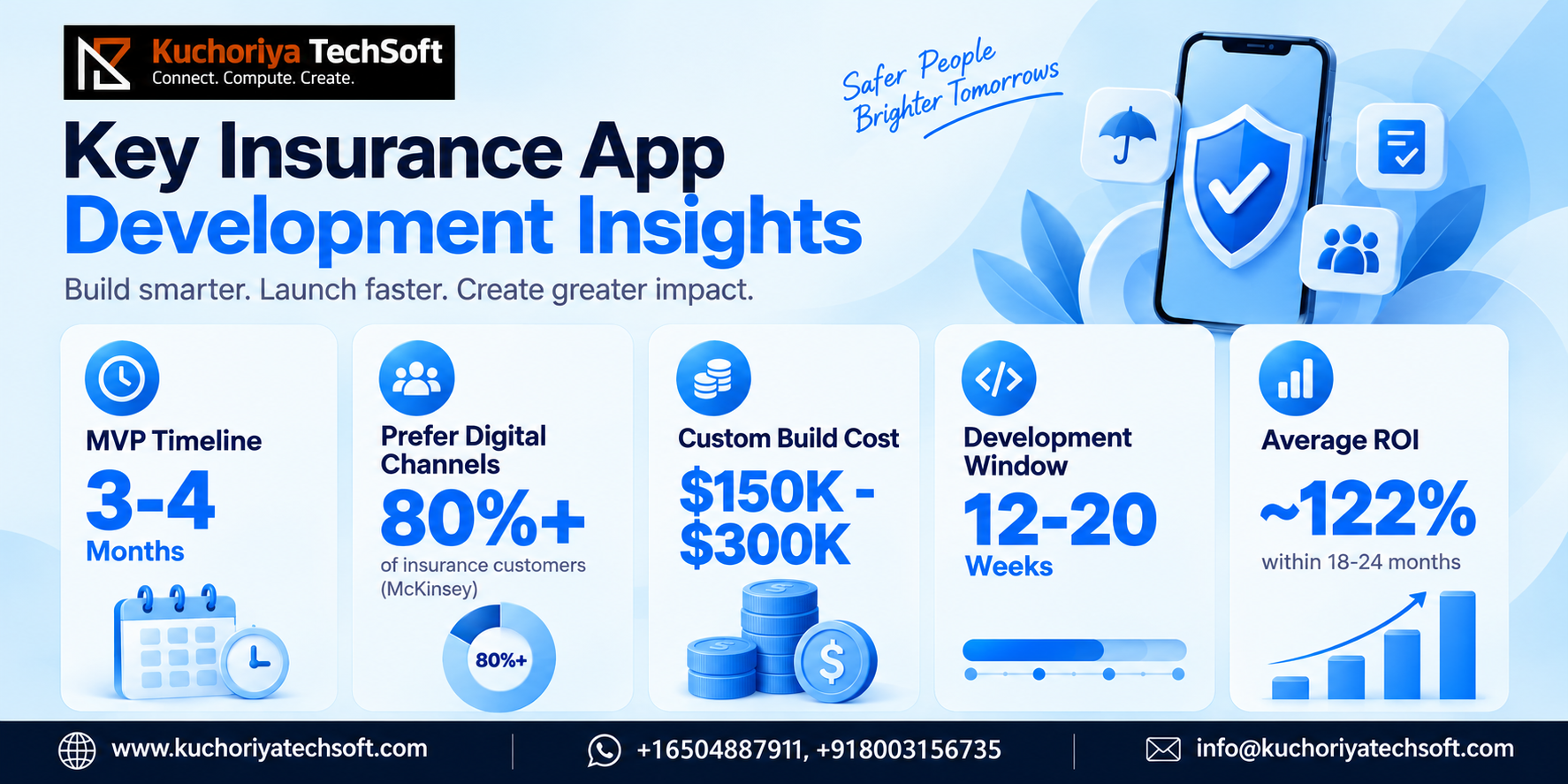
Building one well starts with a solid core insurance software solution, the layer that connects policy data, payments, and everything else underneath. McKinsey found that over 80% of insurance customers now prefer a digital channel over calling an agent, which explains why insurers who stall here keep losing ground.
A customer wants a claim filed in minutes. An agent handling forty policies needs something built for speed under load, not a nicer screen. Mobile insurance app development has to account for both, and timelines shift with that complexity, a lean MVP ships in 3 to 4 months, a fuller build with AI and compliance work runs closer to 9.
Strip away the jargon and what is the insurance app development process comes down to six steps: discovery, design, build, test, launch, support. Insurers who stick with this on focused builds, usually $150K to $300K over 12 to 20 weeks, tend to see returns land around 122% within two years.
Key Steps in Insurance App Development
A clear insurance app development process keeps a project from spiraling into endless revisions and missed deadlines. Here's what actually happens between the first meeting and launch day.
- Nothing gets built without knowing what's actually needed first. Insurance app requirements get documented early, covering everything from user roles to compliance obligations, so nobody's guessing halfway through.
- Before code gets written, there's insurance app planning to sort out, mapping features against budget and timeline so the scope doesn't quietly balloon later.
- Wireframes come next, and this is where insurance app UI/UX design either makes or breaks adoption. A confusing claims form loses users faster than a slow server does.
- Development itself moves through defined insurance app development stages, backend first, then interfaces, then the integrations that tie everything together.
- Larger teams sometimes run a full insurance mobile app development process in parallel tracks, building the customer app and agent app side by side to save time.
- Every one of these insurance app development steps builds on the last, which is why skipping ahead usually means circling back later to fix something.
- Before anything ships, insurance app testing catches the bugs, security gaps, and usability issues that a rushed launch would've missed entirely.
Technology Stack for Insurance App Development
Picking the right insurance app technology stack early avoids the kind of rebuild that eats months of runway later. Here's a breakdown of what actually goes into a modern build.
Insurance App Integrations and APIs
An app that can't talk to the rest of an insurer's systems isn't much use, no matter how polished the interface looks.
- Insurance app integration links the front end to underwriting engines, payment processors, and whatever CRM sales already run on daily.
- Insurance API integration keeps data moving with outside services, credit bureaus, telematics feeds, and document checks, all syncing in real time instead of overnight batches.
- When the right connection doesn't already exist, that's insurance API development stepping in to build a custom bridge to a system that was never meant to talk to mobile software in the first place.
- Insurance app scalability is the difference between a setup that handles 5,000 users fine and one that starts throwing errors the second it hits 50,000.
- Most legacy cores predate modern APIs entirely, so middleware ends up carrying the weight of connecting two systems that were never built to talk to each other.
- Slow sync is its own problem too. A policy update sitting for hours before it shows up in the app makes customers stop trusting the numbers, even once things catch up.
AI and Automation in Insurance App Development
AI insurance app development stopped being optional a while back. Most serious builds start with it baked in, not bolted on after launch.
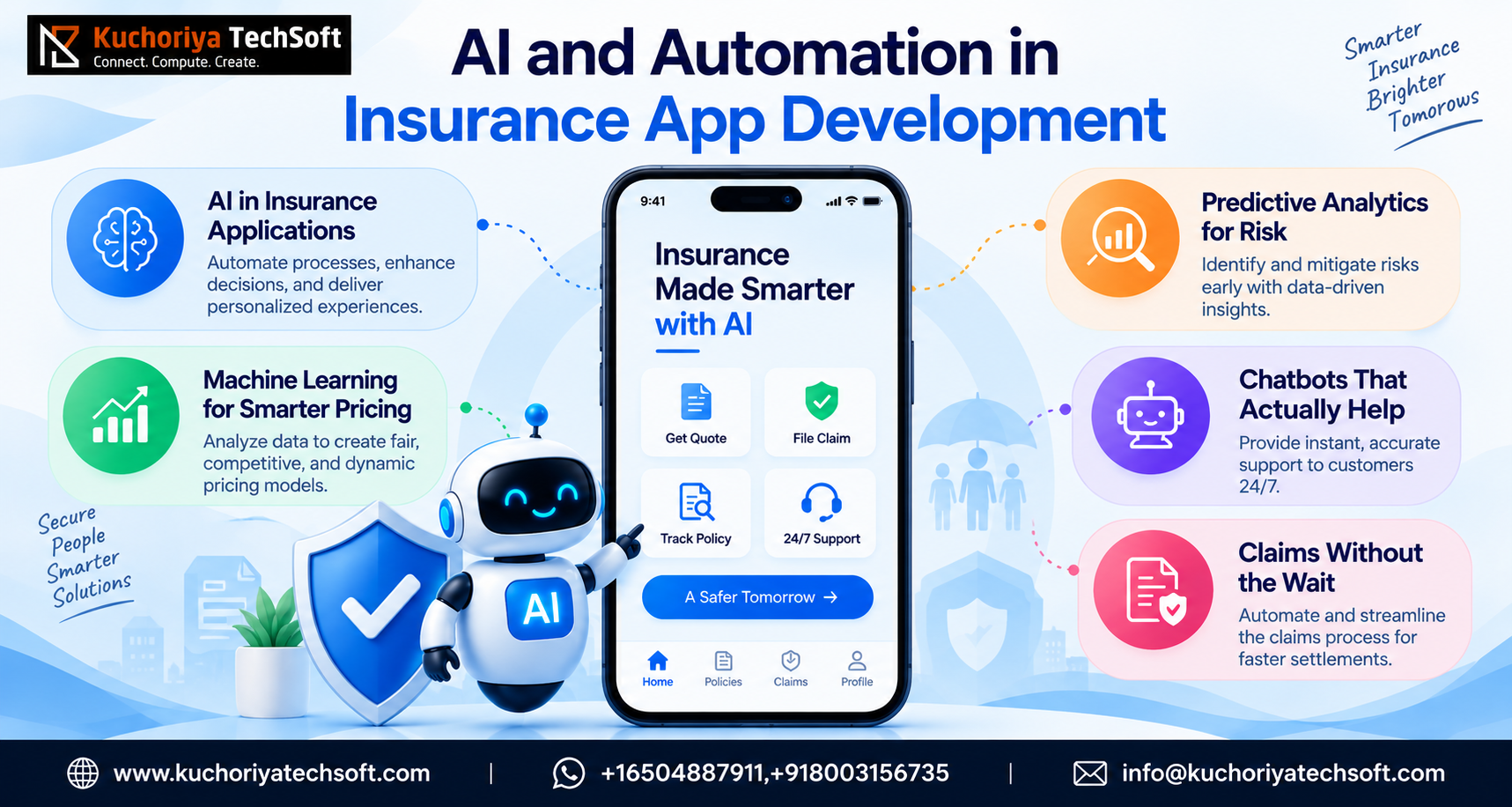
AI in Insurance Applications
Underwriting, fraud checks, and customer support, AI in insurance applications touches all three before a human even opens the file most days.
Machine Learning for Smarter Pricing
Machine learning in insurance catches patterns across thousands of past claims that no fixed pricing formula would ever pick up on its own.
Predictive Analytics for Risk
Predictive analytics in insurance flags a risky policy before it turns into an expensive claim, giving underwriters a head start instead of a nasty surprise later.
Chatbots That Actually Help
Insurance chatbot development handles the repetitive stuff instantly, so support staff isn't stuck answering the same five questions all day.
Claims Without the Wait
Automated claims processing turns a multi-day review into something that clears in hours, usually as part of a bigger claims management software development effort rather than one isolated feature.
How Much Does It Cost to Develop an Insurance App?
Starting cost varies sharply by region, and each market has its own cost drivers too.
- Insurance mobile app development cost for advanced AI-powered builds can reach $80K-$450K+.
- Insurance app development pricing differs mainly due to regional labor costs, not skill gaps.
- Cost to develop an insurance app from scratch runs $150K-$300K for a focused module over 12-20 weeks.
- Insurance mobile app development pricing should include post-launch costs too, roughly 20-30% of the original budget.
- An early insurance app development cost estimate avoids budget surprises down the line.
- Custom insurance app cost depends on compliance scope, integrations, and AI depth.
- Ask how much does it cost to develop an insurance app, and the range runs from $30K lean to $450K+ premium AI-native.
Must Read: A Complete Guide to Insurance App Development: Features, Benefits & Types
How Long Does Insurance App Development Take?
Timeline comes down to scope more than anything else, team size barely moves the needle by comparison.
- A basic insurance app development timeline sits around 3 to 4 months for an MVP with core policy management and claims features, enough to get something in front of real users before committing to a bigger build.
- The question how long does it take to build an insurance app with AI, compliance work, and several integrations gets a different answer, closer to 6 to 9 months, with regulatory requirements usually eating the most time.
- Building out a full Policy Management Software Solution alone can add 4 to 6 weeks to the timeline, since it touches nearly every other feature in the app.
- Multi-region launches stretch things further. An app needing separate compliance sign-off for the US, UK, and UAE markets rarely finishes in under 8 months.
- Cutting corners on this timeline rarely pays off. Skipped testing or compressed sprints tend to show up later as bugs or compliance gaps, costing more to fix than the weeks saved by rushing.
- Ongoing feature updates after launch aren't part of the original timeline but should be budgeted for anyway, most insurers add new capabilities within the first 6 months of going live.
How to Choose an Insurance App Development Company
Picking the right partner shapes everything that comes after, more than any single technical decision.
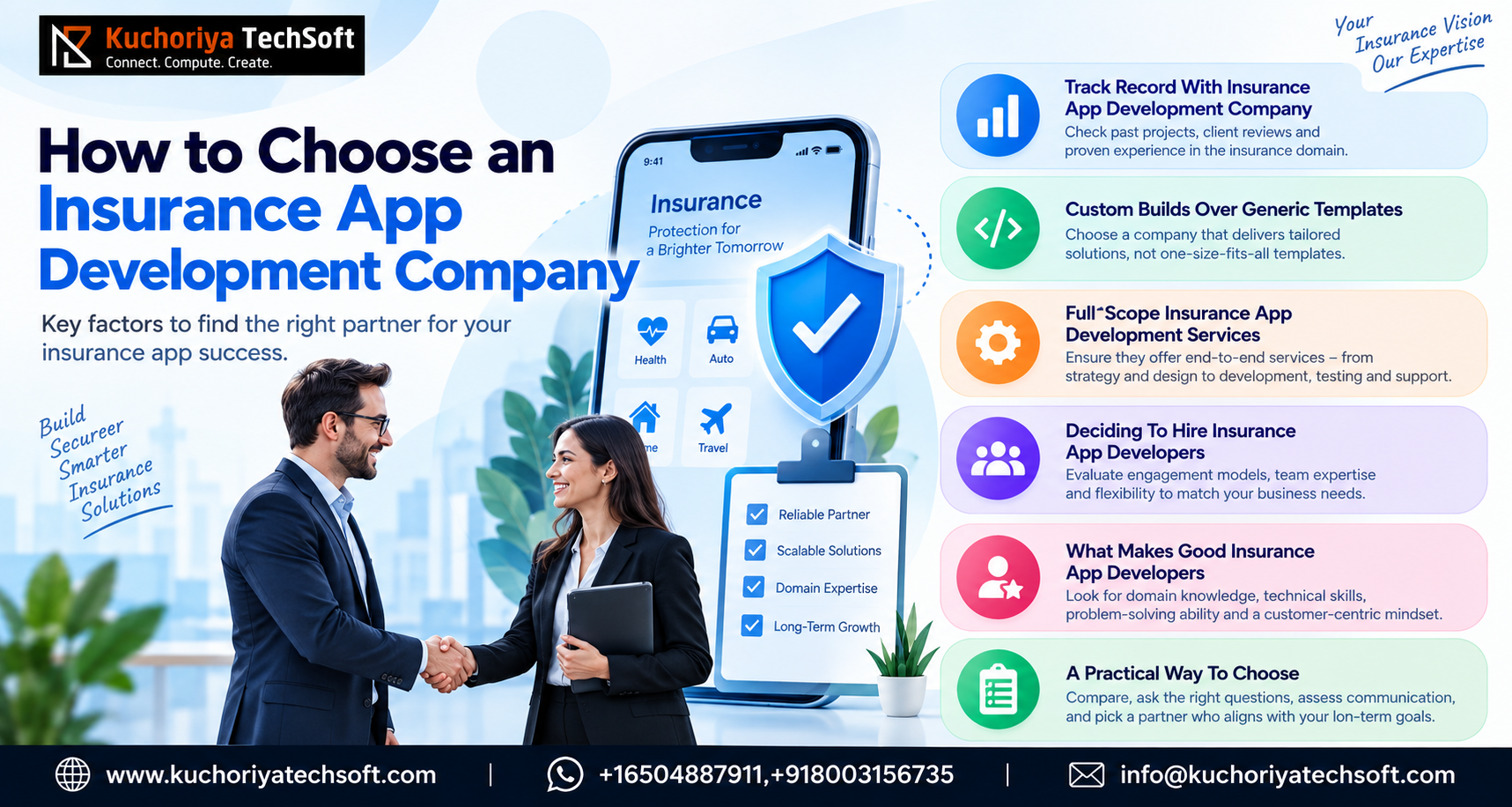
Track Record With Insurance App Development Company
An insurance app development company worth considering has actual fintech or insurance projects behind it, not just generic app work.
Custom Builds Over Generic Templates
Custom insurance app development matters more than most businesses realize, since off-the-shelf solutions rarely fit specific compliance or workflow needs.
Full-Scope Insurance App Development Services
Real insurance app development services cover design, backend, integrations, and post-launch support, not just the initial build.
Deciding To Hire Insurance App Developers
The decision to hire insurance app developers usually comes down to checking portfolio depth before comparing pricing.
What Makes Good Insurance App Developers
Strong insurance app developers understand compliance requirements as well as they understand code.
A Practical Way To Choose
Learning how to choose an insurance app development company comes down to three things: proven experience, transparent pricing, and support that continues after launch.
Why Kuchoriya TechSoft Is a Global Insurance App Partner
Global insurance companies need a partner who understands both the technology and the regional rules shaping it.
Mobile insurance app development here covers the full lifecycle, planning through post-launch support, with real insurance CRM & customer engagement work behind the team's project history. Clients across multiple regulatory environments treat Kuchoriya as a trusted insurance app development company precisely because compliance never gets treated as an afterthought. Being counted among the best insurance app development company options usually comes down to one thing: consistency, and that's what keeps clients across these markets coming back.
Conclusion: Building a Scalable Insurance App
Getting an app live is one milestone. Keeping it running smoothly for years is a different challenge entirely.
Insurance app deployment only marks the starting line, not the finish. The real test comes after launch, when actual users start relying on the app daily instead of a demo environment handling test data.
That's where insurance app maintenance earns its keep. Security patches, performance tuning, and feature updates need to happen continuously, or the app that looked modern at launch starts feeling dated within a year.
Businesses that don't want to manage this alone can bring in outside insurance tech leadership through Kuchoriya TechSoft, getting senior architecture and strategy guidance without hiring a full-time executive.
Agencies interested in offering insurance app development to their own client base can look into the Associate Partner Program.
Freelancers and independent consultants tend to find better fit through the Referral Partner Program instead.
Have a project ready to move forward? Reach out to the team and get a scoping call on the calendar.
FAQs About Insurance App Development
Q. How do you develop an insurance mobile app?
A. Figure out what it actually needs to do first, then move through design, the build, hard testing, and launch. Real users find things a demo never catches, so the work doesn't really stop once it's live.
Q. What is the insurance app development process?
A. Requirements first, always. Then design, then the real grind, backend and integrations. Testing catches what would otherwise blow up after launch, and maintenance keeps things from quietly falling apart six months in.
Q. What technology is used to develop insurance apps?
A. Frontend's usually React Native or Flutter these days. Backend depends on the team, Node.js for speed, Java when there's legacy infrastructure to respect. Hosting sits on AWS or Azure more often than not.
Q. How much does it cost to develop an insurance app?
A. Anywhere from $15K to $450K. A lean build without much AI sits at the low end, throw in heavy compliance and automation and the number climbs fast.
Q. How long does it take to build an insurance app?
A. A basic version takes 3 to 4 months if the scope stays tight. Add AI features and a stack of compliance requirements and that stretches closer to 6 or 9.
Q. How do you choose an insurance app development company?
A. Look past the pitch deck. Ask what they've actually shipped in fintech or insurance, get real numbers on pricing, and find out if support disappears the day the app launches. If you'd rather skip the guesswork, talk to our team and get a straight answer for your specific project.