
Why AI Is Reshaping the Future of Fintech
Every fintech company is talking about AI in fintech app development right now, and the numbers explain why. The global AI in fintech market touched $36.61 billion in 2026, up from $30 billion in 2025, and is projected to cross $99.09 billion by 2031. That kind of growth does not happen without real AI use cases in fintech already running in production. (Source)
What is changing fastest is not the technology itself but how deep it goes. Generative AI fintech trends are moving past basic chatbots into AI financial analytics that read spending patterns in real time, AI-powered expense management that flags waste before it happens, and AML compliance checks that used to take days. Even AI agents in fintech are starting to handle tasks end-to-end, from AI-powered digital banking flows to eWallet app development decisions that once required a full team.
This is the fintech innovation businesses are chasing, and it is why demand for an experienced AI fintech product development company is rising fast, whether you want to hire AI fintech app developers or build intelligent banking automation for AI fintech solutions in the UAE. So how can AI improve fintech applications in practice? The rest of this guide breaks that down section by section.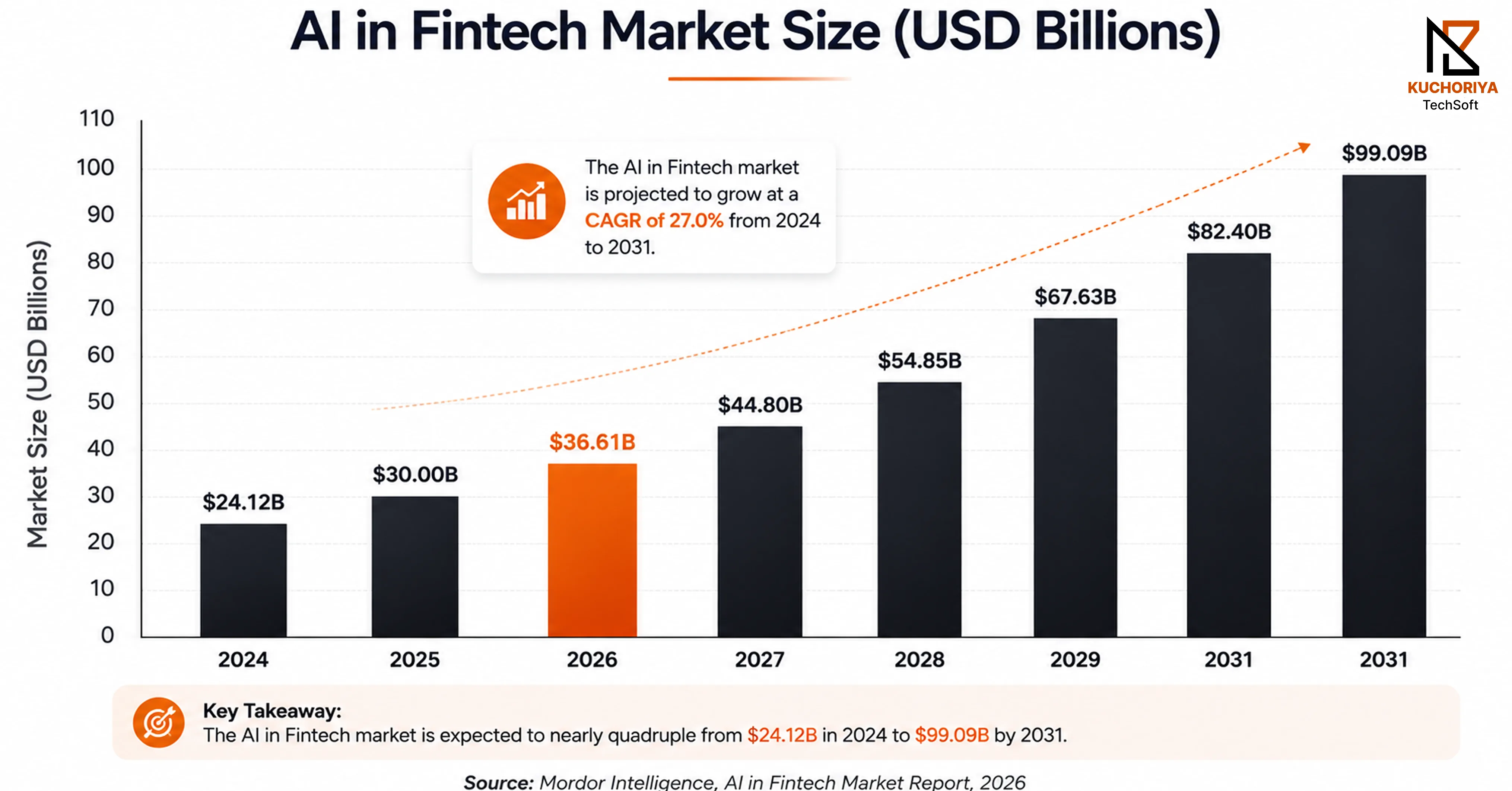
What Is AI in Fintech App Development?
At its simplest, AI in fintech just means financial software that learns from data instead of only recording it, and then acts on what it learns.
- The real benefits of AI in fintech show up in three places: faster decisions, fewer errors, and lower operational cost.
- Machine learning fintech trends are pushing prediction models beyond fraud alerts into daily banking decisions.
- AI credit scoring pulls in far more data points than a traditional credit report ever could.
- Smart expense management software flags unusual spending the moment it happens.
- AI compliance automation keeps regulatory checks running without a manual review queue.
- Autonomous finance tools are starting to handle routine money decisions on their own.
- Digital banking software is now being built around AI instead of adding it later.
- Modern fintech app development treats AI as a core layer, not an extra feature.
- This shift is really fintech digital transformation happening in real time.
- Businesses exploring custom AI fintech solutions want tools shaped around their exact workflow.
- Firms offering AI fintech product development services are seeing demand rise fast.
- That growing demand includes markets like AI fintech companies in Singapore searching for local expertise.
- Behind the scenes, this is what AI-driven financial operations actually look like day to day.
Key Benefits of AI-Powered Fintech Applications

The value of AI shows up fastest in the day-to-day numbers, not just the headlines. Here is where AI-powered fintech apps actually move the needle for a business.
1. Smarter Decisions, Built In
This ties directly into which AI technologies are used in fintech today, from machine learning models to real-time data pipelines that sit inside the app itself.
2. Faster, Fairer Lending
AI-powered credit underwriting cuts approval time from days to minutes, and modern fintech application development now builds this in from day one instead of bolting it on later.
3. Less Manual Work
Expense automation software removes hours of manual reconciliation, and solid financial software engineering behind it keeps the automation accurate at scale.
4. Compliance That Keeps Up
Regulatory technology solutions track rule changes automatically, which is exactly why demand for skilled AI fintech development services keeps climbing.
5. Personalized at Scale
Hyper-personalized banking is only possible with custom AI-powered financial software built around real user behavior instead of generic rules.
6. Stronger Banking Experience
Upgraded online banking software and AI-powered banking solutions USA are already showing what this looks like when done right.
Top AI Use Cases Transforming Fintech Apps
Artificial intelligence in fintech now touches lending, fraud, banking, and support inside one app instead of separate systems.
- Firms bring in AI fintech consulting services before writing any code, just to map where AI fits.
- AI lending software scores applicants on real-time data, cutting approval time from days to minutes.
- AI expense tracking software flags unusual spending the moment it happens.
- AI underwriting software replaces manual risk checklists with models that improve after every claim.
- Personalized financial services and mobile banking solutions now adjust in real time to actual user behavior.
- Solid fintech mobile app development and secure AI fintech software keep these features core, not bolted on.
- Companies that hire AI fintech developers early avoid costly rework, and a strong digital banking software development company ties it all together.
- Demand is rising in markets like AI fintech consulting services in Canada too.
- So how does AI help prevent financial fraud? Mostly by catching patterns a human would take hours to spot, in under a second.
Top 5 AI-Powered Fintech Apps Leading the Market

Real products make this easier to picture than theory ever could. Here are five apps already showing what strong AI fintech solutions look like in production.
1. PayPal
PayPal runs advanced payment gateway and digital wallet development under the hood, catching fraud on millions of transactions before a user even notices something was off.
2. Klarna
Klarna's support system is built on embedded finance solutions and an AI chatbot for banking, and it now closes a large share of customer queries without a human ever stepping in.
3. Revolut
Revolut is a neobanking platform at its core, and its AI-driven spending insights update in real time, something most traditional banking apps still struggle to pull off.
4. Robinhood
Robinhood puts AI to work on trade execution and risk alerts, and its approach to custom fintech app development is a big part of why the app feels this fast.
5. Upstart
Upstart's digital lending platform scores borrowers on AI credit models instead of a standard credit score, which is how it approves loans that older systems would turn down.
Behind all five sits work most users never see, like AI claims processing in adjacent insurance products and PCI DSS-compliant development keeping every transaction secure. A lot of businesses studying these examples end up bringing in an experienced AI fintech development partner to figure out which pieces actually fit their own product. And can AI improve digital banking services? These five are the answer.

Generative AI and Agentic AI: The Next Evolution of Financial Services
These two are often lumped together, but they solve different problems. One writes and responds; the other actually gets things done.
Generative AI in Fintech
Agentic AI in Fintech
Must Read: Top 10 Fintech App Development Companies in 2026
Challenges of Implementing AI in Fintech Applications
AI fintech software development sounds simple on paper, but most teams hit the same set of obstacles once real users and real money enter the picture.
- Fintech automation often breaks down when legacy systems were never built to talk to modern AI tools.
- AI fraud detection models need constant retraining, since fraud patterns shift faster than most teams can update rules.
- AI loan approval systems can quietly absorb bias from historical data if no one is checking the outputs.
- Intelligent banking assistants still struggle with edge cases outside their training, and that gap costs trust fast.
- Insurance automation software has to prove accuracy before regulators will even let it touch a real claim.
- Open banking APIs raise fresh security questions every time a new third party gets access to user data.
- Payment gateway development teams face constant pressure to cut latency without opening new fraud risk.
- A fintech app development company has to balance speed of delivery against the depth of testing AI actually needs.
- Enterprise fintech solutions bring compliance layers that can slow down even a well-built AI feature.
- Not every platform marketed as one of the top AI fintech platforms has been tested at real scale.
- A wealth management software development company deals with a similar problem, since financial advice carries legal weight AI cannot fully own yet.
- Even a strong AI fintech app development company USA runs into talent shortages, since skilled AI-plus-fintech engineers are still rare.
- Which leads to the question most founders actually ask: how much does AI fintech app development cost? Usually more than expected once compliance and testing are priced in properly.
How to Build a Successful AI-Powered Fintech App

AI-powered financial applications succeed when the process is right, not just the code. Here is the actual build order.
Step 1: Lock the Core Before Adding AI
Get financial automation basics solid first. A weak core makes every AI layer built on top of it unreliable.
Step 2: Design Fraud Protection Into the Build
Good fraud detection in fintech gets built into the architecture from the start. Adding it after the first real incident always costs more, and by then some damage is already done.
Step 3: Feed the Models Real Data
AI wealth management features only get accurate once they are trained on real historical data, not guesswork. And AI-driven customer onboarding needs to feel smooth from the very first screen, because users drop off before the AI even gets a chance to prove itself.
Step 4: Test Against Messy Real Cases
Teams working on insurtech software development should run their claims models through genuinely messy edge cases, not just clean sample data that makes everything look fine.
Step 5: Choose Infrastructure That Holds Up
Stable open banking solutions and payment gateway solutions matter more than any single standout feature. One weak API can quietly take the whole app down.
Step 6: Bring in Experienced Hands
Proper fintech app development services and solid enterprise AI fintech solutions planning upfront save far more time than they cost, especially once the app needs to scale.
Step 7: Benchmark Against What Already Works
Best AI fintech solutions for startups make a useful reference point, and an experienced insurtech software development company or a proven AI fintech software development company USA can shortcut a lot of the trial and error.
So which industries benefit most from AI fintech solutions? Mostly lending, insurance, and wealth management, since these are where faster, data-backed decisions matter most.
Why Businesses Should Partner With an AI Fintech App Development Company
Building AI-driven fintech software in-house sounds simple until real complexity hits, and that is where Kuchoriya TechSoft steps in.
- Kuchoriya TechSoft is an established AI fintech software company with existing frameworks, not a starting-from-scratch process.
- Its team runs real-time fraud prevention across live client builds, so models stay tuned instead of going stale.
- Wealth management software development carries legal weight, and Kuchoriya TechSoft has already handled that on prior projects.
- AI customer experience in fintech improves faster with a team that has built it before, which is exactly Kuchoriya TechSoft's experience.
- Digital insurance solutions need domain knowledge most teams lack on day one, an area Kuchoriya TechSoft already covers.
- AI payment processing demands reliability at scale, something Kuchoriya TechSoft's hands-on builds already prove out.
- Its fintech software development services cut the guesswork that slows most first-time projects.
- Getting AI-powered financial decision-making right needs data science skills Kuchoriya TechSoft's team already has in place.
- This is the exact gap Kuchoriya TechSoft fills as an enterprise AI fintech development partner.
- Even AI-powered expense management software takes longer without prior experience, which is where Kuchoriya TechSoft's track record helps.
- Demand is rising fast from markets like AI fintech solutions in Canada too, looking to modernize with the right partner.
- So why are businesses investing in AI-powered fintech apps through a partner like this? Speed, fewer mistakes, and problems already solved.
Future Trends Shaping AI in Fintech Beyond 2026
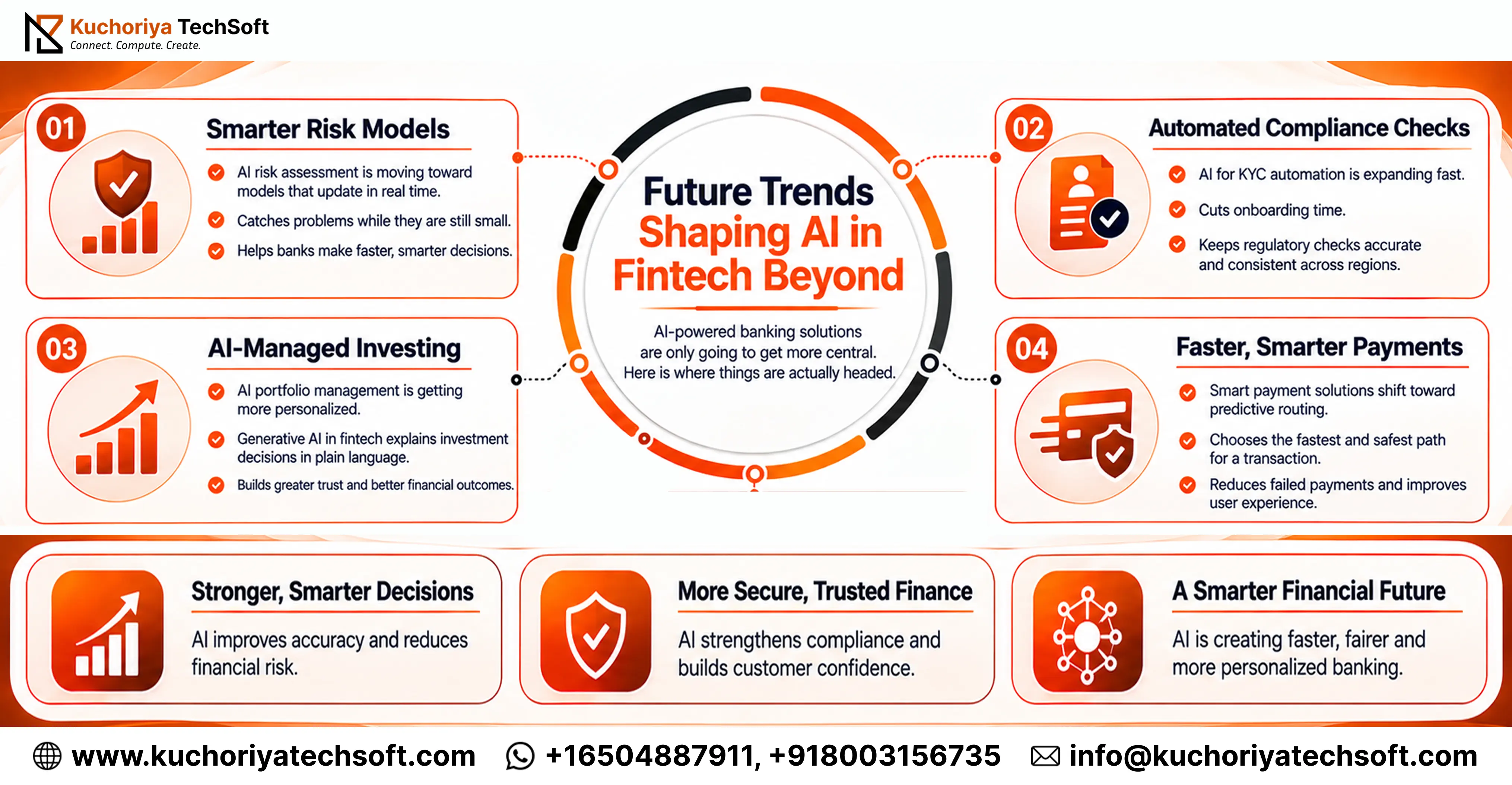
AI-powered banking solutions are only going to get more central, not less. Here is where things are actually headed.
1. Smarter Risk Models
AI risk assessment is moving toward models that update in real time instead of running on quarterly reviews, catching problems while they are still small.
2. Automated Compliance Checks
AI for KYC automation is expanding fast, cutting onboarding time while keeping regulatory checks accurate and consistent across regions.
3. AI-Managed Investing
AI portfolio management is getting more personalized, with generative AI in fintech now helping explain investment decisions in plain language instead of raw numbers.
4. Faster, Smarter Payments
Smart payment solutions are shifting toward predictive routing, choosing the fastest and safest path for a transaction before it even completes.
5. A More Competitive Market
As more players enter the space, comparing an AI fintech software company comparison matters more, and choosing between a general financial app development company or one that leans into next-generation financial platforms will shape long-term results. This is exactly why a solid fintech app development guide matters before committing to a build, and it is a big part of what an AI fintech development company UK is already helping clients figure out.
So what is AI in fintech heading toward, and how do AI-powered banking solutions work in this next phase? Less reacting to problems after they happen, more preventing them before they start. That is the real shift defining the future of AI in fintech.
How AI Is Creating the Next Generation of Financial Services
A bank that flags a problem before the customer notices one, that is where AI-powered financial services are heading right now.
AI fintech trends 2026 show AI-powered risk intelligence catching shifts hours before an analyst would, robo advisor development now sharp enough to pass for human advice, and AI for AML compliance running checks continuously instead of monthly.
GenAI for financial services is drafting reports and spotting risk patterns in the background, while digital wallet app development and intelligent payment processing go predictive instead of reactive. It's why fintech app developers stay busy, and why an AI fintech consulting company gets pulled in early.
At Kuchoriya TechSoft, this is exactly how we build our AI fintech software solutions for banks, and demand is rising fast too, including from AI fintech software company in Australia, as more regions catch up on how AI is used in fintech today.
Curious what this looks like for your platform? Talk to our team, or ask about our referral partner program if you're sending business our way.

Frequently Asked Questions About AI in Fintech
Q. What makes today's AI fintech platforms different from a few years ago?
A. Modern AI fintech platforms now run on predictive analytics in fintech, which means they are catching risks and opportunities before they show up in a report, not after.
Q. Where is AI in fintech actually headed in 2026 and beyond?
A. Based on current fintech trends 2026, expect agentic AI in finance to take on more end-to-end tasks, from approvals to routine account actions, without a person driving every step.
Q. Is AI used for anything beyond fraud detection and lending?
A. Yes. It now shows up in intelligent investment platforms, in mobile wallet development, and even in day-to-day financial technology solutions that most users interact with without realizing AI is behind it.
Q. How does AI handle compliance and identity checks?
A. KYC verification is one of the clearest wins here, since AI cuts onboarding time significantly while still keeping checks accurate and audit-ready.
Q. Who should businesses trust to actually build this?
A. Look for an established AI banking software development company or a proven AI-powered banking software provider, ideally one that already understands how AI is transforming fintech app development in practice, not just in theory.
Q. Is this only relevant for banks, or does it apply to other financial institutions too?
A. It applies broadly. Demand for strong AI fintech solutions for financial institutions is rising fast, including from businesses working with an AI fintech development company Dubai, as more regions move to build this in from the start rather than add it later. If you're weighing your own options here, our team is a good place to start that conversation.