What Is AI in Telemedicine?
Forget the sci-fi version of AI in healthcare. The real story is quieter, an algorithm reading a scan before the radiologist opens the file.
AI in Telemedicine means machine learning in healthcare layered onto virtual healthcare platforms to handle diagnostics and the admin work that used to eat a clinician's day. Doctors still make the call, they just get to it sooner.
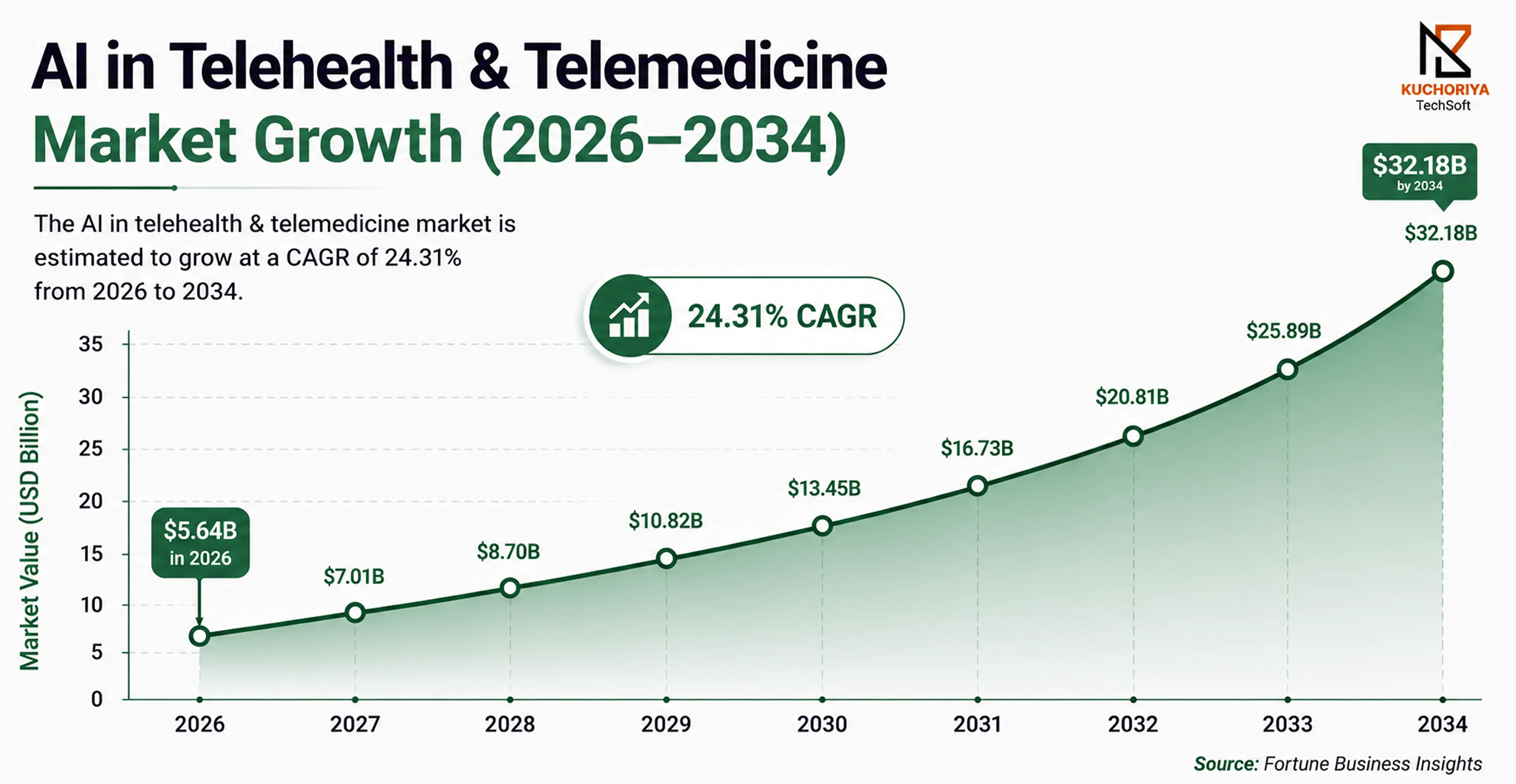
Money is following that shift fast. The AI Telemedicine market sits at $5.64 billion this year and is on pace to hit $32.18 billion by 2034, and most of that growth is coming from remote patient monitoring alone. (Source)
Telehealth AI used to be the extra feature nobody asked for. In 2026, it's what most telehealth platforms are actually built on.
Why AI Is Transforming Virtual Healthcare
Three out of four US health systems now run at least one AI in healthcare application, up from just 59% last year. That jump alone says the shift is past the pilot-project stage.
- Doctors using AI-Powered Telemedicine tools spend 40 to 45% less time on charting, time that goes straight back into seeing patients
- AI Chatbots in Healthcare are picking up intake forms, appointment scheduling, and the after-hours questions nobody wants to staff for, cutting no-shows by 35% in the process
- AI in Digital Health is turning the Electronic Health Records (EHR) system from a filing cabinet into something that flags risk before a doctor even pulls up the chart
None of this happened overnight, but it happened fast. Telemedicine AI Solutions went from pilot programs to default infrastructure in under three years.
Benefits of AI in Telemedicine for Patients and Providers
Hospitals aren't guessing anymore about whether this stuff works, they're measuring it in fewer readmissions and shorter waits.
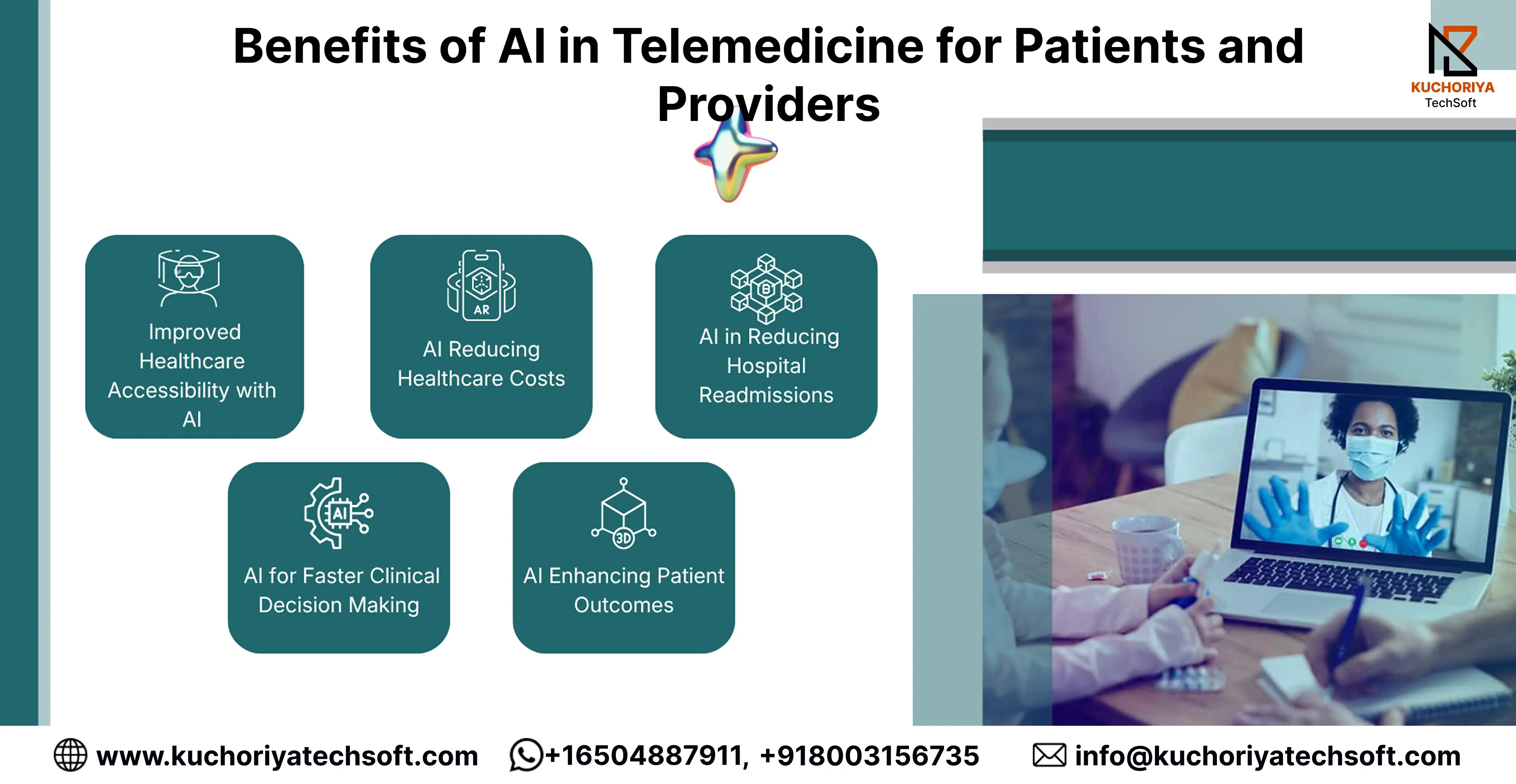
1. Improved Healthcare Accessibility with AI
A patient in a small town used to wait weeks for a specialist referral. Now AI for Virtual Healthcare gets them seen in minutes.
2. AI Reducing Healthcare Costs
Fewer unnecessary ER trips, shorter hospital stays, that's where efficiency gains through AI in telehealth actually show up on a budget sheet.
3. AI in Reducing Hospital Readmissions
Health systems running AI-driven remote patient monitoring have pulled 30-day readmissions down by 25 to 38%, mostly by catching problems before they turn into an ER visit.
4. AI for Faster Clinical Decision Making
Chart reviews that took an hour now take a glance. Flagged risk data reaches the doctor before the patient finishes describing symptoms.
5. AI Enhancing Patient Outcomes
Wearable health devices feeding into AI in remote patient monitoring can spot fluid retention in heart failure patients up to 10 days before symptoms even appear.
Add it up and the benefits of AI in telemedicine stop being a pitch. Fewer readmissions, faster diagnoses, lower costs, hospitals running this today aren't waiting for proof, they already have it.
AI Capabilities Powering Modern Telemedicine Platforms
The technical side of this isn't one feature; it's an entire stack working together across diagnosis, treatment, and admin.
- AI virtual health assistants handle intake and symptom questions before a human even joins the call.
- AI-assisted medical imaging now hits up to 96% accuracy in areas like diabetic retinopathy detection, well ahead of average specialist performance.
- AI medical diagnosis tools are reaching up to 94% accuracy for conditions like breast cancer and heart failure.
- AI in mental health telemedicine picks up on risk language in a patient's own words that a standard intake form would miss.
- AI for faster disease detection is cutting false positives in cancer screening by close to half in some Medicare-population studies.
- AI in tele-rehabilitation follows a patient's recovery day by day instead of waiting for the next scheduled visit.
- AI-driven personalized treatment plans pull from a patient's actual history and current data, so two people with the same diagnosis don't get the same generic printout.
- AI-powered virtual triage figures out where a patient needs to go while they're still typing their symptoms, no 20-minute hold, no guessing.
- AI in telesurgery and AI in robotic surgery assistance are stretching precision surgical support to hospitals that never had it before.
- AI clinical decision support catches drug interactions a tired clinician might miss ten hours into a shift.
- AI healthcare administrative automation clears the scheduling and documentation backlog that used to pile up every single day.
Popular AI-Powered Telemedicine Apps
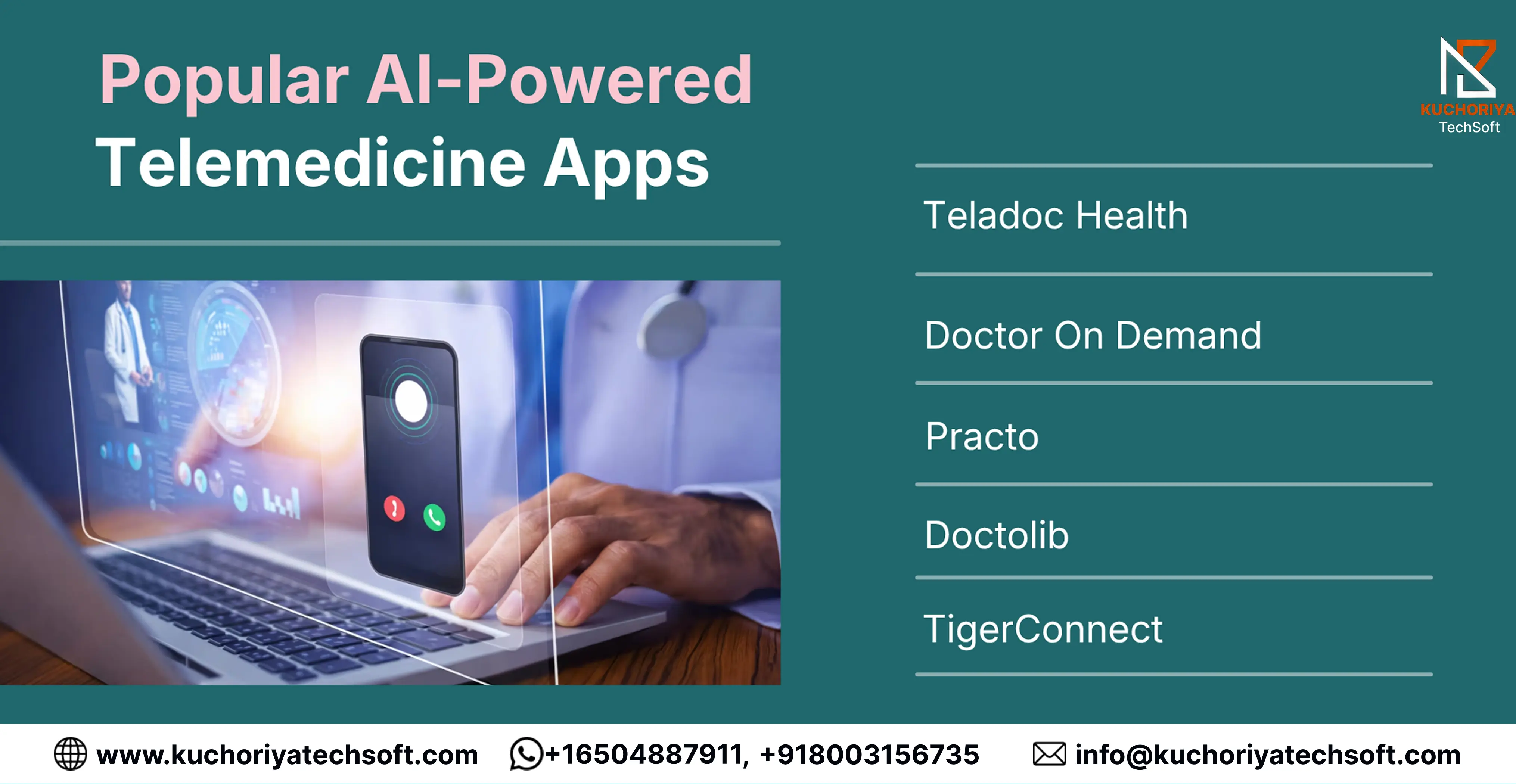
Five names come up again and again in this space, each solving virtual care a little differently.
1. Teladoc Health
Handles chronic condition management and AI-assisted triage at a scale few competitors match. Most Teladoc Health clone builds start here specifically to skip the months of infrastructure work that scale requires.
2. Doctor On Demand
Built for speed, patients get routed to the right specialist through AI without sitting on hold. A doctor on demand clone tends to fit businesses chasing fast, low-friction consultations over anything more complex.
3. Practo
Big across South Asia, this one bundles booking, e-prescriptions, and AI-driven doctor discovery into a single app. A Practo clone makes sense for a full AI doctor consultation app, not just a video call tool.
4. Doctolib
Dominant in Europe, mostly because its AI scheduling logic actually cuts no-shows instead of just claiming to. A Doctolib clone works well for online doctor consultation apps built around getting scheduling right.
5. TigerConnect
Not patient-facing at all, this one routes messages and alerts across hospital staff using AI in real time. A TigerConnect clone fits teams building internal AI healthcare apps rather than anything patients touch directly.
Past these five, new entrants split two ways: build an AI virtual care app from the ground up, or start from proven clone architecture and get one of the best AI telemedicine apps to market faster with less risk.
Must Read: AI in Healthcare Cost Guide 2026: Pricing, Development, Implementation & ROI Explained
Top 10 Telehealth Software Development Companies Powering Digital Healthcare in 2026
Custom EHR & EMR Software Development Services: Complete 2026 Guide for Healthcare Providers
Emerging AI Trends in Telemedicine
Where this goes next matters more than where it started, and emerging AI trends in healthcare are already pointing in one direction for 2026.
- Over 80% of health care executives expect agentic AI in healthcare to deliver real value this year, not by handling single tasks but by coordinating entire workflows on their own.
- Generative AI in healthcare is already live inside half of US healthcare organizations, and the conversation has moved past "should we" straight into ROI and safe scale.
- AI-driven hybrid healthcare models are splitting care into two lanes: in-person visits for anything needing hands-on judgment and everything else handled remotely with AI support.
- AI predictive analytics in healthcare is catching high-risk patients before symptoms turn into a hospital admission, not after.
- AI in remote chronic disease management is keeping diabetes, heart failure, and COPD patients out of the clinic, managed instead through data streams and periodic check-ins.
- Next-generation telemedicine solutions are getting built AI-first from day one, not patched onto old video-call software after the fact.
- AI symptom checker apps give a same-second read on symptoms, while computer vision in remote diagnostics keeps closing the gap on what an in-person exam used to catch.
None of this is happening in one place either. AI innovation in global healthcare is moving fastest in regions that skipped legacy infrastructure entirely and built AI-first from the start.
Challenges of Implementing AI in Telemedicine
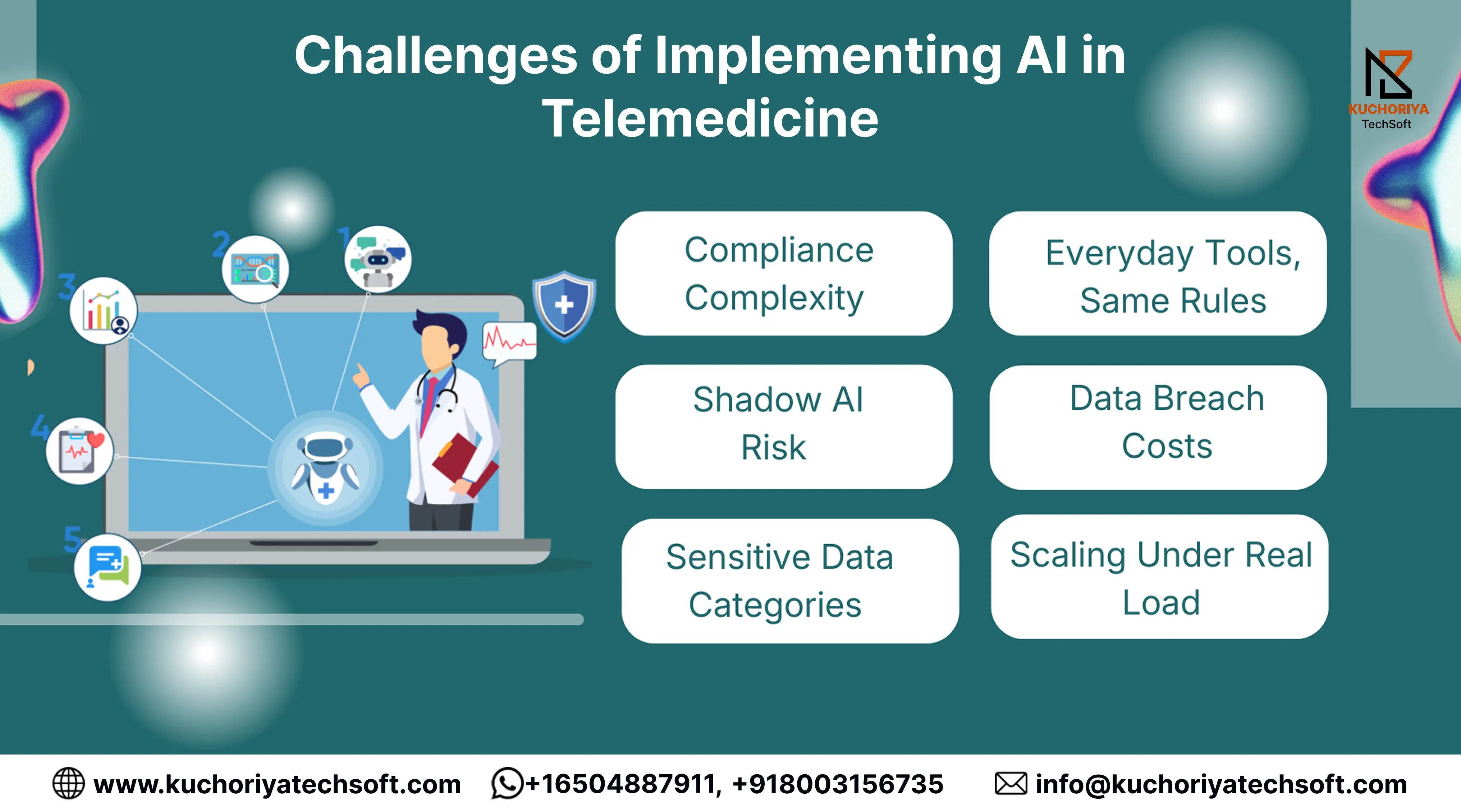
None of this comes free, speed and accuracy both come with a security bill attached.
1. Data Breach Costs
The average healthcare data breach cost $7.42 million in 2025, the most expensive of any industry for 14 years running, and how secure is AI-driven telemedicine stays an open question for most platforms.
2. Compliance Complexity
HIPAA, GDPR, and the EU AI Act now treat healthcare AI as high-risk by default, and AI telemedicine compliance requirements mean audit trails and human oversight most platforms weren't built with from day one.
3. Shadow AI Risk
Over 40% of hospitals have already dealt with unauthorized AI tools running inside their systems, and this gap in AI adoption in telemedicine industry oversight adds roughly $670,000 to the average breach cost.
4. Scaling Under Real Load
What works for a 500-patient pilot doesn't always hold at 50,000, and scalability of AI telemedicine platforms becomes the real test once infrastructure hits production traffic.
5. Sensitive Data Categories
AI in telepsychiatry and AI-powered wearable health monitoring carry some of the highest privacy stakes in medicine, one leaked session note does more damage than most breaches combined.
6. Everyday Tools, Same Rules
Even lower-risk tools like AI-based appointment scheduling and voice analysis in telehealth still touch protected health data, inheriting the same compliance burden as anything clinical, proof that healthcare technology disruption never comes without a governance cost attached.
Why Choose Kuchoriya TechSoft as Your AI Telemedicine Software Development Company
The tech stack matters less than who's building it, pick wrong and even good AI ends up bolted onto a fragile foundation.
1. Full-Scope Telemedicine Development
As a telemedicine software development company offering complete telemedicine app development services, Kuchoriya TechSoft covers mobile, web, and backend together, not just a patient-facing app with nothing solid behind it.
2. Compliance Built In, Not Bolted On
HIPAA-compliant software development gets built into the architecture from day one, so patient data protection isn't a last-minute audit fix.
3. Custom, Not Templated
Every build runs as custom healthcare software solutions, shaped around how a specific care team actually works, backed by broader healthcare app development company experience across the space.
4. Connected Health Records
Through EMR software development and work as an EHR software development company, the platform ties into existing patient records without manual re-entry.
5. Built for Scale and Hardware
From hospital management software development to medical device software development for wearables and monitoring tools, the stack is built to grow past a single pilot.
6. Revenue and Monitoring Covered
Remote patient monitoring app development keeps data pipelines accurate under real conditions, while RCM software development connects the clinical side to billing so claims don't get denied on a technicality.
Why AI Is the Future of Digital Healthcare
Digital health transformation trends aren't slowing down, they're compounding. Future of telehealth technology now means full clinical infrastructure, not just video calls, and that shift is scaling everywhere at once. A telemedicine software development company in USA builds, AI healthcare app development company projects in UAE projects, expansion across Australia, Canada, and Singapore alike.
Mental health app development and EMR/EHR integration services are closing the gaps that mattered most, access and connected records. Behind all of it sits the harder problem, a hospital management system development company that can actually build this right.
Not every team needs a full in-house tech leadership hire to get there. A fractional CTO can guide that architecture decision without the overhead, and partners bringing in healthcare clients can explore the Referral Partner Program. Ready to talk through your project? Contact us and let's map it out.
Frequently Asked Questions About AI in Telemedicine
Q. How Is AI Used in Telemedicine?
A. Most telemedicine platforms lean on AI for symptom checks before a call even starts, sorting patients by urgency, and picking up on things during video visits that help doctors diagnose faster.
Q. What Are the Benefits of AI in Telemedicine?
A. Shorter wait times, quicker answers, and support available even at 2 AM. Clinics also cut down the paperwork pile, so staff get through more patients without burning out.
Q. Is AI Replacing Doctors in Telemedicine?
A. Not even close. It handles the grunt work, sorting data, running early screenings, so doctors spend that time on judgment calls only they can make.
Q. What Is the Future of AI in Telehealth?
A. Expect it to connect with wearables next, catching warning signs before symptoms show up, and conversations with AI feeling less robotic over time.
Q. What Does AI-Powered Telemedicine App Development Cost?
A. Depends on what you're building. A simple version with video calls costs less than one with AI diagnostics and EHR integration baked in.
Q. What Are Virtual Healthcare Apps?
A. These let you see a doctor over video or chat instead of visiting a clinic, often tracking health remotely too.