





Introduction: Why Start an AI Business in 2026?
If you have been thinking about how to start an AI business, 2026 is honestly not a bad time to stop thinking and actually do it.
The market is not waiting. $638 billion in 2024. Crossing $3.6 trillion by 2030. Corporate AI investment doubled last year. Generative AI funding up 200%. New AI companies getting backed grew 71%. AI skill demand shot up 109% in one year. (Source)
But here is the thing nobody tells you upfront. More money flowing into AI also means more competition, more noise, and more founders building things that look impressive but make zero revenue.
The infrastructure is cheaper now. Models are accessible. A small team can ship something real without burning millions. That part is sorted.
What kills most AI startups is not the tech. It is going after a problem nobody actually pays to solve, or copying what already exists without any real edge.
This guide skips the hype and gets into what actually matters when building an AI company from scratch in 2026.

What Is an AI Business?
If you are selling a product that uses AI to solve a real problem, you are running an AI business. Simple as that.
A generative AI development tool that writes product descriptions. An AI chatbot that handles 80% of customer queries. A machine learning development platform that spots fraud before it hits. An AI consulting service that cuts a manufacturer's waste by 30%. All of these count.
Types of AI businesses running right now:
- Custom AI development firms building industry-specific tools
- AI SaaS platforms charging monthly subscriptions for intelligent software
- AI automation agencies replacing repetitive workflows with smart systems
- Generative AI tools handling content, design, code and data at scale
- AI consulting services guiding businesses through strategy and implementation
Why Are AI Businesses Growing So Fast?
Three things happened at the same time.
Build costs dropped. Cloud infrastructure got cheaper. Open source models became genuinely usable. A product that needed $2 million in 2021 can ship in weeks today.
Every industry hit the same wall. Too much data, not enough people to process it. AI in healthcare, AI in finance and banking, AI driven retail stopped being experiments and became actual budget line items.
Then buyers changed. Companies stopped asking whether AI was worth exploring and started asking which vendor to hire. That shift is what built the market we are sitting in right now.
Top Profitable AI Business Ideas and Opportunities in 2026
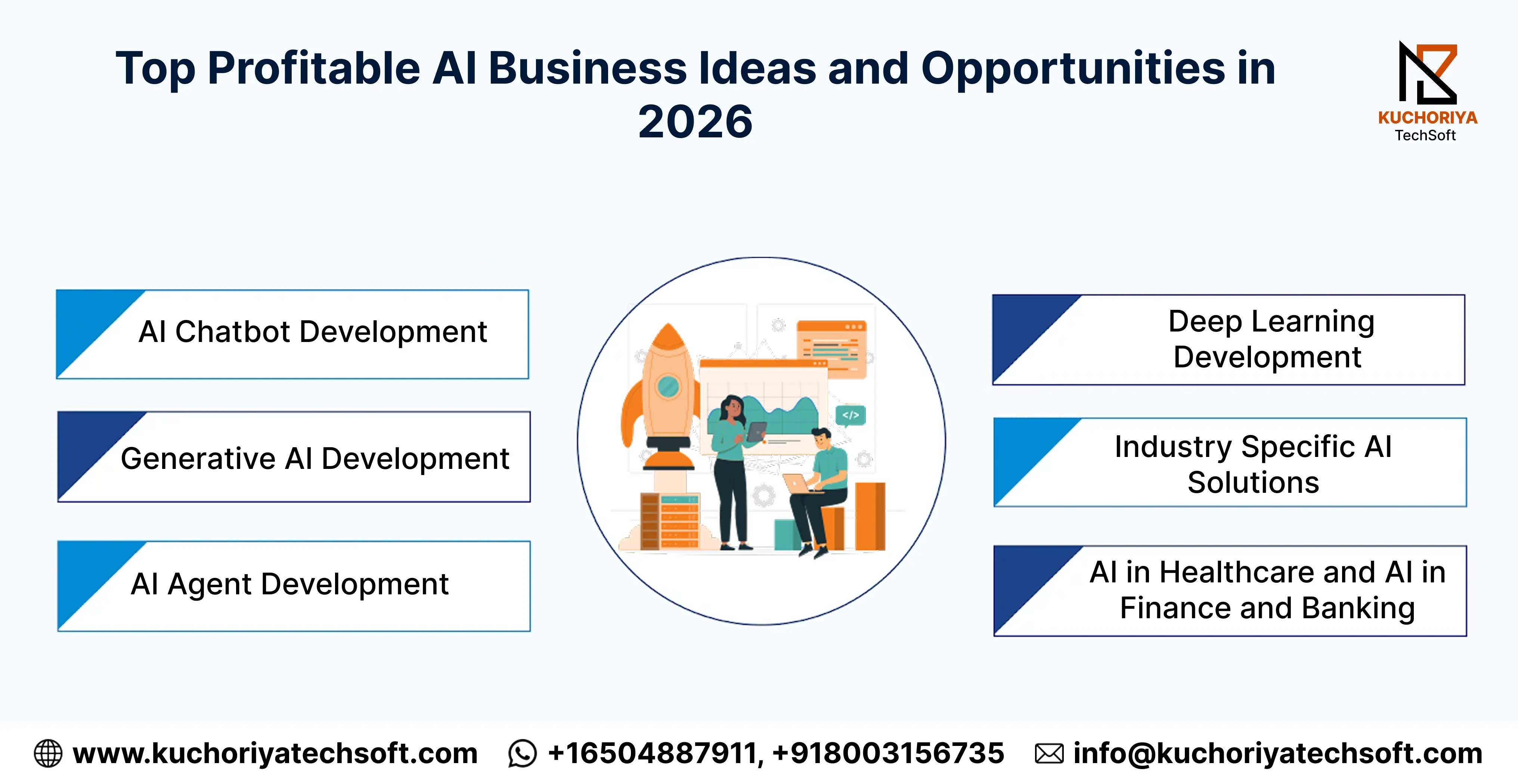
Not every AI idea is worth building. These six have real buyers, real budgets, and real room to grow right now.
1. AI Chatbot Development
Customer support costs are bleeding businesses dry. Intelligent conversational systems cut response time by half, keep customers happy round the clock, and save serious money on support teams.
2. Generative AI Development
Content, code, design, medical summaries, legal drafts. Every team needs more output faster. Investing in custom generative AI development services for niche industries is where founders are closing deals quickly in 2026.
3. AI Agent Development
The market has moved past basic automation. End-to-end AI agent development solutions that schedule, order, process and escalate without human input are what enterprise buyers are actively budgeting for right now.
4. AI in Healthcare and AI in Finance and Banking
These two verticals have the deepest pockets and the clearest pain points. Advanced AI in healthcare solutions are cutting diagnostic delays in hospitals. Smart AI in finance and banking systems are saving businesses millions before a single fraud transaction clears.
5. Industry Specific AI Solutions
Businesses across every sector are writing checks for custom AI in real estate platforms, AI in logistics systems, AI powered ecommerce solutions, AI powered education tools, AI travel solutions, AI in oil and gas, AI driven retail platforms, AI driven manufacturing solutions, AI parking solutions and AI insurance solutions. The exploring phase is over.
6. Deep Learning Development
Enterprise-grade computer vision development services, speech recognition development solutions and NLP development services form the technical core of every serious AI product today. Founders who build here command pricing power that off-the-shelf tools simply cannot match.
Read this: How AI Lead Scoring Tools Drive Predictive Revenue Growth in 2026
Agentic AI vs Generative AI: AI Agents and Differences Explained

How to Start an AI Company: Step-by-Step Guide
Starting an AI company looks true until you’re three months in and realize you missed something obvious. It has order, and order is important.
1. Find a Problem That Hurts
Not a problem that exists. A problem that costs someone real money every single week. That gap is where starting an AI company in 2026 actually begins, not in a pitch deck.
2. Talk Before You Build
Get on calls before touching the product. Ask what tools they currently pay for, where those tools fail them, and what would make them switch tomorrow. Skipping this is how most AI company setup plans fall apart before anything ships.
3. Decide What You Are Building
A full product, a custom AI solutions plugin, or an API layer. Each one has a different price point, a different customer, and a completely different sales conversation.
4. Hire the Right People
A developer who knows code but has in no way worked for your industry will build something technically correct and often useless. When you hire AI developers tool, there are tons of domain information like the technology stack that they recognize.
5. Build the Smallest Thing That Works
One problem. One solution. Solid AI app development on the core use case, nothing else. Extras come after someone pays for it.
6. Structure the Team
Once the MVP is out, structure around what the product actually needs. A smart build AI team approach at this stage keeps burn low and speed high.
7. Ship, Watch, Fix
Put it in front of real users fast. What they do with it will surprise you. That surprise is the most valuable data you will get in the first three months.
Choosing the Right AI Business Model and Strategy
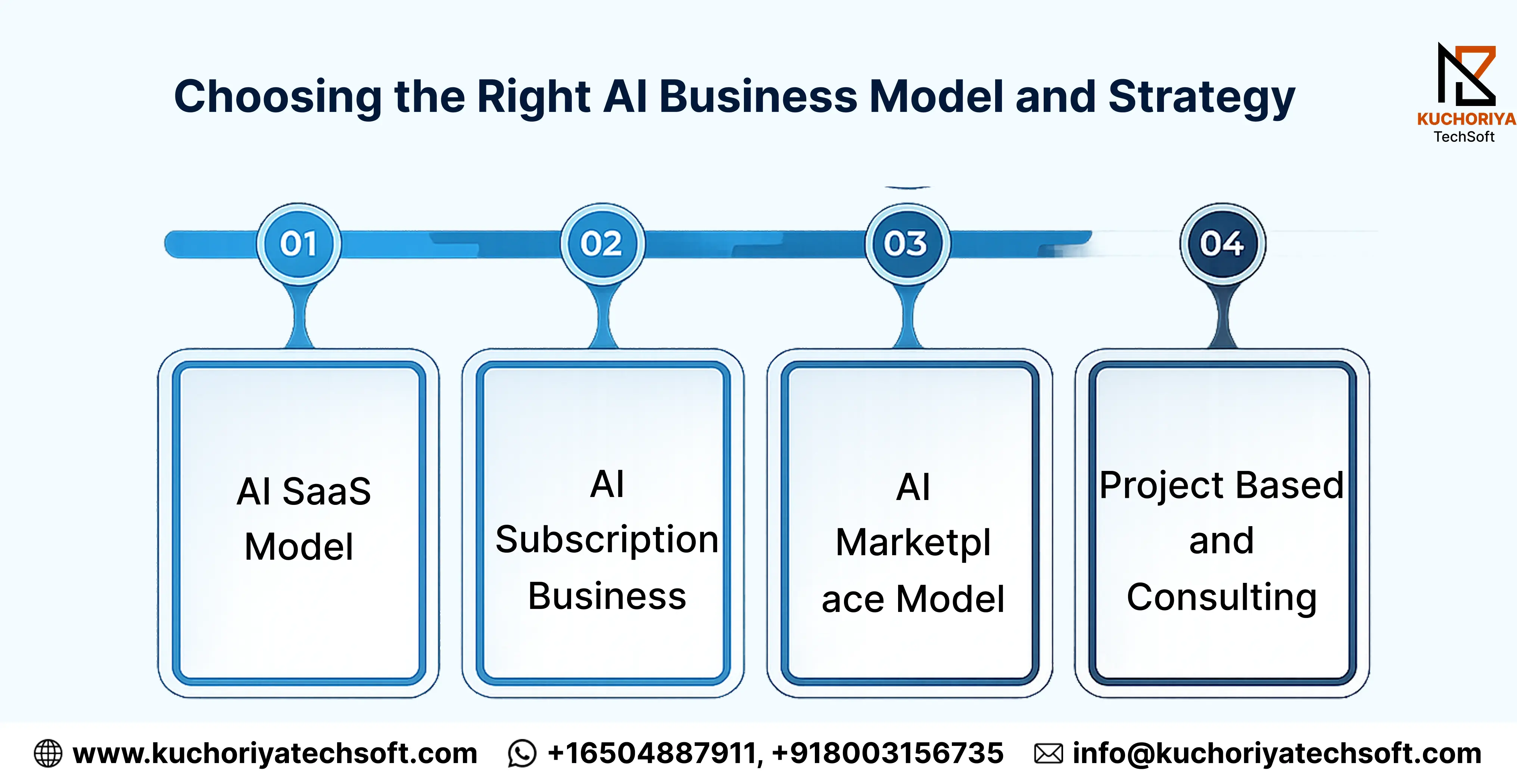
Most founders build first and figure out how to charge later. That is backwards, and it shows up fast when the product is ready but nobody knows what they are buying.
1. AI SaaS Model
Monthly or annual fee for access to your product. The best AI SaaS model works when your tool solves a recurring problem, something users come back to daily or weekly. Predictable revenue, scalable, and the easiest structure to raise money around.
2. AI Subscription Business
Tiered by usage, seats, or features. A well structured AI subscription business gives customers flexibility while giving you steady cash flow. Works well when different sized teams have very different needs from the same product.
3. AI Marketplace Model
Connect buyers and sellers using intelligence to match, rank, or personalise results. A properly built AI marketplace model takes longer to launch but creates network effects that are genuinely hard to compete with once traction hits.
4. Project Based and Consulting
Not every company needs a product from day one. Plenty of founders run profitable operations by selling outcomes first. A sharp AI business strategy 2026 that starts with consulting and moves toward a repeatable product is one of the cleaner paths to scale.
AI Technologies, Tools, and Resources Needed to Build Your Business
Wrong tech choices at the start do not show up immediately. They show up six months later when everything needs rebuilding from scratch.
1. AI Software Development Stack
Python is the default. PyTorch and TensorFlow handle the model layer. Hugging Face cuts weeks off anything involving language models. For solid AI software development work, AWS, Google Cloud or Azure sit underneath all of it depending on where your clients already live.
2. AI Solution Development Approach
Off the shelf models work for some use cases. But when the problem is specific enough, custom AI solution development is the only path to something that performs at production level without embarrassing your clients.
3. IoT Development Integration
For businesses in logistics, manufacturing, fleet or smart infrastructure, connecting IoT development services into your AI layer turns raw data collection into real time decision making.
4. CTO as a Service
A full time CTO on day one is overkill for most startups. Bringing in CTO as a service early gets you proper architecture decisions and team direction without the salary that comes with a senior full time hire.
5. CTO Consulting Services
Scaling teams hit a wall where technical debt, team structure and product direction all need fixing at once. Dedicated CTO consulting services help founders work through that without losing months figuring it out alone.
6. Technology and IT Consulting
Beyond the product itself, getting technology consulting services and IT consulting services involved early means fewer costly pivots, better vendor decisions and a technical roadmap that actually connects to business goals.
How to Develop and Launch a Successful AI Product
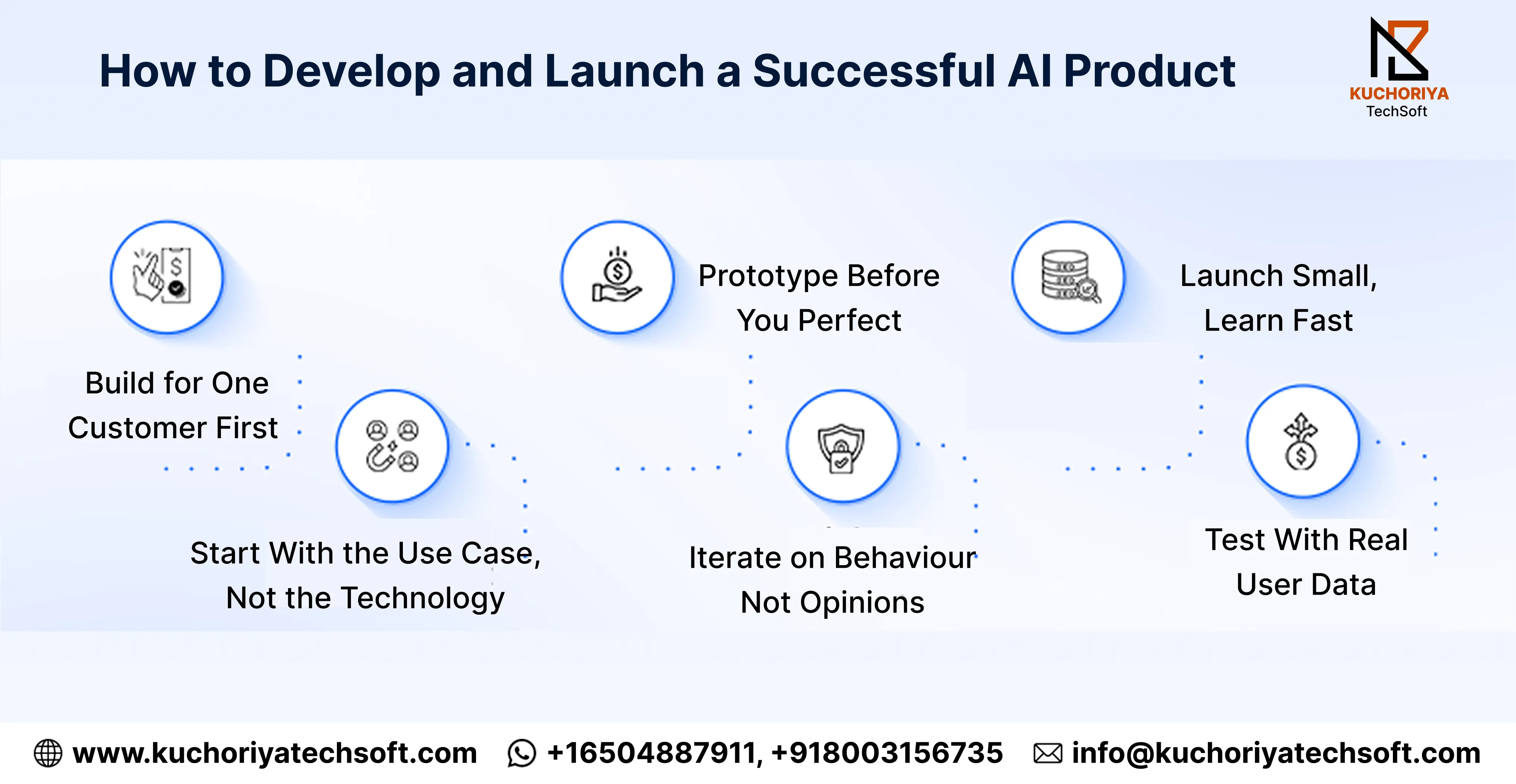
Building something and launching something are two completely different skills. A lot of founders are good at one and terrible at the other.
1. Start With the Use Case, Not the Technology
The model is not the product. The use case is. Before touching any AI product development work, get specific about what the user does differently after using your product than before.
2. Build for One Customer First
Pick one customer, one workflow, one problem. Nail that before expanding. The best custom AI solutions in the market today started as something embarrassingly narrow that worked really well for one specific type of user.
3. Prototype Before You Perfect
Get something clickable in front of a real user within two to three weeks. Early AI app development prototypes do not need to be smart. They need to be real enough for someone to react to honestly.
4. Test With Real User Data
Synthetic data will lie to you. Real user data will not. Get your product running on actual inputs from actual users as early as possible before any AI product launch date gets locked in.
5. Launch Small, Learn Fast
Do not wait for perfection. Launch to a small group and watch what happens. The feedback from a focused AI product launch with real users is worth more than six months of internal testing.
6. Iterate on Behaviour Not Opinions
What users say and what users do are rarely the same thing. Watch the behaviour. Build the next version around what people actually do with your product, not what they tell you in a feedback form.
Building an AI Team and Scaling Your AI Startup
Getting the product right is one thing. Finding people who can keep it growing without burning the company down is something else entirely.
1. Structure Around Outcomes Early
Forget the org chart at the start. Three things need covering. Someone building, someone selling, someone talking to customers every day. That is your whole team until revenue says otherwise.
2. Mix Full Time With Flexible Talent
Full time hires before product market fit eat runway fast. Bring in core people full time and pull in specialists as the work needs them. Cheaper, faster, and you are not stuck with the wrong people six months later.
3. Retain People With Ownership
Good technical people have options everywhere right now. A slightly better salary is not enough. Equity, real problems to work on, and actual say in how things get built, that is what keeps them from leaving for the next offer.
4. Secure AI Startup Funding Before You Need It
The worst time to raise money is when the bank account is running low. Getting AI startup funding sorted early means better terms, less panic, and the freedom to hire on your timeline not theirs.
5. Approach AI Venture Capital Strategically
AI venture capital is not just money. The right firm brings hiring connections, customer introductions, and people who have seen the same problems before. Pick investors who have actually backed something similar, not just anyone available.
6. Scale Headcount Behind the Product
Add people when a specific function becomes the bottleneck. Not before. Hiring ahead of what the product actually needs right now is how startups end up bloated, slow, and confused about priorities.
Challenges of Starting an AI Business and How to Overcome Them
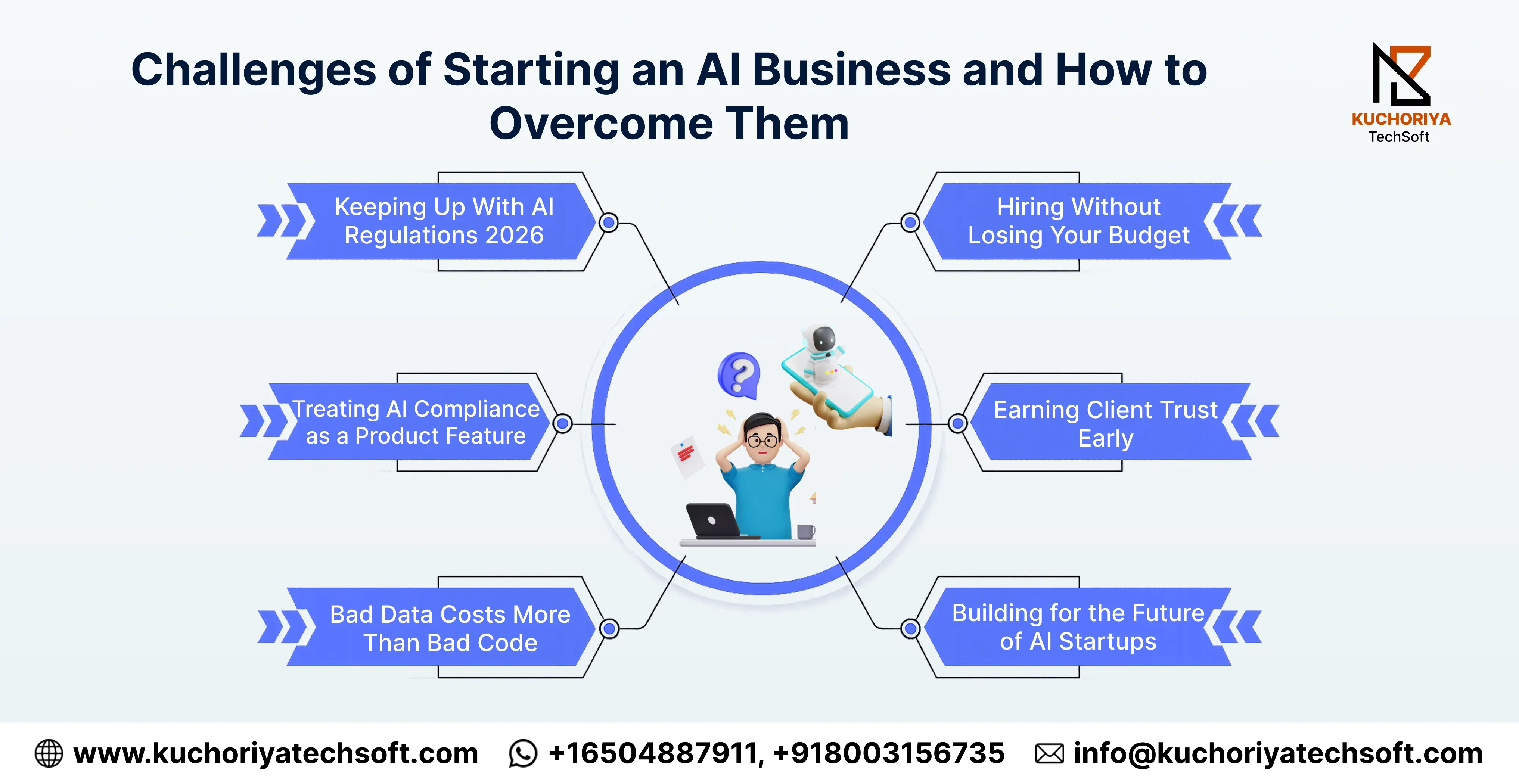
Nobody warns you about most of this stuff. You find out the hard way unless someone lays it out straight before you start spending money.
1. Keeping Up With AI Regulations 2026
AI regulations 2026 are not suggestions anymore. EU AI Act is live. Different markets have different data rules. If you are building for healthcare, finance or enterprise and you have not spoken to a lawyer yet, that is a problem waiting to happen.
2. Treating AI Compliance as a Product Feature
Buyers ask about AI compliance before they sign anything serious. Bias, explainability, data handling. These are not technical footnotes. They are commercial blockers if you cannot answer them cleanly.
3. Bad Data Costs More Than Bad Code
Training data problems do not announce themselves. They show up three months after launch when something breaks in front of a client and nobody has a clean answer for why.
4. Hiring Without Losing Your Budget
Good AI engineers have ten offers. Competing purely on salary against well funded companies is a losing game. Interesting problems and real ownership close more hires than a bigger number on an offer letter.
5. Earning Client Trust Early
Overselling kills retention. Tell clients what the product handles well and where it still needs human input. That honesty closes more renewals than any polished pitch.
6. Building for the Future of AI Startups
In 2026, buyers will look at these things before they sign. Businesses that wove transparency into how the product actually works, not just advertising and marketing, are the ones that thrive anyway. There goes the future of AI startups.
More Insights of AI: AI Statistics 2026 - Market Size, Adoption & Growth Trends
How Much Does It Cost to Build an AI App in 2026?
How an AI Development Company Can Help Build AI Solutions
A good idea with the wrong technical execution is still a failed product. Knowing what to build is only half the job. Getting it built properly is where most founders quietly run out of road.
1. AI Development Company USA
The US market moves fast and enterprise buyers expect polished, secure, scalable products. Working with an AI development company USA that understands compliance requirements and enterprise sales cycles saves founders months of expensive trial and error.
2. AI Development Company UAE and Dubai
Gulf markets run on relationships and local knowledge. An AI development company UAE and AI development company Dubai that has worked in the region knows how government procurement actually moves, what Arabic language support looks like at a product level, and which data rules apply where.
3. AI Development Company UK and Canada
Both markets have strong enterprise demand and strict data privacy requirements. An AI development company UK and AI development company Canada with local market knowledge helps founders navigate regulations while building products that actually fit how businesses in those markets operate.
4. AI Development Company Australia and Singapore
Buyers in Australia and Singapore make decisions differently from US or UK enterprise clients. An AI development company Australia and AI development company Singapore that has sold into those markets knows what the evaluation process looks like and what actually gets a deal across the line.
5. Kuchoriya TechSoft AI Services
Kuchoriya TechSoft has built AI products across healthcare, finance, logistics, retail and more for clients across the USA, UAE, UK, Canada, Australia and Singapore. Kuchoriya TechSoft AI services cover everything from initial concept and architecture through to full product development, deployment and ongoing support, so founders are not stitching together multiple vendors to get one product out the door.
Future of AI Businesses: Trends and Growth Opportunities
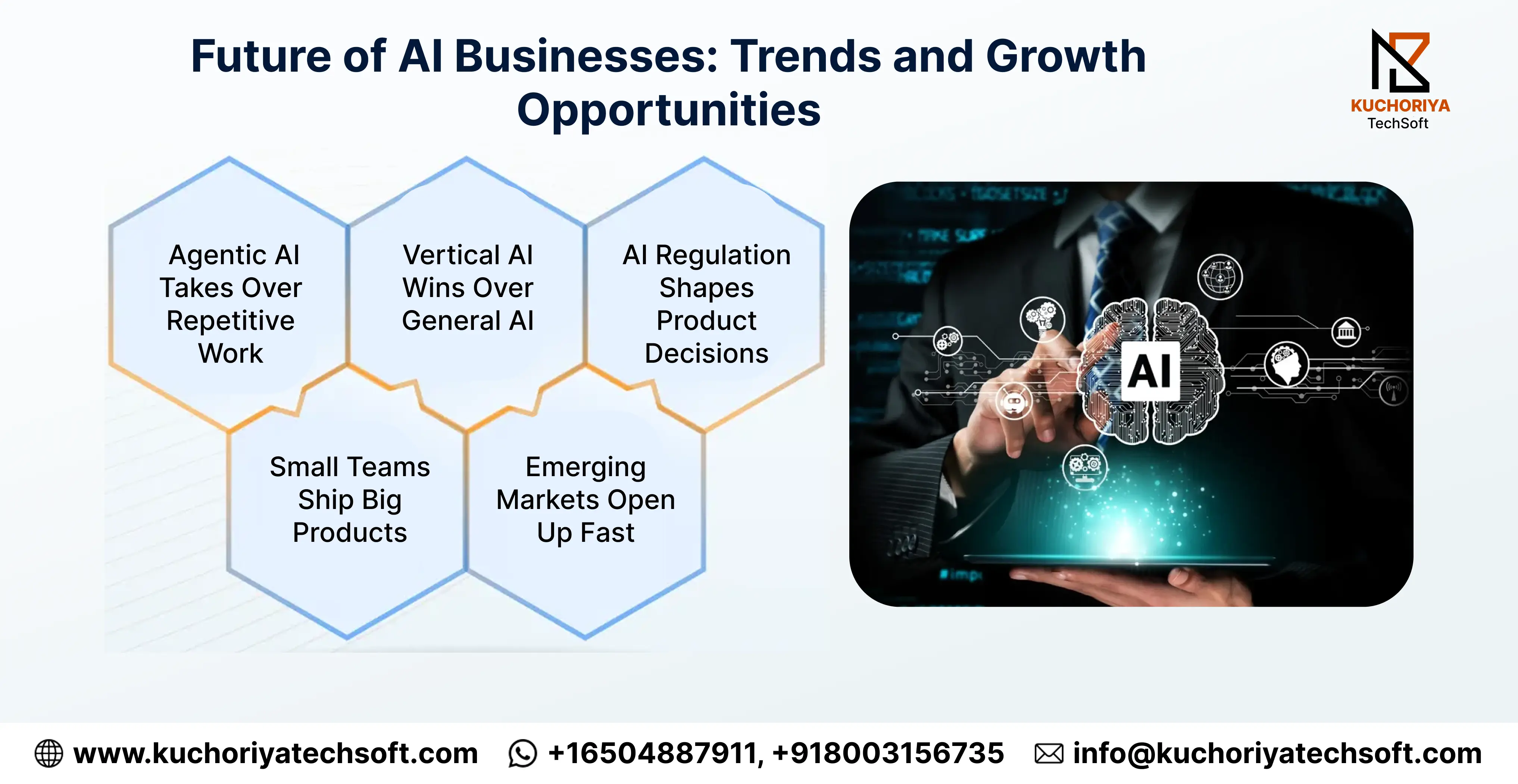
The companies building right now are not just chasing what is trending. They are positioning for what becomes standard in three to five years. Here is where AI business trends 2026 are actually pointing.
1. Agentic AI Takes Over Repetitive Work
Autonomous systems that plan, decide, and execute without human input are moving from experimental to operational. Every business process that runs on a fixed sequence is a candidate for replacement in the next two years.
2. Vertical AI Wins Over General AI
Broad AI tools are losing ground to products built for one industry and one problem. AI business opportunities 2026 appeals to the most important buyers are those who speak the language of a particular region, now not every region at once.
3. AI Regulation Shapes Product Decisions
Compliance becomes a competitive advantage. Companies that have already built clean, explainable, auditable structures win enterprise contracts that others can’t really qualify for.
4. Small Teams Ship Big Products
The gap between a two person startup and a fifty person company is narrowing fast. AI handles the work that used to require headcount. The future of AI startups belongs to lean teams that know exactly what problem they own.
5. Emerging Markets Open Up Fast
Southeast Asia, Middle East, and Africa are moving from AI curiosity to AI procurement faster than most western markets expect. Founders who plant flags there early have real first mover advantage.
Conclusion: Start Building Your AI Business the Right Way
Most founders know how to start an AI business in 2026 in theory. The gap is always execution. Wrong niche, no revenue model, messy data, wrong team. That is where most AI companies quietly stop.
Getting the AI company setup guide right from day one cuts the expensive detours out. If AI consulting services are what you need to get the strategy straight before spending on development, that is where it starts. If you are ready to build, the team is here.
Reach out directly or send founders our way through the Referral Partner Program and earn on every project that closes.

FAQs About Starting an AI Business in 2026
Q. How do I start an AI business with no technical background?
A. Plenty of people running AI companies today have never written a line of code. What they had was a problem they understood better than anyone and a technical partner who could build around it. That combination works. Coding skills alone never built a company.
Q. What does it cost to build an AI product?
A. No honest answer exists without a proper scope. A tight single use case MVP can come in under $50,000. Throw in custom model training, multiple panels, and integrations and the number shifts. Anyone giving you a real AI development cost figure without scoping the project first is guessing.
Q. Which AI business model generates revenue fastest?
A. Project work. A client has a problem, you solve it, they pay. Nothing to install, nothing to adopt, no sales cycle that drags for months. Once you have done it a few times, you know exactly what to productize.
Q. Do I need a CTO from day one?
A. Most teams that started lean did not have one. A good fractional technical lead handled the early architecture calls without the full time cost. Hire a CTO when the product is real and the revenue justifies it, not before.
Q. How long does it take to ship an AI MVP?
A. Depends entirely on how locked in the problem is before building starts. Teams that scope properly and do not shift mid-build have shipped in under ten weeks. Teams that keep changing what they are building take six months and still are not done.