




Where AI Actually Fits in Revenue Cycle Management
A claim gets denied. Nobody notices for weeks. By the time someone catches it, the appeal window's half gone and the hospital's already eaten the cost. That's the everyday reality AI revenue cycle management is built to fix, not replace.
The numbers back up the shift from side project to boardroom priority. The AI Revenue Cycle Management Software USA market alone sits at roughly $21.49 billion in 2026 and is on track to hit $71.27 billion by 2031, growing at a 27% pace year over year. Rising denial volumes and interoperability mandates are accelerating platform deployments across hospitals and health plans. Put plainly, this isn't a niche upgrade anymore; it's where most Healthcare IT Solutions budgets are already heading.
What changed isn't the billing process itself. It's what's watching it. AI in medical billing now flags a coding error before it ever reaches a payer. Generative AI in healthcare drafts appeal language in seconds instead of a biller's whole afternoon. Prior Authorization Automation cuts the back-and-forth that used to take healthcare mornings.
This is what medical revenue cycle management looks like once real AI revenue cycle management software enters the picture: fewer surprises at month-end and a lot less to this; authorization automation cuts through the cracks.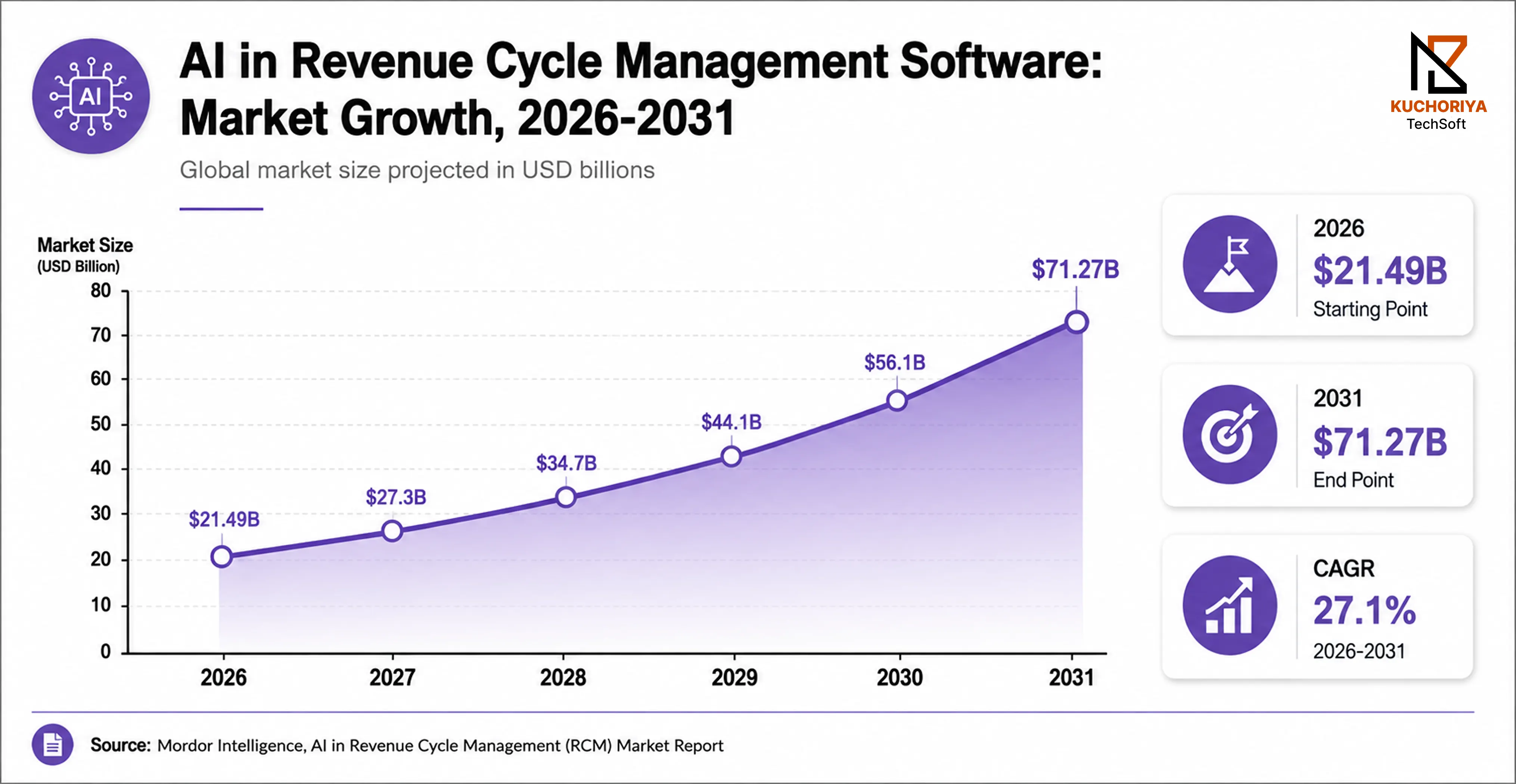
Why Healthcare Organizations Are Adopting AI Now
This didn't happen overnight. Denial rates kept climbing, staffing never caught up, and manual review just stopped being able to keep pace.
- Hospitals putting money into AI-powered revenue cycle management software aren't following a trend so much as patching a hole their teams couldn't patch on their own.
- Medical billing automation takes over the repetitive coding and submission work that used to swallow entire shifts.
- Once Claims Processing Automation enters the picture, turnaround drops from days to hours, which matters a lot when cash flow is riding on it.
- AI-Powered Claims Processing catches formatting and eligibility problems before a claim ever lands on a payer's desk, not weeks later when the denial letter shows up.
- Medical Coding Automation quietly fixes the kind of human error that drains revenue a little at a time, the sort nobody notices until the numbers stop adding up.
- With Healthcare SaaS Development, cloud-first tools finally let smaller practices get into AI without the infrastructure spend that used to keep them out.
- Custom AI RCM Software Development still beats an off-the-shelf tool, since generic software rarely matches how one specific billing team actually works.
- Project requests are climbing fastest wherever compliance pressure is highest, which is exactly why AI Healthcare Software Development USA teams are seeing the sharpest uptick right now.
The Real Benefits of AI in Revenue Cycle Management
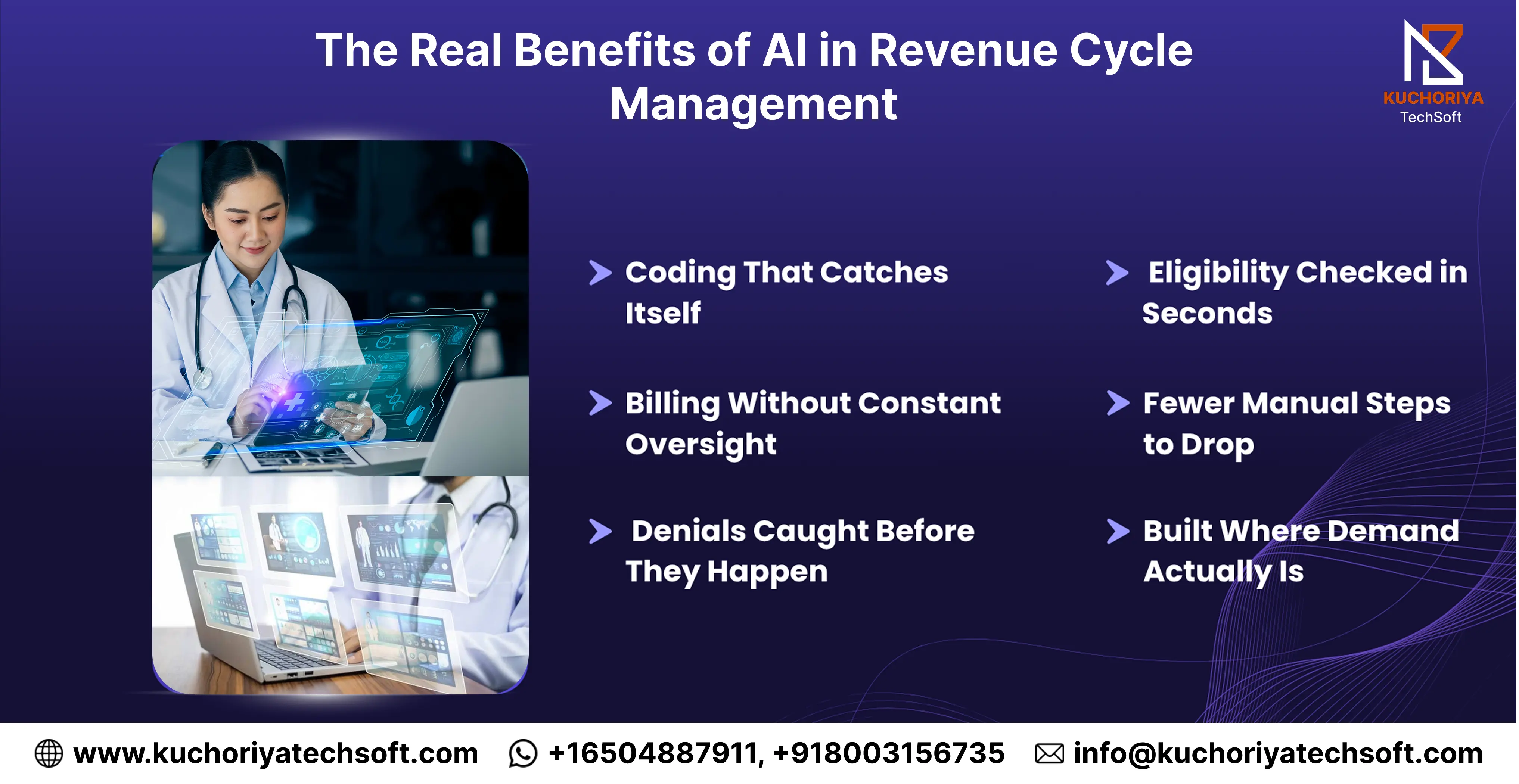
Every dollar lost to a preventable denial adds up fast, and that's exactly where healthcare revenue cycle management stops being reactive once real AI in healthcare tools enter the workflow.
1. Coding That Catches Itself
AI Medical Coding flags mismatched or outdated codes before submission, the kind of error a tired biller might miss on a Friday afternoon.
2. Billing Without Constant Oversight
Healthcare billing automation handles the repetitive parts of the cycle, freeing staff to deal with claims that actually need a human eye.
3. Denials Caught Before They Happen
AI Denial Management studies patterns across thousands of past claims to flag the ones likely to bounce back, before they're ever filed.
4. Eligibility Checked in Seconds
Eligibility Verification Software confirms coverage in real time, cutting out the hold-music routine front-desk staff used to deal with all day.
5. Fewer Manual Steps to Drop
Healthcare Automation Solutions connect scheduling, coding and billing so nothing gets re-entered three separate times.
6. Built Where Demand Actually Is
Serious AI healthcare software development work is scaling fastest across North America, with AI revenue cycle management Canada projects picking up right alongside US demand.

Top AI Use Cases: Billing, Coding, Claims, and Denials
Most of the value from AI for Healthcare RCM shows up in a handful of places, not everywhere at once. Here's where it's actually making a difference right now.
- Healthcare AI solutions are showing up most in claims scrubbing, catching errors before a human even opens the file.
- Revenue Integrity Solutions cross-check charges against documentation, closing the gap where revenue quietly leaks out.
- AI Eligibility Verification confirms coverage the moment a patient books, not after they've already been seen.
- Payment posting automation matches remittances to claims automatically, cutting a task that used to take hours down to minutes.
- Practices using Digital Healthcare Solutions now expect billing, scheduling, and records to work off the same data, not three separate systems.
- AI Medical Billing Software flags denial-prone claims before submission, based on patterns pulled from thousands of past rejections.
- Demand for this kind of build is rising outside the US too, with AI healthcare software UK projects picking up as NHS-adjacent providers modernize billing.
What to Look for in AI-Powered RCM Software
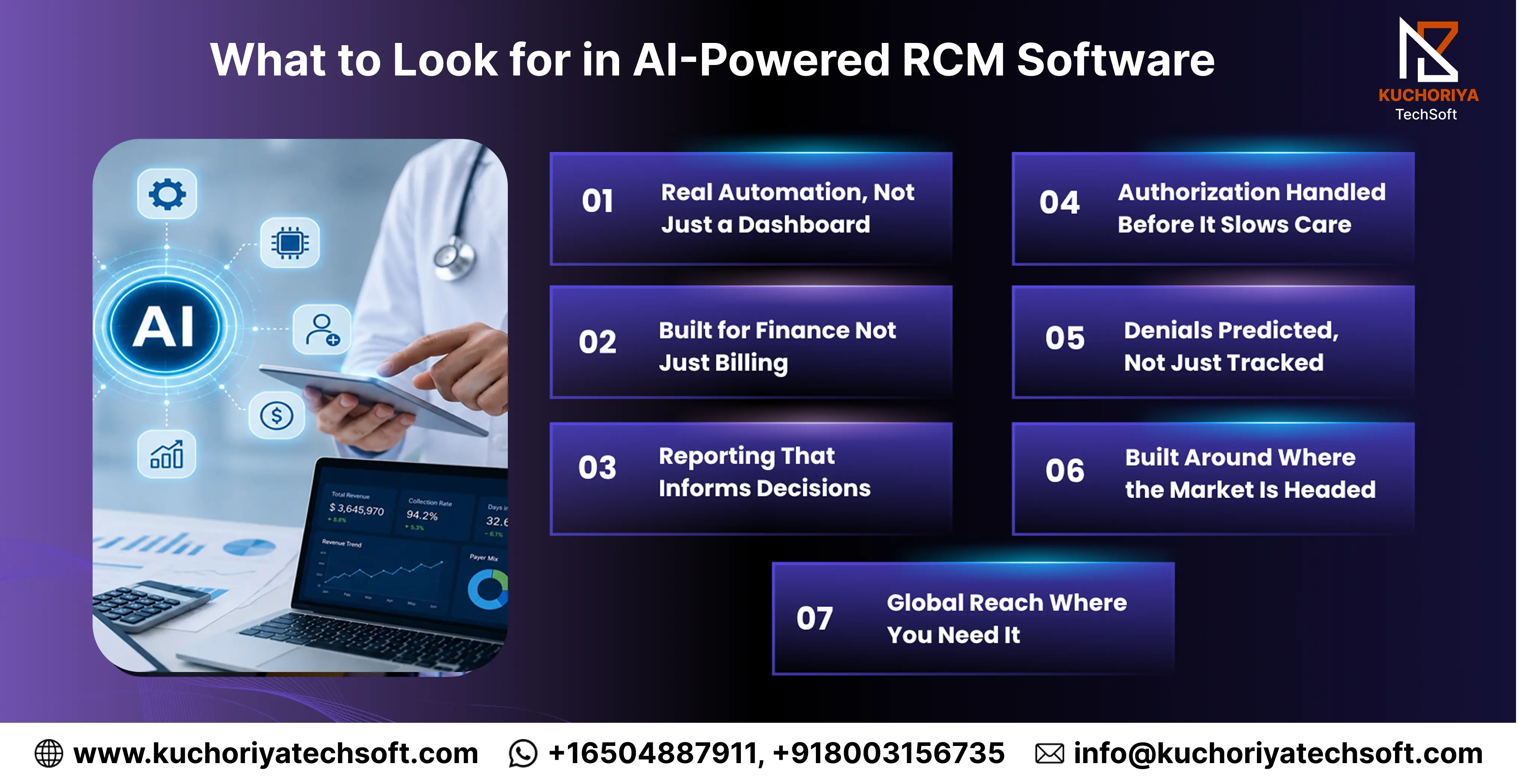
Not every platform advertised as AI-powered actually earns the label. Revenue Cycle Management Automation should mean fewer manual steps, not the same workflow with a new logo on it, and the same standard applies to any serious AI Agent Development work, not just billing tools.
1. Real Automation, Not Just a Dashboard
True Revenue Cycle Management Automation removes manual touchpoints across the cycle instead of just visualizing the same data prettier.
2. Built for Finance Not Just Billing
AI in healthcare finance tools should give finance teams forecasting power, not just claim status updates; the way a solid healthcare management software system centralizes decisions instead of scattering them across five logins.
3. Reporting That Informs Decisions
Strong healthcare financial management features turn denial trends into actionable fixes, not another static report nobody reads.
4. Authorization Handled Before It Slows Care
AI Prior Authorization cuts the wait time between a doctor's order and payer approval, a delay serious Telemedicine Software Development work has to account for on the clinical side too.
5. Denials Predicted, Not Just Tracked
Reliable Denial Management Software flags risky claims before submission, not after the rejection letter arrives.
6. Built Around Where the Market Is Headed
A platform worth choosing keeps pace with healthcare technology trends, especially as AI claims processing software becomes standard rather than optional.
7. Global Reach Where You Need It
Some healthcare groups specifically look for AI Revenue Cycle Management Australia experience, particularly for compliance alignment with APAC regulations.
Related Insights: AI in EHR/EMR Software Development
AI-Powered Hospital Management Software
AI in Telemedicine: Benefits, Use Cases & Future Trends
Where AI Adoption Still Runs Into Trouble
Not every rollout goes smoothly. Even solid AI healthcare automation projects hit friction, and most of the trouble isn't the AI itself; it's everything wrapped around it.
- Legacy systems are still the biggest blocker. An AI revenue cycle software platform can only automate what it can actually connect to, and plenty of hospitals are running billing tools older than the staff using them.
- Patient billing solutions built on AI still confuse patients who just want a plain answer about what they owe, not a smarter invoice.
- AI Revenue Analytics is only useful if someone on staff actually reads the dashboards. A lot of tools go unused past month one.
- Revenue Integrity Management requires clean data going in. Feed an AI model messy records and it just automates the mess faster.
- Healthcare process automation stalls when staff isn't trained on the new workflow, and training budgets rarely match the software budget.
- Not every vendor claiming AI expertise is a real healthcare AI development company. Some are relabeling old rules-based tools and hoping nobody checks.
- Compliance slows things down too, especially for an AI Healthcare Software Dubai rollout, where data residency rules add steps a US deployment wouldn't need.
- Full generative AI development work still needs human review loops, since even strong models get medical coding edge cases wrong occasionally.
- The same friction shows up in healthcare app development generally; AI features look great in a demo and stall once real patient data hits the system.
What's Next: AI Trends Shaping RCM Through 2026 and Beyond
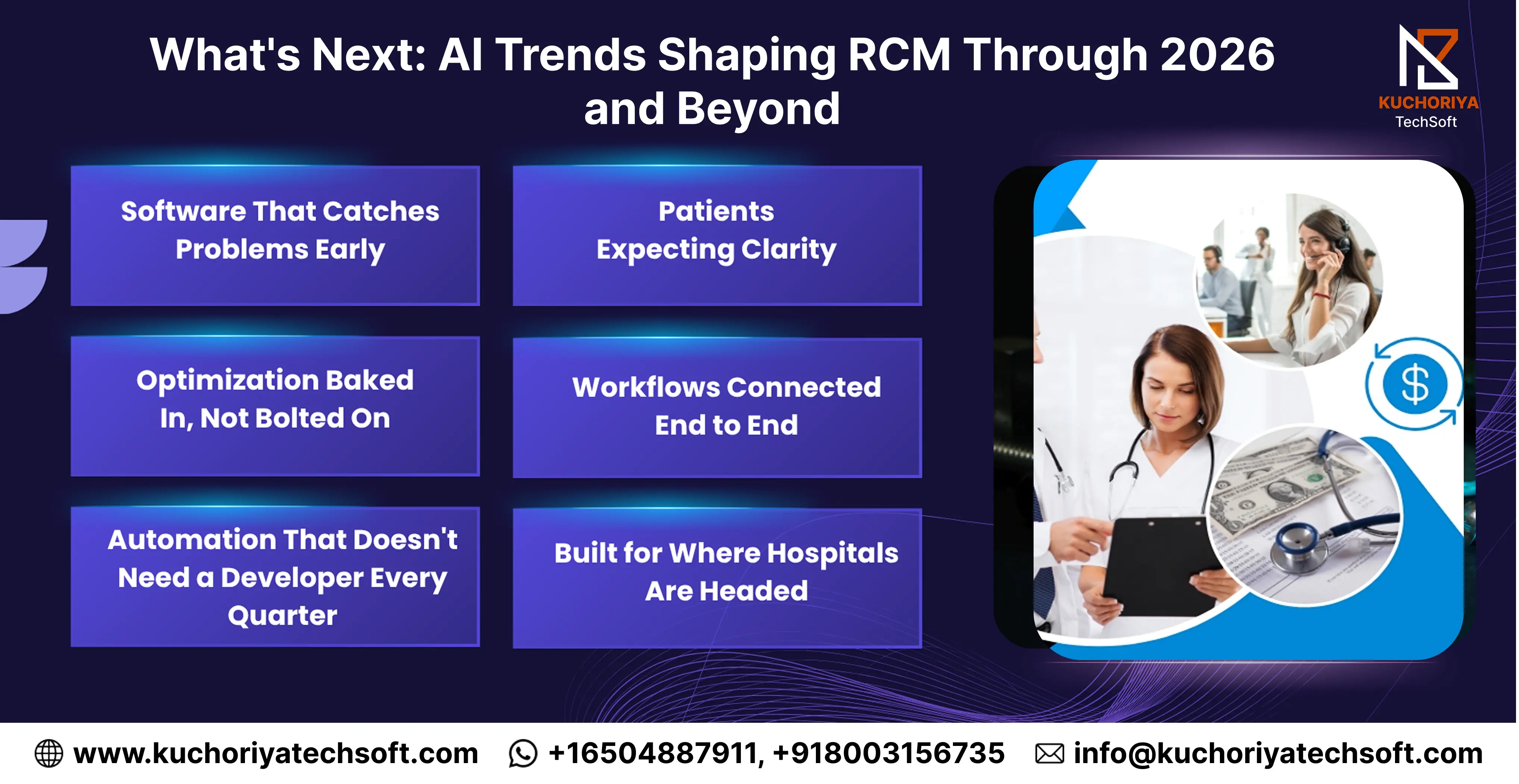
The next wave isn't about adding more dashboards; it's about AI medical billing systems that finally act on their own, and the shift is already visible across broader AI chatbot development work being adopted at the front desk.
1. Software That Catches Problems Early
Intelligent Revenue Cycle Management is moving away from fixing claims after they bounce, toward flagging a denial risk weeks before the claim even goes out.
2. Optimization Baked In, Not Bolted On
Healthcare revenue optimization is becoming a default feature rather than an add-on module, built into the platform from the first release.
3. Automation That Doesn't Need a Developer Every Quarter
Intelligent Automation in Healthcare is starting to adjust its own rules as claim patterns shift, instead of waiting on a manual update cycle.
4. Patients Expecting Clarity
Patient financial experience is finally getting real attention, with clearer statements replacing the confusing itemized bills nobody could read before.
5. Workflows Connected End to End
Clinical workflow automation is starting to link directly with billing, closing the gap between a doctor's note and the claim it generates, the same integration work driving demand for solid AI in EHR/EMR software development.
6. Built for Where Hospitals Are Headed
AI Software for Hospitals is scaling fastest in regions with strict compliance needs, and AI Revenue Cycle Management UAE deployments are a clear example of that trend in motion.
Why Choose Kuchoriya TechSoft for AI-Powered RCM Development
Plenty of vendors talk about AI. Fewer can show it running inside a real billing system. This is where Kuchoriya TechSoft's AI Claims Management work actually holds up, backed by broader deep learning development capability across the team.
- Full healthcare revenue cycle software built around how a specific practice bills, not a template forced onto every client.
- Clean Healthcare Claims Management, from submission through denial tracking, handled under one system instead of three stitched-together tools.
- AI Workflow Automation that connects scheduling, coding, and billing so nothing gets entered twice.
- Real Administrative Burden Reduction, the kind staff actually notice within the first month, not just in a pitch deck.
- Serious healthcare software development experience across EHR/EMR integration and broader healthcare management software platforms, not just billing modules.
- Enterprise AI Healthcare Solutions built to scale with a hospital network instead of needing a rebuild in two years.
- Delivery reach that includes AI Healthcare Solutions Singapore clients, alongside teams already working across the USA and UAE.
Best Dive: Top 10 Revenue Cycle Management Software Development Companies in 2026
Conclusion: Is AI the Future of Revenue Cycle Management?
At this point, it's less a question and more a formality. AI Claims Processing isn't experimental anymore; it's become an expectation for any serious revenue cycle management software platform.
The shift touches everything downstream too. Medical billing software built without AI already looks dated next to tools using predictive analytics in healthcare to catch problems before they cost anyone money. Healthcare Operations Automation is doing the same across scheduling and records, not just billing, and the broader HealthTech Solutions space is following that same pattern fast.
Choosing AI Revenue Optimization Software now isn't about staying trendy; it's about staying solvent as denial volumes keep climbing. That's true whether the deployment is local or reaches an AI healthcare software Hong Kong client on the other side of the world, and it applies just as much to full-scale AI development services work as it does to a single billing module.
The same logic extends past RCM too, showing up in projects as specific as a Doctor On Demand Clone App Development build, where AI-driven scheduling and billing work side by side from day one.
Need this kind of work done right? Kuchoriya TechSoft offers Fractional CTO Services and Virtual CTO Advisory Services for teams that need senior technical direction without a full-time hire, plus a Healthcare Referral Partner Program for agencies bringing AI-RCM projects to a team that delivers. Reach out to the team to talk through your project.
Frequently Asked Questions About AI-Powered Revenue Cycle Management Software
Q. What does revenue cycle optimization actually mean for a hospital's bottom line?
A. Revenue Cycle Optimization means catching revenue leaks before they show up as write-offs, mostly through better coding accuracy and faster claim turnaround. Paired with solid revenue cycle management solutions, most hospitals see fewer denials within the first few months.
Q. How is AI changing healthcare payment processing right now?
A. Healthcare Payment Processing is getting faster because AI matches remittances to claims automatically instead of a biller doing it line by line. That same shift is showing up across AI Healthcare Operations more broadly, not just in payment posting.
Q. Why does EHR integration matter so much for RCM tools?
A. Without clean EHR integration, a billing system is working off incomplete data, which defeats the purpose of automation entirely. It also feeds directly into healthcare data analytics, since reporting is only as good as the records behind it.
Q. What should I look for in AI Healthcare Platform Development for RCM?
A. Look for a platform that handles denial prediction and coding checks natively, not as an add-on. Full AI healthcare platform development should also scale across facilities without needing a separate build each time.
Q. Does it matter where the development team is based?
A. Sometimes, yes. Some healthcare groups need an AI revenue cycle management Saudi Arabia based team for regional compliance. That same regional lens applies to full iOS app development projects too, where data residency shapes the build as much as the feature list.
Q. Is this kind of work limited to billing, or does it extend further?
A. It extends further. The same AI principles are showing up in general healthcare product work now, including healthcare web development, patient portals, and even niche builds like a Teladoc Health Clone App Development project.
Q. Do you also build mobile apps for healthcare companies in Canada?
A. Yes. Beyond RCM platforms, the team works with app developers in Canada looking for a dependable company for app development, handling everything from mobile app development in Canada to full builds for practices searching for the best mobile app development company to partner with long-term.